
Latest data released on Wednesday showed that the U.S. ADP employment report—often dubbed the “Little NFP”—fell short of expectations in June. However, when viewed alongside sharply declining layoff figures and accelerating wage growth, the U.S. labor market continues to demonstrate notable resilience.
Zhitong Finance APP learned that the latest data released on Wednesday indicated the U.S. ADP employment report—commonly referred to as the “Little NFP”—missed expectations in June. Nevertheless, considering metrics such as a sharp decline in layoffs and accelerating wage growth, the U.S. labor market remains resilient.
According to the ADP National Employment Report, private-sector employment in the U.S. rose by 98,000 in June. This increase fell short of economists’ forecast of 120,000 and marked a slowdown from May’s gain of 122,000. Despite this, the ADP data still signals robust private-sector hiring, capping the strongest three-month stretch of job gains in over a year.
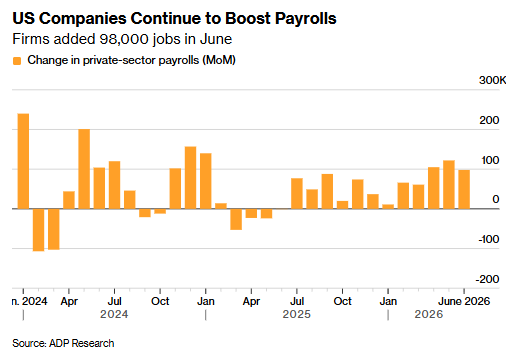
 The report, jointly issued by ADP and the Stanford Digital Economy Lab, also highlighted shifts in wage trends: annual pay for job switchers climbed to 6.6% year-over-year, accelerating from the prior reading, while wage growth for stayers remained largely flat at 4.4%.
By industry, nearly half of June’s new jobs—approximately 48,000—came from the education and health services sector, which has consistently served as a stable engine of employment growth. Total service-sector job additions reached 96,000, compared with just 2,000 from non-service sectors.
Other sectors posting employment gains included trade, transportation, and utilities (+15,000), financial activities (+14,000), and other services (+8,000). Natural resources and mining shed 5,000 jobs, making it the only sector to record negative growth. Leisure and hospitality added just 2,000 positions, continuing its weak performance this year as a barometer of consumer demand.
From the perspective of firm size, job growth was more concentrated among small businesses. Establishments with fewer than 50 employees added 53,000 jobs, large firms with over 500 employees added 25,000, and medium-sized firms added 29,000.
Sharp Decline in Layoffs Reflects Structural Strength in Labor Market
In contrast to the moderation in ADP job gains, employer willingness to lay off workers remains extremely low. Data released the same day by global outplacement firm Challenger, Gray & Christmas showed that planned layoffs by U.S. employers plummeted 53% month-over-month in June to 45,849. Total layoffs in the first half of the year declined sharply by 40% compared with the same period in 2025.
Andy Challenger, senior executive at Challenger, noted, “The pace of layoffs cooled significantly in June, aligning with typical seasonal patterns. However, layoffs remain concentrated in the technology sector, as artificial intelligence (AI) continues to reshape corporate workforce planning.”
Despite a decline in layoffs, the labor market’s 'felt temperature' remains mixed. Data show that corporate hiring plans announced in June fell by 44% month-over-month.
Nela Richardson, Chief Economist at ADP, stated, 'The current pace of hiring reflects signals from both supply and demand sides. We observe that job seekers are taking longer to find employment, yet signs of constrained labor supply persist in certain sectors. Overall, these factors together indicate that job growth is slowing.'
This trend is also reflected in the Conference Board’s survey, which found that the share of consumers who consider jobs 'hard to get' rose in June to its highest level in nearly five and a half years.
Markets Await Official Nonfarm Payrolls Data
ADP data have historically served as a precursor to the nonfarm payrolls report. The U.S. Bureau of Labor Statistics will release the more comprehensive June nonfarm payrolls report on Thursday. Markets currently expect totalnonfarm payrollsemployment to increase by 115,000, down from May’s gain of 172,000. May saw a surge in government hiring, which is not expected to repeat in June. If realized, this would represent the strongest six-month hiring performance since mid-2024. The unemployment rate is forecast to remain unchanged at 4.3%, while average hourly earnings are projected to rise 0.3% month-over-month and 3.5% year-over-year.
A resilient labor market with accelerating wage growth could reinforce market expectations that the Federal Reserve will continue raising interest rates this year to curb inflation. Additionally, the recent temporary agreement between the United States and Iran to end hostilities has eased geopolitical tensions in the Middle East, leading to lower energy prices and potentially boosting consumer confidence—factors that could provide further support to the labor market. However, given the frequent discrepancies between ADP data and official nonfarm payrolls figures, the final employment picture awaits confirmation from the official release.