
Meta plans to lease out excess computing capacity, causing a sharp sell-off in AI hardware stocks as the market worries about oversupply and downward revisions to capital expenditure. However, several Wall Street investment banks argue this does not signal an industry inflection point—Meta’s capacity represents only a limited share of the broader cloud infrastructure market. For Meta itself, selling compute capacity serves more as a short-term EPS buffer and supplementary revenue stream; for newer cloud providers like CoreWeave, it poses a competitive stress test as customers potentially become rivals. The true direction will only become clear after the upcoming earnings season.
A report that Meta is considering selling excess computing capacity has simultaneously brought to the forefront several of the most sensitive issues in AI transactions: whether there is truly a shortage of computing power, whether Meta might revise its capital expenditure plans downward, and how long Neocloud can continue generating profits.
Wall Street News reported that Meta is formulating a cloud business strategy and may offer two types of external services: one involving hosted models or API access, similar to AWS Bedrock; the other involving the leasing of raw computing capacity, akin to Neocloud.
 Following the news, shares of CoreWeave, a rising star among next-generation GPU cloud providers, plummeted by 13%, while NEBIUS dropped 15%, triggering a sharp sell-off across the AI hardware sector, including chips. If Meta begins selling computing capacity, investors will naturally raise three key questions:
First, has Meta over-purchased computing capacity?
Second, is Meta scaling back its heavy investment in models and AI products?
Third, will the demand curve for AI hardware and Neocloud shift?
According to ZHU Feng Trading Desk, on July 1, Wall Street investment banks including UBS Group, Morgan Stanley, and Bernstein swiftly analyzed the implications of this development. This move may not signify a collapse in AI fundamentals but rather reflects a pragmatic effort by tech giants to balance computing constraints against financial returns. It also should not be simplistically interpreted as 'Meta no longer needing computing capacity.' However, the implications differ across asset classes.
For Meta, leasing out computing capacity could serve as a bridge to near-term revenue and EPS. UBS Group noted: 'Selling cloud computing capacity or model access rights could theoretically generate near-term revenue faster than waiting for Meta Business Agents and Meta AI chatbots to scale, thereby alleviating concerns about flat or declining EPS in 2027.'
For Neocloud companies like CoreWeave, this represents potential competitive pressure.
For the chip and server supply chain, the market is more concerned about whether the pace of future capital expenditures will change.
‘Having surplus capacity available for lease’ does not equate to ‘industry-wide computing overcapacity.’
The market’s shortest-chain logic is: leasing computing capacity = computing overcapacity = downward revision of capital expenditures.
Meta may have阶段性 surplus computing capacity available for lease at certain times, but this does not automatically imply industry-wide overcapacity. Different institutions also use varying definitions of capacity, making direct aggregation inappropriate.
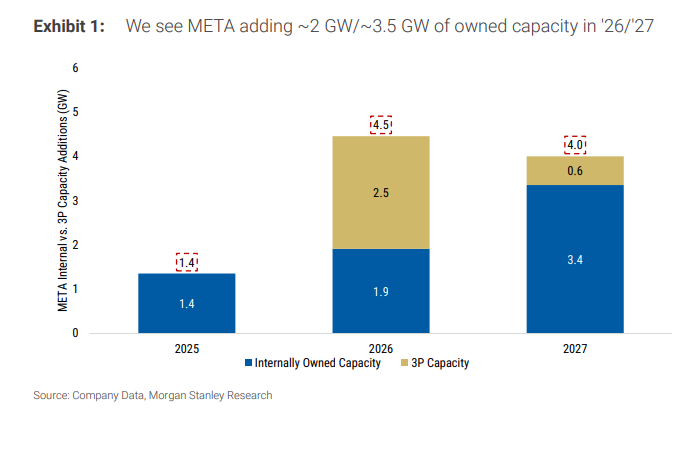
According to Morgan Stanley’s model, Meta is expected to add approximately 2 GW and 3.5 GW of self-operated IT capacity in 2026 and 2027, respectively, against a baseline of roughly 3 GW by the end of 2025. By comparison, hyperscale cloud providers such as Amazon and Google are projected to add new IT capacity on the order of 5 GW and 9 GW, respectively, by 2027. In other words, even if Meta leases out a portion of its own capacity, it is unlikely to significantly alter the overall cloud infrastructure buildout trajectory over the next three years.
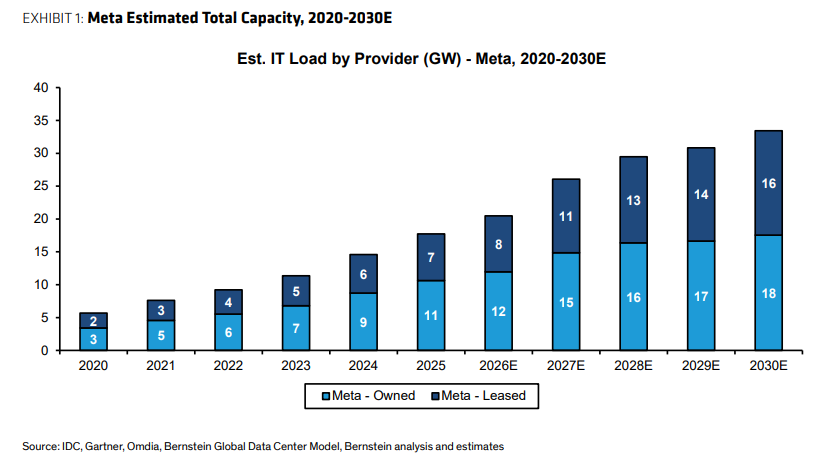
Bernstein uses a broader definition based on total data center footprint: Meta’s current global capacity is estimated at approximately 20 GW, with an additional ~14 GW slated to come online in the coming years, comprising both owned and leased assets. While this figure appears substantial, it does not represent ‘fully leasable AI computing capacity,’ nor does it imply uniformity in GPU generation, workload type, or pricing curves.
Market estimates also include a more aggressive back-of-the-envelope calculation: using contracts and capacity plans—such as those between Google and Anthropic, AWS and Anthropic/OpenAI, and Microsoft and OpenAI—as anchors, the combined AI computing capacity of several major cloud providers could each reach around 20 GW or even higher. Demand-side observations also incorporate OpenAI’s own Stargate project and arrangements involving NVIDIA and Broadcom on the order of 10 GW. The purpose of this broader metric is not to provide precise forecasts, but rather to illustrate one key point: Meta’s limited external leasing activity alone does not indicate that global AI infrastructure development has entered a phase of overcapacity.
More counterintuitively, Bernstein also noted weekend reports suggesting that Google had restricted Meta’s access to its computing resources due to its own capacity constraints. If accurate, this implies Meta is simultaneously seeking external computing capacity while preparing to offer some of its own capacity externally—a dynamic better described as ‘reallocation across different generations, use cases, and time windows’ rather than simple ‘excess capacity.’
This is not the first time Meta has put ‘selling computing capacity’ on the table.
On May 27, 2026, a shareholder asked whether Meta would launch a cloud business to compete with AWS and Azure. Zuckerberg responded:
‘Certainly, that’s definitely under consideration... We haven’t done it yet because we believe we’ll need all this capacity ourselves. But clearly, if we reach a point where we feel we’ve built too much, that would be an option available to us—and that confidence is part of why we’re comfortable continuing to invest in capacity expansion.’
As early as October 29, 2025, Zuckerberg also discussed a similar rationale:
“Any compute capacity we don’t need, we are quite confident we can absorb a very significant portion of it... Of course, there is indeed a risk of overbuilding. If that happens—and we see substantial new demand both internally and externally—companies outside Meta approach us almost weekly, asking if we could build API services for them or whether they could access different types of compute capacity from us. We haven’t done this yet. But clearly, if you reach a point of excess capacity, this becomes an option.”
This explains why UBS Group referred to it as 'not news.'
For Meta shareholders, selling compute capacity resembles an 'EPS bridge' rather than a new core business.
For Meta, the most immediate benefit of leasing out compute capacity is converting future AI investments into near-term revenue.
According to UBS Group’s table, Meta’s diluted EPS for 2026 and 2027 is projected at approximately $32.6 and $33.0, respectively. The market is concerned that 2027 EPS may plateau or even decline slightly compared to 2026. Leasing compute capacity or selling model access rights could provide a temporary buffer in revenue and profits before Meta Business Agents and the Meta AI chatbot achieve meaningful scale.
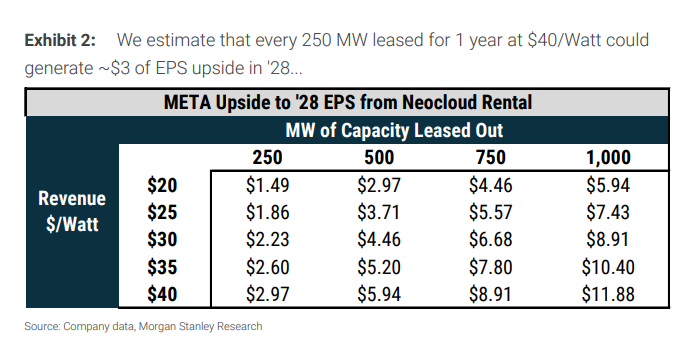
Morgan Stanley’s sensitivity analysis offers a more intuitive perspective: leasing out 250 MW of capacity for one year at $40 per watt could add roughly $2.97 to Meta’s 2028 EPS—equivalent to about 8% upside. EPS sensitivity would further increase or decrease depending on capacity levels of 500 MW, 750 MW, or 1,000 MW, or variations in pricing.
This is also why the market did not interpret the move solely as bearish. From Meta shareholders’ perspective, Zuckerberg now has an additional fallback option: if internal AI products cannot absorb all available compute capacity in the short term, Meta can sell excess capacity to external AI labs to recoup part of its investment.
The market also draws parallels with xAI leasing capacity to Anthropic: 500 MW translates to roughly $1.25 billion per month, or approximately $30 billion per GW annually. If this pricing holds, it implies exceptionally high returns and suggests that high-quality compute capacity remains tight in certain scenarios. This is not evidence of 'unwanted compute,' but rather proof that idle capacity can be quickly monetized at premium rates.
However, this remains a bridge—not a core strategy. Morgan Stanley still anchors Meta’s valuation on frontline product innovation: whether Meta AI, business agents, messaging services, diffusion offerings, subscriptions, and other initiatives can drive sustained user engagement and revenue growth. Selling compute capacity can bolster EPS, but it does not automatically lift valuation multiples.
Capital expenditures may not be revised downward; going fully into cloud services could actually burn more cash.
The market’s biggest concern is that Meta might cut its capital expenditures for 2027, leading the entire AI hardware supply chain to lower expectations accordingly.
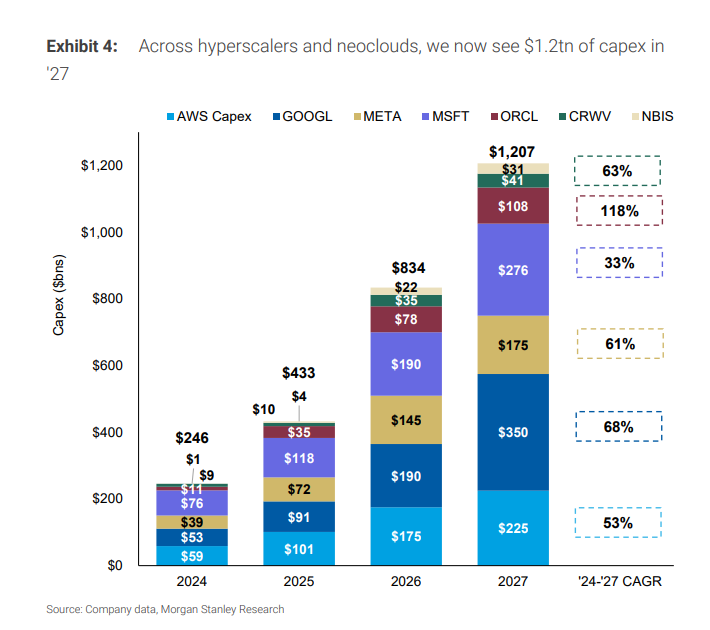
However, Morgan Stanley’s current model assumes Meta’s capital expenditures will rise from USD 145 billion in 2026 to USD 175 billion in 2027 and further to USD 205 billion in 2028. This projection is based on the premise that Meta is primarily building capacity for its own first-party products rather than developing a full-scale hyperscale cloud service provider.
If Meta were to significantly expand its external cloud services—particularly by offering model/API platforms rather than temporarily leasing raw compute capacity—it could face upward pressure on capital expenditures. A full-fledged cloud business requires longer-term data center capacity, more sophisticated software platforms, and enterprise-grade delivery capabilities.
Bernstein also views this issue through a post-2027 lens. Meta is one of the most significant 'checkbooks' in the AI market, and any shift in its build-out pace would ripple through the supply chain. However, the implications for capital expenditures differ fundamentally between 'temporary external leasing' and 'permanent expansion into cloud services'—these scenarios must not be conflated.
On the demand side, inference and agent applications remain the larger drivers. HY Computing & AI Compute’s market synthesis treats OpenAI’s recent weekend article on Codex/agentic AI as a demand signal: individual non-developer users grew 137-fold, organizational users grew 189-fold, and internal OpenAI users grew 12-fold. This perspective underscores how new use cases could continue to drive up demand for inference compute capacity.
Thus, the core of the current divergence lies not in whether Meta will sell compute capacity, but in whether the AI demand curve continues to steepen. If overseas ARR accelerates, inference applications grow, and cloud providers continue to raise their capex guidance, Meta’s external leasing of compute capacity would resemble a temporary asset monetization strategy. Only if subsequent earnings seasons collectively revise capex downward would this become a genuine inflection point signal for the industry.
Selling raw compute capacity is easy; building a full AI cloud platform is hard.
Meta has two potential paths forward, which differ significantly in difficulty.
The first path involves selling 'raw compute' or bare-metal chip capacity, similar to neocloud. Customers purchase GPU/compute resources, and Meta does not need to immediately develop a complete suite of enterprise software, developer tools, model platforms, or a dedicated sales organization.
The second approach involves offering托管 models or API access, similar to AWS Bedrock or Google Vertex AI. This is not a business that can be pursued simply by having data centers and chips. It requires robust model capabilities, a comprehensive software stack, strong developer experience, enterprise sales expertise, and reliable customer support.
Morgan Stanley’s model is more cautious about this second path. It notes that Meta’s Muse model family has not performed exceptionally well on TerminalBench and SWE Bench Verified—benchmarks closely tied to coding capabilities and third-party usage scenarios. If Meta aims to compete with cutting-edge models like Gemini, its future iterations will need to demonstrate significant improvements.
This also undermines the argument that 'Meta selling compute capacity equals Meta exiting the model game.' Model/API access was always among the potential strategies. Core products such as Meta AI, business agents, messengers, diffusion offerings, and subscription revenue remain central to Meta’s long-term valuation. The real question is not whether Meta will develop models, but whether it can transform its model capabilities into a cloud service compelling enough for external customers to pay for.
Some market participants also point to Muse Spark, Meta’s closed-source strategy, and recent management adjustments as evidence that Meta remains at the AI model table. However, these factors are better treated as items for ongoing monitoring. At least from the perspective of three analytical frameworks, the clearer near-term conclusion is this: selling raw compute capacity has a low execution barrier, whereas building a full-stack AI cloud platform has a high barrier to entry.
Is CoreWeave the biggest 'victim'? Customers turning into potential competitors
The most immediate impact of this shift falls on new cloud/GPU-as-a-Service (GPUaaS) providers such as CoreWeave.
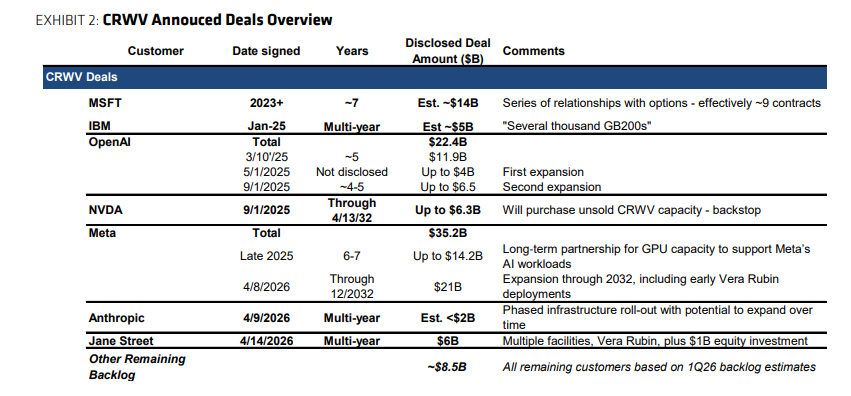
Bernstein has assigned CoreWeave an Underperform rating with a price target of $67, while rating Meta as Outperform with a $850 price target. Its reasoning is straightforward: if Meta begins offering cloud infrastructure externally, it could directly compete with CoreWeave.
The situation is further complicated by the fact that Meta is already one of CoreWeave’s largest customers. According to Bernstein, Meta currently holds $35.2 billion in contracts with CoreWeave, accounting for over one-third of CoreWeave’s total order backlog. Combined with Microsoft’s approximately $14 billion in contracts, nearly half of CoreWeave’s backlog comes from clients who may become competitors upon contract renewal.
The short-term risk is not immediate. Existing contracts are binding and unlikely to be terminated abruptly, so CoreWeave’s near-term revenue and debt pressures may not deteriorate right away.
The longer-term challenge is more difficult to manage. If customers build their own clouds and sell compute capacity themselves, the bargaining power of new cloud providers like CoreWeave will diminish. Particularly at renewal time, CoreWeave will no longer be negotiating solely with demand-side clients, but with well-funded, technically capable, and data-center-experienced potential suppliers.
JPMorgan’s trading desk noted that the market’s reaction—CRWV down 13% and NBIS down 15%—is relatively straightforward to interpret: Meta instantly transformed from a customer into a potential competitor. The impact on chip hardware is more indirect, while for GPU-as-a-Service (GPUaaS), it resembles a stress test of the business model.
Why hardware fell first: crowded positioning beyond fundamentals
At the short-term trading level, the market is not solely pricing in fundamentals.
JPMorgan’s trading desk frames the debate in two parts: one concerns whether the Meta news signals a shift in the narrative around cloud service providers’ (CSPs’) capital expenditure and AI compute demand; the other centers on excessively crowded positions, deleveraging, and profit-taking amplifying the sell-off. The desk leans toward the latter carrying greater weight, noting that a definitive assessment of any fundamental shift will depend on guidance during the upcoming earnings season.
Positioning was far from light. Major index rebalancing has just concluded, leaving aggregate flows and leverage starting from elevated levels. Over the past four weeks, both long and short positions have increased by more than +2 standard deviations. Historically, hedge funds often undergo deleveraging in July, with typical shifts ranging between -1 and -3 standard deviations. Semiconductor and memory holdings are near the 100th percentile.
This explains why a single Meta-related headline triggered a broad selloff across the entire AI hardware chain. When crowded trades encounter a narrative suggesting ‘compute capacity may not be scarce,’ the instinct is to sell first. On the same day, software names, crowded shorts, and China ADRs rallied by more than 1.4 standard deviations, consistent with short-covering behavior during deleveraging.
Key reversal signals the market is watching include: whether Meta issues clarifications; whether overseas AI application ARR accelerates; whether cloud providers continue to raise capex guidance; and whether Q2 results beat expectations. These catalysts are concentrated between July and August. Currently, the environment resembles an observation period rather than one where consensus conclusions have already formed.
There is also a tail risk: the higher the share price, the harder it becomes to ignore equity financing rumors.
If Meta’s stock price is boosted by the narrative that ‘compute capacity is monetizable,’ this could actually increase the likelihood of equity financing speculation.
The logic is that Meta would be unwilling to pursue dilutive financing if its valuation remains below 17x FY2027 EPS. However, if this news event combined with strong Q2 results pushes its valuation above 20x, the market should not be surprised by potential equity issuance.
This is not the main narrative within the framework of the three foreign-invested entities, nor has it been confirmed by any company. However, it explains why Meta's stock price reaction may not be straightforward. Selling computing power could alleviatereturn on investmentanxiety, while rumors of equity financing would simultaneously raise concerns about share dilution. These two forces will affect trading at the same time.
The valuations from the three institutions do not price Meta as a 'computing capacity seller.'
UBS Group maintains its Buy rating on Meta with a price target of $865, based on a full-year diluted GAAP EPS of $33.26 through Q1 2028 and a 26x P/E multiple. As the company has not confirmed potential computing capacity sale news, UBS has not yet adjusted its forecasts.
Morgan Stanley maintains its Overweight rating and Top Pick designation for Meta with a price target of $775. Its base case implies a P/E multiple of approximately 23x for 2027, with core drivers remaining advertising revenue, Reels monetization, AI-driven engagement gains, operational efficiency improvements, and optionality from new products.
Bernstein maintains its Outperform rating on Meta with a price target of $850, while maintaining an Underperform rating on CoreWeave with a $67 price target. This pairing clearly illustrates market divergence: Meta’s strategic optionality is expanding, while CoreWeave faces intensifying competitive pressure.
However, risks have not disappeared. Downside factors include a weakening advertising cycle, regulatory pressures, uncertain returns from Reality Labs investments, and execution missteps in data center construction that could lead to higher long-term capital intensity.
Editor/KOKO