
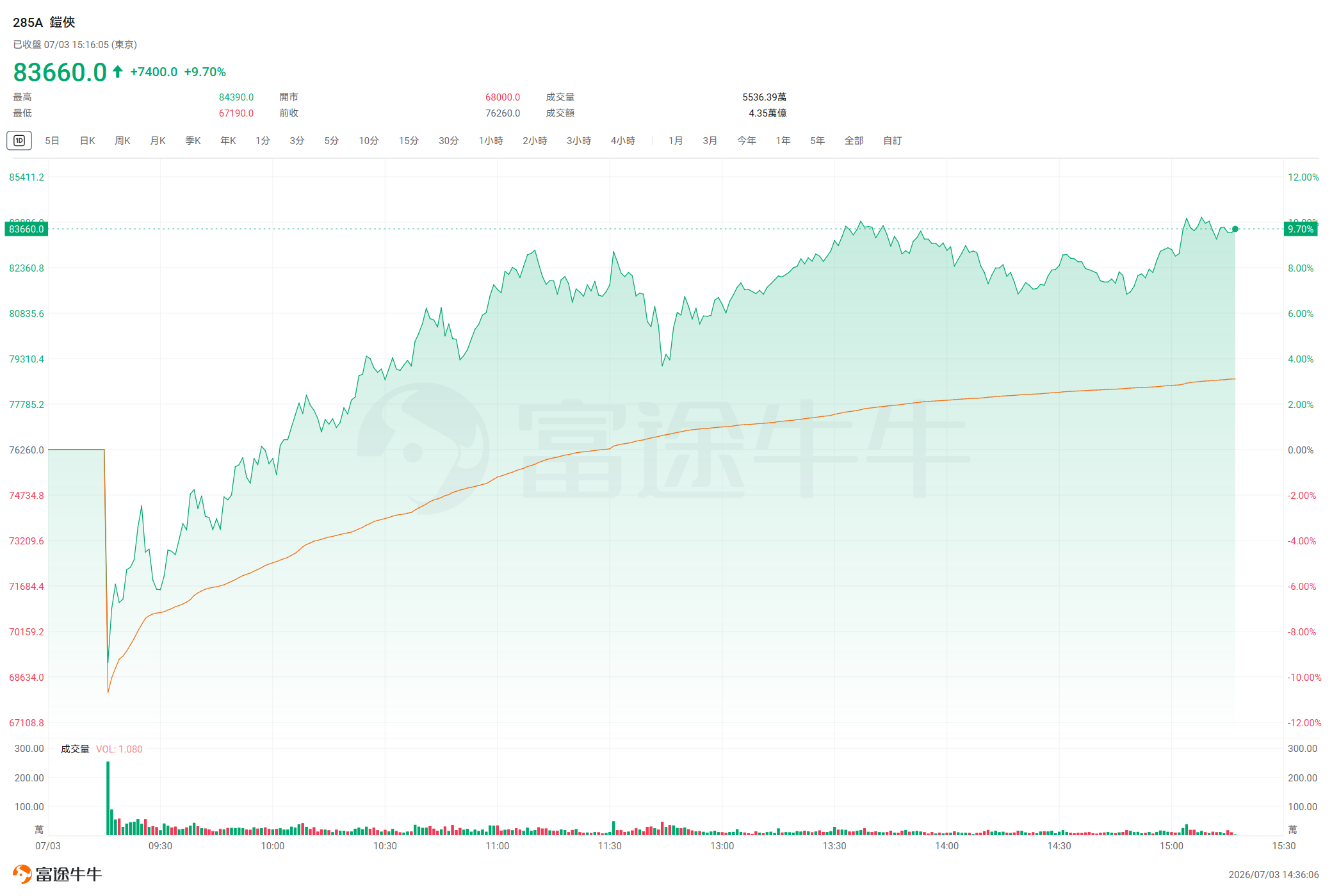
$Kioxia Holdings (285A.JP)$The company's debut of its next-generation flash memory chips in the AI data center market, coupled with a strong statement from its CEO, boosted market confidence and triggered a sharp V-shaped reversal in its share price.
Kioxia Holdings announced on Thursday that it has begun sampling its 10th-generation BiCS FLASH 3D NAND chips to AI data center customers and plans to commence mass production in 2027 at its Kitakami factory in Japan. This is the company’s most advanced flash memory product to date, offering approximately 60% higher storage density than its previous flagship generation and a data transfer rate of 4.8 Gbps—about 30% faster than the prior generation.
$Kioxia Holdings (285A.JP)$At a media briefing, CEO Hiroo Ota stated unequivocally, "We do not see any signs of weakening demand from data centers," adding that the company would "resolutely respond to market growth," signaling it may further increase capital expenditures. This statement directly addressed market concerns about the sustainability of AI-driven storage demand.
 Hiroo Ota further noted at the event that the rise of AI agents and the broader adoption of AI technologies in fields such as robotics will further expand the addressable market for flash memory.
Fueled by both the new product announcement and the CEO’s forceful remarks, Kioxia’s stock staged a dramatic intraday V-shaped recovery—plunging more than 12% at one point before staging a strong rebound, ending the day up nearly 10% at the time of reporting. Year-to-date, Kioxia’s share price has surged over 680%, propelling its market capitalization into the top tier of Japanese listed companies.
10th-Generation Chips: Differentiated Technical Approach Targeting Hyperscale Data Centers
According to Bloomberg,$Kioxia Holdings (285A.JP)$The sampled BiCS 10 chips feature a 332-layer stacked architecture and incorporate Kioxia’s proprietary CBA (CMOS Direct Bonded Array) technology. Each die offers 1 Tb of TLC storage capacity and will be used in solid-state drive (SSD) products.
Notably, Kioxia has deliberately differentiated its layer count from competitors. According to EE Times Japan, Atsushi Inoue, General Manager of Kioxia’s Memory Business Division, explained that when stacking exceeds 400 layers, more memory layers are activated during read/write operations, increasing power consumption. Additionally, thinner memory cell layers could compromise charge retention, negatively impacting long-term reliability.
Kioxia stated that its 332-layer design reduces cost per gigabyte by approximately 10% and improves power efficiency by about 10% compared to solutions exceeding 400 layers, while also enhancing memory cell reliability by roughly 35%. Continued implementation of CBA technology has enabled Kioxia to maintain a lead in interface speed—since its introduction in the 8th generation, interface rates have risen from 3.6 Gbps to 4.8 Gbps. According to EE Times Japan, this advantage gives Kioxia an estimated one-year lead over competitors in technological advancement.
BiCS 10 will be manufactured at Kioxia’s second wafer fabrication facility at its Kitakami plant in Iwate Prefecture, Japan, which began operations in September last year.
Market share under pressure; data centers are key to breaking through
Despite recognition of its technological capabilities,$Kioxia Holdings (285A.JP)$its market share in the data center NAND segment still lags significantly behind that of its South Korean rivals. According to Akira Minamikawa, an analyst at market research firm Omdia, Samsung Electronics is estimated to hold approximately 40% of the data center flash memory market in 2025, SK Hynix around 30%, and Kioxia only about 10%.
South Korean manufacturers hold an advantage by bundling NAND storage chips with high-bandwidth memory (HBM), leveraging their established HBM sales channels to offer one-stop solutions to hyperscale data center customers. Kioxia currently lacks an HBM product line, which somewhat constrains its penetration into the data center market.
However, Minamikawa offered a positive assessment of Kioxia’s technological competitiveness. "Kioxia’s NAND chips demonstrably outperform competitors in data processing speed—a metric highly valued by U.S. hyperscale data centers," he stated. "The tenth-generation chip represents a major breakthrough in this regard and exhibits very strong competitiveness."
South Korean rivals accelerate capacity expansion, intensifying industry competition
$Kioxia Holdings (285A.JP)$While advancing new products, South Korean competitors are also accelerating capacity investments. According to Korea’s Chosun Biz,$SK Hynix (000660.KR)$Samsung announced on July 2 a plan to invest a total of KRW 100 trillion in Cheongju, of which KRW 80 trillion will be allocated to the M17 NAND production facility. SK Hynix CEO Kwak Noh-jung stated that NAND demand is growing rapidly while supply remains tight. Construction of the M17 plant is scheduled to begin next year, with operations targeted to commence in the first half of 2029.
Meanwhile, according to The Bell in April this year, Samsung Electronics also plans to build a new NAND production line at its Pyeongtaek P5 facility, with the cleanroom expected to be completed next year. If implemented, this would mark Samsung’s first large-scale NAND capacity expansion since the P3 facility.
Simultaneous capacity expansions by the three major players have heightened market concerns about future supply-demand balance and price trends. This context has also contributed significantly to the prior downward pressure on Kioxia’s share price.