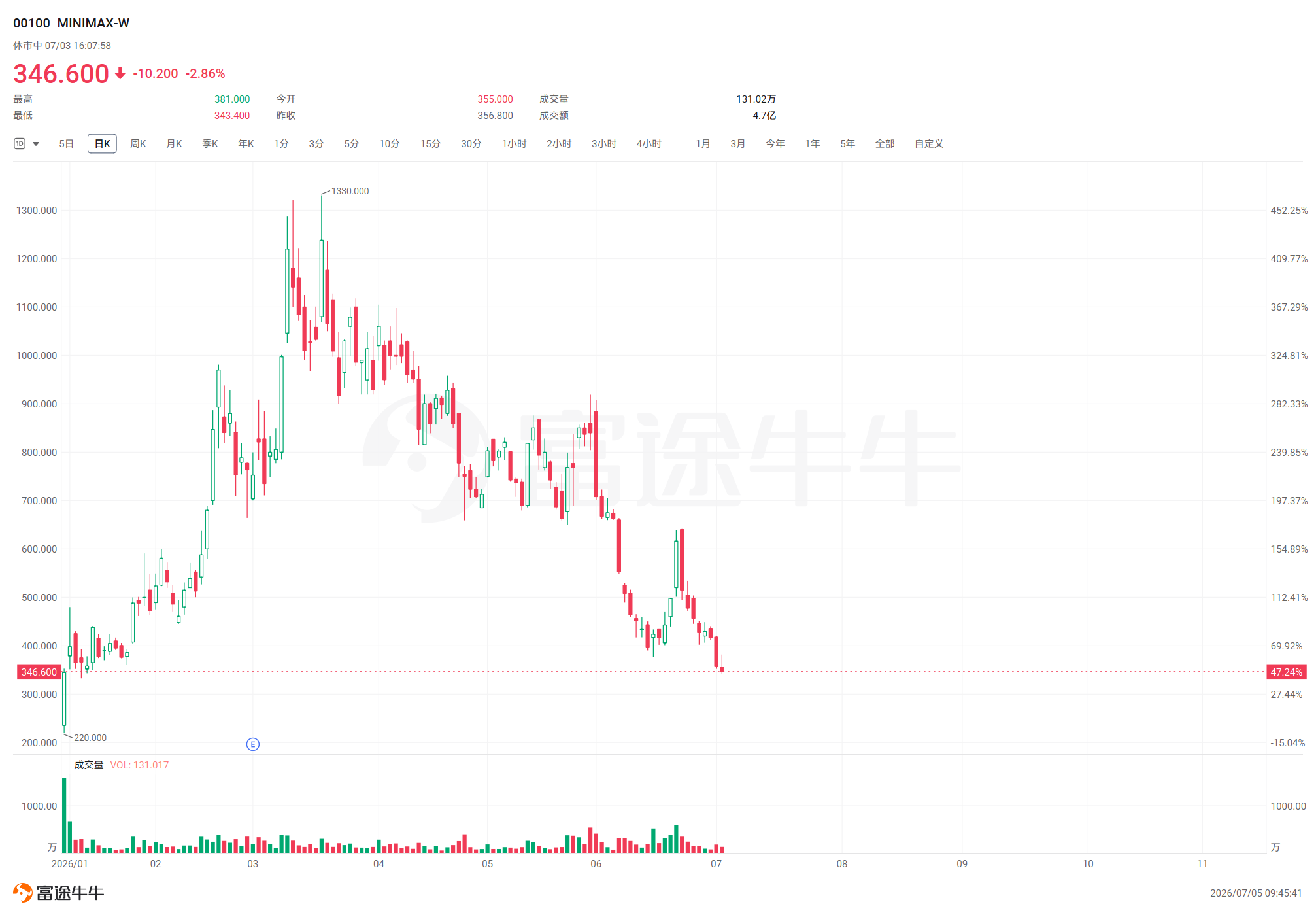
Goldman Sachs believes the key catalyst lies in the inflection point of a 'price war' emerging in China's large AI model industry, where competitors' price hikes highlight their cost barriers. The company, with over 90% compute utilization and architectural upgrades, maintains low pricing while achieving exceptionally high gross margins. Additionally, it will launch its H3 multimodal video model within weeks to enter film and television production. The firm maintains a Buy rating with a 12-month target price of HK$860, implying 141% upside from the current share price of HK$356.80.
On July 4, Goldman Sachs released a new research report on July 3, stating that $MINIMAX-W (00100.HK)$ the earnings call sent strong signals regarding commercialization and technological evolution: management expressed confidence in achieving its target of $1 billion in annual recurring revenue (ARR) by the end of 2026.
The report noted that the most critical catalyst is that China’s AI large-model industry is reaching an inflection point in its 'price war'—as competitor DeepSeek announced price increases during peak periods, industry pricing is returning to rationality.
MiniMax has achieved gross margins significantly higher than peers while maintaining highly competitive pricing (at $0.22 per million tokens for its M3 model blend), thanks to over 90% compute utilization, deep integration with domestic chips, and unique 'organizational agility.' Furthermore, the upcoming launch of its H3 video-generation model in several weeks will further expand the potential of the multimodal market.
Goldman Sachs maintains a Buy rating with a 12-month target price of HK$860, implying 148% upside from the current share price.
ARR growth trajectory: From $100 million to $1 billion, management outlined a clear roadmap
The report stated that during the earnings call, MiniMax management systematically outlined key milestones for ARR (annual recurring revenue) growth:
End of December 2025: ARR reaches $100 million;
February 2026: ARR rises to $150 million;
April 2026: ARR doubles again compared to February;
Prior to the official launch of the M3 model on June 1: ARR accelerates further.
Management explicitly stated that it remains fully confident in achieving its $1 billion ARR target by the end of 2026.
On pricing strategy, M3 maintains the same pricing as its predecessor M2.7; however, management emphasized that this approach is sustainable at the gross margin level—primarily because architectural upgrades in both training and inference have delivered more than a twofold reduction in costs, largely offsetting the cost increase from doubling the total parameter count.
The company also previewed that it will launch larger-scale M3-series models in the second half of 2026, aiming to further enhance intelligence while maintaining strong cost-performance characteristics.
This ARR growth trajectory serves as the core basis for Goldman Sachs’ revenue forecast—Goldman Sachs expects MiniMax’s revenue to surge from $79 million in 2025 to $300 million in 2026, further rising to $880.1 million in 2027, and surpassing $2.4696 billion in 2028.
DeepSeek’s Price Increase: A Breakthrough Signal for Industry Pricing Rationalization, Directly Benefiting MiniMax
This is the most market-catalytic external event highlighted in Goldman Sachs’ report.
DeepSeek announced this week that its V4 official release will go live in mid-July, introducing a peak/off-peak API differential pricing mechanism: rates during peak hours (9 a.m. to 12 p.m. and 2 p.m. to 6 p.m. Beijing time) will be double those during off-peak hours, with blended pricing at approximately $0.35 per million tokens for the Pro version and $0.12 for the Flash version.
Goldman Sachs interprets this as an early signal that aggressive pricing by Chinese AI model companies since late April 2026—where some players operated with zero or even negative gross margins—is transitioning toward a more rational phase, fundamentally reflecting the real-world pressure of inference costs manifesting in pricing decisions.
By comparison, MiniMax M3’s blended pricing stands at $0.22 per million tokens, offering a significant competitive advantage on a performance-per-dollar basis, along with markedly higher gross margins than peers—thanks to its greater proportion of self-built, optimized computing capacity and an architectural design enabling efficient inference with fewer activated parameters.
MiniMax also specifically noted that its proprietary computing infrastructure achieves over 90% utilization, balancing peak and off-peak demand by serving knowledge workers and developers during high-demand periods and repurposing idle capacity for experiments and data processing during low-demand periods—thereby supporting the cost advantage required for long-duration agentic workflows.
H3 Video Model: Launching in Weeks, Deeply Integrated with M3 Architecture
Meanwhile, MiniMax is set to launch its next-generation video generation model, H3, expected to be officially released "within the coming weeks."
The core upgrades of H3 are reflected in two dimensions:
A comprehensive enhancement in video generation quality and functional diversity, underpinned by significant architectural improvements (including optimization of annotation/classification/feedback loops);
Deep integration with the M3 model architecture: large language model capabilities have been embedded into H3’s DiT (Diffusion Transformer) architecture—for example, enhancing understanding of human motion and fundamental physical relationships.
Additionally, MiniMax is bringing in domain-specific experts to gradually enter the feature film and television series production market, expanding the commercial boundaries of video generation.
Competitive Landscape: From the "Hundred-Model Battle" to Market Consolidation—"Organizational Agility" Emerges as a Core Barrier to Entry
Goldman Sachs believes MiniMax’s assessment of China’s AI model competitive landscape carries significant strategic insight: the market is rapidly consolidating from hundreds of players a year or two ago toward a concentrated group of leaders.
During the earnings call, when addressing competition from AI labs under major domestic internet conglomerates, MiniMax defined its key advantages as:
An efficient corporate organizational structure;
Higher infrastructure utilization;
Rapid model iteration capability;
Agile response to emerging agent opportunities—for example, the swift commercial launch of MaxClaw following the rise of OpenClaw, and the rapid deployment of MiniMax Code products.
Company management believes that as competition among AI models shifts from 'one-off benchmark leaderboard chasing' to 'continuous product iteration and real-world deployment,' sustainable return on investment (ROI) will become the key evaluation criterion, and organizational agility will grow increasingly valuable under this new competitive paradigm.
Global infrastructure integration with domestic chips: Localization accelerating
At the compute infrastructure level, MiniMax employs a dual-track strategy:
Directly leasing computing capacity from global cloud service providers (CSPs);
Deep collaboration with emerging cloud service providers (neo-clouds).
Currently, MiniMax’s localized inference infrastructure spans over 200 countries and regions globally, with a highly diversified customer base and no significant concentration risk in any single country.
In the Chinese market, MiniMax has already deeply integrated domestically produced AI chips (ASICs) for inference tasks. As domestic chip capabilities continue to improve, this localization effort is accelerating. This strategic positioning not only reduces reliance on overseas computing resources but also enhances supply chain resilience amid U.S.-China technological competition.
In terms of talent strategy and reserves, MiniMax sustains intense technological competition with an exceptionally lean team:
The company employs 400 to 500 people, over 80% of whom are engaged in research and development;
Between 300 and 400 employees participate in the Employee Stock Ownership Plan (ESOP), which allocates approximately 7% of the company’s equity to enhance talent retention through equity incentives;
It continuously recruits new graduates from China’s top universities and prestigious overseas institutions;
Through its "10X Talent Program," it brings in seasoned experts from specialized fields to translate industry know-how into capabilities for model training and real-world task optimization.
Want to select stocks or get a stock diagnosis? Curious about the opportunities and risks in your portfolio? For all your investment questions,Just ask Futubull AI!