
Donald Trump’s war on Iran may be over, but its impact on global monetary policy will persist.
Economists at Bloomberg Economics widely agree that while the latest Middle East conflict initiated by U.S. President Donald Trump against Iran may have ended, its impact on global monetary policy will persist. They generally note that although a fragile ceasefire is likely to hold in the short term following the U.S. military offensive in the region, the interest rate paths of major central banks worldwide have now shifted significantly higher for the next several years.
The aggregated borrowing cost forecasts from these economists indicate that by 2028, the Federal Reserve’s FOMC benchmark rate trajectory could be as much as half a percentage point—or more—higher than the path envisioned prior to the Middle Eastern geopolitical conflict. This shift is reflected both in Bloomberg Economics’ compiled global benchmark interest rate indicators and in its projections for advanced economies such as the United States.
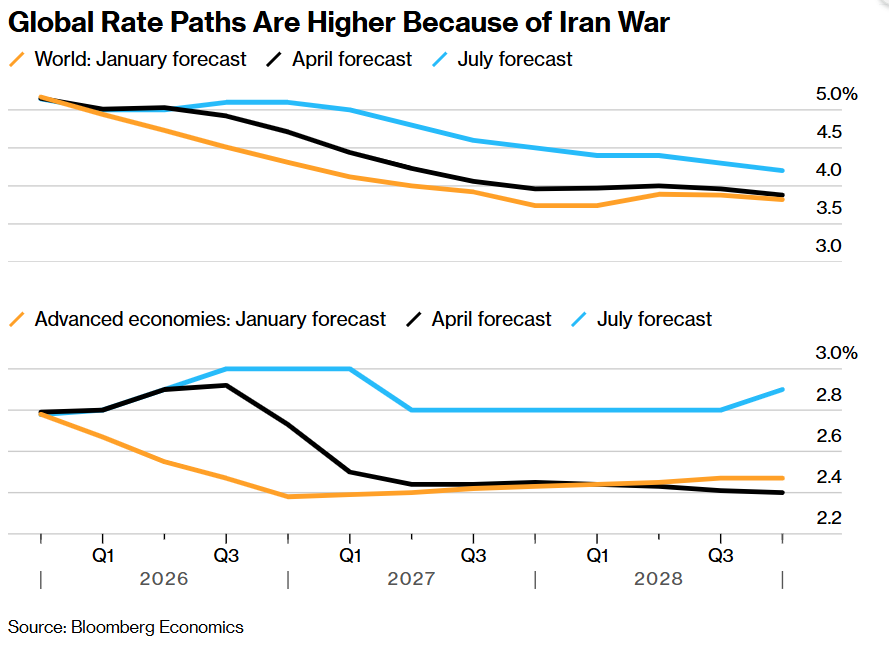
 As illustrated in the chart above, economists at Bloomberg Economics uniformly expect that the global interest rate path has been lifted due to the war with Iran.
This outlook reflects evolving inflation risks, including those potentially stemming from productivity gains driven by the race to adopt artificial intelligence and the risk of large-scale job displacement; however, these risks may eventually fade. Nevertheless, price momentum triggered by the earlier full blockade of the Strait of Hormuz continues to persist.
With the conflict subsiding, Bloomberg Economics’ forecast data show that households and businesses now face a period during which the cost-of-living shock will coincide with notably higher borrowing and mortgage costs than would otherwise have been the case.
Earlier this year, economists at Bloomberg Economics had unanimously projected that by mid-2027, the Fed funds rate would ultimately settle one percentage point below current levels, rather than the current expectation of just a 25-basis-point cut. The European Central Bank is now expected to hike rates again—by half a percentage point above initial assumptions—before eventually pivoting toward easing at an appropriate time.
“Scarred by post-pandemic inflation experiences, central banks globally have largely maintained hawkish rhetoric on inflation. With price pressures surging further—even if only temporarily—the willingness to retreat from this stance appears limited. Despite falling oil prices, our central bank communication indicator remains firmly in hawkish territory,” said Jamie Rush, Global Head of Economics at Bloomberg Economics.
The consensus outlook among economists also suggests that the global economy is proving resilient enough to withstand higher borrowing costs, demonstrating its capacity to absorb repeated shocks. However, given Trump’s penchant for disruption—this war follows last year’s campaign to impose sweeping reciprocal tariffs globally—this robust resilience will surely be tested again soon.
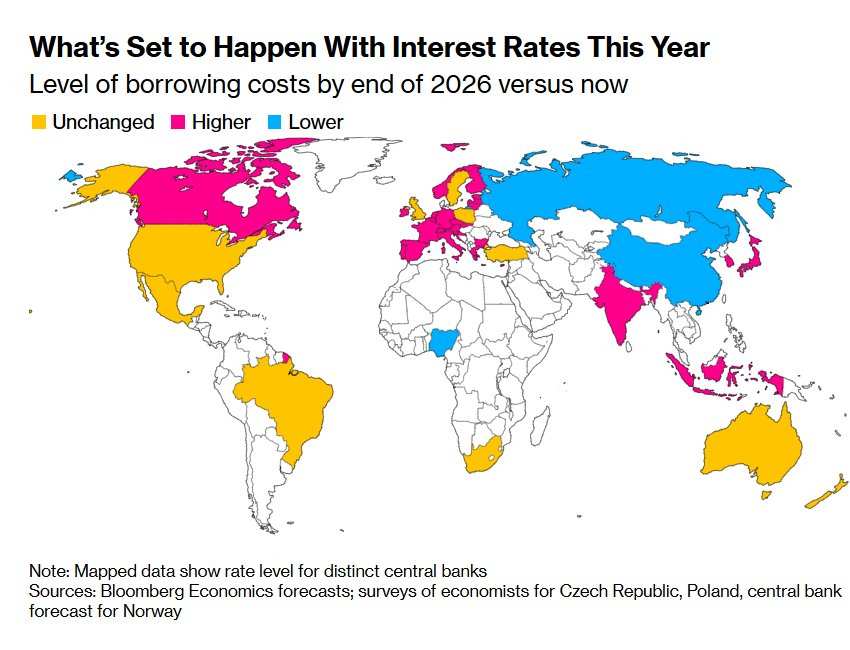
With this caution in mind, below is Bloomberg Economics’ quarterly forward-looking guide to monetary policy for the world’s major central banks, which collectively account for at least 50% of global economic output.
Federal Reserve
Current federal funds rate (upper bound): 3.75%
Bloomberg Economics’ forecast for end-2026: 3.75%
Bloomberg Economics’ forecast for end-2027: 3.5%
Interest rate futures markets are pricing in a near-universal expectation among traders for one full 25-basis-point rate hike by year-end, with the probability of a second hike during the year exceeding 20%.
The Federal Reserve era under new Chair Kevin Warsh has already begun and may usher in a series of changes.
Following the new chair’s first press conference in June, where he emphasized the U.S. central bank’s strong commitment to fighting inflation, investors have uniformly raised their expectations for rate hikes this year. According to the Fed officials’ most recent projections, roughly half of policymakers expect at least one rate increase this year.
Since taking the helm at the Fed, Warsh has placed renewed emphasis on price stability mechanisms and shifted the Fed’s forward guidance framework toward a “less communication” approach, which—combined with Wall Street’s repricing of the rate path—has driven the U.S. Dollar Index to its strongest monthly performance in nearly a year.
It is reported that Warsh is also actively advancing a new communication strategy that includes scaling back forward guidance, meaning investors will receive fewer signals about future policy direction. Longtime central bank observers describe this as a potentially significant shift, presenting both opportunities and risks.
How the Federal Reserve manages its interest rate policy over the coming months could significantly influence the U.S. midterm elections in November. Inflation and affordability remain top concerns for many Americans, particularly following the Iran conflict’s impact on energy and other prices. Trump continues to call for lower rates, but whether the Fed chair he personally selected will secure the economic conditions necessary to deliver rate cuts remains to be seen.
The Federal Reserve will hold its annual Jackson Hole symposium in late August. Fed chairs often use this forum to deliver major announcements, and observers will closely watch whether Warsh—who has pledged to drive 'institutional reform' at the central bank and is currently assembling multiple working groups to review monetary policy implementation—follows suit.
“As the new Federal Reserve chair’s working group reviews potential reforms, it provides a rationale for the increasingly hawkish committee to remain in wait-and-see mode, making it likely that the Fed will stay on hold for the remainder of 2026. According to the latest forecast from Bloomberg Economics, the Fed will resume rate cuts in the first half of 2027 as inflationary pressures ease and productivity gains from artificial intelligence become more evident,” said Andrew Sacher, senior economist at Bloomberg Economics.
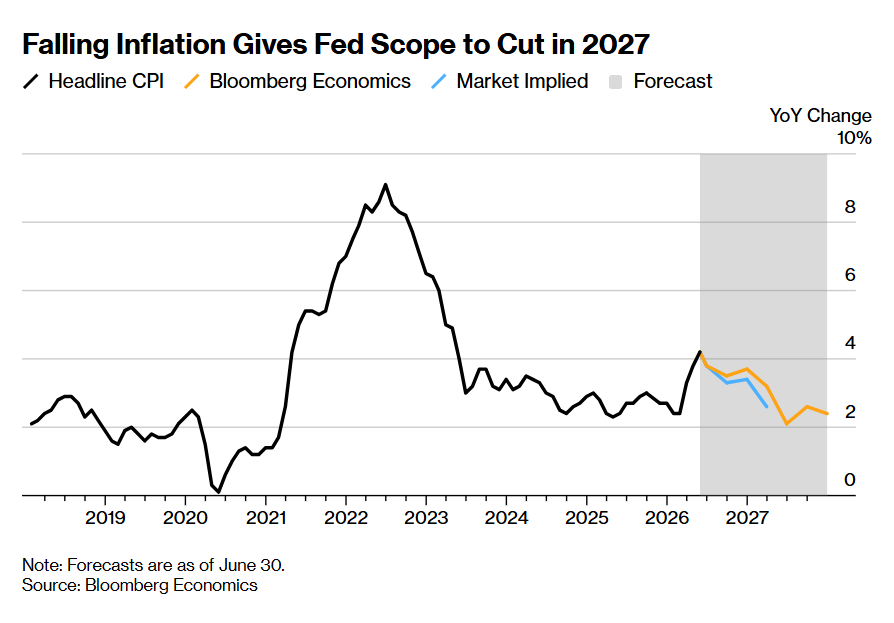
As shown in the chart above, declining inflation could create room for the Fed to cut rates in 2027. Note: Forecasts as of June 30.
European Central Bank
Current deposit rate: 2.25%
Bloomberg Economics forecast for end-2026: 2.5%
Bloomberg Economics forecast for end-2027: 2%
Market pricing trajectory: Swap markets are pricing in an approximately 80% probability of a 25-basis-point rate hike by year-end and fully pricing in one additional hike before the start of next year.
Progress in the Middle East peace process has given the European Central Bank time to assess its decision in June—the first rate hike since 2023. U.S.-Iran negotiations triggered a sharp decline in oil prices, which fed through to inflation, including underlying price pressures and closely watched services indicators. Some policymakers are now wavering, uncertain whether further action is needed, leading investors to question whether another rate hike will occur this year.
However, other officials caution against declaring the all-clear, warning that the initial surge in energy costs continues to ripple through the economy and could prompt workers in the region to demand higher wages as food and services inflation lag but accelerate. The September meeting will feature new economic projections, at which point diverging views may spill into the open.
“Lagarde’s recent remarks suggest she still favors a rate hike in September, and we continue to expect a 25-basis-point increase. However, the drop in oil prices following the U.S.-Iran agreement announcement, along with the easing of eurozone inflation in June, has weakened the case for an additional hike. This likely marks the end of this brief tightening cycle,” said David Powell, senior economist at Bloomberg Economics.
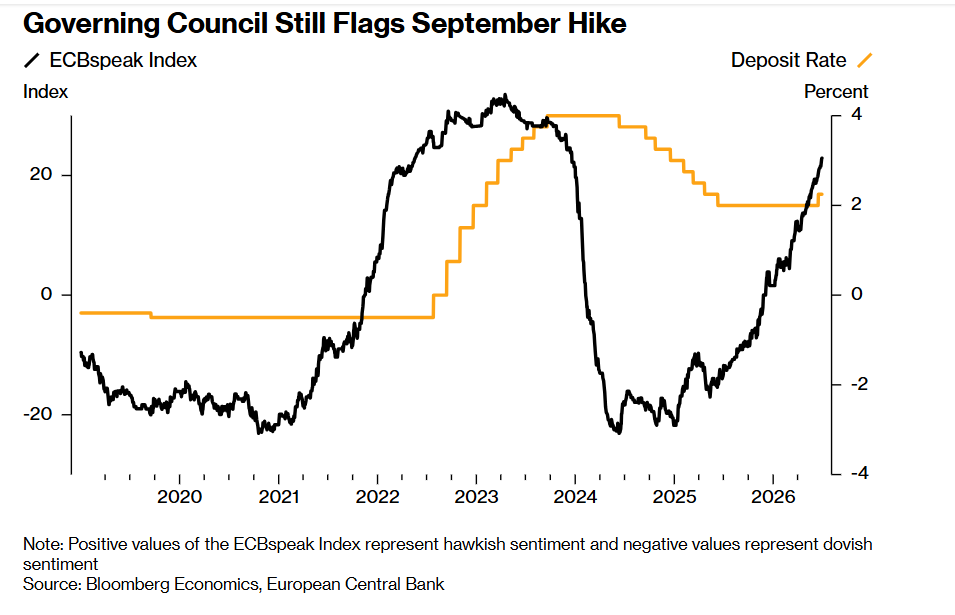
As shown in the chart above, central bank governors of major eurozone economies, who also sit on the ECB Governing Council, continue to signal a rate hike in September. Note: A positive value for the ECB speakers index indicates hawkish sentiment, while a negative value indicates dovish sentiment.
Bank of Japan
Target interest rate (upper bound): 1%
Bloomberg Economics’ forecast for end-2026: 1.25%
Bloomberg Economics’ forecast for end-2027: 1.5%
Market pricing: Money markets are pricing in a 22-basis-point rate hike by year-end, implying a probability of approximately 90%.
With upside inflation risks continuing to accumulate, the Bank of Japan will need to weigh in the coming months whether to accelerate its so-called tightening cycle beyond the current pace of roughly once every six months.
BOJ Governor Kazuo Ueda just raised borrowing costs last month, but market expectations for faster action have intensified, with some highlighting the risk of a move as early as September.
The yen’s benchmark exchange rate against the U.S. dollar has weakened to its lowest level since 1986, raising concerns that higher import costs could fuel inflation. The Bank of Japan already expects price gains to remain above its 2% target over the next few years.
Fiscal stimulus policies under Prime Minister Sanae Takaichi will also be a key factor. Although she has consistently signaled support for accommodative monetary policy, her dovish stance has exacerbated yen weakness, potentially increasing pressure on the Bank of Japan to normalize policy earlier than she would prefer.
“Some market participants believe that the yen’s decline could push the Bank of Japan toward a hawkish stance and bring forward its next rate hike—possibly as early as October. We disagree. The Bank of Japan is guided by its inflation outlook, and falling oil prices have reduced the urgency for swift action. Local governments, which strongly support stimulus policies, may also continue pressuring the central bank to slow the pace of monetary tightening and delay normalization. We expect the Bank of Japan to raise its policy rate to 1.25% in December,” said Taro Kimura, Senior Economist at Bloomberg Economics.
Bank of England
Current bank rate: 3.75%
Bloomberg Economics’ forecast probability for end-2026: 3.75%
Bloomberg Economics’ forecast probability for end-2027: 3.5%
Traders unanimously assign a 75% probability to a 25-basis-point rate hike this year and expect one full rate increase by mid-2027.
The sharp decline in oil and natural gas prices has eased pressure on the Bank of England to raise rates to counter inflationary threats stemming from the Iran conflict.
Although Bank of England Governor Andrew Bailey stated it is still too early to consider resuming the rate cuts officials had planned before the conflict, economists at Bloomberg Economics now expect the inflation peak to be lower than the most optimistic scenario outlined by the Bank in its spring forecast.
The Bank of England has adopted a wait-and-see approach to the economic impact of the conflict, with policy already in restrictive territory prior to the outbreak of war. Falling energy prices combined with a weakening labor market may now allow the Bank to avoid raising borrowing costs altogether.
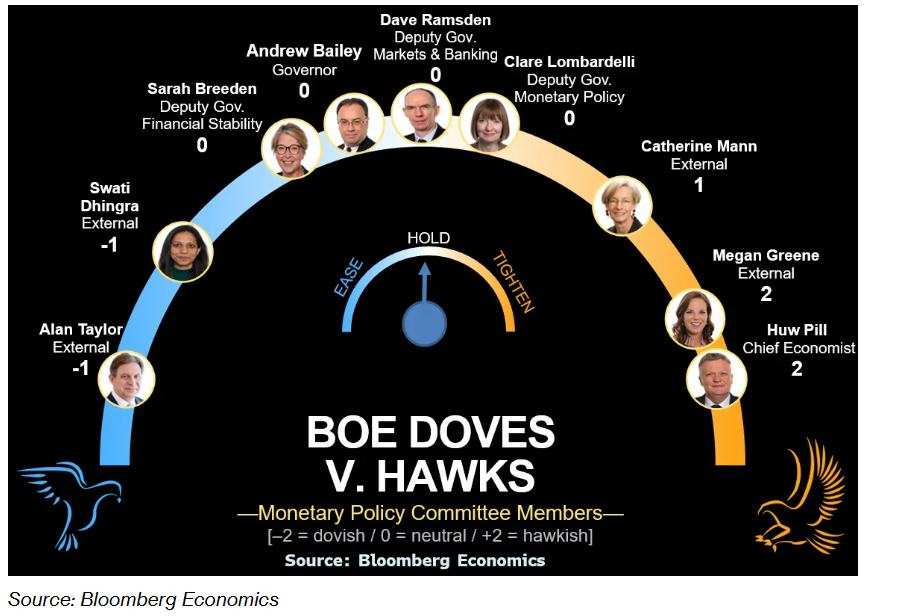
“The Bank of England may hold rates steady through 2026 as it balances above-target CPI against a weak economy. Lower energy prices have reduced the risk that the current bout of high inflation becomes more persistent and requires forceful intervention from the Bank. The prospect of looser fiscal policy following the appointment of a new prime minister could limit the Bank to a single 25-basis-point rate cut in 2027,” said Dan Hanson, Senior Economist at Bloomberg Economics.
Bank of Canada
Current overnight lending rate: 2.25%
Bloomberg Economics forecast for end-2026: 2.5%
Bloomberg Economics forecast for end-2027: 3%
Market pricing: Swap market pricing indicates a slightly above 50% probability of a 25-basis-point rate hike by year-end.
The Canadian economy continues to face significant headwinds from U.S. tariffs and a sharp slowdown in non-permanent immigration. Although economic activity appears to have rebounded in the second quarter, this recovery followed two consecutive quarters of contraction—an outcome that met one definition of a technical recession—and prompted economists to downgrade their growth forecasts for this year.
At their previous meeting, Bank of Canada policymakers broadly noted that the combination of economic slack and rising global energy prices posed a significant 'dilemma,' complicating their policy decision-making.
However, with domestic gasoline costs beginning to decline and core inflation hovering near the central bank’s 2% target, upside inflation risks are receding. This should afford Bank of Canada Governor Tiff Macklem greater room to temper some of his more hawkish remarks on potential rate hikes and shift focus toward the weak housing market, persistent uncertainty around business investment, and a soft labor market.
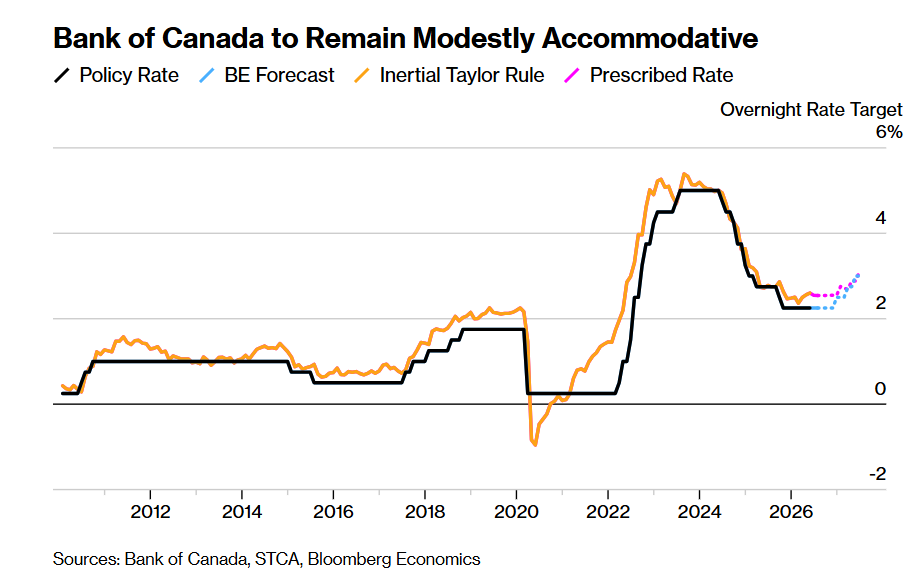
“Weak economic activity, a soft labor market, and cooling core inflation all support the Bank of Canada maintaining an accommodative stance. Many of the challenges facing the economy lie beyond the central bank’s control, but policymakers have demonstrated a willingness to help smooth economic activity during this ‘period of structural change.’ We expect clarity on the USMCA in the second half of the year, which would support improved investment and hiring. This would open the door for the Bank of Canada to raise rates by 25 basis points to 2.5% toward year-end,” said Stuart Paul, Senior Economist at Bloomberg Economics.
Editor/melody