
Guolian Minsheng Securities believes that ChangXin Technology's IPO has been approved, with plans to raise RMB 29.5 billion to expand and upgrade its production capacity, acting as a catalyst for the realization of orders along the domestic supply chain. The expansion wave will unfold sequentially across three tiers—equipment, components, and materials: front-end etching and thin-film deposition equipment will benefit first, followed by scaled-up output of core components, while consumable materials in the later stages will continue to see demand fulfillment as production lines ramp up wafer starts.
Structural growth in AI computing demand is driving the global memory industry into a new supercycle of capital expenditure, and$CXMT Corporation (688825.SH)$Changxin Technology’s STAR Market IPO could become a key catalyst for the realization of orders across China’s domestic semiconductor supply chain.
In May 2026, ChangXin Technology’s IPO application for the STAR Market was approved by the Listing Committee. The company plans to raise RMB 29.5 billion, earmarked for three major projects: upgrading its memory wafer manufacturing mass-production line, advancing DRAM technology, and conducting forward-looking R&D. In a research report dated the 7th, the team led by Xue Hongwei at Guolian Minsheng Securities noted that this milestone holds significance beyond the capitalization of a single enterprise—ChangXin’s current capacity utilization rate has risen from 87% in 2023 to approximately 96% in 2025, nearing full production, which provides strong support for expansion. Following the successful fundraising from the IPO, a new round of large-scale capital expenditures is expected to resume.
 Capital expenditure will be transmitted sequentially along the industrial chain, creating three tiers of beneficiaries: equipment, components, and materials. Guolian Minsheng Securities believes the sequence of benefits from this industrial impulse is clear: the equipment segment benefits first, components follow as system-level orders scale up, and materials and consumables realize sustained gains once wafer production ramps up—making the elasticity ranking and investment timing across these segments the core logic for positioning in this cycle.
AI-Driven: Global Memory Manufacturers Collectively Increase Capex
This memory upcycle fundamentally differs from previous cycles driven by consumer electronics, with its core driver being the rapid expansion of AI computing power demand.
The displacement effect of HBM on standard DRAM capacity is the key mechanism behind the current supply-demand gap. According to TrendForce, the share of HBM wafers in total DRAM wafer inputs by the top three manufacturers is projected to rise from approximately 18% in 2025 to about 22% in 2026, and further increase to around 30% in 2027. Since HBM requires roughly 2.5 to 3 times the wafer capacity per bit compared to standard DDR5, each additional unit of HBM capacity displaces several units of general-purpose DRAM capacity, structurally compressing the supply of conventional DRAM.
Supply-demand gaps are prompting memory manufacturers to collectively raise capital expenditures.$Micron Technology (MU.US)$Capital expenditure for FY2025 is approximately USD 13.8 billion; according to TrendForce data, it is expected to exceed USD 25 billion in FY2026, representing year-over-year growth of over 80%.$Samsung Electronics (005930.KR)$Planned total investment for FY2026 (including R&D) exceeds KRW 110 trillion (approximately USD 73.3 billion), surpassing KRW 100 trillion for the first time. Samsung explicitly stated in its earnings call that “capital expenditure in the memory segment will increase significantly in 2026.”$SK Hynix (000660.KR)$Capital expenditure for FY2025 amounts to approximately KRW 30.2 trillion (about USD 25.6 billion), with a significant year-over-year increase planned for FY2026. Core projects include ramping up capacity at the new M15X fab in Cheongju and constructing an AI data center in the Chungcheong region.
TrendForce forecasts that AI-driven demand will push combined DRAM and NAND Flash revenue to USD 889.3 billion in 2026, rising further to approximately USD 1.28 trillion in 2027—a 44% year-over-year increase—with DRAM alone reaching USD 903.3 billion, serving as the primary engine of this market expansion.
Capex Transmission: Three-Stage Rollout, Equipment Leads
ChangXin’s capital expenditure for capacity expansion will not be evenly distributed across all segments of the supply chain but will instead be transmitted sequentially according to project implementation timelines.
The first phase involves bidding and procurement of front-end equipment. According to Economic Observer, ChangXin officially launched equipment tenders in Q2 2026, with plans to expand wafer production capacity by 50,000 to 60,000 wafers this year, corresponding to equipment procurement needs of USD 5–6 billion. SEMI data indicates that equipment typically accounts for 70%–80% of total fab investment, making the equipment segment the earliest beneficiary in the supply chain.
The second phase is driven by core components. Once equipment manufacturers secure bulk orders, they pass on inventory preparation demands upstream, triggering mass procurement cycles for key components such as chambers, vacuum systems, RF power supplies, and precision temperature control modules. Compared with original equipment manufacturers (OEMs), some critical components require new precision machining production lines, enhanced process capabilities, and customer qualification, resulting in longer lead times for supply ramp-up. During periods of surging demand, these components are prone to becoming supply bottlenecks and may exhibit greater earnings elasticity than equipment vendors.
The third phase entails sustained release of materials and consumables. After fabs complete installation and commissioning and enter the ramp-up stage, demand for electronic specialty gases, wet chemicals, high-purity sputtering targets, CMP slurries, and other consumables scales continuously with wafer input volumes. This segment exhibits pronounced lagging characteristics but features strong demand sustainability and high repurchase frequency.
Equipment Leads: Etch and Thin-Film Deposition Form the First Tier
Within the equipment segment, Guolian Minsheng Securities ranked sub-sectors based on per-tool value, domestic supply foundation, and customer qualification progress.
Etch and thin-film deposition equipment are classified as the top-tier core categories. Etch tools are among the most critical process equipment in memory manufacturing; as DRAM nodes continue to scale down, requirements for pattern transfer accuracy and high-aspect-ratio structure processing keep rising. ChangXin’s capacity expansion will drive etch equipment demand through both new capacity additions and technology upgrades. Moreover, the repetitive, high-volume nature of memory production ensures strong order continuity once tools are qualified. Among domestic suppliers, Advanced Micro-Fabrication Equipment (AMEC) has established a solid product base in CCP and ICP etch technologies, while NAURA has built a platform-level presence across etch, thin-film deposition, and thermal processing in front-end processes. In thin-film deposition, the importance of CVD, ALD, and PVD tools continues to grow with node scaling, and domestic vendors already have volume shipment capabilities in certain segments.
CMP and cleaning equipment form the second tier, closely tied to the construction of new production lines,$Hwatsing Technology (688120.SH)$、$ACM Research (688082.SH)$Companies such as these have a relatively strong foundation for domestic substitution. Segments including photoresist coating and developing, metrology and inspection, and ion implantation currently exhibit low localization rates, resulting in relatively weaker near-term certainty; however, any breakthrough within the ChangXin ecosystem would generate significant upside potential due to the low base effect.
Components Take Over: Supply Bottlenecks Amplify Earnings Elasticity
Growth in equipment orders transmits upstream, and core components are expected to demonstrate higher earnings elasticity than finished equipment.
Semiconductor equipment integrates multiple functional subsystems—including precision mechanics, vacuum systems, fluid/gas delivery, RF power, temperature control, wafer handling, and electrical control—where component precision and reliability directly affect equipment uptime and wafer yield. During rapid demand upswings, capacity expansion for precision machining takes longer than for finished equipment. Shortages of critical components such as vacuum pumps, sensors, and precision temperature control units can become bottlenecks that delay entire tool deliveries.
Supply constraints overseas will prompt equipment manufacturers to accelerate the adoption of domestic suppliers, creating spillover order opportunities for local component makers. Additionally, certain components—such as process kits, chamber liners, and gas distribution plates—exhibit consumable characteristics, benefiting not only from new equipment installations but also from maintenance and replacement cycles for existing tools, thereby ensuring strong revenue continuity.
Materials: Catching Up – Domestic Substitution Progressing from Mid-to-Low-End Toward High-End Segments
The materials segment lags behind equipment and components in terms of timing of benefits, yet demonstrates the strongest demand sustainability.
According to SEMI data, the global semiconductor materials market reached USD 73.2 billion in 2025, of which wafer fabrication materials accounted for USD 45.8 billion. In terms of localization progress, significant divergence exists across sub-segments: wet electronic chemicals have advanced rapidly, with an overall domestic substitution rate in the semiconductor sector reaching approximately 50% by 2025; the electronic specialty gases market remains dominated by foreign players—as of June 2025, Air Products, Linde Group, Air Liquide, and Taiyo Nippon Sanso collectively held around 86% market share, leaving substantial room for domestic substitution; high-end photoresists and advanced-node specialty gases remain heavily import-dependent.
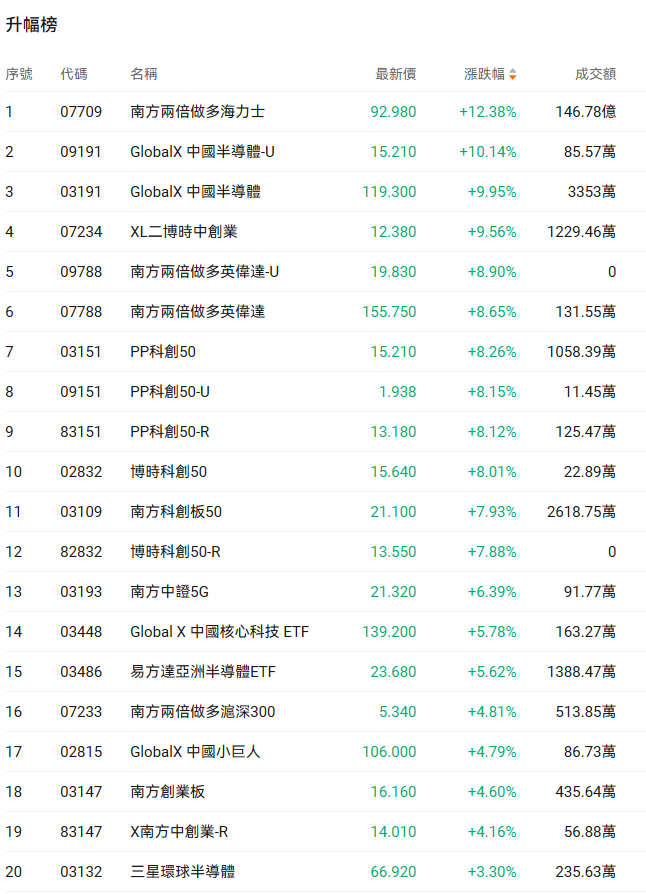
On the afternoon of July 9, Hong Kong-listed semiconductor stocks performed strongly,$SMART-CORE (02166.HK)$surging over 27%,$GIGADEVICE (03986.HK)$rising nearly 20%,$MONTAGE TECH (06809.HK)$up nearly 18%,$SMIC (00981.HK)$rose nearly 12%,$ILUVATAR COREX (09903.HK)$、$VIEWTRIX TECH (03310.HK)$gaining over 8%,$ZTE (00763.HK)$and gaining nearly 8%.
Hong Kong-listed semiconductor-themed ETFs surged across the board, $Global X China Semiconductor ETF (03191.HK)$ rising nearly 10%, $CSOP STAR 50 INDEX ETF (03109.HK)$rose nearly 8%, $EFund A SEMICON ETF (03486.HK)$ Rising more than 5%.
 Looking to select stocks or analyze your holdings? Want to understand the opportunities and risks in your portfolio? For any investment-related questions,just ask Futubull AI!

Editor/melody