On Thursday, Federal Reserve Chair Kevin Warsh officially announced the membership of five external task forces. Comprising Wall Street titans, business leaders, academic experts, and former central bank officials, these advisory groups will conduct a comprehensive review of the Federal Reserve's operational framework, focusing on core issues such as communication mechanisms, data governance, balance sheet management, productivity and employment, and the inflation assessment framework.
On Thursday, Federal Reserve Chair Kevin Warsh formally announced the membership of five external task forces. This group of advisors—comprising Wall Street titans, business leaders, academic experts, and former central bank officials—will conduct a comprehensive review of the Federal Reserve’s operational framework, focusing on core issues such as communication mechanisms, data governance, balance sheet management, productivity and employment, and the inflation assessment framework. Notably, the task force examining the economic implications of artificial intelligence (AI) has drawn particular attention due to the strong consensus among its members.
Warsh stated, 'I am deeply honored that leading scholars from diverse disciplines have agreed to collaborate with us to enhance the Federal Reserve’s effectiveness. Our objective is clear: to ensure that the Fed operates at its best during this critical period to fulfill its policy mandates.' As part of Warsh’s promised comprehensive review of monetary policy, these task forces will broadly examine topics ranging from inflation dynamics to the impact of AI, and will 'start from first principles, ask tough questions, scrutinize current practices, and evaluate alternative approaches.'
 According to the Federal Reserve’s statement, each task force will 'operate independently, guided by fact-based analysis, candid feedback, and rigorous inquiry,' and will ultimately present its findings to the Federal Open Market Committee. Federal Reserve staff will provide logistical and technical support to all task forces.
Composition of the Five Task Forces
The announced roster reflects a diversity of ideological perspectives and professional backgrounds. The specific groupings and their members are as follows:
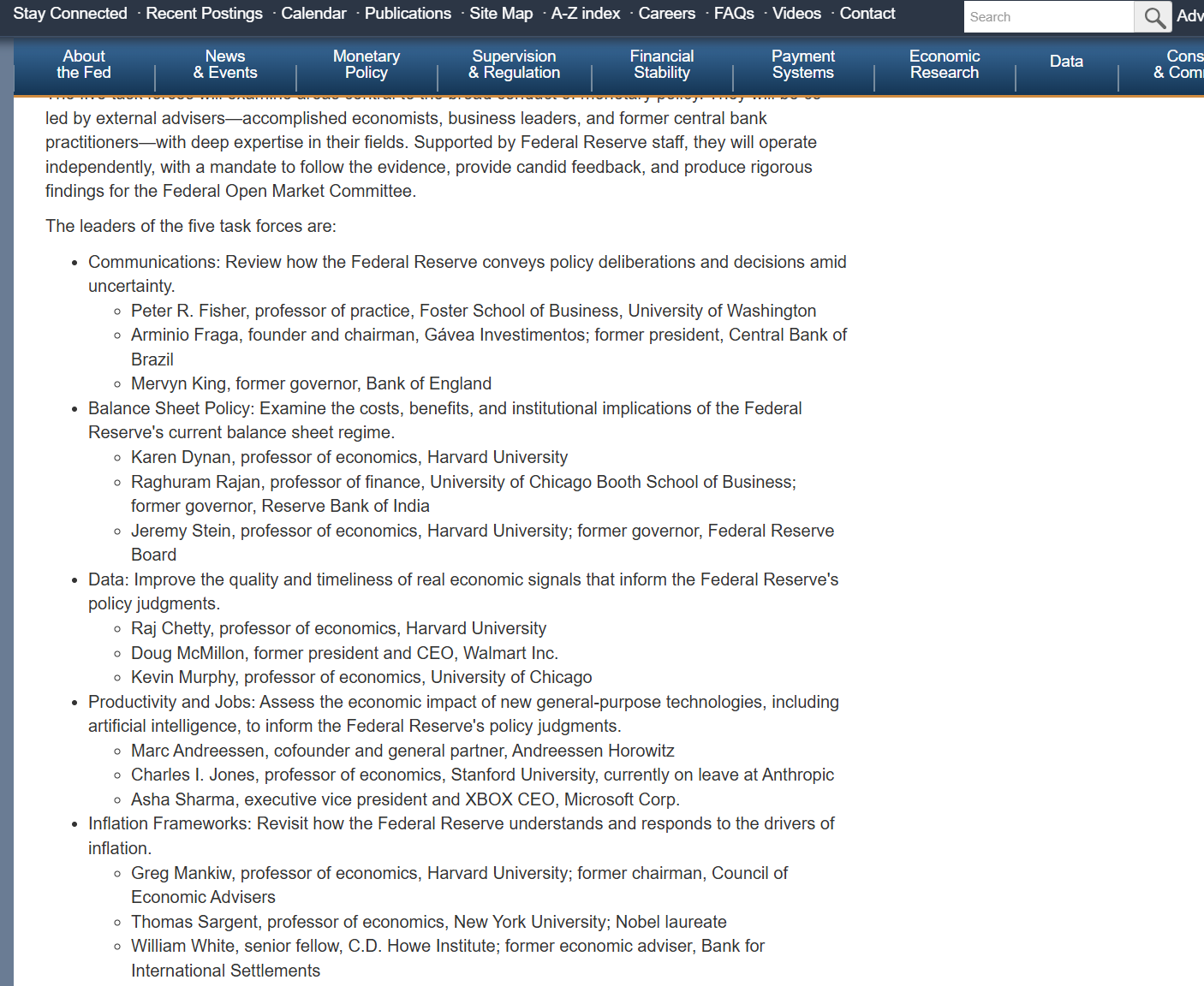
Communication Strategy Task Force: Peter Fisher (Professor of Practice, Foster School of Business, University of Washington), Arminio Fraga (Founder, Gávea Investimentos; former Governor of the Central Bank of Brazil), Mervyn King (former Governor of the Bank of England).
Balance Sheet Policy Task Force: Karen Dynan (economist, Harvard University), Raghuram Rajan (former Governor of the Reserve Bank of India), Jeremy Stein (former Federal Reserve Board Governor).
Data Task Force: Doug McMillon (former Chief Executive Officer, Walmart Inc. [WMT.US]), Raj Chetty (economist, Harvard University), Kevin Murphy (economist, University of Chicago).
Productivity and Employment Task Force: Marc Andreessen (venture capitalist), Charles Jones (economist, Stanford University), Asha Sharma (Executive Vice President and CEO of Xbox, Microsoft Corporation [MSFT.US]).
Inflation Framework Task Force: Greg Mankiw (former Chairman of the Council of Economic Advisers), William White (Canadian economist who warned of the 2008 financial crisis), Thomas Sargent (economist, New York University; Nobel Laureate).
AI Working Group: Like-Minded Optimists
Among the aforementioned groups, the Productivity and Employment Group—tasked with 'assessing the economic impact of new general-purpose technologies, including AI, to inform Federal Reserve policy judgments'—exhibits remarkable alignment in its members’ views. All three external advisors firmly believe that AI will be a transformative technology with profound implications for growth and productivity, a stance consistent with Wall’s long-held perspective.
Wall has long been an advocate of AI’s transformative potential. In his first press conference after assuming the chairmanship in June, he stated that the adoption of AI 'may be the most significant change I’ve witnessed in my lifetime across the economy, business, and households.' As early as 2025, he expressed confidence that advances in AI would justify interest rate cuts by the Federal Reserve, as it could enable rapid economic growth without triggering inflation. All members of this working group were personally selected by Wall.
Group member and venture capitalist Marc Andreessen is a longtime personal friend of Wall. After leaving the Federal Reserve in 2011, Wall managed venture capital investments for investor Stanley Druckenmiller—a role that expanded his Silicon Valley network and significantly increased his personal wealth. Andreessen, who built his fortune developing early web browsers, is now one of AI’s most ardent evangelists. In a recent podcast, he described silicon-based AI chips by saying, 'We turned sand into thoughts.'
Economist Charles Jones likewise exudes strong Silicon Valley optimism. He recently took a leave of absence from Stanford University to join a research institute affiliated with leading AI firm Anthropic. In a recent academic paper, Jones noted that U.S. per capita growth has long hovered around 2%, but 'if AI ultimately automates nearly all the weak links in the economy, growth could accelerate substantially, potentially exceeding 5% annually.' He stated plainly that AI 'is likely to become the most transformative technology of the modern era.'
The third member, Xbox CEO Asha Sharma, embodies a more pragmatic form of optimism. Although she says she 'absolutely believes in AI,' as a business leader she notably chose not to prioritize AI features on Xbox gaming consoles, explaining that 'our console players aren’t excited about that kind of experience.' However, this does not reflect any underlying skepticism on her part.
Internal Skepticism and Demand Shock Concerns
Although Wall aims to use the working group to bring external insights into the Federal Reserve and shift its perspective, skepticism and caution persist among members of the Federal Open Market Committee (FOMC), who hold actual voting power over interest rates. Minutes from the June meeting, released this week, revealed that committee members discussed whether AI could boost productivity. While some participants agreed that productivity growth could accelerate, they emphasized that 'considerable uncertainty remains regarding the timing and magnitude of any potential productivity gains,' and that such gains are expected to lag behind AI’s current stimulative effect on demand.
Meanwhile, the full-scale commitment of U.S. tech firms to AI has already begun heating up the economy. On Thursday, New York Fed President Williams explicitly voiced concern, stating that the AI boom is driving up prices for electricity and semiconductors. He described the price increases as 'hockey-stick-shaped,' with some components doubling or even tripling in cost. Williams characterized AI as a 'demand shock,' noting it remains unclear whether supply can expand sufficiently in tandem to contain inflationary pressures.
It is reported that the Federal Reserve has not set a hard deadline for the working group to complete its task, but Wall previously indicated he expects related reforms to move forward within this year, with all groups anticipated to finalize their work by year-end. The Fed’s next policy meeting is scheduled for late July, and markets widely expect rates to remain unchanged at that time.
Editor/KOKO