
① Two days after the official launch of Hy3, computational resources for the Hy3 model on Tencent's WorkBuddy platform were overwhelmed, with queue rates exceeding 50% in the afternoon. ② Over the past two years, Tencent has consistently been 'left out of the main conversation' in the large-model arena. Now, this moment of servers being 'overwhelmed' speaks louder than any product launch—Tencent AI is finally in high demand.
The Shanghai Science and Technology Innovation Board Daily, July 10 (Reporter Li Jiayi) — At 10 a.m. on July 8, $TENCENT (00700.HK)$ the computing resources for the HunYuan HY3 model on the WorkBuddy platform were overwhelmed, with the queue rate exceeding 50% in the afternoon. The official team urgently scaled up capacity overnight and announced service restoration on the morning of July 9.
Also on July 9, Hy3—currently in its limited-time free trial phase—rose to eighth place on the list of most popular models on OpenRouter, a global large-model API platform. On the same day Hy3 was launched, Tencent’s share price rose by 4.82%, prompting Bank of America Securities to issue a 'Buy' rating, noting that Hy3’s actual performance exceeded expectations.
 Over the past two years, Tencent has consistently been 'left out of the main conversation' in the large-model arena. At the company’s May shareholder meeting this year, Pony Ma described Tencent’s AI situation as: 'We got on the boat, only to later discover it was leaking; now we’re standing on it—but still can’t sit down comfortably.'
Now, with a 50% queue rate, this moment of servers being 'overwhelmed' speaks louder than any product launch—Tencent AI is finally in high demand.
▎ What Does a 50% Queue Rate for Hy3 Really Mean?
In the large-model industry, 'queuing' has never been purely negative.
The queues during ChatGPT’s explosive rise in early 2023 reflected panic amid supply-demand imbalance; the queues during DeepSeek’s surge in 2024 resulted from unexpected technical breakthroughs catching users off guard. Tencent’s Hy3, however, triggered queuing on WorkBuddy—a workplace AI agent platform designed for real-world, complex tasks such as automated script generation and workflow orchestration.
Users accessing Hy3 via WorkBuddy aren’t just 'trying it out'—they’re using it to complete genuine productivity tasks.
Hy3 was officially released on July 6 and overwhelmed WorkBuddy just two days later. During its preview phase, daily token consumption had already surged 20-fold, and the number of users on WorkBuddy who voluntarily selected the Hy3 preview increased sixfold. The subsequent queuing following the official release clearly indicates a qualitative shift in market recognition of the 'Hy3' brand.
The immediate cause of the queueing is that API call volume exceeded expectations—users are willing to come and wait. During peak queuing periods, over half of requests were awaiting processing, yet user churn remained low. This itself constitutes a form of implicit voting: Hy3’s productivity value is worth waiting for.
From a technical standpoint, Hy3 follows the approach of 'a compact model competing with large models.'
Hy3 adopts a Mixture-of-Experts (MoE) architecture, with a total of 295 billion parameters but only 21 billion activated parameters—delivering performance comparable to flagship models with 2x to 5x more parameters using just 21 billion 'active parameters,' making it especially well-suited for coding and agent-based scenarios.
Hy3 has already been integrated into multiple business applications, including WorkBuddy/CodeBuddy, Yuanbao, Marvis, ima, and WeChat. Its API is now available on Tencent Cloud TokenHub, and several overseas API platforms will soon follow suit.
So, how does Hy3 perform in real-world work scenarios?
Data shows that in a blind test conducted by 270 experts based on real-world tasks, Hy3 achieved an average score of 2.67 out of 4, surpassing GLM-5.1’s 2.51/4—particularly excelling in front-end development, data and storage, and CI/CD categories. Its hallucination rate dropped from 12.5% to 5.4%, and its factual error rate decreased from 25.4% to 12.7%.
Elden, Head of Context Engineering at WorkBuddy, told Science and Technology Daily that internal evaluation data shows Hy3’s official release improved task completion rates from 72% to 90% compared to the Hy3 preview version, while reducing average processing time by 34%. Meanwhile, in high-frequency office tasks, Hy3 consumed significantly fewer tokens than GLM-5.2—saving 47.4% on document processing and 49.0% on PPT creation.
Priced to reflect its practical and accessible positioning, Hy3 charges RMB 1 per million input tokens and RMB 4 per million output tokens, with cache-hit inputs priced at RMB 0.25 per million tokens. Additionally, Hy3 is released under the commercially friendly Apache 2.0 open-source license, allowing global developers to download and use it freely for commercial purposes.
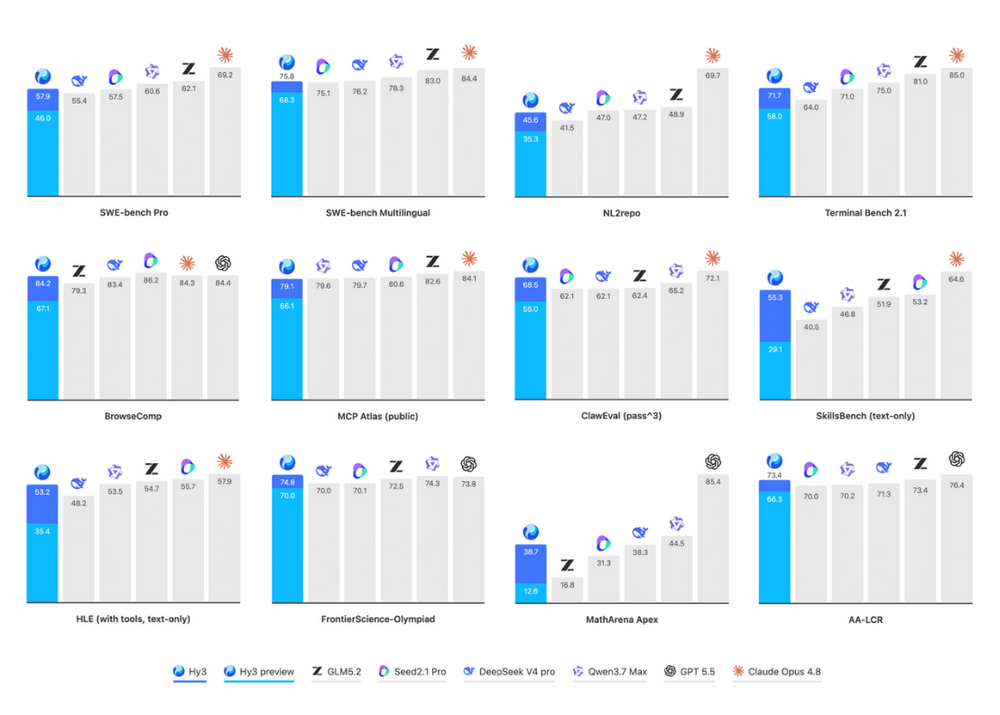
It should be noted that Hy3 also exhibits some specialization bias, with its strengths concentrated in search-oriented agent scenarios. On BrowseComp (an AI model benchmark), it scored 84.2—nearly on par with GPT-5.5’s 84.4—and its performance at the agent execution level is similarly commendable.
However, in complex reasoning and hardcore coding—areas that define the upper limits of large model capabilities—Hy3 falls slightly short. For instance, it scored 57.9 on SWE-bench Pro (an AI programming benchmark), trailing behind Claude Opus 4.8’s 69.2 and Qwen’s 60.6; on MathArena Apex (a mathematical reasoning benchmark), it scored 38.7—less than half of GPT-5.5’s score and also behind Qwen’s 44.5.
Although somewhat specialized, industry consensus on Tier-1 status is not based on who is more versatile, but rather on who occupies an indispensable position in core domains. Hy3’s leadership in search agents and agent execution is sufficient to qualify it for Tier-1 standing.
▎Yao Shunyu’s Six Months: How Tencent AI Moved from 'Memorizing Answers' to 'Taking a Seat at the Table'
To understand why Hy3 has secured its place in line, one must first grasp how this model came into being.
In December 2025, 28-year-old Yao Shunyu joined Tencent as Chief AI Scientist of the Office of the CEO/President. At that time, HunYuan—the AI initiative he took over—was not even seated at the main table within Tencent. At Tencent’s internal annual meeting in January 2026, Liu Chiping reviewed HunYuan’s prior development challenges, using a vivid analogy: 'Like a high school student cramming answers for exams—grades look good on paper, but performance collapses under real test conditions.'
Upon assuming his role, Yao Shunyu’s first priority was not rushing to release a new model, but rather starting from scratch.
At the end of January 2026, HunYuan launched a comprehensive overhaul of its foundational infrastructure, including rebuilding pre-training pipelines, reinforcement learning frameworks, data systems, and evaluation methodologies. His guiding philosophy was Co-design: training and deployment occur in parallel, with product feedback driving iterative model improvements. In March, Tencent officially dissolved its decade-old AI Lab, consolidating its core R&D resources into the HunYuan initiative.
From the infrastructure rebuild initiated at the end of January to the preview release of Hy3 on April 23 and its official launch on July 6, HunYuan completed the full cycle—from foundational reconstruction to product-driven iteration—in less than six months. On social media, Yao Shunyu noted that the leap from Hy2 to Hy3 preview and then to Hy3 represented yet another massive stride achieved within half a year.
Notably, according to media reports, Tencent is set to welcome Tian Yonglong, a former OpenAI research scientist and Yao Shunyu’s former colleague at OpenAI, as the new head of HunYuan’s multimodal modeling team. His arrival signals that Tencent is finalizing the last critical piece of its multimodal capabilities.
Tencent has never lacked entry points or application scenarios; what it truly lacked was a central model capable of powering these access points. The emergence of Hy3 signifies that this core capability gap has now been filled—but simultaneously, new challenges have arisen.
Hy3’s cost-performance strategy is now facing dual pressure: from above, leading large models continue to slash prices; from below, vendors such as DeepSeek, Alibaba, Zhipu AI, and Xiaomi are rolling out models with lower costs and stronger reasoning capabilities. How long Hy3’s price advantage can endure in today’s market remains to be seen.
Moreover, industry consensus holds that Tencent’s strongest asset in AI is WeChat—with 1.4 billion monthly active users and the richest array of use cases and data across all sectors. However, the issue is that WeChat data is subject to privacy protections and cannot be directly used for model training. In other words, Tencent possesses the industry’s most extensive context, yet it faces significant challenges in effectively integrating it into the model training loop.
At this stage, Yao Shunyu has established Tencent AI’s initial identity as one that is diligently refining its foundational models, and Hy3 has finally provided Tencent AI with a verifiable interim achievement. Yet, having returned to the table, whether it can secure its position and mount a comeback remains to be seen.
Editor/KOKO