As the HBM market leader with a share exceeding 56%, SK Hynix's U.S. listing is seen as a 'referendum' on the sustainability of AI demand. Despite significant volatility in its underlying shares and limited arbitrage conversion, institutional investors expect its ADRs to trade at a 5% to 30% premium over its Korean-listed shares, given its notably lower valuation compared to U.S.-listed peers, making it a new barometer for Wall Street’s ongoing debate over AI valuations.
$SK hynix (SKHY.US)$ American Depositary Receipts (ADRs) listed on Nasdaq on Friday, in what is the largest-ever U.S. equity offering by a foreign company, are becoming a litmus test for Wall Street's enthusiasm for AI-related investments.
As previously reported by Wall Street Insights, SK Hynix priced its ADRs at $149 per share—representing a premium of approximately 3.1% over the closing price of its Seoul-listed ordinary shares on Thursday—and raised around $26.5 billion, surpassing Alibaba’s record-setting $25 billion U.S. IPO in 2014. Institutional demand exceeded seven times the offering size, with buyers including major global long-only funds and sovereign wealth funds, underscoring exceptionally strong market interest. The ADRs will begin pre-launch trading under the ticker symbol "SKHYV" on Friday and officially list under "SKHY" on July 13.
 However, the true focal point of this offering lies not in its fundraising scale but in the premium the ADRs command over their Korean-listed counterparts post-listing—a metric that will directly reflect how much extra U.S. investors are willing to pay for a core player in the AI memory segment. Institutional estimates for this premium vary widely, ranging from 5% to over 30%, and the ongoing debate over AI sector valuations is expected to find partial resolution through the pricing of this new tradable instrument.
Bill Birmingham, Managing Director at REX Financial, noted that the listing essentially serves as a 'referendum' on three key questions: how long the memory shortage will persist, whether AI-driven demand is sustainable, and whether a U.S. listing can finally settle the market’s disagreement over the appropriate valuation range for memory stocks.
Largest-ever U.S. equity offering by a foreign company now complete
The ADR offering comprises 177.9 million units, raising approximately $26.5 billion and breaking the decade-long record held by Alibaba. SK Hynix is South Korea’s second-largest company by market capitalization, trailing only Samsung Electronics, with a market value of roughly $1 trillion on the Seoul exchange. According to the Financial Times, the ADR issuance represents less than 3% of the company’s total market capitalization.
SK Group Chairman Chey Tae-won personally traveled to New York to attend the listing ceremony and will meet with global investors to discuss expanding AI memory collaborations with key clients. Reports indicate he may also hold meetings with executives from NVIDIA and Tesla. SK Hynix stated that the U.S. listing aims to secure a valuation in global capital markets that better reflects the company’s pivotal role in AI infrastructure.
The offering was jointly led by Bank of America, Citigroup, Goldman Sachs, and JPMorgan, with nine additional institutions participating in the underwriting syndicate.
Leadership in HBM fuels investor enthusiasm
SK Hynix holds a unique position in AI-related memory chips, which forms the core rationale attracting U.S. capital.
According to the company's filings with the U.S. Securities and Exchange Commission (SEC), SK Hynix holds a 56.4% market share in high-bandwidth memory (HBM) chips, a critical component essential to high-end AI chips such as NVIDIA GPUs. Shay Boloor, Chief Market Strategist at Futurum Equities, stated that SK Hynix is 'the purest publicly traded proxy for the HBM bottleneck, with deeper business integration with NVIDIA than its competitors,' and that 'its HBM purity exceeds Samsung’s, and its current leadership in HBM surpasses Micron Technology.'
David Fetherstonhaugh, Investment Strategist at VistaShares, noted that this listing 'is clearly a positive signal for U.S. and global funds that previously could only gain indirect exposure to SK Hynix through proxy instruments.' He also projected that initial capital flows from ETFs and other proxy vehicles into the ADR could exert short-term pricing pressure.
From a fundamental perspective, SK Hynix and Samsung trade at a discount in Seoul compared to their U.S. peers. According to Visible Alpha data, Micron Technology trades at an estimated forward price-to-earnings ratio of approximately 6x for 2028, while both SK Hynix and Samsung trade at just 4x. U.S. investors may view part of this discount as an entry opportunity, potentially driving a premium for the ADR relative to the Korean-listed shares.
The magnitude of the premium remains the biggest uncertainty, with institutional expectations diverging significantly.
The appropriate range for the ADR's first-day premium is the focal point of the most intense market debate.
According to a memo obtained by Bloomberg and distributed to institutional clients, Morgan Stanley’s sales and trading desk estimates an initial premium range of 5% to 10%, noting that inclusion of the ADR in U.S. indices or ETFs could further expand the premium. However, some institutional investors hold more aggressive expectations, anticipating premiums exceeding 30%.
Independent analyst Travis Lundy, who publishes research on Smartkarma, stated:
"Until the ADR undergoes sufficient market calibration, no one can know precisely how much this premium is worth on any given day. History shows that premiums can rise, but they do not remain at extremely elevated levels over the long term."
Taiwan Semiconductor’s ADR offers the most relevant historical precedent. According to research by Goldman Sachs analysts, ADRs typically trade within a 5% spread of their underlying shares under normal conditions. However, Bloomberg data shows that Taiwan Semiconductor’s ADR has averaged a premium of approximately 16% over the past month and has exceeded 20% multiple times over the past three years. The Financial Times noted that this premium peaked during the smartphone demand surge in 2009 before narrowing to zero two years later. SK Hynix lacks Taiwan Semiconductor’s decades-long ADR trading history as a reference, making pricing considerably more challenging.
Arbitrage trading faces high barriers, and the conversion mechanism is subject to asymmetric constraints.
Compared with Taiwan Semiconductor, arbitrage trades involving SK Hynix ADRs face a more complex operational environment.
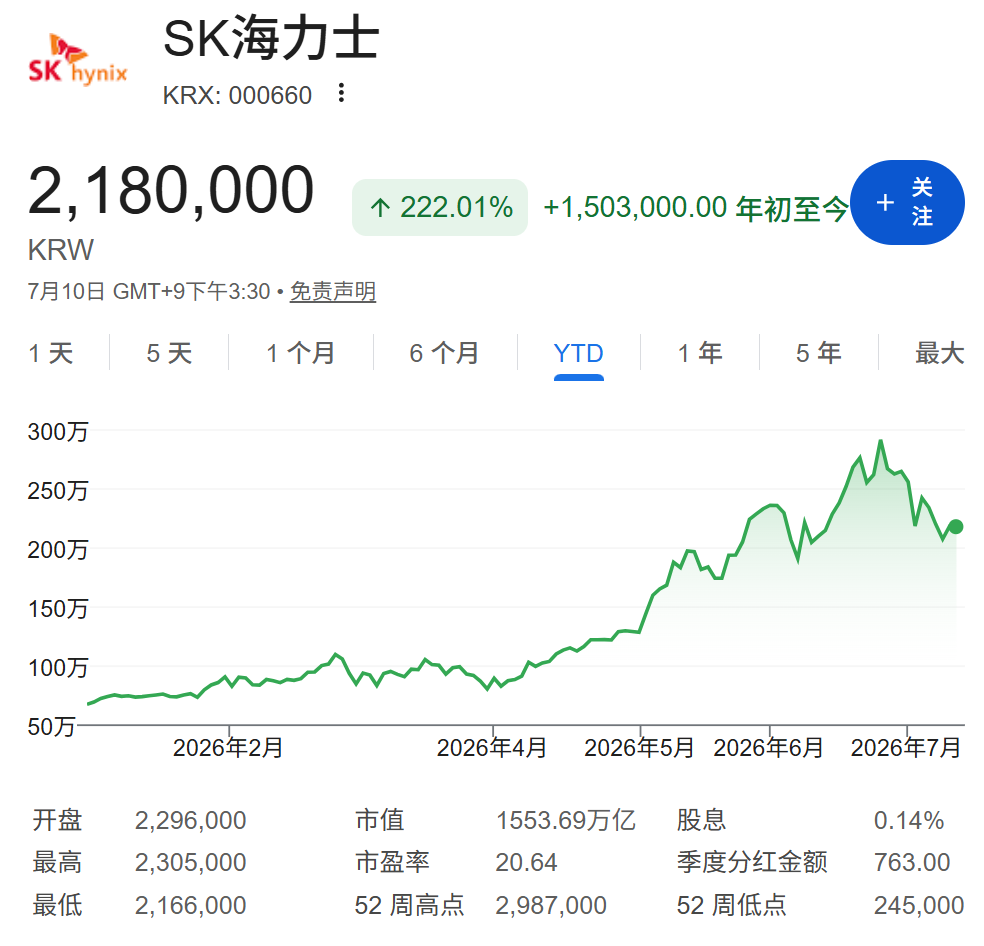
SK Hynix’s underlying shares have exhibited extreme volatility. Data show that the stock has experienced more than 50 trading days this year with daily price swings exceeding 5%. Despite this, it has still posted a year-to-date gain of over 200%. Alex Au, Managing Director at Alphalex Capital Management HK Ltd. in Hong Kong, who has engaged in Taiwan Semiconductor ADR spread trading for many years, stated:
"Given SK Hynix’s volatility, the spread risk is significantly higher. Therefore, traders seeking to capture the premium need a higher return to compensate for that risk."
Asymmetry in the conversion mechanism further constrains arbitrage opportunities. According to a filing dated July 6, ADR holders may cancel their ADRs and receive Seoul-listed shares in exchange, but the reverse—converting ordinary shares into ADRs—may require approval from Korean regulators and is not seamless. This mechanism differs from that of Taiwan Semiconductor ADRs, limiting the feasibility of two-way arbitrage.
However, Bill Birmingham, Managing Director at REX Financial, noted that the core significance of this listing lies not in price discovery, but rather serves as a kind of 'referendum' on three key questions: how long the memory shortage will persist, whether AI-driven demand is sustainable, and whether a U.S. listing can finally resolve market debates over the fair valuation range for memory stocks.
Behind the Listing: The Capital Logic of AI Investment Expansion
The proceeds from this U.S. listing will be directly allocated to SK Hynix’s extensive capital expenditure plan related to AI.
The company is currently constructing an advanced chip packaging facility in West Lafayette, Indiana, a project supported by $458 million in funding from the Biden administration under the CHIPS and Science Act. Meanwhile, SK Hynix and Samsung Electronics are aligning with the South Korean government’s national investment initiative—totaling approximately $880 billion—to ramp up domestic investments in AI and semiconductor industries.
Despite robust AI demand, the inherent cyclicality of the memory industry remains a key risk factor for investors to weigh. Boloor stated that SK Hynix stands to benefit the most if HBM scarcity persists longer than expected, but should the memory cycle eventually turn, the downside risk cannot be ignored—though such a reversal may not occur until as early as 2028. Birmingham advised investors to closely monitor contract pricing trends in 2027 to assess the sustainability of demand.
SK Hynix’s U.S.-listed shares may serve as a better gauge of the AI boom’s intensity than as a standalone investment vehicle.
Editor/lambor