
Japan’s Finance Minister urged the $1.8 trillion Government Pension Investment Fund (GPIF) to increase its holdings of domestic assets, prompting an immediate rally in the yen and Japanese government bonds, though the trillion-dollar behemoth is unlikely to pivot significantly in the short term.
Zhitong Finance APP learned that Japanese Finance Minister Satsuki Katayama stated at a regular press conference on Friday (July 10) that the government will implement policies to encourage pension funds—including the Government Pension Investment Fund (GPIF), one of the world’s largest pension funds—to increase their investments in domestic Japanese financial assets.
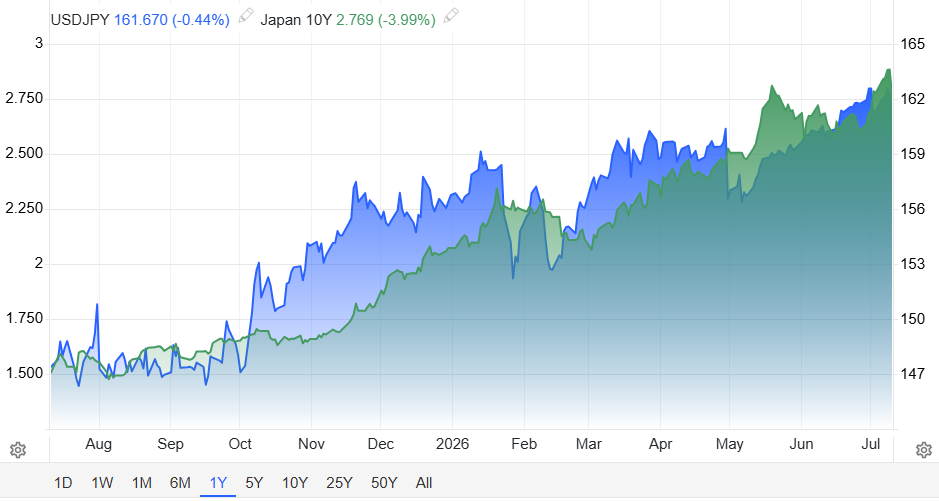
Katayama’s remarks immediately triggered a market chain reaction: the yen strengthened against the U.S. dollar from 162.43 to as high as 161.29, gaining 0.7%; the yield on the benchmark 10-year Japanese government bond fell by approximately 10 basis points; and the Nikkei 225 index rose as much as 2.4%. Yugo Tsuboi, Chief Strategist at Daiwa Securities, remarked bluntly that Katayama’s statement could drive a 'triple rally' in Japanese equities, bonds, and the yen.
 Yet beneath this market euphoria lies a more fundamental issue that has been overlooked: this 'trillion-yen whale,' which manages ¥293.6 trillion (approximately USD 1.8 trillion), is virtually incapable of making significant asset allocation adjustments before at least 2030.
Katayama’s 'Triple Agenda': The Yen, JGBs, and Fiscal Credibility
Katayama’s statement was not an isolated event but rather a calculated 'three-birds-with-one-stone' strategy driven by multiple pressures.
The first pressure stems from the yen. Last week, the yen weakened to 162.84 against the U.S. dollar, hitting a nearly 40-year low since 1986. By urging GPIF to increase its holdings of domestic assets at this juncture, Katayama is effectively attempting to provide structural support for the yen through capital repatriation. David Forrester, Senior Strategist at Crédit Agricole, noted that Katayama is addressing the structural causes of yen weakness through nuanced messaging—not by emphasizing potential foreign exchange intervention, but by tackling deeper issues such as ultra-loose monetary policy, concerns over fiscal sustainability, and persistent current account outflows.
The second pressure comes from Japanese government bonds (JGBs). Since the beginning of this year, the yield on the 10-year JGB has continued to rise, approaching a 29-year high of 2.81% just before her Friday remarks. Market concerns over Prime Minister Hayato Takano’s expansionary fiscal policy, coupled with fears of potential political interference in monetary policy, have fueled sustained selling of JGBs. Abhijit Surya, Analyst at Capital Economics, pointed out that Katayama’s comments may help moderate the recent surge in bond yields, but they are 'by no means a panacea.'
The third pressure concerns fiscal credibility. In her statement, Katayama also pledged to ensure market confidence by reducing the debt-to-GDP ratio. Masahiro Ichikawa, Chief Market Strategist at Sumitomo Mitsui DS Asset Management, remarked that if allocations to foreign equities and foreign bonds are reduced, it would naturally ease downward pressure on the yen while providing support to the bond market.
To alleviate market concerns about government interference in monetary policy, Economic and Fiscal Policy Minister Minoru Mori explicitly stated on Friday that the government 'will absolutely not communicate in advance any views regarding the timing or magnitude of interest rate hikes or cuts to the Bank of Japan.'
GPIF’s 'Iron Rule': Portfolio Reviews Every Five Years, with Overseas Assets Maintaining Dominance
Although Katayama's remarks triggered a strong market reaction, GPIF has extremely limited room for actual adjustment.
GPIF’s asset allocation framework is subject to a strict statutory cyclical review. The fund conducts a strategic asset allocation review every five years. The most recent review was completed in 2025, establishing the allocation for fiscal years 2025–2029 at 25% each for Japanese equities, foreign equities, Japanese bonds, and foreign bonds. The next scheduled review is set for 2030. GPIF’s allocation principles and return objectives are formulated by the Ministry of Health, Labour and Welfare, with adjustments made every five years based on assessments of economic conditions, interest rates, demographic trends, and global market shocks.
Overseas assets have consistently outperformed domestic assets over the long term. Over the past decade, both equities and fixed-income investments abroad have persistently delivered superior returns compared to their domestic counterparts. In the third quarter of 2025, GPIF reported a return of 11.0% on domestic equities versus 9.8% on foreign equities. During its previous review in 2020, GPIF rationally adjusted its portfolio to maximize returns by increasing its foreign bond allocation from 15% to 25% while reducing its domestic bond allocation from 35% to 25%.
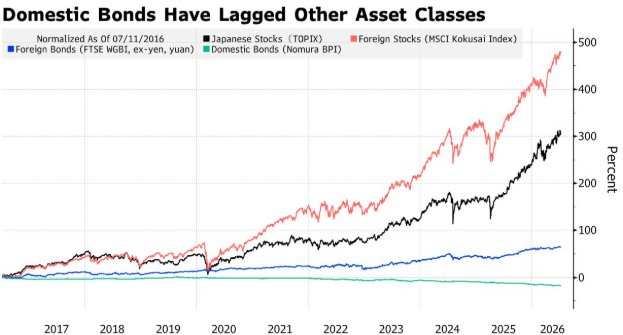
GPIF’s statutory mandate is ‘to maximize long-term returns for pension beneficiaries,’ and any increase in domestic investments must be grounded in investment considerations rather than policy objectives. Koji Takeuchi, Senior Research Fellow at Itochu Economic Research Institute, stated plainly: ‘Changing the strategic asset allocation faces very high barriers. The portfolio was established within a legal framework and informed by external expert advice, making it difficult to revise.’
A spokesperson for GPIF said the fund had taken note of Kataoka’s remarks but declined to comment further.
Historical Precedents and Global Context: The Government Is Not Without Leverage
Despite GPIF’s formidable institutional constraints, history shows that the government is not entirely without means to exert influence.
In 2014, former Prime Minister Shinzo Abe successfully pushed GPIF to abandon its traditional emphasis on Japanese government bonds by reshuffling the fund’s management, expanding the board’s composition, and appointing its first full-time commissioners. This led to an increase in the domestic equity allocation from 12% to 25%, while domestic bonds were reduced from 60% to 25%. The entire process—from Abe taking office to GPIF implementing the revised asset allocation—took nearly two years.
From an international perspective, government efforts to steer pension funds toward greater domestic investment are not unprecedented. In 2024, the Canadian government eliminated the rule capping pension fund holdings in Canadian entities at 30% to encourage large-scale domestic investment. In May 2026, South Korea’s National Pension Service significantly raised its target allocation to domestic equities from 14.9% to 20.8% by the end of 2026.
These cases demonstrate that governments can influence pension funds through administrative measures, though such interventions typically require considerable time and a specific political window of opportunity.
Outlook: Easy to Announce, Hard to Execute
Kataoka Satsuki’s statement was, in essence, a carefully orchestrated exercise in policy expectation management—she sought to simultaneously reassure the foreign exchange and bond markets by signaling a potential shift from GPIF, the 'trillion-dollar whale,' without actually deploying scarce foreign exchange reserves or incurring the political costs of direct intervention.
However, this strategy faces two fundamental contradictions: First, GPIF’s institutional inertia far outweighs political rhetoric. Until its next strategic review in 2030, GPIF is unlikely to make any significant asset allocation changes. Kataoka’s remarks were more of a 'signal' than an 'action.' Second, the return advantage of overseas assets is hard to ignore. As long as foreign equities and bonds continue to deliver superior long-term returns compared to domestic assets, GPIF will find it difficult—within its fiduciary duty framework—to substantially pivot toward domestic allocations.
For the yen and Japanese government bonds (JGBs), Kataoka’s comments provided a brief sentiment boost but cannot resolve the underlying structural imbalances. As Surya of Capital Economics noted, this is 'certainly no panacea.' The trillion-dollar whale’s genuine reallocation may not occur until 2030—and until then, markets will likely continue to fluctuate amid the gap between expectations and reality.
Market View: The Gap Between Short-Term Expectations and Reality
Although Kataoka’s remarks have already triggered a strong market reaction, most analysts believe GPIF is unlikely to execute a meaningful reallocation in the near term.
Philip McNicholas, Asia Sovereign Strategist at Robeco in Singapore, stated that Kataoka’s comments are broadly positive for the yen and domestic assets; if GPIF increases its allocation to domestic assets, it could further support the yield curve beyond the 10-year horizon.
However, Surya of Capital Economics warned that GPIF cannot arbitrarily expand its balance sheet. The fund’s domestic bond portfolio is primarily passively managed, and shifting significantly into bonds would require selling equities—a move that would entail substantial fiscal costs. Even if short-term pressures on the JGB market ease, concerns could quickly resurface that Finance Minister Hayashi’s verbal interventions to maintain low rates might cause the Bank of Japan to fall behind the curve.
Editor/Deng