U.S. forces conducted airstrikes on Iran for the third consecutive night. Trump warned that the U.S. would strike Iran’s most hardened underground nuclear facility, 'Fordow,' while also telling the media that 'a deal is still possible.' The Islamic Revolutionary Guard Corps has retaliated by attacking U.S. military bases, and Houthi forces have launched missiles at Saudi Arabia, bringing a four-year truce to an end.
The United States launched airstrikes against Iran for the third consecutive night, following President Trump’s announcement of a multi-day wave of attacks.
U.S. Central Command stated in a social media post that at 4:45 p.m. Eastern Time on July 13 (00:15 Iran time on July 14; 04:45 Beijing time), acting on President Trump’s orders, U.S. forces initiated their third consecutive night of strikes against Iran. The statement added that these operations would 'maintain continuous pressure, inflict severe damage on Iranian military capabilities, and degrade Iran’s ability to attack innocent civilians and commercial vessels in the Strait of Hormuz.'
 Trump told a radio host that the U.S. would strike Iran 'very hard' on Monday and Tuesday, adding, 'and there’s nothing they can do about it.' Shortly before the Monday airstrikes began, Trump further announced that the U.S. would target 'Pickaxe Mountain'—a hardened underground nuclear facility that had not been attacked since the outbreak of war on February 28.
Trump said, 'We’re going to destroy Pickaxe Mountain—tell the Iranians to get ready.' He added that the U.S. had been closely monitoring the site: 'There’s no activity there right now. Their nuclear program isn’t going well. Every time we detect anything related to it, we blow it up. We might strike Pickaxe Mountain very soon.'
It is understood that Pickaxe Mountain is located near Iran’s Natanz uranium enrichment facility and contains two deeply buried tunnel complexes. It is considered one of Iran’s most fortified underground nuclear sites—so robust that it may even withstand strikes from the most powerful bunker-busting bombs currently in the U.S. arsenal.
Nevertheless, Trump still believes a deal with Iran is possible. On July 13 local time, he told reporters at the White House that he continues to believe an agreement between the U.S. and Iran remains achievable, stating, 'Iran wants a deal and has re-engaged with the U.S.' Trump also said U.S. forces would continue conducting intense strikes against Iran to significantly degrade its ability to disrupt navigation through the Strait of Hormuz, while simultaneously reinstating a 'blockade targeting Iran exclusively,' under which any vessel conducting business with Iran would be barred from passage, while other countries’ vessels could continue normal transit.
U.S. officials stated that these attacks are intended both to punish Tehran for its actions against shipping in the Strait and to pressure the regime back to the negotiating table. While few believe Trump is seeking a return to full-scale war, The Wall Street Journal previously reported that he had received briefings on what a resumption of such a level of combat might entail.
On Monday, the White House sent Congress a letter dated July 10, stating that the U.S. had resumed a state of hostilities with Iran as of July 7, thereby reactivating a 60-day window during which the U.S. may initiate military action against Iran without congressional approval.
In a letter to Senate President pro tempore Chuck Grassley of Iowa, Trump wrote: 'I am acting pursuant to my constitutional authority as Commander-in-Chief and Chief Executive to conduct the foreign relations of the United States.'
Earlier that day, Trump announced on social media that the U.S., as the 'new guardian' of the Strait of Hormuz, would impose a 20% fee on all cargo transiting the waterway. Critics argued this move would violate decades of U.S. support for freedom of navigation and uninterrupted trade on the high seas. It would also contradict prior statements by senior officials—including Secretary of State Rubio and U.S. Ambassador to the United Nations Mike Waltz—who have emphasized that charging tolls on international waters violates international law.
On the 13th local time, the Joint Maritime Information Center (JMIC), led by the U.S. Navy, announced that U.S. military forces will commence a naval blockade of all Iranian ports and coastal areas effective at 20:00 GMT on July 14 (04:00 Beijing time on July 15). The blockade applies to all vessels, regardless of flag state. It covers Iran’s entire coastline, including but not limited to all Iranian ports and oil terminals. The blockade will not impede transit passage through the Strait of Hormuz by neutral vessels traveling to or from non-Iranian destinations. Humanitarian cargo shipments will be permitted to pass, subject to inspection.
Iranian Foreign Minister Araghchi mocked Trump’s proposal to impose fees, writing on X: “Iran has always been the guardian of the Strait and will remain so forever. Twenty percent is certainly too much. We will be fair.” The United Nations maritime agency also rejected the proposal, stating that imposing mandatory tolls on transit through the Strait lacks legal basis.
At current oil prices, a 20% fee on a fully loaded very large crude carrier would amount to approximately USD 32 million—far exceeding the tolls previously charged by Iran, which sources indicated reached up to USD 2 million.
On Monday, Iran’s Islamic Revolutionary Guard Corps stated that in response to U.S. attacks, it had struck U.S. military facilities in Bahrain and Kuwait, destroyed Oman’s radar systems, and attacked fuel tanks and ammunition depots at Prince Hassan Air Base in Jordan.
Meanwhile, Yemen’s Houthi rebels accused Saudi Arabia of bombing an airport under their control and subsequently launched missiles at Saudi territory, breaking a four-year ceasefire agreement between Riyadh and the Iran-aligned group. According to AXIOS, U.S. officials revealed that Trump expressed support for Saudi Crown Prince Mohammed bin Salman’s unusually aggressive military action against the Houthi rebels in Yemen.
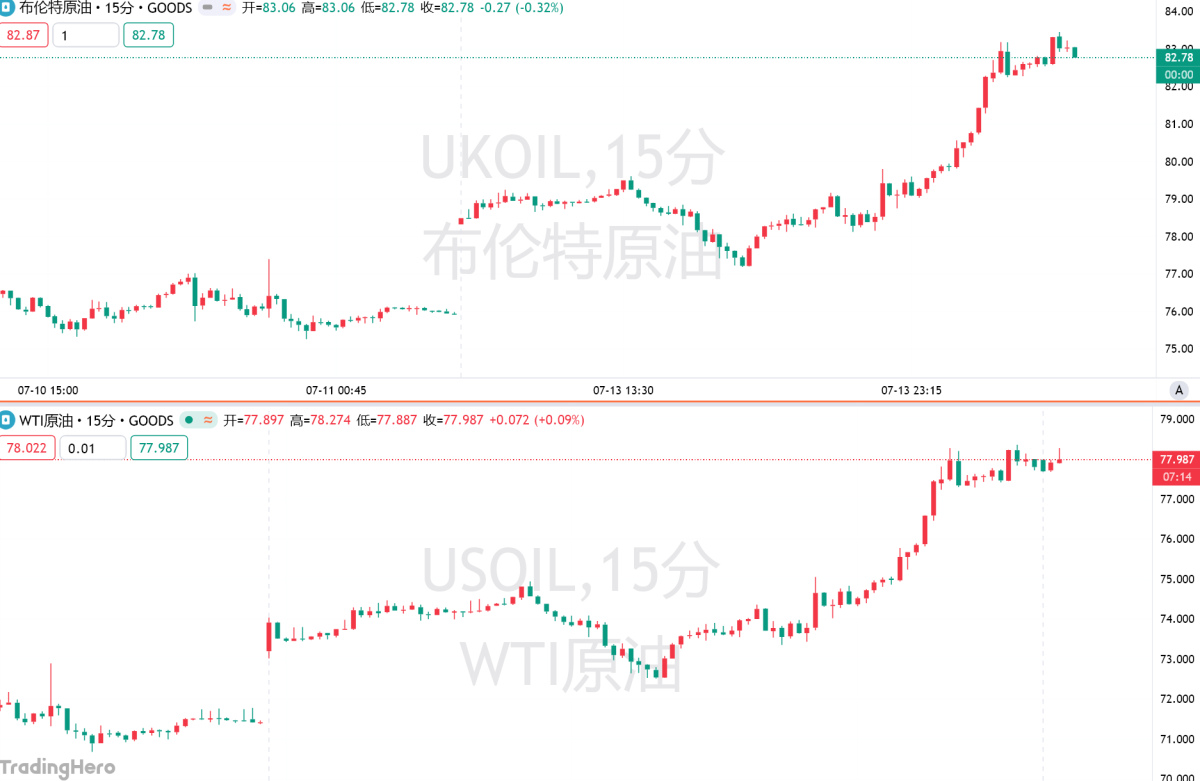
Oil prices rose more than 9% on Monday, with Brent crude futures posting their largest single-day dollar gain since April 2 and settling at their highest price since June 12.