
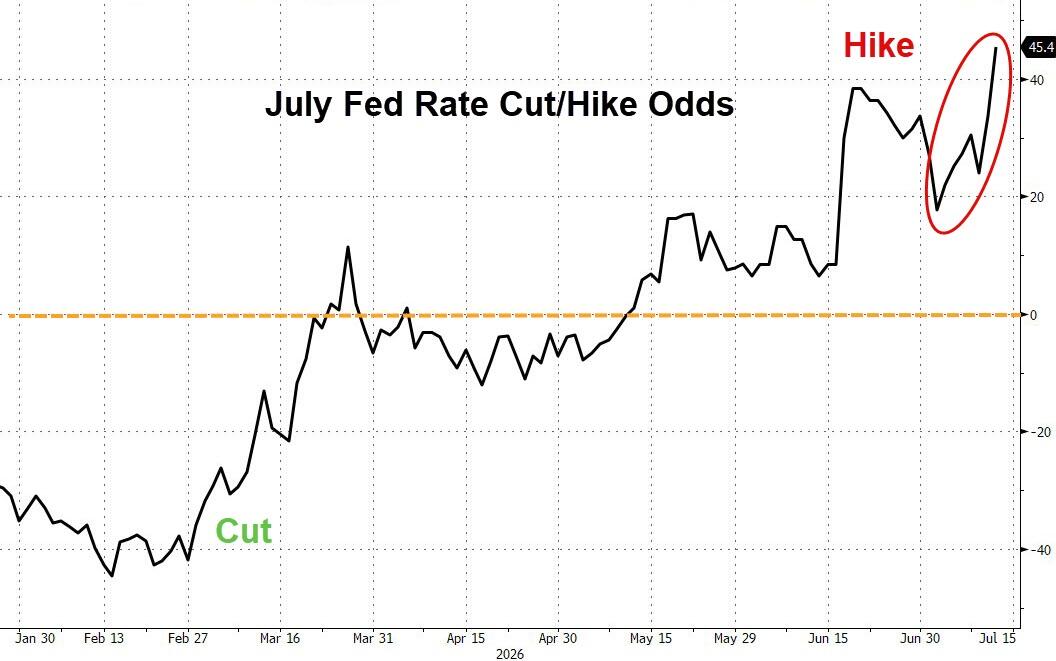
①Pricing in the interest rate swaps market shows that traders have significantly increased their bets on a 25-basis-point rate hike by the Federal Reserve in July, following a series of new U.S. strikes against Iran since the weekend. ②The latest pricing indicates that the probability of a Fed rate hike by the end of this month has risen to nearly 50%, up from less than 40% earlier.
This Monday, Wall Street’s betting on a rate hike by the Federal Reserve within the year reached its highest level since Waller took office…
Pricing in the interest rate swaps market shows that traders have significantly increased their bets on a 25-basis-point rate hike by the Federal Reserve in July, following a series of new U.S. strikes against Iran since the weekend. The latest pricing indicates that the probability of a Fed rate hike by the end of this month has risen to nearly 50%, up from less than 40% earlier on Monday.
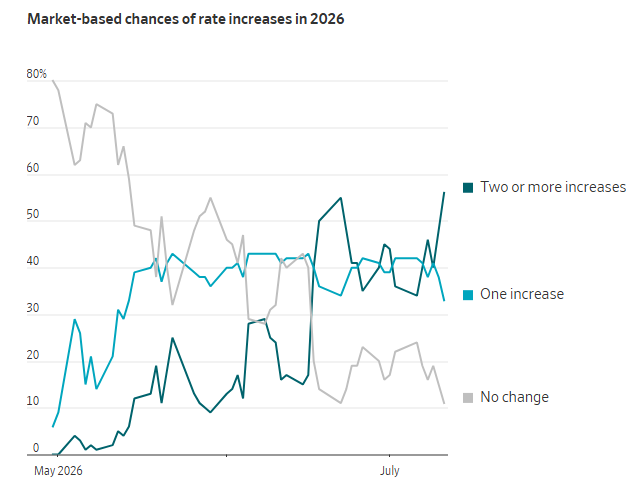
 Meanwhile, the likelihood of at least two rate hikes by the Federal Reserve before the end of this year has surged from 34% at the beginning of the month to 56%. This also means that two rate hikes have become the most probable interest rate scenario for the Fed this year.
Accompanying the sharp spike in rate hike probabilities overnight was another episode that once again put many Wall Street traders on edge—the crude oil, U.S. equity, and Treasury markets exhibited a high degree of correlation: a surge in oil prices occurred almost simultaneously with steep declines in U.S. stocks and bonds.
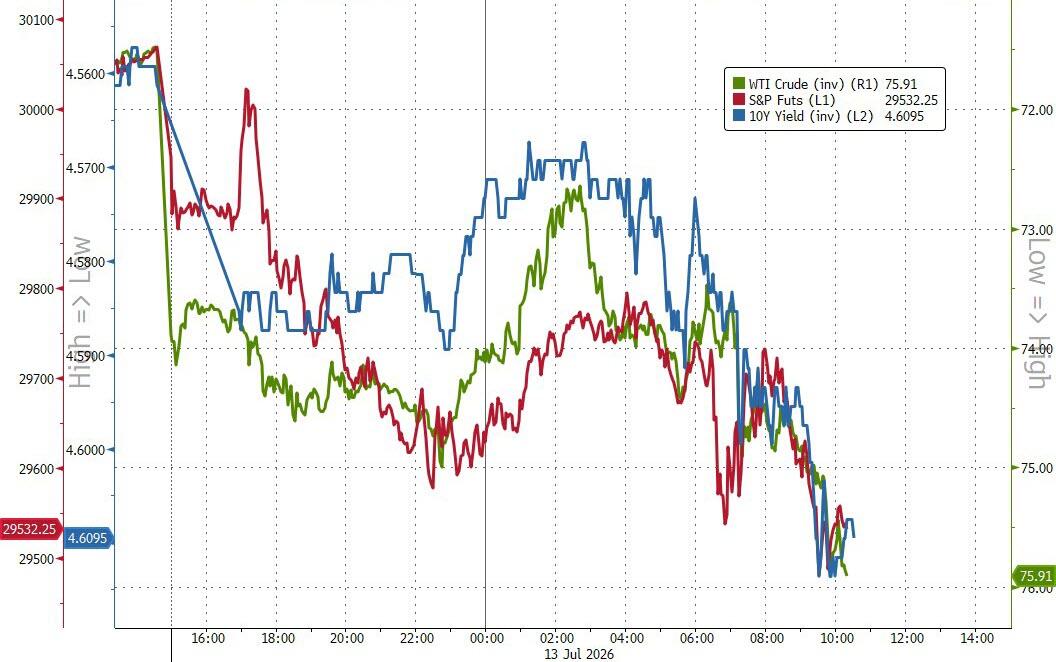
The well-known financial blog Zerohedge noted that, in short, Monday’s price action was primarily driven by three key factors:
The sharp escalation in tensions between Trump and Iran pushed up oil prices (as well as bond yields and the U.S. dollar); growing concerns over artificial intelligence-related capital expenditures (particularly fears surrounding hyperscale data center debt) triggered volatility in semiconductor and other AI-related sectors; and the markedly hawkish shift in stance by Federal Reserve Chair Waller—Waller is scheduled to testify before Congress on Tuesday—led to a sharp selloff in Bitcoin and gold prices.
In a sense, these three factors are deeply intertwined and collectively fueled market anxiety.
Surge in Oil Prices
Turning first to the crude oil market: oil prices jumped sharply on Monday after President Trump announced that the U.S. would reimpose a maritime blockade on Iran.
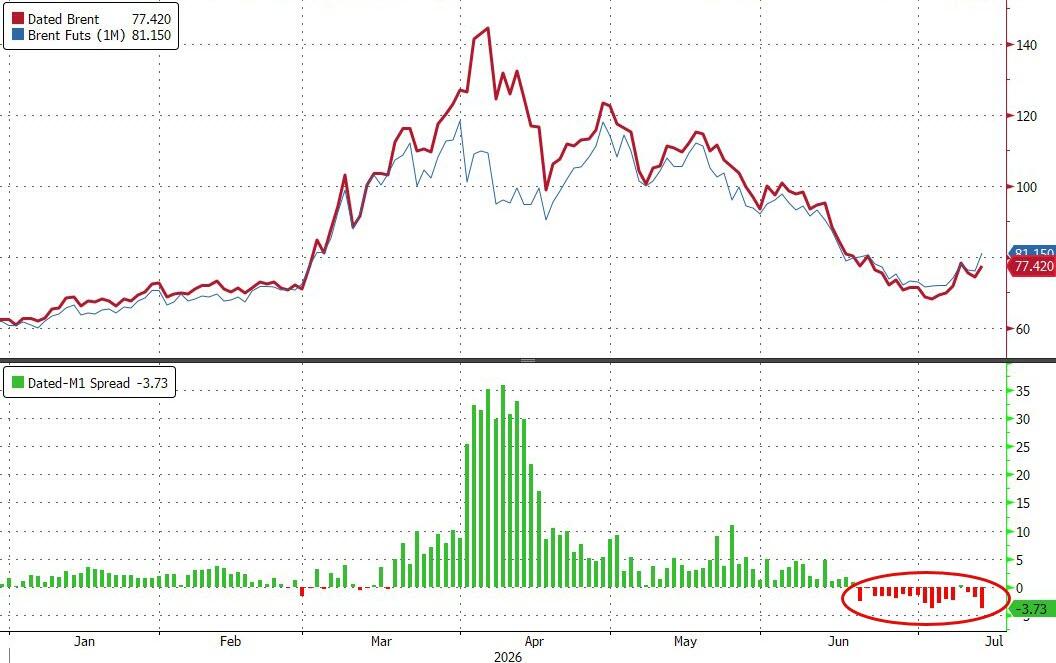
Brent crude futures rose 9.6% to settle at $83.30 per barrel, marking the international benchmark's largest single-day gain since May 2020. U.S. WTI crude futures also climbed 9.4%, closing at $78.14.
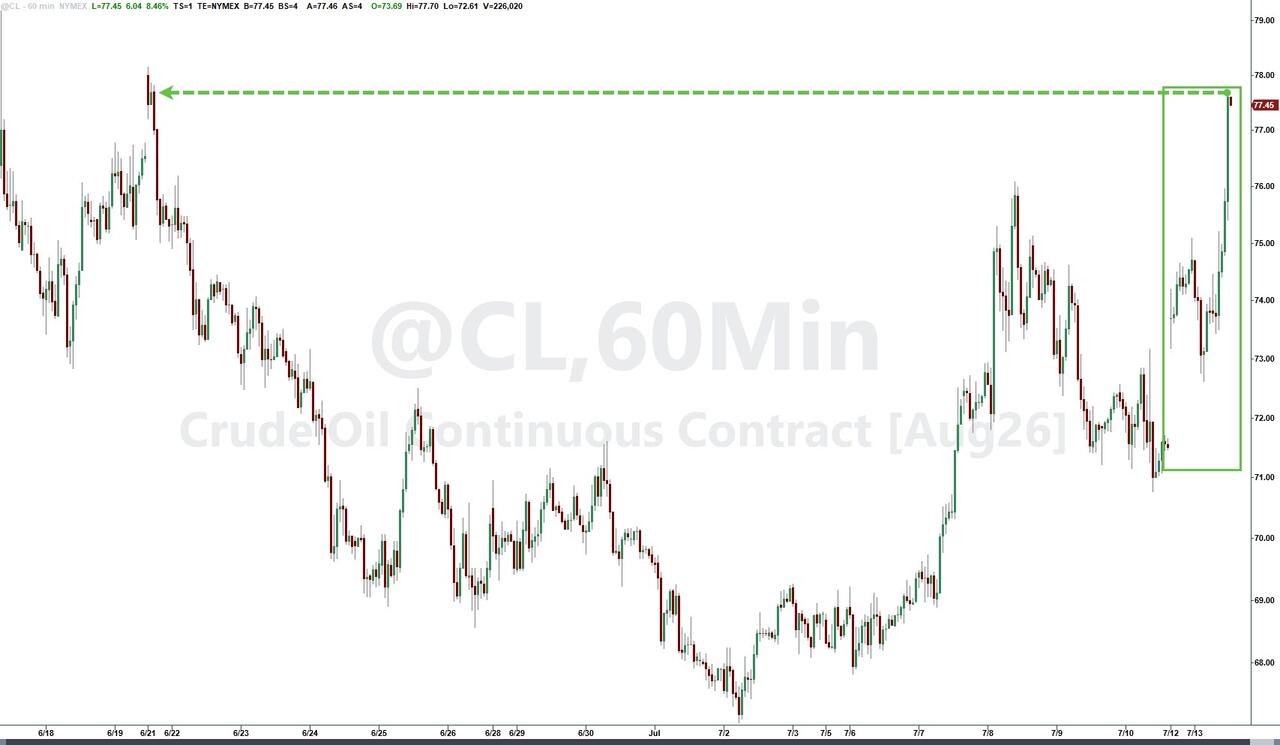
On July 13, U.S. President Trump posted on social media that the United States would reinstate its maritime blockade on Iran and impose a 20% fee on all cargo transiting through the Strait of Hormuz.
Additionally, according to U.S. Central Command, after striking 140 targets on Saturday, U.S. forces launched another wave of airstrikes against Iran on Sunday. These strikes were in response to an attack by Iran’s Islamic Revolutionary Guard Corps on a container ship transiting the Strait of Hormuz.
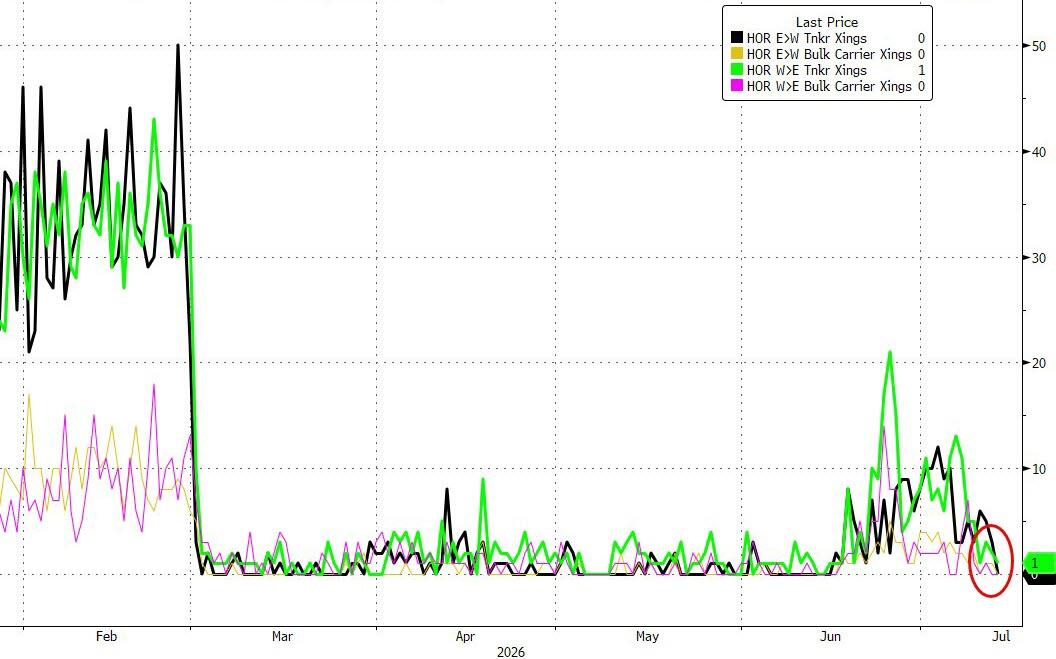
Clearly, the latest developments in the Strait of Hormuz have once again heightened anxiety among crude oil market traders. As industry analyst Michael McDonough recently tracked, commercial traffic through the strait plummeted to just three transits in the past 24 hours—one east-to-west and two west-to-east—down significantly from seven transits on Sunday, eleven on Saturday, and a recent peak of 57 transits on June 24.
As Brent crude futures surged sharply, the Brent prompt-month futures premium also soared on Monday to its highest level since December 2022.
The head of Goldman Sachs’ One-Delta division noted that the market’s central debate has shifted from whether the Strait of Hormuz is open or closed to determining whose authorization is required for transit.
Goldman Sachs believes that while the U.S. insists the waterway remains open, Iran asserts that vessels must use Iranian-controlled routes. Commercial operators are naturally reluctant to verify either party’s claims. From a policy perspective, Washington—not Tehran—is likely to remain the truly binding authority. Goldman Sachs’ base-case scenario remains an unstable compromise: de facto Iranian control over transit, with the U.S. adapting to on-the-ground realities and allowing traffic to gradually resume. This scenario assumes a Brent crude price range of $75–85 per barrel.
Equity, bond, and gold markets all suffered sharp losses.
In the bond market, escalating tensions involving Iran drove up oil prices, fueling speculation that the Federal Reserve might need to raise interest rates to contain inflation. Overnight, short-end U.S. Treasury yields jumped to their highest levels since early 2025.
By the close of the New York session, U.S. Treasury yields rose across the board. The 2-year yield increased by 7.77 basis points to 4.282%, the 5-year yield rose by 7.47 basis points to 4.376%, the 10-year yield climbed by 6.44 basis points to 4.622%, and the 30-year yield advanced by 4.85 basis points to 5.106%.
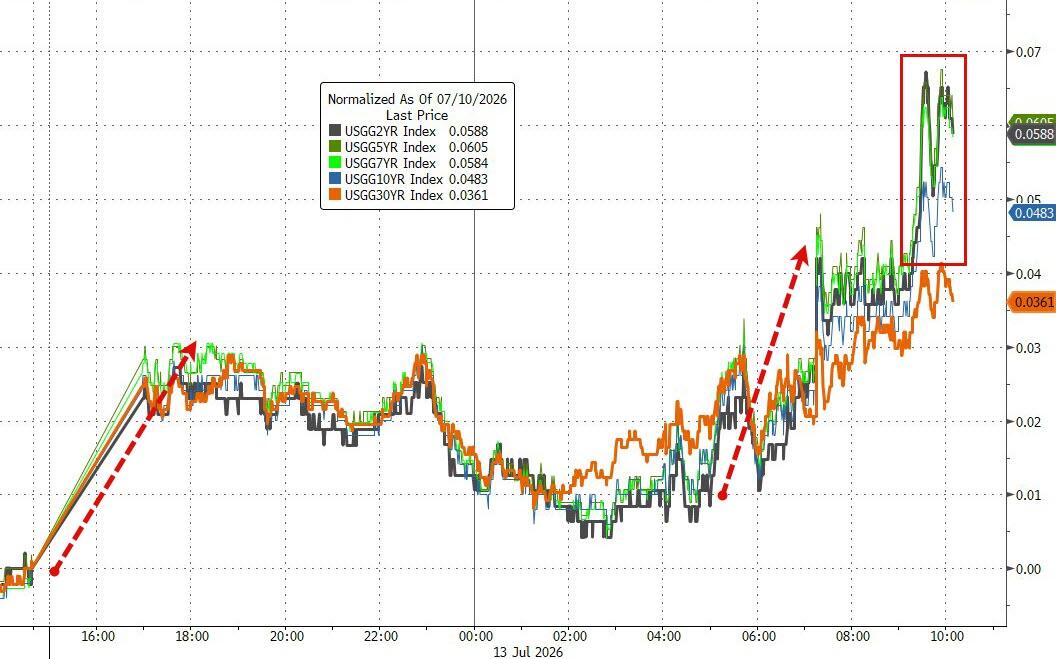
In addition to U.S.-Iran tensions and rising oil prices, hawkish remarks from Federal Reserve officials further intensified the sell-off in U.S. Treasuries on Monday. Fed Governor Christopher Waller stated that if underlying inflation continues to show broad-based price pressures, policymakers may need to raise interest rates.
Ian Lyngen, Head of U.S. Rates Strategy at BMO Capital Markets, noted that the 2-year U.S. Treasury note—the maturity most closely tied to Fed rate expectations—is continuing to weaken, with investors still focused on the Federal Reserve’s policy decision on July 29, which they view as a potential timing for the first rate hike under Kevin Warsh.
These concerns also ended the S&P 500’s winning streak, as the index faced downward pressure at the start of the week due to a sharp decline in semiconductor stocks. As of Monday’s close, the Dow Jones Industrial Average fell 138.37 points, or 0.26%, to 52,498.64; the Nasdaq Composite dropped 408.43 points, or 1.55%, to 25,873.18; and the S&P 500 declined 60.05 points, or 0.79%, to 7,515.34.
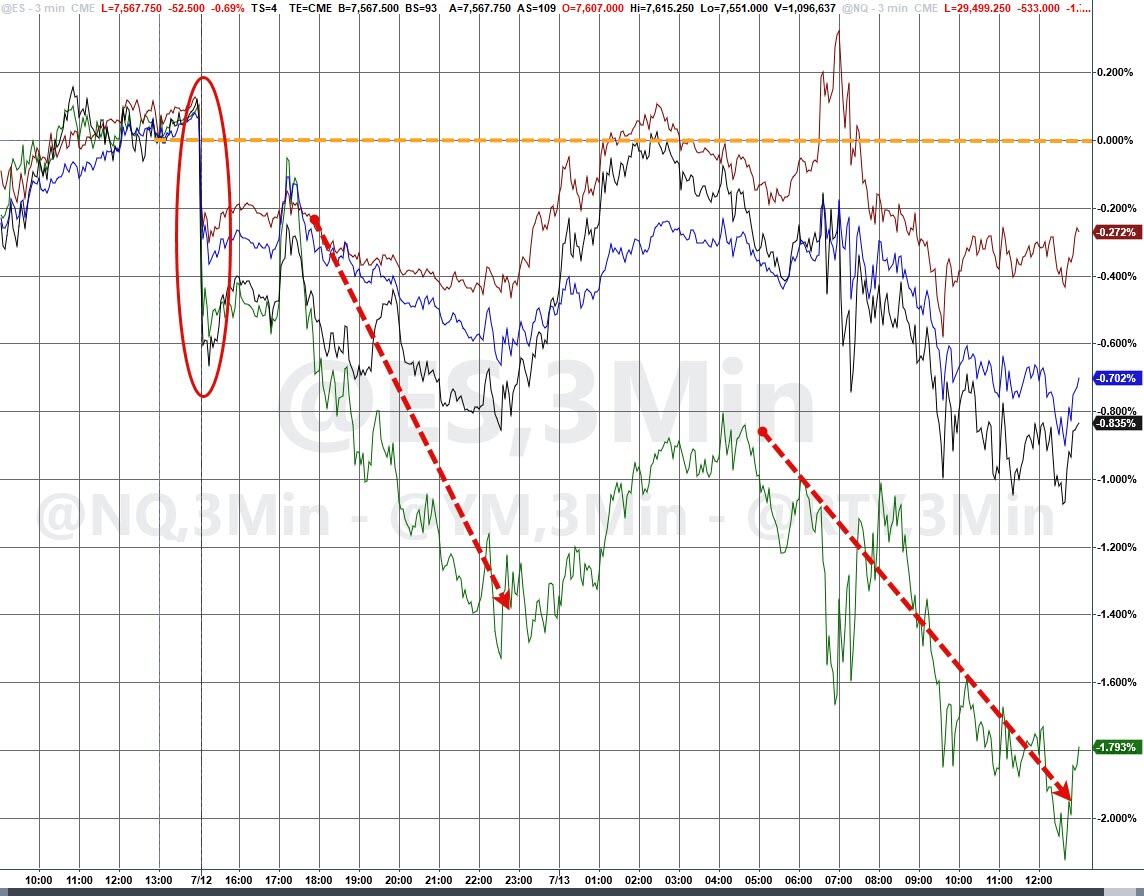
Paul Christopher, Global Investment Strategist at Wells Fargo Investment Institute, said, 'As global interest rates rise, investors are questioning the sustainability of technology-related spending, and valuations of certain tech and artificial intelligence–related companies are once again under scrutiny. We are seeing the market differentiate between beneficiaries and spenders of artificial intelligence.'
'Tensions in the Strait of Hormuz have once again become a focal point for global markets, with the energy sector currently driving price action across global markets,' said Ian Lyngen of BMO Capital Markets. 'There is a growing sense that the situation could deteriorate further before it improves.'
The precious metals market also suffered heavy losses on Monday. Spot gold prices overnight fell once again below the critical $4,000 'Maginot Line'...
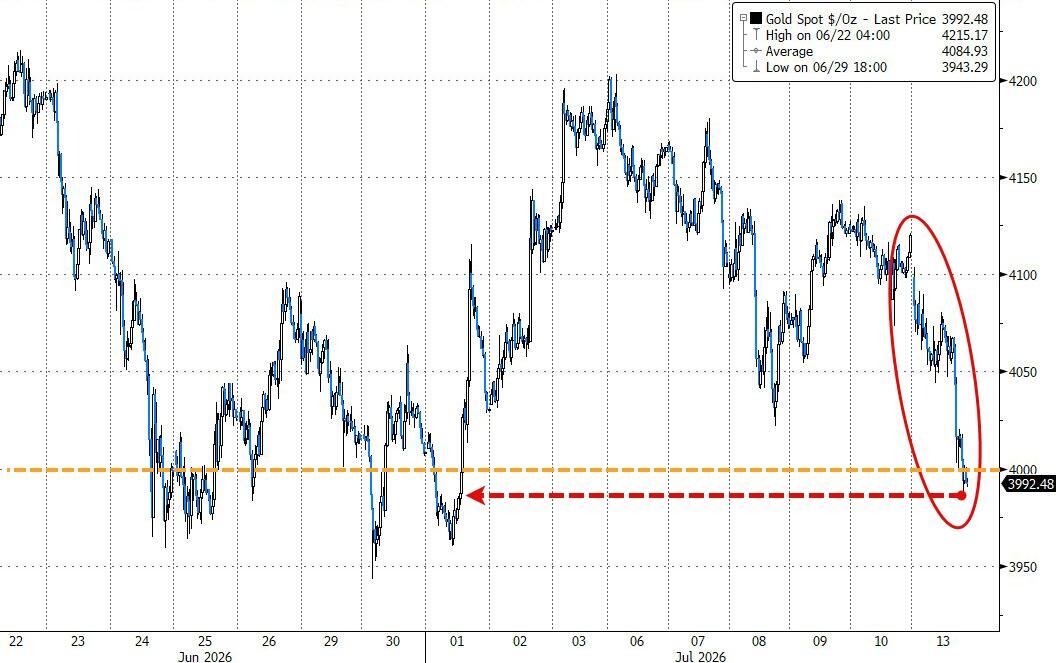
As precious metals analyst Tatiane Darie pointed out, although the $4,000 level provided support when it was last breached in late June, the renewed rise in oil prices, bond yields, and the U.S. dollar is now making it difficult to sustain that support.
Gold prices remain heavily influenced by real interest rates and the U.S. dollar, both of which are currently moving in directions unfavorable to gold. With the Strait of Hormuz once again facing blockage—threatening an already fragile recovery in shipping—crude oil prices continue their upward trajectory. Combined with the Fed’s hawkish signals, this has created new headwinds for gold.
Focus shifts to 'Super Tuesday'
In any case, the sharp increase in market pricing of the likelihood of a Fed rate hike this month, coupled with mounting panic across multiple interconnected global markets, will clearly make today’s U.S. macroeconomic data-packed 'Super Tuesday' even more pivotal.
According to the schedule, the U.S. Department of Labor will release June’s CPI data at 8:30 p.m. Beijing time tonight, and Federal Reserve Chair Waller will deliver testimony before Congress at 10:00 p.m.
Recent declines in gasoline prices could help pull down the headline CPI, which may record its first month-over-month decline since the pandemic began in 2020. The year-over-year increase could also fall out of the '4%' range and return to the '3%' range—market expectations are for a 3.8% year-over-year rise in June CPI. However, this figure would still remain well above the Federal Reserve’s 2% target.
“Markets raised short-term rate hike expectations following Waller’s remarks on Monday,” said Molly Brooks, U.S. rates strategist at TD Securities. “This makes Tuesday’s CPI data even more critical and likely to increase volatility; if the data comes in strong, it could further steepen the flattening trend in the yield curve.”
Ian Lyngen of BMO also stated, “Tuesday’s CPI release and Waller’s testimony will undoubtedly influence the likelihood of a rate hike.”
Regarding Waller’s congressional testimony, Nick Timiraos—a prominent journalist often dubbed the ‘Fed whisperer’—noted that since the Fed’s last policy meeting, some of Waller’s colleagues have grown increasingly concerned about inflation and may push to consider a rate hike at the next FOMC meeting on July 28–29. Waller will have an opportunity this week during his congressional testimony to shape this emerging consensus, armed with the latest June inflation data—the final key dataset before the next meeting.
Timiraos pointed out that given Waller’s reluctance to signal his personal stance clearly, the Fed’s July interest rate decision will be especially significant: it will serve as the first real indication of how he intends to lead the Federal Reserve.
Timiraos believes Waller may side with those advocating to hold rates steady—despite potentially drawing one or two dissenting ‘hawkish’ votes—and await more data before deciding. Alternatively, he might support raising rates, either to reinforce the credibility of his commitment to price stability or to proactively champion a rate hike he deems inevitable.
 Stay ahead on major financial events and discover investment opportunities early! Open Futubull > Market > US Stocks >Financial Calendar/Featured Macro Data, seize the investment opportunity ahead of the curve!
Editor/lambor