
With three key variables converging on the same day, U.S. equities stand at a critical crossroads. Goldman Sachs warns that if interest rate hikes resume, growth expectations, capital costs, and historical valuation patterns will exert a triple squeeze on U.S. stocks.
Heightened expectations for a Federal Reserve rate hike, the official start of bank earnings season, and the new Fed chair’s first congressional appearance—these three variables converging within the same time window have made this Tuesday the most pivotal single day for markets in recent weeks.
On Tuesday, the U.S. June CPI data will be released first at 8:30 a.m. Washington time, followed by Federal Reserve Chair Kevin Warsh’s debut appearance before the House Financial Services Committee in his new role. Later that day, JPMorgan, Bank of America, Wells Fargo & Co, Goldman Sachs, and Citigroup will simultaneously report second-quarter earnings, marking the beginning of this earnings season. Ian Lyngen, head of U.S. rates strategy at BMO Capital Markets, stated, “The combination of the CPI data and Warsh’s testimony will significantly shift the probability of a rate hike in one direction or another.”
 On Monday, Federal Reserve Governor Christopher Waller clearly outlined the trigger conditions for a rate hike, stating that if core inflation data this week turns out “hot again,” the FOMC will need to consider tightening monetary policy soon. This statement quickly reshaped market pricing: the implied probability of a July rate hike in money markets surged from below 10% to approximately 50%, and the yield on two-year U.S. Treasuries reached 4.28%, its highest level in over a year. Meanwhile, geopolitical tensions between the U.S. and Iran escalated once more, pushing Brent crude oil prices up by nearly 10% in a single day, delivering a dual shock to inflation expectations.
On the earnings front, Goldman Sachs expects S&P 500 earnings to grow by 22% year-over-year in the second quarter, with AI infrastructure-related stocks accounting for roughly 50% of the index’s total earnings growth. However, Goldman Sachs also warned that if the Fed initiates a rate-hiking cycle, downward pressure on growth expectations, rising capital costs, and the historical vulnerability of highly valued equity markets would pose a triple headwind for U.S. equities.
CPI Outlook: Energy Drags Down Headline, Core Inflation Remains the Central Concern
Markets widely expect the headline June CPI to show a month-over-month decline of approximately -0.2%, with the year-over-year rate easing from May’s 4.2% to 3.8%. This would mark the first monthly decline since the pandemic outbreak in 2020, primarily driven by falling gasoline prices—regular gasoline prices dropped about 15% between mid-May and the end of June.
Goldman Sachs forecasts a headline CPI decline of -0.11% month-over-month and a core CPI increase of 0.17%, below the market consensus of 0.2%. Goldman Sachs economists noted that potential sources of further disinflation in the coming months include lower airfares as jet fuel prices retreat, hotel prices—measured at booking time—falling back from elevated levels during the World Cup, and continued moderation in rent inflation.
However, the pace of improvement in core PCE inflation is expected to lag behind that of core CPI. Goldman Sachs projects that core PCE will average a monthly increase of about 0.23% over the next three months, partly due to sustained upward pressure from implicit prices in financial services linked to rising equity markets, as well as higher prices for software and peripheral products—a category that carries 30 times more weight in core PCE than in core CPI.
Regarding PPI data, the situation is more complex. The energy shock triggered by the conflict involving Iran continues to ripple through supply chains, and the 12-month year-over-year growth rate of core PPI is expected to accelerate from 4.9% to 5.2%.
Warsh’s Congressional Debut: Reduced Forward Guidance Heightens Policy Uncertainty
Waller will testify before the House of Representatives on Tuesday and the Senate on Wednesday, marking his first public testimony on monetary policy since assuming the role of Federal Reserve Chair in May.
Unlike the Powell era, Waller has previously made clear his intention to scale back forward guidance on the interest rate outlook—a stance that has made it difficult for markets to anchor policy expectations. Ed Al-Hussainy, portfolio manager at Columbia Threadneedle, stated bluntly, "The likelihood of a rate hike in July is higher than no hike," adding that returning inflation to 2% "will require some luck."
Lyngen noted that even if CPI data comes in softer than expected, markets may still price in some probability of a July rate hike, and the possibility of the Fed delivering a surprise rate increase without sufficient market anticipation cannot be ruled out.
Andrew Sacher, chief U.S. economist at Bloomberg, offered a more moderate view. He argued that a significant upward revision in the probability of a rate hike would require both "a hotter-than-expected CPI print" and "a clearly hawkish statement from Waller," neither of which is highly likely. The current market-implied 24% probability of a rate hike already reflects mainstream skepticism toward near-term tightening.
Earnings Season Kicks Off: Strong Profit Growth Meets Policy Uncertainty
This earnings season opens with an unusually dense lineup. JPMorgan, Bank of America, Wells Fargo & Co, Goldman Sachs, and Citigroup will all report results before the market open on Tuesday. Later in the week, results from ASML and Taiwan Semiconductor will directly test the strength of global AI chip demand.
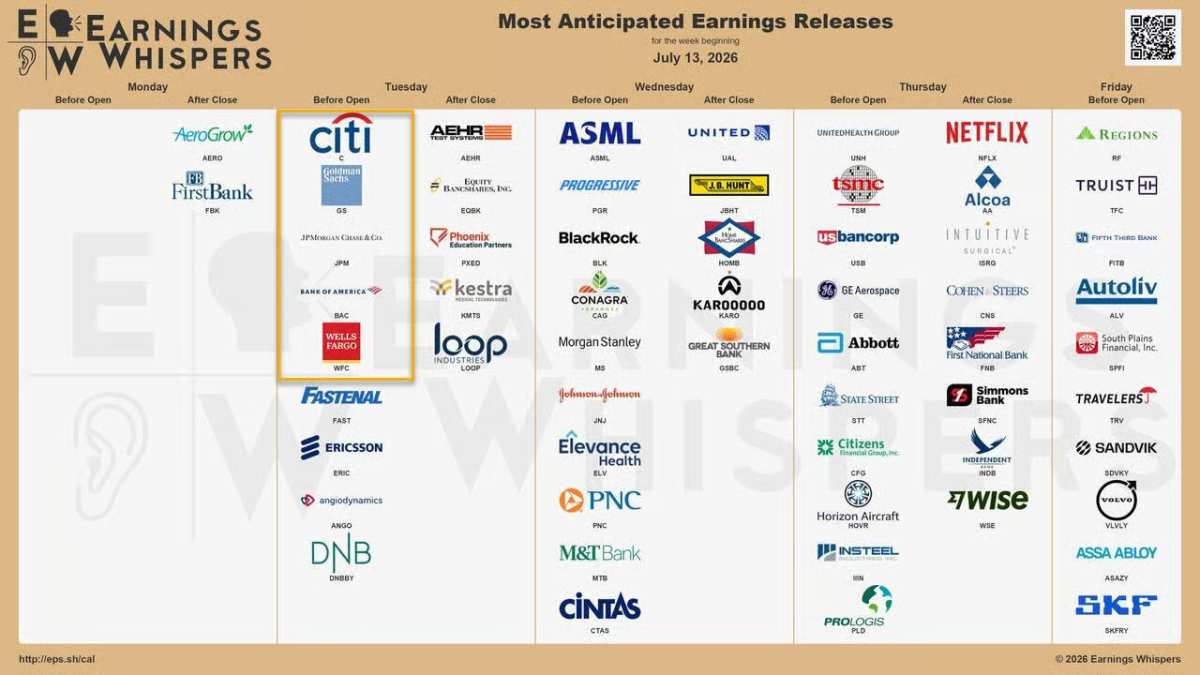
According to Goldman Sachs’ trading desk, consensus estimates project a year-over-year earnings growth of approximately 22% for S&P 500 companies in Q2—the highest level since 2021. However, earnings have beaten consensus expectations in each of the past 11 quarters; in Q1, actual growth reached 27%, exceeding expectations by roughly 15 percentage points, with the outperformance largely driven by AI-related sectors.
At the banking sector level, $JPMorgan (JPM.US)$ one area of focus is the potential impact of Marianne Lake’s departure on management premium; $Bank of America (BAC.US)$ expense spending and visibility into NII guidance are viewed as key variables driving the stock price on the day; $Citigroup (C.US)$ benefiting from the European Central Bank’s rate hikes, which positively boost Services NII, and given relatively low capital markets expectations, upside potential may be significant; $Goldman Sachs (GS.US)$ is widely regarded as a core beneficiary of the AI-driven capital markets cycle, with its equities trading division drawing particular attention; $Wells Fargo & Co (WFC.US)$ whether its 2026 NII target can be achieved remains subject to the risk of insufficient deposit growth in the second half of the year.
Goldman Sachs’ market analysis warns that this earnings season may lack the additional catalyst provided last quarter by a significant upward revision in AI-related capital expenditure expectations. Against a backdrop of tightening macro policy conditions, the market’s reliance on earnings to continue driving equity indices higher now faces greater execution challenges.
Waller Sets Rate Hike Trigger Threshold, Tipping the Policy Balance Clearly
Waller’s Monday speech to the National Association for Business Economics in New York was interpreted by markets as the clearest warning yet of an impending rate hike.
He noted that the core Personal Consumption Expenditures (PCE) index had risen 3.4% year-over-year as of May, and has been trending upward consistently since January—well before the U.S.-Iran conflict emerged. Factors driving inflation include tariffs, energy prices, and large-scale investments in AI infrastructure. "Inflation is moving higher this year by any measure," he said. "I am currently concerned about the persistently elevated trajectory of core inflation."
Waller also cited the policy missteps that led to runaway inflation in 2021–2022 as a cautionary precedent, warning that the FOMC faced widespread criticism at the time for delaying rate hikes—and that such errors must not be repeated. He stated explicitly that he would support holding rates steady if several consecutive months of cooling data were observed, though he emphasized that the required conditions are stringent.
These remarks align with the direction set in last month’s FOMC meeting minutes, which showed that half of the 18 officials anticipated at least one 25-basis-point rate hike at some point this year. The rate-hike option is shifting from a peripheral consideration to the center of policy discussions. According to Goldman Sachs economists led by Jan Hatzius, Waller’s latest comments, together with the June meeting minutes, confirm that the Committee’s openness to resuming rate hikes is rising significantly.
Threefold pressures from a potential rate hike: growth, cost of capital, and historical precedent
Goldman Sachs explicitly stated in its latest weekly U.S. equity strategy report that if the Federal Reserve resumes rate hikes, U.S. equities will face three key headwinds in the near term.
First, tighter monetary policy would directly dampen growth expectations. Although economic growth matters more to equities than interest rate levels per se, all else equal, monetary tightening would weigh on market assessments of future growth.
Second, this economic cycle is significantly more capital-intensive. Stocks tied to AI infrastructure now account for 42% of the S&P 500’s total market capitalization and are expected to contribute roughly 50% of the index’s earnings growth by 2026. Goldman Sachs data show that hyperscale cloud computing firms are projected to spend capital expenditures this year equivalent to 100% of their operating cash flow, with net debt reaching $239 billion in Q1 2026—an increase of approximately 190% year-over-year. Meanwhile, U.S. equity financing totaled $252 billion in Q2, setting a new record that surpasses the previous high in Q1 2021. Any rise in the cost of capital would directly impact this cycle’s most critical growth engine.
Third, historical data indicate that Federal Reserve rate hikes often precede peaks in bull markets characterized by high valuations and concentration. Rate-hike cycles preceded market tops in 1929, 1972, 1987, and 1999, while in 2022, markets peaked in anticipation of rising rates. Goldman Sachs’ rates strategists estimate that if interest rate volatility rises to levels seen during the 2022–2023 hiking cycle, it would correspond to a roughly 6% contraction in the S&P 500’s price-to-earnings ratio—equivalent to about one full valuation multiple.
Goldman Sachs currently maintains an end-of-year target of 8,600 for the S&P 500 and a 12-month target of 8,300, implying potential upside of approximately 14% and 10%, respectively, from the current level of 7,544. However, strategists emphasize that achieving these targets hinges on the assumption that the macro policy environment does not materially tighten—a condition that will face its most direct test within the next two days.
 Stay ahead on major financial events and discover investment opportunities early! Open Futubull > Market > US Stocks >Financial Calendar/Featured Macro Data, seize the investment opportunity ahead of the curve!
Editor/KOKO