
① U.S. dollar-denominated investment-grade bond issuance is accelerating markedly in 2026, with the technology sector’s share rising to 20%; the AI supply chain has become a significant source of new issuance. ② Long-duration technology bonds are consuming more duration and risk capacity; heightened issuance concentration could drive up new-issue premiums and financing costs. ③ Multi-currency bonds, private credit, infrastructure funds, and project finance will collectively help meet funding demands for data center construction and related infrastructure.
Caixin Global, July 14 (Editor: Xia Junxiong) — Artificial intelligence (AI) infrastructure development is evolving from a capital expenditure race among technology firms into a long-term financing challenge for global credit markets.
In its latest report, Goldman Sachs noted that the five hyperscale cloud providers—Microsoft, Alphabet (Google’s parent company), Amazon, Meta, and Oracle—are projected to invest a combined USD 5.8 trillion in AI-related capital expenditures between fiscal years 2025 and 2030. As investments in data centers, chips, power, and network infrastructure expand rapidly, internal corporate cash flows are increasingly insufficient to cover all funding requirements, elevating the importance of debt financing.
 However, even the world’s largest and most liquid market—the U.S. dollar-denominated investment-grade corporate bond market—may be unable to absorb such massive financing needs on its own.
Goldman Sachs believes that over the coming years, AI-related investment will need to draw simultaneously on multiple funding channels, including multi-currency bonds, high-yield debt, bank loans, private credit, infrastructure funds, and project finance.
Technology companies are issuing bonds at an accelerated pace, with U.S. dollar-denominated bond supply far exceeding historical levels.
AI financing demand is already evident in bond issuance data.
Data show that as of July 8, 2026, year-to-date issuance of U.S. dollar-denominated investment-grade bonds has reached USD 1.369 trillion (approximately USD 1.37 trillion), significantly higher than the comparable figures in recent years.
Goldman Sachs had previously forecast total U.S. dollar-denominated investment-grade bond issuance for 2026 at USD 2.1 trillion, but this projection now faces clear upside risk.
In June 2026 alone, U.S. dollar-denominated investment-grade bond issuance totaled USD 240 billion, compared with a monthly average of just USD 129 billion between June 2020 and June 2025—a surge of approximately 86% above the historical average. As of July 8, July issuance had already reached USD 51.5 billion, while the average total issuance for the entire month of July over the past six years was only USD 104 billion.
Typically, summer is the traditional off-season for corporate bond issuance in Europe and the United States, but the seasonal slowdown has not yet materialized in 2026. If technology companies and firms across the AI supply chain continue to accelerate fundraising, total annual issuance could surpass Goldman Sachs’ current forecast of USD 2.1 trillion.
The technology sector has become the primary source of new bond supply. Since the start of 2026, the broader technology sector has accounted for 20% of U.S. dollar-denominated investment-grade bond issuance—a record high since Dealogic began tracking such data. However, this figure may still understate the actual scale of AI-related financing, as relevant issuers are also classified under categories such as aerospace, satellite communications, real estate, utilities, and industrials.
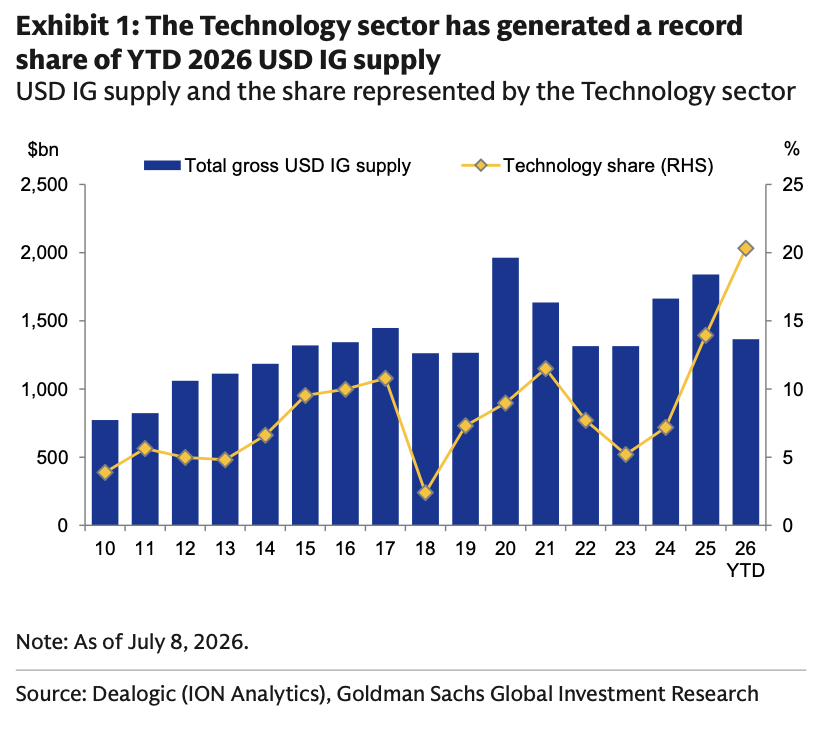
(Trend in the technology sector’s share of U.S. dollar-denominated investment-grade bond issuance)
For example, SpaceX recently completed a USD 25 billion debt transaction, which Dealogic categorizes under the aerospace sector, while the Bloomberg U.S. Dollar Investment Grade Corporate Bond Index classifies it under cable and satellite communications—thus excluding it from the traditional technology sector.
AI capital expenditures cannot be supported by operating cash flow alone.
Goldman Sachs estimates that the combined AI-related capital expenditures of the five major cloud providers will reach USD 5.8 trillion between fiscal years 2025 and 2030.
Market consensus expectations for these companies’ 2026 capital expenditures already account for the majority of their operating cash flow.
Although large technology firms generally maintain substantial cash reserves, strong profitability, and low leverage, sustaining elevated capital spending over the long term solely through operating cash flow is impractical.
AI infrastructure is characterized by high upfront investment, long construction cycles, and concentrated initial cash outflows.
Building a large-scale data center entails not only purchasing GPUs and servers but also acquiring land, constructing facilities, securing power connections, installing substations, implementing cooling systems, deploying networking equipment, and arranging ongoing maintenance. Some projects take several years from planning to operational launch, with returns realized gradually through compute capacity leasing, cloud service revenues, or commercialization of AI applications.
More importantly, Goldman Sachs’ projected total spending of USD 5.8 trillion includes only the five leading cloud service providers and does not fully encompass other segments of the AI ecosystem, such as semiconductor manufacturing, memory chips, optical communications, power grid expansion, standalone data centers, AI startups, and other related supply chain components.
This implies that the actual financing needs of the broader AI ecosystem could be significantly larger.
The U.S. dollar bond market may struggle to absorb all of this financing demand.
Some market participants argue that the U.S. dollar investment-grade bond market is sufficiently large to shoulder the bulk of AI-related financing. The Bloomberg U.S. Dollar Investment Grade Corporate Bond Index has an outstanding balance of USD 7.9 trillion, and the five major cloud providers currently maintain low leverage ratios, theoretically leaving substantial room for additional debt issuance.
Even with a significant increase in debt, most leading technology companies could still meet the credit metrics required to retain their investment-grade ratings. Therefore, credit ratings themselves are not the primary constraint.
However, the real limitation stems from issuer concentration.
If the five major tech companies continue to issue debt at scale, their weightings within bond indices would rise rapidly. Many institutional investors already hold substantial positions in U.S. tech equities through stocks and index funds; adding bonds issued by the same companies to their credit portfolios could result in excessive aggregate exposure to the technology sector and individual issuers.
Compared with equity investors, bond investors place greater emphasis on principal preservation, potential rating downgrades, and tail risks.
Equity upside is theoretically unlimited, whereas bond returns primarily derive from fixed coupons and limited price appreciation. Consequently, credit investors typically will not indefinitely increase holdings of a single issuer’s bonds without adequate spread compensation.
Goldman Sachs estimates the potential capacity for the five cloud providers in the U.S. dollar investment-grade bond market by benchmarking against large banks such as JPMorgan, Morgan Stanley, and Bank of America. If each of the five companies were to raise its index-eligible debt outstanding to the level of the largest bank issuers, this could theoretically create approximately USD 510 billion in additional debt capacity.
However, the USD 510 billion figure does not represent a certain future issuance volume, but rather a potential 'ceiling' estimated based on the current weight of bank debt in bond indices. Compared to the USD 5.8 trillion in capital expenditures, investment-grade U.S. dollar bonds alone would still be insufficient to meet the full funding requirement.
Technology-sector bonds have longer maturities and are more challenging for the market to absorb than bank bonds.
The report also notes that maturity duration is another significant constraint that cannot be overlooked.
In the U.S. dollar investment-grade market, the weighted average maturity of bank bonds is approximately 7 years, around 11 years for non-bank corporates, and reaches 15 years for technology-sector bonds. In the euro market, the average maturity of bank bonds is about 6.6 years, roughly 8 years for non-bank corporates, and close to 12 years for technology bonds.
The longer the maturity, the more sensitive the bond is to interest rate changes, and the greater the duration and risk budget it consumes. For asset management institutions, absorbing USD 25 billion worth of 15-year technology bonds is not equivalent to absorbing the same amount of 7-year bank bonds.
Therefore, even though tech giants enjoy high credit quality, the concentrated issuance of large volumes of long-dated bonds could still demand a higher new-issue premium. As supply continues to rise, strong corporate fundamentals no longer guarantee persistently low financing costs; issuance timing, bond maturity, and market positioning will all influence final pricing.
Of course, some investors are willing to increase their allocations to technology bonds, viewing them as a way to gain exposure to the long-term AI growth theme. However, Goldman Sachs believes that as the investment cycle progresses, the market will make increasingly nuanced distinctions among issuers based on their use of proceeds, return prospects, and debt structure.
Multi-currency bonds and private capital jointly meet AI financing needs.
In fact, AI-related financing has already begun expanding beyond the U.S. dollar market.
Since 2026, the five major cloud service providers have issued approximately USD 194 billion in bonds across various currencies globally, accounting for about 9% of total investment-grade bond issuance in major markets. Of this, roughly 32% of investment-grade bonds were issued in currencies other than the U.S. dollar, including euros, British pounds, Japanese yen, Swiss francs, and Canadian dollars.
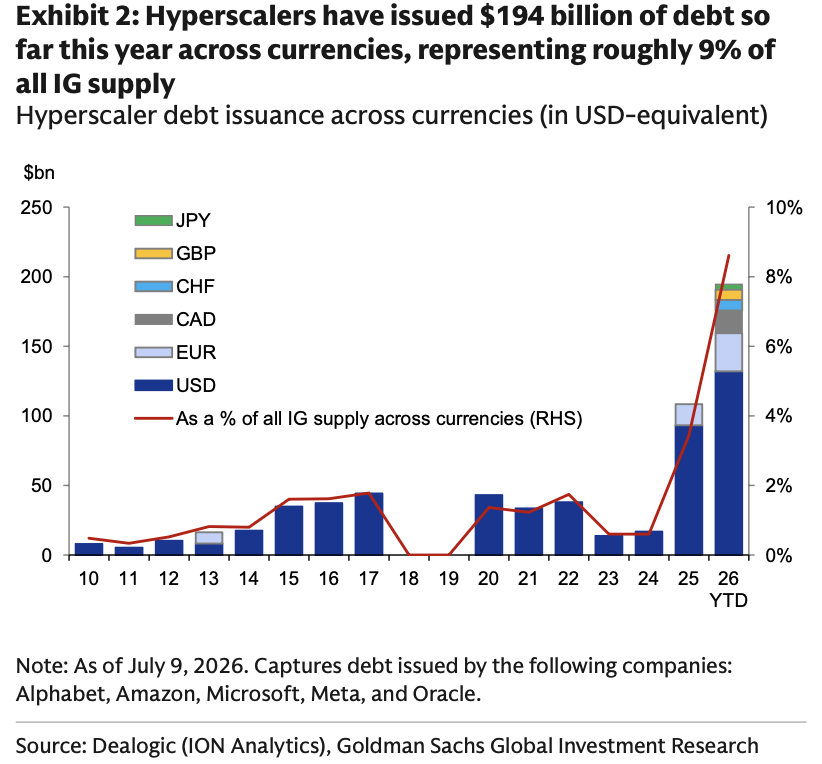
(The five major cloud service providers have already issued multicurrency bonds in 2026.)
Issuing debt in multiple currencies can broaden the investor base, alleviate concentration risk in the U.S. dollar market, and reduce financing costs by taking advantage of varying interest rate and funding conditions across regions.
In addition to the public bond market, private capital is becoming an important source of funding for data center construction.
Since early 2025, infrastructure funds, real estate investors, private equity firms, and private credit institutions have provided over USD 140 billion in financing for data center transactions—a figure that does not include investments in other AI-related areas such as semiconductors.
Goldman Sachs estimates that the global infrastructure asset base, including digital infrastructure, could exceed USD 3 trillion by 2030.
Going forward, large technology companies may increasingly adopt project finance-style joint venture structures. For example, cloud service providers could co-invest with infrastructure funds, utilities, real estate developers, or sovereign capital in data centers and power facilities, with debt repayment sourced from the project’s own cash flows, thereby reducing direct balance sheet pressure on the parent company.
Meanwhile, suppliers and data center operators with lower credit ratings may rely more heavily on high-yield bonds, leveraged loans, and bank financing. As a result, AI-related financing is expected to expand beyond investment-grade bonds issued by a handful of tech giants into the broader credit market.
Editor/Deng