
$SK hynix (SKHY.US)$Just three trading days after its listing, the American Depositary Receipt (ADR) has seen its premium over the locally listed South Korean shares surge to more than 50%. The fundamental reason underpinning this persistent price divergence is the structural failure of arbitrage mechanisms between the two markets.
On Tuesday, SK Hynix’s ADR surged by 27% in a single day, pushing its premium over Seoul-listed ordinary shares to 51%—far exceeding the initial spread of approximately 3% at issuance last week, when the company raised USD 26.5 billion through the ADR offering. Meanwhile, major U.S. options exchanges officially launched options contracts on SK Hynix ADRs, with short-dated call options becoming the most heavily traded instruments, further fueling investor enthusiasm for the ADR.
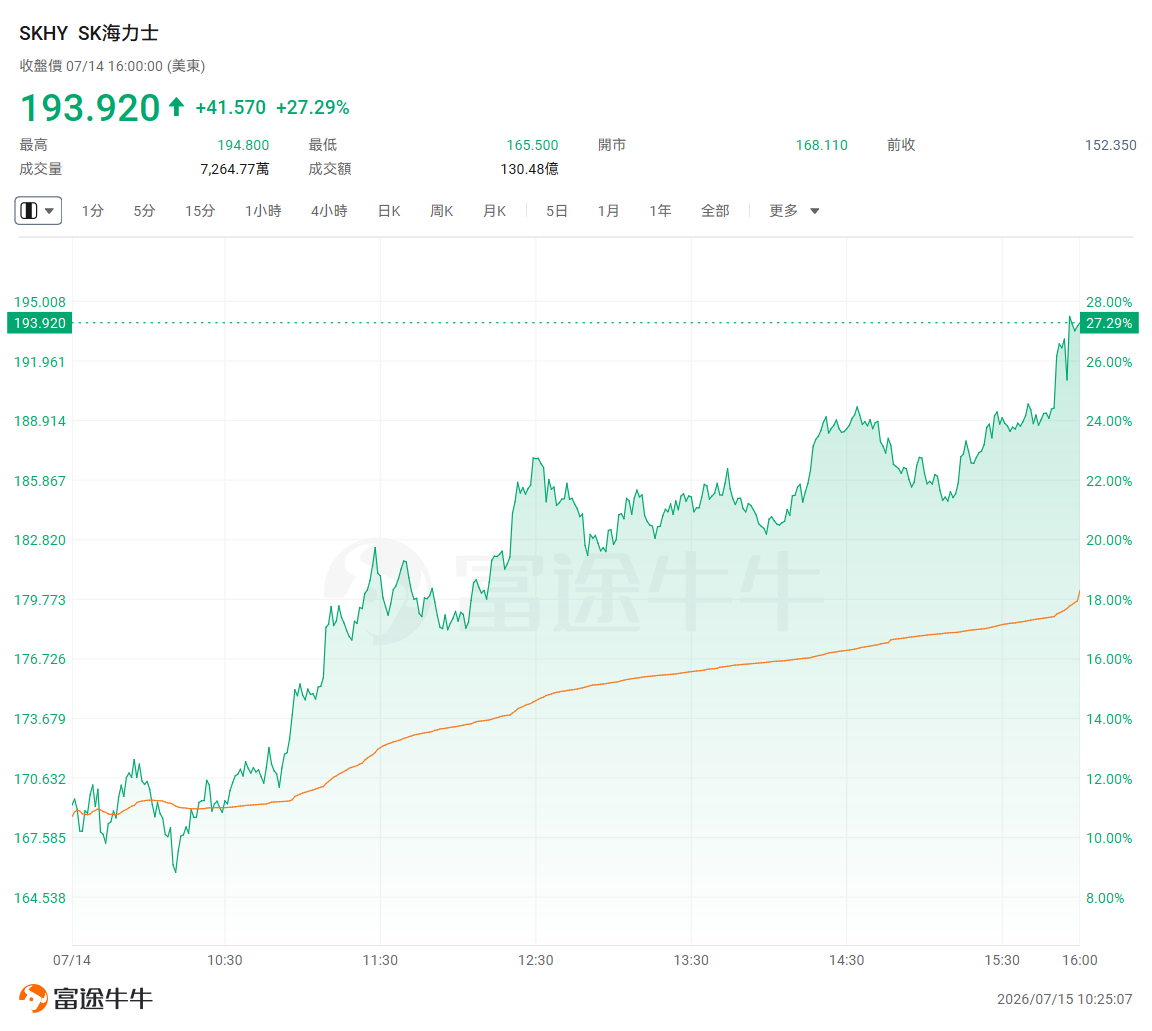
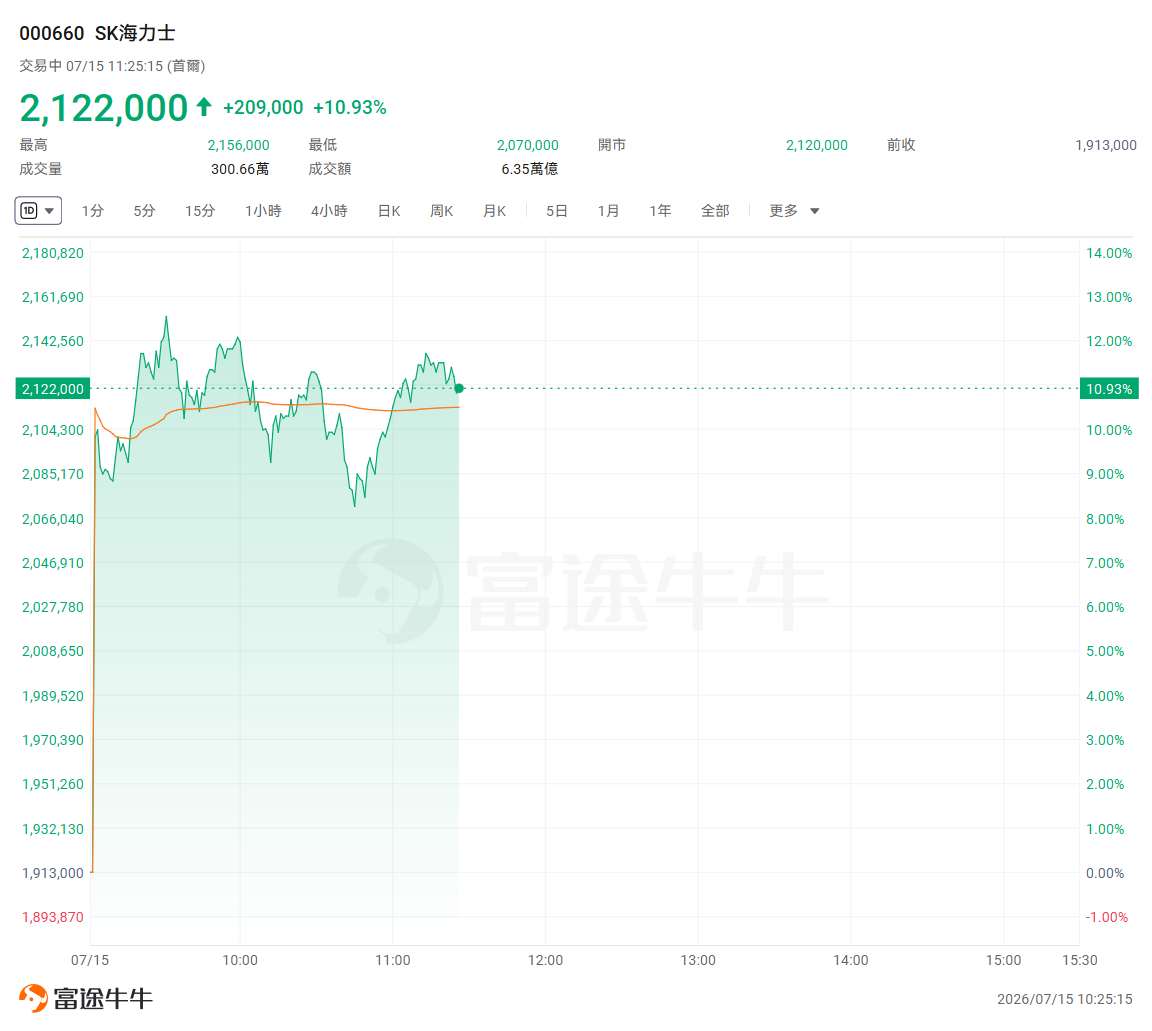
However, while the ADR premium has soared, the locally listed shares in Korea have continued to face downward pressure. From July 10 to July 14—the period immediately preceding the ADR listing—SK Hynix’s local shares have declined by 12.25% cumulatively, with a weekly return of approximately -15% and a maximum drawdown from the recent peak reaching 28.2%. The market had initially expected that the post-listing ADR premium would attract arbitrage-driven buying of local shares, but this mechanism has effectively broken down.
Physical Closure of Arbitrage Channel: Conversion Impossible Prior to New Share Listing
 The immediate cause of this arbitrage breakdown lies in the fact that the 'mutual conversion' channel linking the two markets remains closed.
According to the Korea Securities Depository (KSD), the new local shares underlying this ADR issuance are scheduled to begin domestic trading on July 29. Applications for mutual conversion between local shares and ADRs can only be submitted after this domestic listing date. The KSD stated, 'Applications for mutual conversion between SK Hynix’s original shares and ADRs will be accepted starting from the scheduled domestic listing date of July 29.' The specific conversion timetable will be separately announced based on instructions from the depositary bank, Citi.
This means that, prior to July 29, arbitrage strategies involving purchasing local shares, converting them into ADRs, and selling them in the U.S. market to capture the price differential are institutionally unfeasible. The absence of an operational arbitrage mechanism prevents normal market forces from correcting the cross-market price gap, allowing the premium to continue expanding.
Asymmetric Conversion Rules: ADR-to-Local Conversion Is Unrestricted, but the Reverse Is Constrained
Even after the conversion channel opens on July 29, institutional asymmetries in the rules will continue to limit arbitrage efficiency.
Under KSD rules, the cancellation of ADRs and their conversion back into local shares faces no quantitative restrictions and can be directly processed through account transfers. However, conversion from local shares into ADRs is subject to the ADR issuance cap set by the issuer. The KSD illustrated this with an example: if the ADR issuance ceiling corresponds to 1 million local shares and 900,000 shares’ worth of ADRs have already been issued, then no more than 100,000 local shares can be converted into ADRs.
This mechanism—accommodative in one direction but constrained in the reverse—means that even when an arbitrage window opens, the scale of convertible shares is subject to hard limits, preventing sufficient arbitrage pressure from building up to compress the premium.
Retail investors locked out: Individual investors cannot complete conversions via MTS
Structural barriers go beyond this. Even after institutional investors gain the ability to attempt arbitrage operations following the end of July, individual investors remain entirely excluded.
Individual investors holding local shares currently cannot convert those shares into ADRs through either the Mobile Trading System (MTS) or the Home Trading System (HTS). Converting local shares into ADRs involves complex administrative procedures with the depository and settlement institution as well as foreign exchange transaction reporting requirements, which in practice only institutional investors are equipped to handle.
A brokerage representative stated, "There is a price discrepancy between shares listed in Korea and those listed in the U.S., and there are also quantitative restrictions on listings. In principle, conversion is not impossible, but it requires meeting numerous conditions, so the service (for individuals) has not yet been opened."
This reality implies a clear 'unequal playing field' between individual and institutional investors in arbitrage transactions.
Taiwan Semiconductor precedent: Conversion frictions may sustain the premium over the long term
Market analysts believe that the aforementioned structural constraints could cause SK hynix’s ADR premium to persist for a considerable period.$Taiwan Semiconductor (TSM.US)$(Taiwan Semiconductor’s) historical trajectory provides an important reference point.
An analyst at iM Securities noted, "Numerous inconveniences exist in converting between local shares and ADRs, hindering smooth arbitrage operations," and added, "As seen in Taiwan Semiconductor’s case, it is quite possible that the U.S.-listed ADR will maintain a significant premium overall."
Some analysts note that although Taiwan Semiconductor’s ADRs have been delisted and its shares now trade relatively freely as local Taiwan-listed stock, the process of converting local shares into U.S.-listed ADSs remains constrained by limits on approval quotas and regulatory restrictions. "It is precisely due to these arbitrage constraints that Taiwan Semiconductor’s premium has averaged 19.1% since 2024 and has remained around 17.5% on average since 2026."
Overall, the premium on SK hynix’s ADRs is supported both by strong fundamental demand from U.S. investors for leading global memory chip stocks and reinforced structurally by institutionalized arbitrage barriers. Given multiple constraints—including the closure of conversion channels prior to new share listings, asymmetric conversion rules, and the exclusion of retail investors—this premium is unlikely to converge naturally through market forces in the near term.
Editor/Rocky