
The producer price index excluding food and energy prices rose 4.7% year-over-year; meanwhile, the U.S. PPI declined 0.3% month-over-month in June, marking the largest monthly drop since April 2020.
Zhitong Finance APP learned that a key producer inflation indicator—the Producer Price Index (PPI), often dubbed the 'barometer of upstream economic conditions'—came in unexpectedly below consensus economist forecasts. This further suggests that the inflationary impact stemming from higher energy prices due to the Iran conflict, along with broader ripple effects from elevated oil prices, remains largely contained. It also indicates that pressures during the early stages of market expansion and production pipeline development had already eased significantly before the latest escalation of the Iran conflict. Following Tuesday’s surprisingly weak CPI data, the PPI reading reinforced the trajectory of sustained disinflation led by falling energy prices. Traders swiftly scaled back expectations for a Federal Reserve rate hike in July, with current interest rate futures markets now pricing the most likely timing of the next hike as December rather than July.
Data released Wednesday by the U.S. Bureau of Labor Statistics showed that the core Producer Price Index (core PPI), which excludes food and energy, rose 4.7% year-over-year in June—significantly below economists’ consensus forecast. The headline PPI, which includes food and energy, also showed marked deceleration, primarily driven by a sharp 12% decline in gasoline prices.
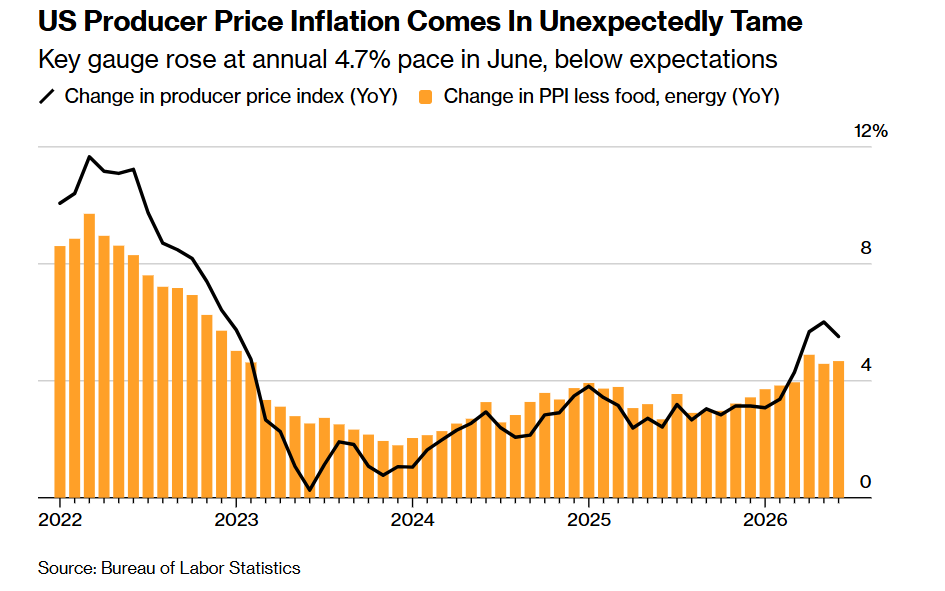
 As illustrated in the chart above, U.S. producer price inflation came in unexpectedly mild—with the key metric rising just 4.7% year-over-year in June, notably below expectations.
The headline PPI declined unexpectedly by 0.3% month-over-month in June, marking its first drop since last year and falling well short of economists’ expectation of roughly flat (0%) growth. Year-over-year headline PPI inflation narrowed sharply to 5.5%, substantially below the consensus forecast of approximately 6.2%. Core PPI, excluding food and energy, rose 4.7% year-over-year, below the expected 5.1%, while core PPI increased 0.2% month-over-month, below the anticipated 0.3% and down from a prior reading of about 0.4%.
Dubbed the 'barometer of upstream price pressures,' the PPI measures the prices received by domestic producers and can provide an early signal of shifts in costs for raw materials, energy, transportation, and intermediate goods. As such, it holds leading predictive value for future CPI and PCE inflation. However, factors such as corporate profit margins, productivity, import prices, and firms’ ability to pass through costs can dampen this transmission. Therefore, PPI alone should not be used to gauge future inflation trends; analysis must be complemented with CPI, core PCE, wage data, and inflation expectations.
June’s CPI and PPI readings jointly signaled marginal disinflation and reduced urgency for near-term rate hikes. John Williams, President of the Federal Reserve Bank of New York and the Fed’s third-ranking official, recently acknowledged that inflation remains at around 4%—an 'unquestionably too high' level—but noted that price shocks from tariffs, housing inflation, energy costs, and supply-demand imbalances caused by AI-related investment may gradually ease. He projects headline inflation to fall to approximately 3.25% by year-end and return to the 2% target by 2028. Citi, the Wall Street financial giant, has publicly revised its outlook, now expecting the Fed to refrain from adopting a hawkish stance as inflation continues to cool. Citi forecasts two 25-basis-point rate cuts in October and December 2026, followed by a third cut in January 2027—adjusting from its earlier projection of consecutive cuts in September, October, and December 2026.
U.S. PPI comes in softer than expected, erasing bets on a July Fed rate hike
The PPI report indicated that several key categories that had risen in recent months due to war-related disruptions broadly cooled. This could give the Federal Reserve more room to delay rate hikes—especially after another report on Tuesday showed similarly mild consumer prices for June. However, many economists caution that with Middle Eastern geopolitical tensions flaring up again recently, the recent moderation in both energy and core inflation may prove temporary.
Following the release of the report, U.S. stock index futures rose and Treasury yields fell as investors sharply reduced their bets on a Fed rate hike in July. Current pricing in interest rate futures and swap markets jointly implies a roughly 5% probability of a July hike and about a 40% chance of a September hike.
Federal Reserve Chair Kevin Warsh warned in congressional testimony on Tuesday that policymakers should not declare victory in the fight against inflation merely because consumer price reports appear favorable.
Data released on Wednesday showed that energy prices fell 6.4% in June compared to the previous month, and transportation and warehousing prices also declined. Nevertheless, trucking freight rates remain elevated due to rising fuel costs and a reduction in the number of drivers caused by President Donald Trump’s tighter immigration policies.
Meanwhile, food prices declined for the first time in three months. So far this year, food prices have generally been rising due to a combination of factors including adverse weather, war, and tariffs.
Several components of the Producer Price Index (PPI) are closely watched by the Federal Reserve because they feed into its preferred inflation gauge—the Personal Consumption Expenditures (PCE) price index. These components showed mixed performance: airfares surged by 1.9%, while portfolio management fees rose at a significantly slower pace than in May.
The U.S. Bureau of Economic Analysis plans to release June’s Personal Consumption Expenditures (PCE) price data—widely regarded as the Federal Reserve’s preferred inflation indicator—as well as income and spending figures, on July 30 at Eastern Time.
“With all the relevant data now in hand, we estimate that the Personal Consumption Expenditures (PCE) price inflation metric will show slightly stronger readings than the relatively mild Consumer Price Index (CPI) for June, but likely still mild enough to allow the Federal Reserve to hold rates steady at its upcoming meetings—and possibly through year-end,” said senior economist Troy Dooly of Bloomberg Economics.
A measure of inflationary pressures at earlier stages of production—prices for processed intermediate goods excluding food and energy—rose just 0.6%, marking the smallest increase since the beginning of the year. Prices for plastic resins and materials, key raw inputs for many consumer goods, declined for the first time in 2026.
The report also indicated that two newly emerging sources of inflationary pressure this year—data centers and defense production—both cooled off. Prices for electronic components and accessories declined for the second consecutive month, and prices tied to government defense procurement fell by 2.2%.
Details in the Producer Price Index report regarding wholesale and retail trade services margins have also been closely monitored to assess the extent to which businesses absorb tariff-related costs themselves or pass them on to consumers. In June, these margins rebounded following a sharp decline in May.
Although the U.S. Supreme Court struck down several tariffs implemented by Trump earlier this year, the administration is seeking alternative ways to impose taxes on imported goods. The U.S. has also recently decided not to renew its long-standing trade agreements with Canada and Mexico, opting instead for annual reviews—a move that could create additional uncertainty for businesses in the coming months.
Another report released Wednesday by the Federal Reserve Bank of New York showed that the Empire State Manufacturing Survey’s general business conditions index improved in July, as new orders and shipments increased and employment indicators rose to their highest level since December 2022. The prices paid index declined but remained elevated; businesses’ expectations for both future input prices and selling prices also decreased.
Williams Offers a Dovish Buffer, Waller Holds the Hawkish Line, and Citi Bets on a 'Three Rate Cuts' Scenario
June’s CPI and PPI jointly signaled a marginal cooling of inflation and reduced urgency for near-term rate hikes: headline CPI declined by 0.4% month-over-month and slowed year-over-year from 4.2% to 3.5%, while core CPI was flat month-over-month and eased year-over-year to 2.6%. Final-demand PPI fell 0.3% month-over-month but rose 5.5% year-over-year; excluding food, energy, and trade services, the core PPI increased just 0.1% month-over-month. Together, these reports indicate that falling energy prices, moderating shelter inflation, and some easing in producer-side cost pressures are temporarily flattening the inflation trajectory. However, elevated PPI year-over-year readings and persistent strength in personal consumption expenditure (PCE)-related components—such as airfares and asset management fees—suggest this should be interpreted as a downgrading of hawkish risks rather than a definitive victory over inflation.
In his confirmation hearing, newly appointed Fed Chair Waller effectively established a policy reaction function leaning hawkish, yet refrained from indicating the next move: he emphasized 'zero tolerance' for persistently high inflation, rejected declaring 'mission accomplished' based on a single benign CPI print, deliberately avoided committing to a rate hike in July or subsequent meetings, and reiterated that both interest rates and the balance sheet remain active tools. His true policy signal lies in de-emphasizing traditional forward guidance, reinforcing data-dependent decisions at each meeting, and initiating a reassessment of the ample-reserves framework, the composition of the Fed’s asset holdings, and its communication mechanisms. While this approach preserves policy flexibility, it also heightens the market sensitivity to every incoming data point on inflation, employment, and oil prices.
Williams’ remarks, by contrast, reflect a conditionally neutral-to-dovish stance: he acknowledged that inflation remains at around 4%, which is 'unquestionably too high,' but judged that tariff-induced price shocks, shelter inflation, energy costs, and supply-demand imbalances from AI-related investment may gradually ease. He projects headline inflation to decline to approximately 3.25% by year-end and return to 2% by 2028. Meanwhile, Williams noted that the U.S. labor market, as measured by nonfarm payrolls, is not generating additional inflationary pressure, and expects the unemployment rate to gradually fall back to 4%.
However, Williams, as President of the New York Fed and a permanent voting member of the FOMC, did not advocate for an immediate rate cut. Moreover, FOMC members remain roughly split between those who believe no further hikes will occur this year and those who expect at least one additional 25-basis-point increase. Thus, Waller and Williams are not fundamentally at odds: the former stresses vigilance until sustained evidence of disinflation emerges, while the latter contends that the current policy rate range of 3.50%–3.75% is sufficient to allow inflation to recede organically. Both positions collectively point toward a July pause and maintaining optionality thereafter, though Waller’s stance is clearly more hawkish.
To economists, much of the recent decline in U.S. inflation stems from falling energy prices in June—the CPI energy component dropped 5.7% month-over-month, and PPI energy prices fell 6.4%. However, with renewed escalation in U.S.-Iran tensions, oil prices have already rebounded. Economists broadly forecast that June’s core personal consumption expenditures (PCE) price index will still register a year-over-year increase of approximately 3.3%, significantly above the Fed’s 2% target. Although New York Fed President Williams believes inflation may have peaked, he continues to describe current levels as 'unquestionably too high.'
Consequently, most economists view a July hold by the Fed as nearly consensus, and the probability of no rate changes throughout the year has risen significantly—though tail risks of a hike after September remain.
If core inflation remains subdued for several consecutive months, labor market and consumer spending show clear signs of cooling, and Middle East tensions ease—thereby lowering energy prices—then Citi’s dovish scenario could indeed regain prominence in market narratives. Citi’s economics team forecasts two 25-basis-point rate cuts by the FOMC in October and December 2026, followed by a third cut in January 2027. However, Citi also acknowledges that a single below-forecast CPI and PPI reading alone is insufficient to confirm that the Fed would swiftly implement multiple rate cuts while the economy remains resilient.
Editor/Deng