
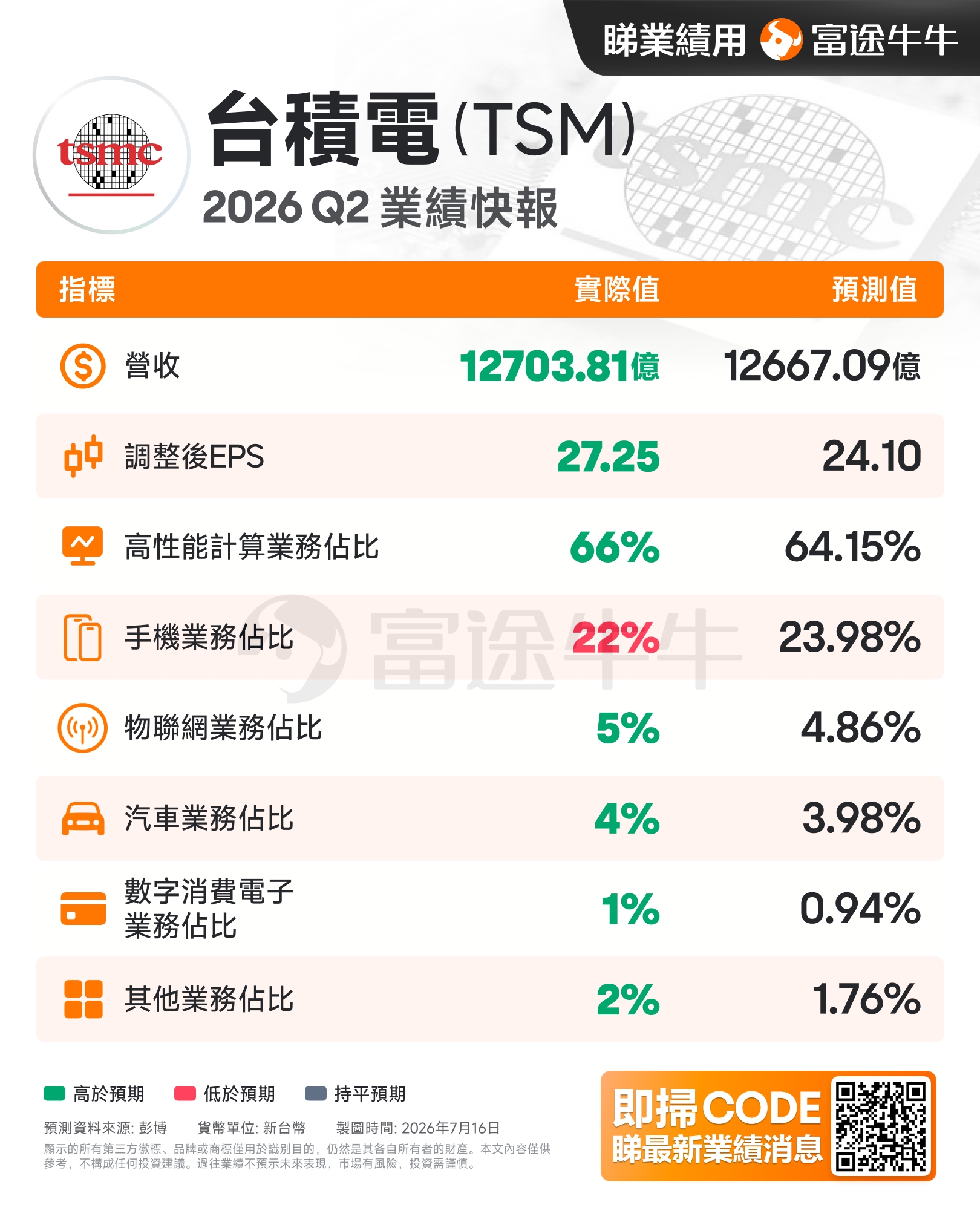
Taiwan Semiconductor reported a 77.4% year-over-year increase in Q2 net profit, reaching NT$706.6 billion, surpassing the analyst consensus estimate of NT$623.7 billion. Revenue rose 36% year-over-year to NT$1.27 trillion, near the upper end of the company’s guidance range. Gross margin reached 67.7%, exceeding market expectations of 67.1%. Market attention is focused on Taiwan Semiconductor’s capital expenditure plan for this year, which amounts to approximately USD 56 billion, and whether its leading-edge process technology and advanced packaging capacity will be sufficient to support further upward revisions to its spending scale.
$Taiwan Semiconductor (TSM.US)$ The latest quarterly results once again exceeded market expectations, underscoring the sustained demand for advanced-process chips driven by the global AI infrastructure build-out.
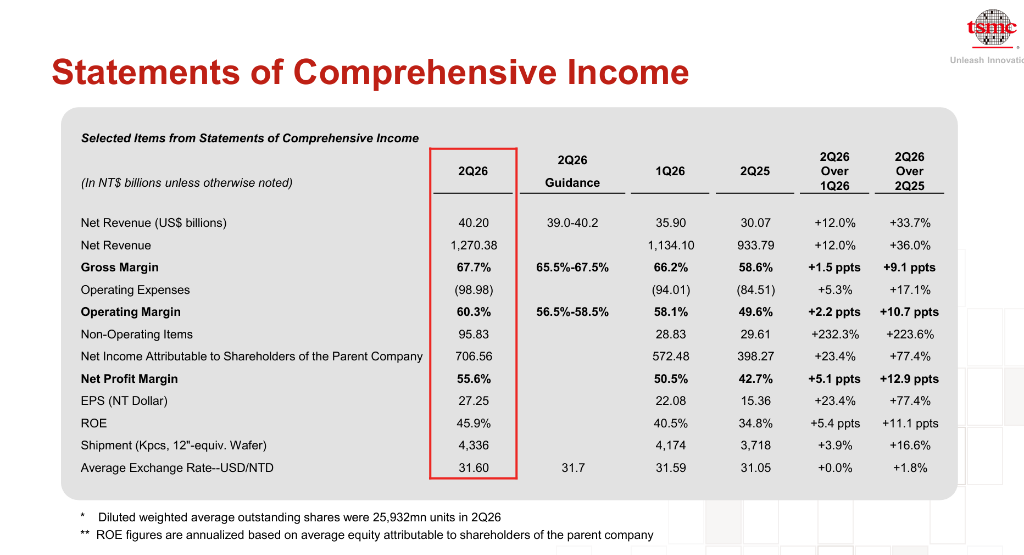
On July 16, Taiwan Semiconductor reported that net profit for the second quarter ended June 30, 2026, surged 77.4% year-over-year to NT$706.6 billion (approximately USD 22 billion), surpassing the analyst consensus estimate of NT$623.7 billion. Revenue rose 36% year-over-year to NT$1.27 trillion, or roughly USD 40.2 billion, nearing the upper end of the company’s guidance range. Gross margin reached 67.7%, above the market’s forecast of 67.1%, and operating margin stood at 60.3%, also exceeding expectations.
 At the time of the earnings release, market attention centered on Taiwan Semiconductor’s capital expenditure plan of approximately USD 56 billion for this year, and whether its leading-edge process technology and advanced packaging capacity would be sufficient to support a further increase in spending. In June, Taiwan Semiconductor CEO C.C. Wei had warned that despite ongoing capacity expansion in the U.S., the company would remain unable to meet chip demand—primarily from U.S.-based customers—for several years to come.
Meanwhile, investors are also assessing the sustainability of data center operators’ aggressive debt-financed expansions and whether the massive investments in AI will ultimately translate into meaningful returns.
Results Broadly Beat Expectations, with Advanced Nodes Driving Revenue
Taiwan Semiconductor’s Q2 results showed revenue growth of 36% year-over-year and 12% quarter-over-quarter; net profit surged 77.4% year-over-year and 23.4% quarter-over-quarter. In USD terms, quarterly revenue reached USD 40.2 billion, representing a 33.7% year-over-year increase.
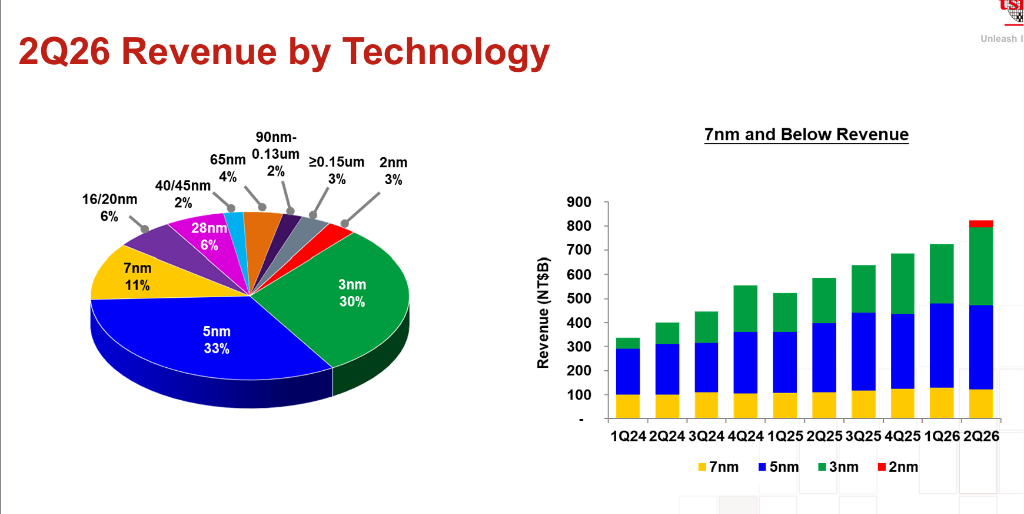
By process node, advanced technologies (7-nanometer and below) accounted for 77% of total wafer revenue. Specifically, the 3-nanometer node contributed 30%, the 5-nanometer node 33%, and the 7-nanometer node 11%. The 2-nanometer node, newly introduced this quarter, accounted for 3% of revenue.
Following the earnings release, Bloomberg analyst Charles Shum noted that Taiwan Semiconductor’s June sales data further reinforced the view that demand for AI and server processors will offset weakness in the smartphone and PC markets. He added that this positions the company well to implement price increases, potentially lifting its gross margin outlook toward the top end of its guidance range at 67.5%—above the current market consensus of 67.1%.
AI-Driven Capex Wave Continues, with Demand Visibility Extending Beyond 2030
Taiwan Semiconductor’s capital expenditure is widely viewed as a key barometer of global AI infrastructure demand, spanning NVIDIA AI accelerators, Tesla automotive processors, and AI server chips. The company has confirmed that its 2026 capital expenditure will approach a record-high USD 56 billion.
As the primary chip foundry for NVIDIA and Apple, Taiwan Semiconductor is widely viewed by market observers as a barometer of the AI infrastructure investment boom led by tech giants such as Meta. Global spending on AI infrastructure is estimated to exceed $725 billion in a single year this year.
In the memory chip segment, SK Hynix anticipates that the supply shortage for memory chips will persist beyond 2030, as large-scale procurement by data center operators continues to drive up demand for AI-related chips such as high-bandwidth memory (HBM).
Market concerns remain unresolved, and the path to returns on AI investments remains uncertain.
Despite Taiwan Semiconductor’s strong financial performance, investor concerns about the broader AI supply chain have not subsided. Major data center operators are continuing to borrow and raise capital to fund large-scale construction projects, with a significant portion of their AI-related investments relying on ever-expanding debt financing. Whether these massive outlays will yield substantial returns remains unclear at this stage.
Market debate surrounding Taiwan Semiconductor has thus centered on two key questions: first, whether its current elevated stock valuation already fully reflects future growth expectations; and second, whether the scale of computing capacity being built by tech giants like Meta exceeds their actual future needs.
Taiwan Semiconductor takes a contrary view on these concerns. C.C. Wei previously stated explicitly that the company’s capacity expansion still lags behind demand and expects this gap to persist for several years.
Taiwan Semiconductor is significantly increasing its domestic manufacturing capacity in the United States. The company plans to invest approximately $265 billion in its advanced manufacturing campus in Arizona.
Market attention on Taiwan Semiconductor’s upcoming earnings call also focuses on how the company will respond to competitive pressures from Intel’s EMIB-T packaging technology and potential challenges posed by Tesla’s Terafab initiative, in order to clarify Taiwan Semiconductor’s medium- to long-term competitive position in advanced packaging.
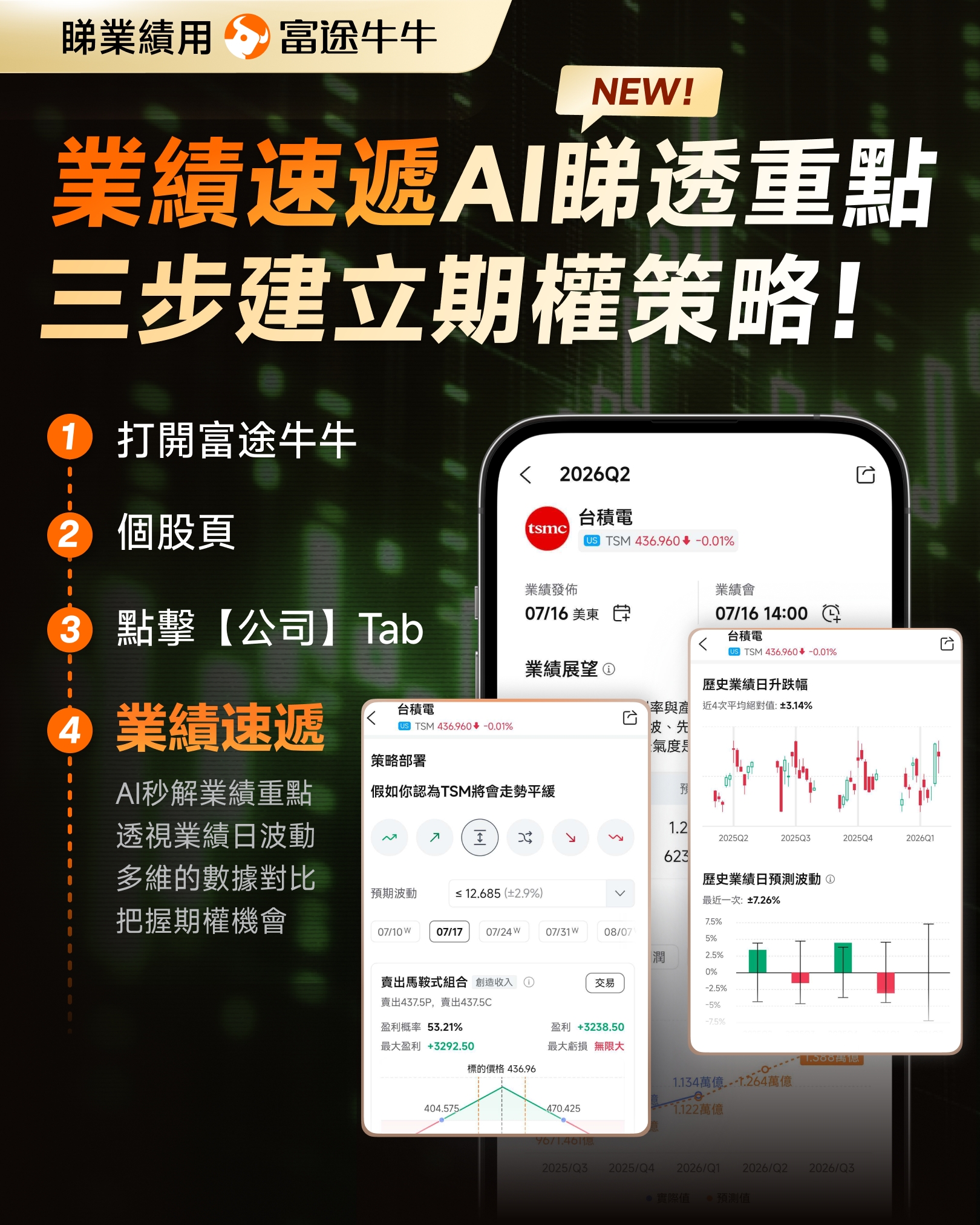
 AI-Powered Earnings Insights: Build Your Options Strategy in Three Steps! Open Futubull > Stock Page > Tap [Company] >Earnings Update
Editor/lambor