C. C. Wei stated frankly, 'I'm really jealous' of competitors' gross margin as high as 86% and noted that his Korean rival 'made a huge profit,' while also emphasizing that AI is an entirely new industry whose demand will remain robust through 2030.
Taiwan Semiconductor expects its full-year revenue growth in U.S. dollar terms to be slightly above 40%, exceeding its previous guidance of over 30%. The company also announced an additional $100 billion investment in the U.S. to build chip fabrication plants.
$Taiwan Semiconductor (TSM.US)$The company reported quarterly earnings that significantly exceeded expectations and raised its full-year revenue and capital expenditure outlook across the board. During the earnings call, Chairman and CEO C. C. Wei made several notable remarks, candidly stating, 'I’m really envious' of memory manufacturers’ 86% gross margin, and clearly affirming that AI represents a brand-new industry with strong demand expected to persist through 2030.
 During its earnings call on Thursday, Taiwan Semiconductor announced it is raising its 2026 capital expenditure forecast from $52–56 billion to $60–64 billion and expects full-year revenue growth in U.S. dollar terms to be slightly above 40%, surpassing its earlier guidance of over 30%. C. C. Wei remarked, 'Last time we said capital expenditures over the next three years would be significantly higher than the past three years—now, they will be even more significantly higher.'
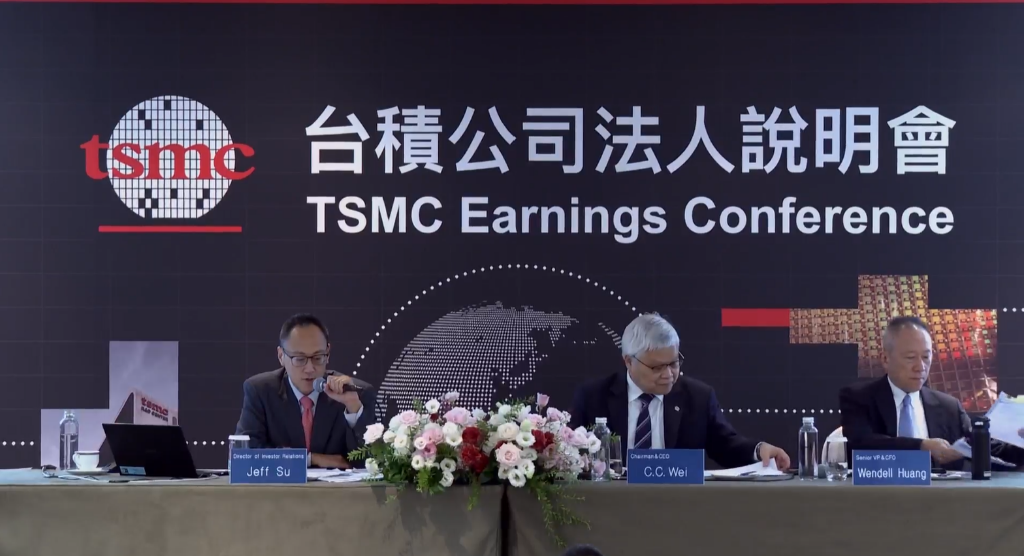
Taiwan Semiconductor also disclosed that third-quarter sales are expected to range between USD 44.6 billion and USD 45.8 billion, with a midpoint of approximately USD 45.2 billion—about USD 2 billion above the market consensus of USD 43.11 billion. As the key foundry partner for tech giants such as NVIDIA and Apple, Taiwan Semiconductor’s capital expenditure scale is widely viewed by the market as a critical indicator of the global AI chip supply-demand landscape.
Taiwan Semiconductor confirmed an additional $100 billion investment in Arizona, with the new funds earmarked for constructing four semiconductor fabrication plants. Additionally, the company plans to build 13 leading-edge process and advanced packaging wafer fabs in Taiwan over the coming years.
Taiwan Semiconductor's second-quarter financial reportshowed net profit reached NT$706.6 billion, exceeding the market expectation of NT$623.73 billion; gross margin stood at 67.7%, also outperforming market forecasts. The strong earnings performance has provided solid support for the company's continued increase in capital expenditures.
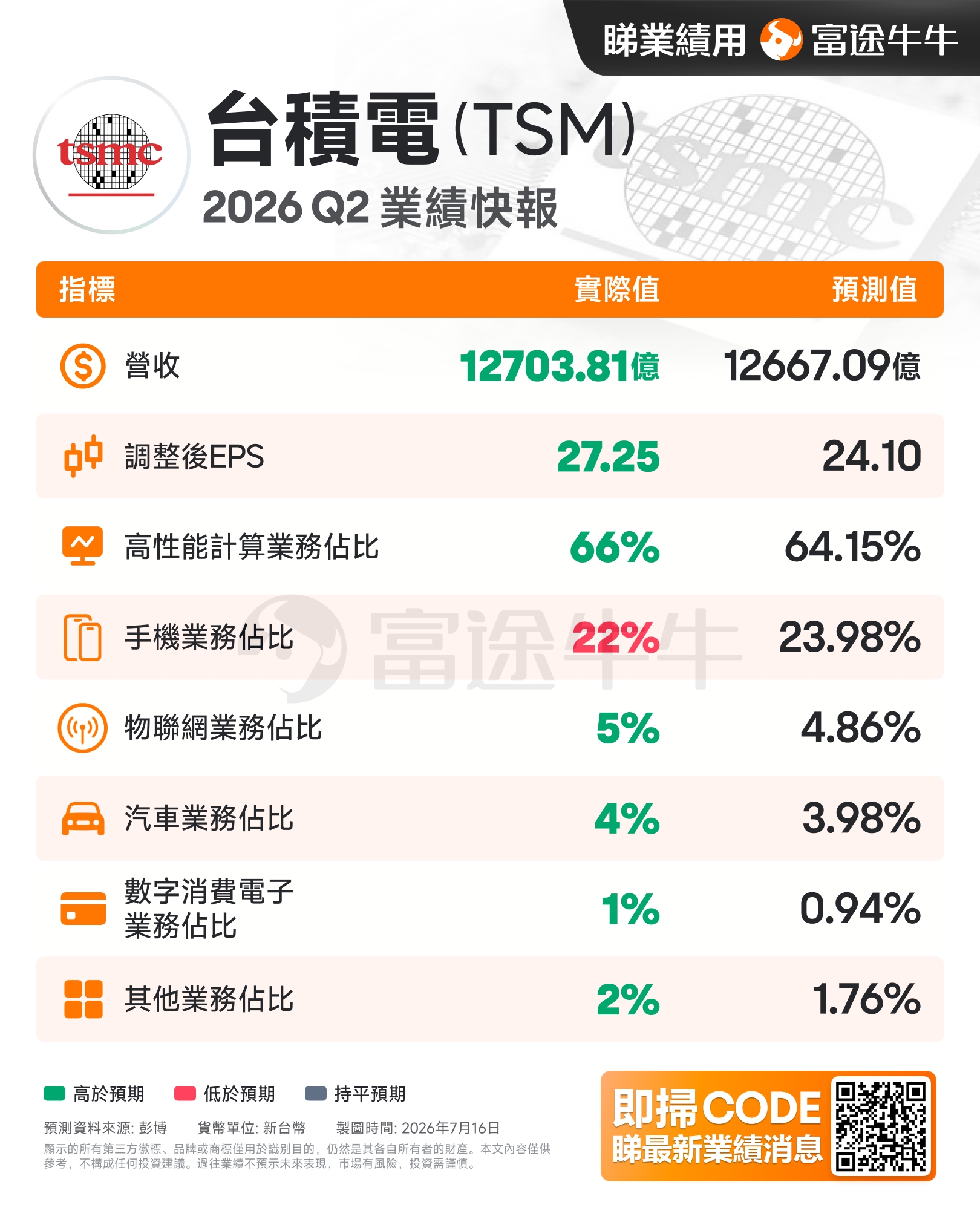
Results exceeded expectations across the board, with profitability continuing to strengthen.
Taiwan Semiconductor’s strong second-quarter profitability provides solid support for the company’s continued aggressive capital investments.
However, C. C. Wei remarked that upon seeing memory companies achieve an 86% gross margin, he was 'really jealous' ('I'm really jealous about the memory companies. 86% gross margin.'), but emphasized that as a 'partner' to its clients, Taiwan Semiconductor would not suddenly raise prices sharply enough to push customers out of the market: 'Our customers must succeed.'
He also said, 'One of my Korean competitors indeed made a huge profit—to be honest, I really envy them.'
The third-quarter guidance also surpassed market expectations. Taiwan Semiconductor forecasts third-quarter sales between USD 44.6 billion and USD 45.8 billion, compared to the prior market consensus of USD 43.11 billion. Gross margin guidance is set at 65%–67%, and operating margin guidance at 56%–58%, both broadly in line with market expectations.
The company’s CFO stated that Taiwan Semiconductor sees no bottlenecks in capacity expansion and expects cash dividends to continue increasing in 2027.
Full-year capital expenditures have been substantially increased, rising by approximately 14%.
Taiwan Semiconductor has raised its 2026 capital expenditure ceiling from the previously announced $56 billion to $64 billion, an increase of approximately 14%.
C. C. Wei revealed that the 'most important reason driving the upward revision in capital expenditure is sustained demand growth. We are feeling significant pressure from customers urging Taiwan Semiconductor to expand capacity accordingly.'
Regarding future capital expenditure, C. C. Wei stated clearly:
"Last time we said that capital expenditure over the next three years would be significantly higher than in the past three years. Now, capital expenditure over the next three years will be even more significantly higher than in the past three years."
In response to concerns from some market participants about the sustainability of AI-related capital spending, C. C. Wei responded directly:
"I believe demand will remain very strong from now through 2029 and 2030. I’m not entirely certain whether there will be fluctuations along the way, but this trend is so powerful that I believe we are witnessing the emergence of a new industry—the AI industry."
A14 technology progress exceeds expectations and will be larger and longer-lasting than N2
During the earnings call, C. C. Wei highlighted progress on A14 technology, stating that A14 development is proceeding as planned, 'customer tape-out activities are already underway and ahead of schedule,' with pilot production scheduled to begin in 2027 and volume production planned for 2028.
He emphasized specifically: 'The A14 and its derivative technologies will drive the A14 family to become a larger and more enduring node than N2, just as 2-nanometer technology is a larger and more enduring node than 3-nanometer.' A13 (97% optical shrink) and A12 (super power rail) are both scheduled for volume production in 2029.
On the challenges of advanced process development, C. C. Wei remarked candidly, 'There are no shortcuts. Developing new technologies like A14, building capacity, and ramping up production now takes five to seven years.'
Investment in Arizona expands to $265 billion, accelerating U.S. footprint
Taiwan Semiconductor confirmed an additional USD 100 billion investment in Arizona. C. C. Wei stated that the new investment will be used to build 'several or more' logic wafer fabs utilizing 2-nanometer and below technologies, as well as advanced packaging facilities. According to Bloomberg, citing a U.S. official who requested anonymity, the additional funds will finance the construction of four chip plants, bringing Taiwan Semiconductor’s total number of wafer fabrication facilities in the U.S. to ten and advanced packaging facilities to two, with total investment scaling up to USD 265 billion.
C. C. Wei also noted that over the next few years, the company plans to construct 13 leading-edge process and advanced packaging wafer fabs in Taiwan and will continue making further investments.
Taiwan Semiconductor’s CEO previously stated that even with continued capacity expansion in the U.S., the company will struggle to meet demand from American customers over the next several years.
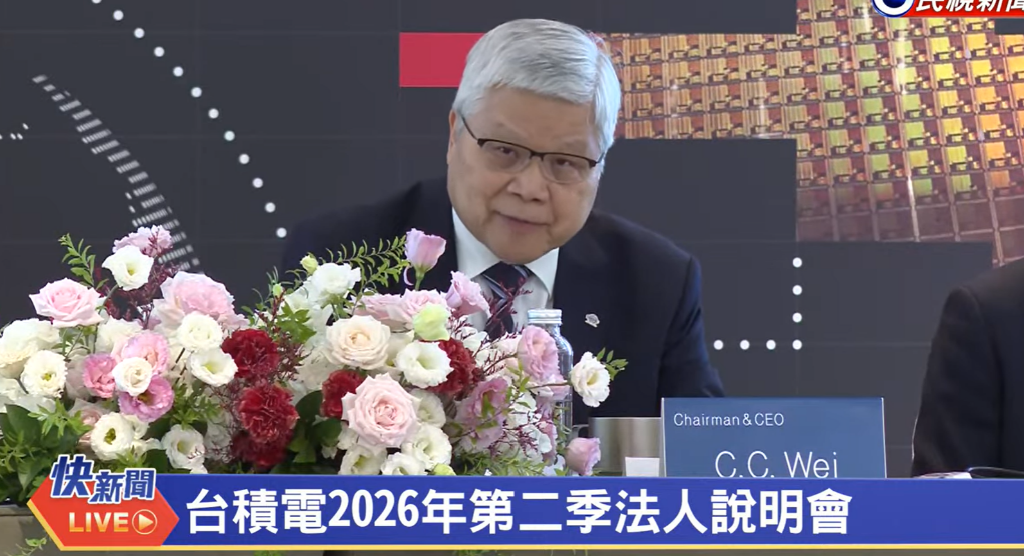
Competitive Landscape: Choosing a Technology Partner Is Not Like Buying Milk at 7-Eleven
In response to investor questions regarding competitive pressures from Samsung Electronics of Korea and Intel of the U.S., C. C. Wei stated bluntly, 'There are no shortcuts in selecting a technology partner—it’s not like going to the 7-Eleven next door to buy milk. If you don’t like one store, you just go to another—that’s not how it works.' He emphasized that competition in the semiconductor industry must return to fundamentals: technology, manufacturing capability, and customer trust. 'These three pillars have remained unchanged for over 30 years and have always been the secret to Taiwan Semiconductor winning business.'
Regarding competition in the advanced packaging segment, C. C. Wei remarked that packaging and wafer manufacturing 'are two different things,' adding that Taiwan Semiconductor’s back-end packaging capacity is severely supply-constrained. 'I welcome competitors offering greater flexibility to customers—this actually benefits Taiwan Semiconductor’s front-end wafer business.'
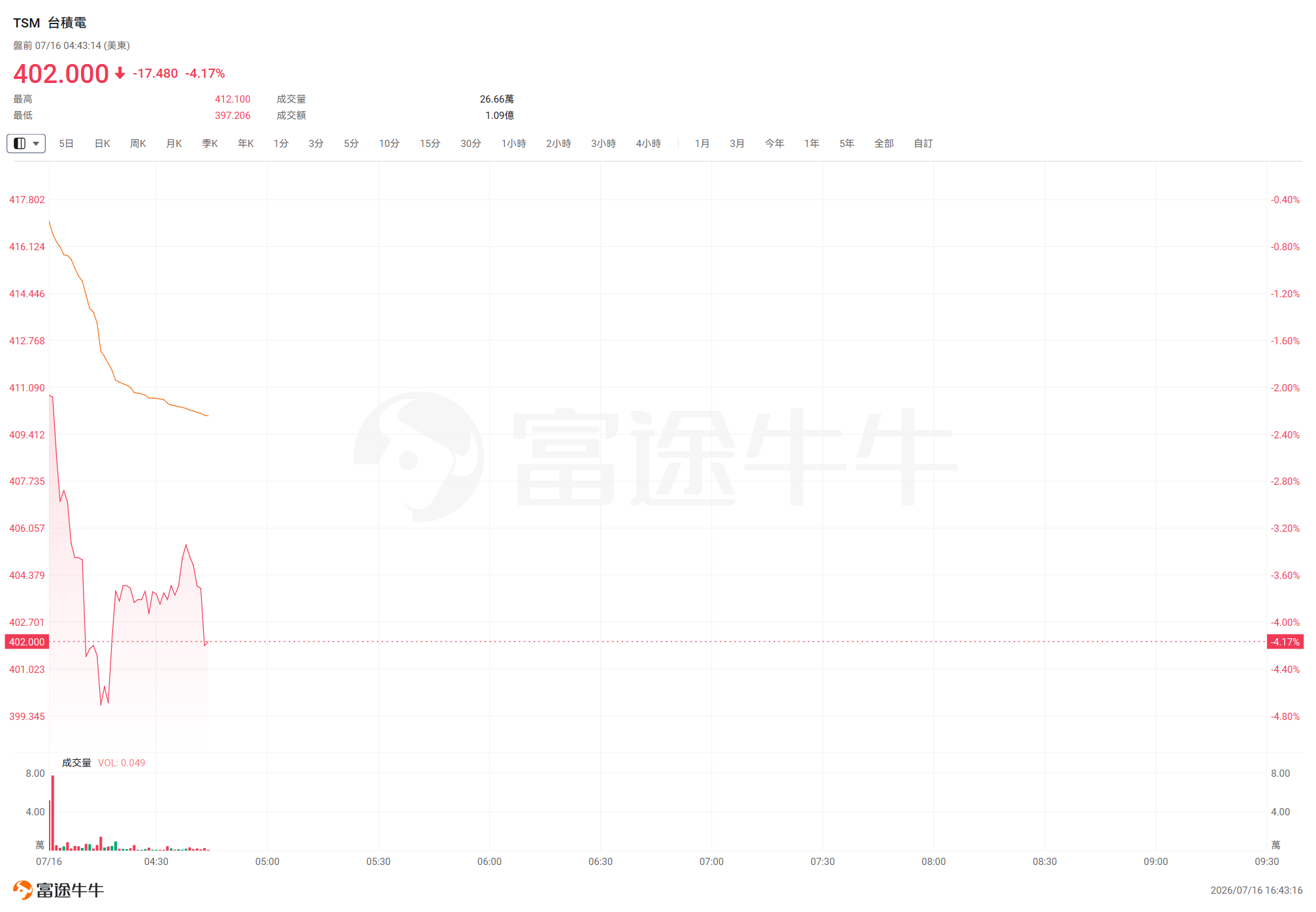
Following the release of the financial results, as of this report,$Taiwan Semiconductor (TSM.US)$the stock fell more than 4% in pre-market trading on the U.S. exchange.
Below is the full transcript of the earnings call:
Taiwan Semiconductor Q2 2026 Earnings Conference Call Transcript
Conference Date: July 16, 2026 Company Name: Taiwan Semiconductor (TSMC) Event Description: Q2 2026 Earnings Conference Call
Presentation Segment
Jeff Su, Head of Investor Relations:
Good afternoon, everyone. Welcome to Taiwan Semiconductor’s second-quarter 2026 earnings release and conference call. I am Jeff Su, Head of Investor Relations at Taiwan Semiconductor, and I will be moderating today’s event. This event is being webcast live on Taiwan Semiconductor’s official website at www.tsmc.com, where you can also download the earnings materials. If you are participating via telephone, your line is in listen-only mode.
The agenda for today’s event is as follows: First, Mr. Randy Huang, Senior Vice President and Chief Financial Officer of Taiwan Semiconductor, will summarize the company’s operational performance for the second quarter of 2026 and provide guidance for the third quarter of 2026. Following that, Mr. Huang and Dr. C. C. Wei, Chairman and Chief Executive Officer of Taiwan Semiconductor, will jointly deliver the company’s key messages. Afterward, we will open the floor for Q&A from both in-person and online participants.
As a customary reminder, please note that today’s discussion may contain forward-looking statements, which are subject to significant risks and uncertainties, and actual results may differ materially from those expressed in such forward-looking statements. Please refer to the safe harbor statement included in our press release.
Now, I would like to invite Mr. Randy Huang, Chief Financial Officer of Taiwan Semiconductor, to present a summary of operations and provide guidance for the quarter.
Senior Vice President and Chief Financial Officer Randy Huang:
Thank you, Jeff. Good afternoon, everyone, and thank you for joining us today.
My presentation will begin with the financial highlights for the second quarter of 2026, followed by guidance for the third quarter of 2026.
Revenue by technology node:
The 2-nanometer process technology contributed 3% of wafer revenue this quarter;
3nm, 5nm, and 7nm accounted for 30%, 33%, and 11%, respectively;
Advanced process technologies (defined as 7nm and below) collectively represented 77% of wafer revenue.
Revenue contribution by platform:
HPC (High-Performance Computing) increased by 20% quarter-over-quarter, accounting for 66% of second-quarter revenue;
Smartphones declined by 4%, representing 22%;
IoT grew by 4%, accounting for 5%;
Automotive electronics rose by 15%, representing 4%;
DCE increased by 5%, accounting for 1%.
On the balance sheet:
As of the end of the second quarter, our cash and marketable securities amounted to NT$3.5 trillion (approximately USD 110 billion). On the liabilities side, current liabilities increased by NT$144 billion quarter-over-quarter, primarily driven by a NT$58 billion increase in accounts payable and a NT$48 billion increase in accrued liabilities and other items.
Regarding financial ratios:
Days sales outstanding increased by 3 days to 29 days; inventory days increased by 7 days to 87 days, primarily due to the ongoing ramp-up of N2 technology.
Regarding cash flow and capital expenditures:
In the second quarter, we generated approximately NT$783 billion in cash from operations, incurred capital expenditures of NT$496 billion, and paid NT$156 billion in cash dividends for the third quarter of 2025. Overall, cash balance at quarter-end increased by NT$99 billion to NT$3.1 trillion. In U.S. dollar terms, capital expenditures for the quarter totaled USD 15.7 billion.
This concludes the financial summary. Below is our guidance for the current quarter:
Based on our current business outlook, we expect third-quarter revenue to range between USD 44.6 billion and USD 45.8 billion, representing a sequential increase of approximately 12% and a year-over-year increase of approximately 37%. At the midpoint and assuming an exchange rate of USD 1 to NT$32, gross margin is expected to be between 65% and 67%, and operating margin between 56% and 58%.
We will now move to the key messages section, beginning with profitability for the second and third quarters of 2026:
Compared to the first quarter, second-quarter gross margin improved by 150 basis points sequentially to 67.7%, slightly exceeding guidance, primarily driven by cost improvement initiatives and moderately higher overall capacity utilization, partially offset by the dilutive impact from overseas wafer fabs.
Our just-released third-quarter gross margin guidance has a midpoint of 66%, representing a sequential decline of 1.7 percentage points. This is primarily due to the rapid ramp-up of 2-nanometer technology, which is expected to dilute gross margin by approximately 3 to 4 percentage points. This dilution is expected to be partially offset by strong demand for leading-edge technologies and ongoing cost improvement initiatives, including enhanced production efficiency and cross-node capacity optimization.
Looking ahead to the second half of the year, considering the six key factors affecting gross margin, the following points warrant attention:
First, the rapid ramp-up of 2-nanometer production is expected to dilute gross margins by approximately 3 to 4 percentage points in the second half of the year. Second, as our overseas expansion scales up, we anticipate that the initial phase of overseas fab ramp-ups will dilute gross margins by 2% to 3%, widening to 3% to 4% in later stages. On the other hand, demand for leading-edge technologies remains very strong, and we will continue leveraging our manufacturing excellence to increase wafer output and drive cross-node capacity optimization to support profitability. Additionally, foreign exchange rate movements are beyond our control but remain a contributing factor.
Regarding the 2026 capital expenditure budget:
Higher levels of capital expenditure have always corresponded to greater growth opportunities in the coming years. With our strong technological leadership and differentiated advantages, we are well positioned to capture structural, multi-year demand driven by industry trends in 5G, AI, and HPC. Given our customers’ sustained and robust structural demand—including from the emerging agentic AI market—we have decided to raise our full-year 2026 capital expenditure budget to between USD 60 billion and USD 64 billion.
While actively investing to support customer growth, we consistently collaborate closely with equipment suppliers well in advance—whether during strong upcycles or downturns—to prepare capacity ahead of time, just as our customers proactively coordinate capacity planning with us. Therefore, we face no bottlenecks in our capacity expansion plans.
Of the 2026 capital expenditure allocation, approximately 70% to 80% will be directed toward advanced process technologies, about 10% toward specialty process technologies, and roughly 10% to 20% toward advanced packaging, testing, mask manufacturing, and other areas.
Even with such significant capital expenditure committed to future growth, we remain committed to delivering profit growth for shareholders and to steadily increasing cash dividends per share—both on an annual and quarterly basis.
In 2025, Taiwan Semiconductor distributed a total of NT$467 billion in cash dividends, an increase of 28.6% year-over-year, resulting in NT$18 per share for shareholders. In 2026, shareholders will receive NT$24 per share, representing a further 33% year-over-year increase, and we expect cash dividends per share to continue rising in 2027.
I will now turn the microphone over to Mr. C. C. Wei.
C. C. Wei, Chairman and Chief Executive Officer:
Thank you, Wendell. Good afternoon, everyone.
Let us first discuss the near-term demand outlook:
In U.S. dollar terms, our second-quarter revenue was USD 40.2 billion, reaching the high end of our guidance range, driven by strong demand for leading-edge process technologies. As we enter the third quarter, our business will continue to be supported by sustained robust demand for leading-edge technologies, including the rapid ramp-up of our 2-nanometer technology.
Looking ahead, we observe that consumer and price-sensitive end markets are facing certain challenges due to component price increases and macroeconomic uncertainty. Accordingly, we are maintaining a prudent approach in our business planning and remain focused on strengthening our competitive advantages. Nevertheless, AI-related demand remains exceptionally strong. The overarching AI megatrend continues to drive demand for computing power, underpinning robust demand for leading-edge silicon chips. Our customers—and their customers, primarily cloud service providers—are consistently conveying very strong positive signals and optimistic expectations to us. Consequently, our confidence in the multi-year AI megatrend remains very high, backed by our significant technological differentiation and broad customer base.
We currently expect full-year 2026 revenue growth (in U.S. dollar terms) to slightly exceed 40%.
Regarding the accelerated development of agent AI:
The AI market remains highly dynamic. The emergence of agent AI is driving CPUs to resume a significant role within AI data centers, further boosting silicon chip demand beyond AI accelerators. We view this as favorable for Taiwan Semiconductor, as virtually all CPU architectures—whether x86, ARM, or RISC-V—are customers of ours. We are already working closely with our CPU customers, supporting them with our most advanced technologies and necessary capacity to capture opportunities presented by agent AI.
Regarding Taiwan Semiconductor’s capacity expansion strategy:
Taiwan Semiconductor collaborates closely with customers and their customers to jointly plan capacity. Given the inherent complexity of leading-edge technologies and the requirements associated with design-in and lead times, we have clear visibility into our customers’ multi-year product roadmaps and production plans. This visibility is critical because the entire process—from technology and product development, through capacity preparation, to volume ramp—takes more than five years, with no shortcuts available.
Internally, Taiwan Semiconductor employs a rigorous capacity planning system, continuously assessing market demand from both top-down and bottom-up perspectives. Based on our assessments, we are increasing capital expenditures to expand capacity and support our customers’ future growth.
We have announced an additional USD 100 billion investment in Arizona to construct multiple semiconductor logic wafer fabs supporting 2-nanometer and below process technologies, as well as advanced packaging facilities, to meet the strong multi-year demand from leading U.S. customers.
Meanwhile, we are constructing 13 leading-edge and advanced packaging wafer fabs in Taiwan, China, and will continue to increase our investment in Taiwan. Taiwan Semiconductor’s semiconductor technology and manufacturing will continue to play a pivotal role in supporting the global semiconductor industry and unlocking our customers’ innovation potential.
Regarding the current N3 capacity expansion:
We are actively advancing our global capacity expansion plan by adding three new 3-nanometer wafer fabs—located in Taiwan, China; Arizona; and Japan—to support the robust multi-year demand pipeline for 3-nanometer technology. In addition to building new fabs, we are continuously converting 5-nanometer tools in Taiwan to 3-nanometer capacity, leveraging our manufacturing excellence to enhance wafer output across all sites, and driving cross-node capacity optimization among N7, N5, and N3 nodes. In summary, we are employing multiple approaches—doing everything possible, wherever possible, and in every possible way—to maximize support for all our customers.
Regarding our mature node strategy:
Taiwan Semiconductor’s strategy for mature nodes remains unchanged. Our top priority is to fully support customer demand, and we will continue to increase—not reduce—mature node capacity in high-value segments. For example, we are expanding mature node capacity for CMOS image sensor applications through JASM’s second fab in Japan and increasing capacity for automotive and industrial applications through ESMC in Germany.
In the current market environment, demand for mature nodes outside specific segments such as power management ICs and CMOS image sensors is not strong. Therefore, Taiwan Semiconductor will continue to focus on high-value and strategic segments to ensure it maintains the necessary capacity to support customer growth.
Regarding progress on A14 technology:
As previously noted, the complexity of leading-edge technologies continues to rise. Developing new technologies such as A14, building the required capacity, and ramping it to volume production now takes five to seven years—there are no shortcuts.
A14 technology is the second-generation nanosheet transistor offering a four-node leap forward from N2, delivering performance and power efficiency advantages to meet the urgent demands of high-performance and energy-efficient computing. Compared to N2, A14 achieves a 10% to 15% speed improvement at the same power, a 25% to 30% reduction in power consumption at the same speed, and nearly a 20% increase in chip density.
Development of A14 technology is progressing smoothly and on schedule. Internal product testing shows device performance is approaching 90% of target benchmarks, and 256 Mbps SRAM yield is also nearing 90%. We are observing strong interest and active engagement from customers in smartphone and HPC/AI applications, with customer tape-outs already underway and ahead of schedule. Risk production is scheduled to begin in 2027, with volume production targeted for 2028.
Through our continuous enhancement strategy, we have also introduced A13 and A12 as extensions of the A14 family. Building upon A14, A13 further evolves with an innovative 97% optical shrink, achieving over 6% die area savings, while delivering additional performance and power efficiency gains through ongoing design and process optimizations. Certain design rules remain backward-compatible with A14, ensuring smooth IP migration. A12 integrates our innovative Super Power Rail technology into the A14 platform, offering superior performance, power, and area advantages. Both A13 and A12 are scheduled for volume production in 2029.
We believe that A14 and its derivative technologies will make the A14 family a larger and longer-lasting node for Taiwan Semiconductor than N2—just as the 2-nanometer technology is a larger and more enduring node than the 3-nanometer node—further solidifying and extending our technology leadership.
This concludes the core message. Thank you all for your attention.
Q&A Session
Jeff Su, Head of Investor Relations:
Thank you, Mr. C. C. Wei. This concludes the presentation segment.
Please note that we aim to conclude today’s meeting by approximately 3:10 p.m. We will do our best to accommodate as many questions as possible. Should we be unable to address all questions, we apologize in advance and appreciate your patience.
We will now open the floor for Q&A. We will first take a few questions from the audience on-site before moving to online participants. First, please welcome Sunny Lin from UBS Group.
Sunny Lin (UBS Group, Analyst):
Thank you very much, and congratulations on the company’s exceptionally strong results and outlook. My first question concerns capital expenditures. Given the significantly stronger demand and tight supply conditions, I believe it is very important that Taiwan Semiconductor demonstrates a stronger commitment to capacity expansion. Aside from 2026, could the company share its capital expenditure outlook for the next three years—2026, 2027, and 2028—in a manner similar to what was done in 2021?
C. C. Wei:
Sunny, regarding the three-year capital expenditure guidance, we currently do not have specific figures to share. However, as you know, our capital expenditures this year are being made to position ourselves for future business opportunities, and we will not hesitate to invest whenever such opportunities arise. As reflected in our core messaging, we remain firmly confident in the strong, long-term AI megatrend, and we are continuously increasing our capital expenditures, including raising them for this year.
Last time, we stated that capital expenditures over the next three years would be significantly higher than those of the past three years. Now, we can say that capital expenditures over the next three years will be even more substantially higher than those of the past three years.
Sunny Lin:
Understood. Let me approach the capital expenditure question from a different angle. You just announced an additional $100 billion investment in the U.S., which is critical for securing your business there. Total investment in Arizona has now reached $265 billion. Could you share your capacity deployment plans for Arizona over the coming years?
Huang Renzhao:
In other words, with the additional $100 billion investment in Arizona, bringing total investment to $265 billion, what is the timeline and plan for these investments, Sunny?
C. C. Wei:
Yes. Sunny, the timeline depends on market conditions. Given the current environment and the strength of this megatrend, we have announced the additional $100 billion investment in Arizona. How many new fabs will be built? Many. In fact, we expect to build approximately four or more additional fabs.
Sunny Lin:
Does this include both front-end and back-end facilities?
C. C. Wei:
Yes.
Charlie Chan (Morgan Stanley, Analyst):
Thank you for the opportunity to ask a question, and good afternoon. My first question is about foundry competition. I understand there are no shortcuts for new entrants, but Samsung Foundry benefits from substantial profits generated by its memory business, while Intel has received strong U.S. government support. Reports indicate that several U.S. companies are currently engaging with these peers. Additionally, ASML just announced yesterday that it will expand EUV capacity for 2028. How does Taiwan Semiconductor view the competitive threat posed by rivals expanding capacity in leading-edge businesses?
C. C. Wei:
My Korean competitor has indeed made a lot of money—I’ll admit, I’m quite envious. The one in the U.S. has received very strong government support.
However, as we’ve said before, there are no shortcuts. This means that in the semiconductor industry, we must always return to fundamentals: government support is certainly welcome, and funding is undoubtedly important, but what matters most—what we have consistently emphasized—are the three core fundamentals: technology, manufacturing, and customer trust. Throughout my 30- to 40-year career, these three elements have always been paramount and remain the cornerstone of how Taiwan Semiconductor wins business.
Selecting a technology and ramping it into volume production isn’t as simple as buying milk from a convenience store—that’s a quote I borrowed from a customer. There’s no shortcut when choosing a technology partner; you need deep technical understanding, genuine implementation, close collaboration, prepared capacity, and a joint effort to drive the ramp. As I mentioned, this typically takes about five years. You can’t simply switch suppliers today because you think someone else’s milk tastes better. That’s my answer.
Charlie Chan:
Understood—I hope you buy even more milk so others can’t get any. Let me shift to a more exciting topic. C. C., you mentioned receiving very strong signals from your customers’ customers and have raised your full-year guidance. Are you now prepared to revise upward your previously stated five-year compound annual growth rate (CAGR) forecast for AI semiconductors? If I recall correctly, it was in the high 50% range. Furthermore, agent-based AI is driving significant CPU demand—a major opportunity for Taiwan Semiconductor—but could rising memory costs pose a meaningful headwind to AI capital expenditure? Please share your latest view on the AI semiconductor CAGR and how you assess the contribution of AI-related business to Taiwan Semiconductor’s growth.
C. C. Wei:
Charlie, if you focus on our core message, our continued increase in investment and capital expenditure is well justified. Regarding the CAGR for AI, I don’t have a specific figure to share with you, but I can only say: stronger, stronger, and even stronger. The reason we are not providing a number right now is that it continues to rise—more robustly than our previous forecasts.
Arthur Rakowski (Macquarie, Analyst):
First, congratulations on the company’s strong execution and performance. My question concerns competition in advanced packaging. We’ve noticed technologies like EMIB are gaining attention—how does Taiwan Semiconductor view this competitive landscape?
C. C. Wei:
Our packaging capacity is currently extremely tight and has become a bottleneck limiting our customers’ growth. Therefore, we welcome greater flexibility in the market, which will support the growth of Taiwan Semiconductor’s front-end wafer business—that remains the core of our operations. From reports, this technology appears to be performing well, and we hope it succeeds, as it could help alleviate some of the load currently on Taiwan Semiconductor. We are actively working to narrow the gap between demand and capacity, so we welcome these additional alternative options that provide more flexibility for our customers.
Arthur Rakowski:
Thank you—that makes a lot of sense. A quick follow-up: if customers require Taiwan Semiconductor’s support for this new technology, how would the company respond?
Huang Renzhao:
Let me address this question. Our primary principle is to support our customers’ success. If something benefits our customers’ businesses, we aim to be involved. Does that answer your question?
Anonymous Participant (Gokul):
Thank you, C.C., Wendell, and Jeff. My first question is about your philosophy on capacity expansion. As the undisputed market leader, a prolonged state of supply falling short of demand is not ideal for Taiwan Semiconductor either—you would likely prefer a more balanced market. How do you factor in competitive pressures, and how long do you anticipate it will take to meet current demand? Secondly, alongside the chip shortage, there is considerable discussion in the market about data center delays, power supply constraints, and related issues. How do you incorporate these factors into your planning framework to avoid the risk of chips being ready while data center deployment lags behind?
C. C. Wei:
That’s a good question. Indeed, when planning our business, we prioritize competitive dynamics as a key consideration. We assess multi-year demand from both top-down and bottom-up perspectives, incorporating inputs from our customers and cloud service providers (CSPs) to form our judgment.
It’s important to note this: I believe every customer is telling me their truth, but adding up everyone’s 'truth' doesn’t necessarily equal the actual truth. Customers are naturally optimistic, and the figures they provide represent their best forecasts. We must exercise prudent judgment on that basis—such judgment may not always be correct, but we make it thoughtfully and carefully. After all, this involves substantial capital: this year, we’ve raised our capital expenditure from $50 billion to $56 billion, and further to between $60 billion and $64 billion—an enormous sum—so naturally, we proceed with great caution.
Regarding your second question—we are indeed verifying the progress, location selection, demand outlook, and risks associated with AI data center construction to ensure that Taiwan Semiconductor’s chips do not end up sitting idle in customer inventory.
Anonymous Participant (Gokul):
Understood. C.C., even with such an extensive capacity expansion plan in place, do you believe we will still be in a state of supply shortage by the end of next year?
C. C. Wei:
You’re asking for a guarantee, aren’t you? Let me say this: I believe that from today until roughly 2029 or 2030, demand will remain very strong. Whether there might be brief fluctuations in between, I cannot be entirely certain—but the underlying trend is powerful enough that I believe we are witnessing the birth of a new industry, which I would call the 'AI industry.' It will profoundly impact our daily lives, including in areas like automobiles, humanoid robots, and across all sectors. Judging by the scale of investment from all major cloud service providers, this is a brand-new industry of immense global significance. Demand will persist, and at its foundation lies semiconductor chips—most of which come from Taiwan Semiconductor.
Anonymous Participant (Gokul):
Thank you. My second question is about profitability. C.C., you joked about envying the gross margins of memory competitors, but in the long run, wafer foundry—especially leading-edge foundry—should be more profitable than memory, given the smaller number of competitors. As you make significant investments on behalf of numerous customers, how are pricing negotiations progressing? Given that your profitability is no longer the highest in semiconductor manufacturing, does this imply that the pressure you face in delivering and capturing value has relatively eased?
C. C. Wei:
Gokul, your question is actually quite straightforward—it’s about TSMC’s wafer pricing strategy and target gross margin. Of course, the higher the better. However, we operate as partners—I’ve emphasized many times that our customers must succeed; I don’t want to price them out of the market. Moreover, we are a highly trustworthy company and would never suddenly impose large price increases. We earn reasonable profits by creating value, ensuring our gross margin is sufficient to support long-term, sustainable expansion—which benefits both our customers and TSMC. This is our business philosophy.
Yes, I truly do envy memory companies’ 86% gross margin—if TSMC could approach 68%, I’d already be very satisfied. We are an extremely trustworthy company.
Operator: The next question comes from Jim Fontanelli of Arete.
Jim Fontanelli (Arete, Analyst):
Thank you for the opportunity to ask a question. How do you view the risks associated with rising customer concentration, given that AI demand continues to significantly outpace other end markets? I believe your top-five customer concentration is reaching an all-time high, and I’d like to understand your perspective on this risk.
C. C. Wei:
This is not a concern for us. The large customers you mentioned are indeed growing even larger, and we are very pleased about that. At the same time, the AI industry is also seeing many fast-growing new players emerge, so the risk of customer concentration isn’t as concerning as you’ve described.
Jim Fontanelli:
Okay. I also noticed that some of Taiwan Semiconductor’s direct customers are making capital investments to enter their end customers’ businesses. Is Taiwan Semiconductor considering a similar arrangement—specifically, investing in its customers’ customers?
C. C. Wei:
To answer your question directly: No, Taiwan Semiconductor currently does not intend to pursue such financial arrangements, as we believe our existing collaboration model with customers is smooth and successful.
Operator: Our next question comes from Mateo Hosseini of Sig.
Mateo Hosseini (Sig, Analyst):
Thank you for the opportunity to ask a question. I’d like to return to the USD 100 billion investment in the United States. Could you provide some clarity on the timeline—over the next three or five years—on how we should understand the pace at which this USD 100 billion investment will be deployed?
C. C. Wei:
We do have plans, but frankly, the pace typically depends on market conditions and customer demand. If you’re asking me for a definitive schedule, we don’t have one at this time—but we do have plans and will advance them as quickly as possible. Currently, there is a significant gap between demand and supply, so we are accelerating construction of our new fabs in Taiwan and Japan.
Mateo Hosseini:
Okay. My second question is that I’d like to better understand the computing aspect of HPC, specifically regarding network switches—when will the CoUP platform start making a material contribution to your revenue?
C. C. Wei:
I believe AI data centers need to reduce power consumption and increase communication bandwidth. Therefore, I expect demand for the CoUP platform will continue to grow and become a very important technology in the coming years. We have already begun volume production and will ramp up output over time.
Laura Chen (Citi, Analyst):
Thank you very much for the opportunity to ask a question. My first question is this: TSMC has raised its capital expenditure and growth outlook, and you also mentioned the growth potential of agentic AI and CPUs. Could you provide more detail on the demand growth and visibility between GPU accelerators and CPUs within AI-related chips?
C. C. Wei:
Laura, I can’t give you very specific numbers, but I can say that all these chips are manufactured at Taiwan Semiconductor and all use the same leading-edge process technologies. We are working closely with our customers to allocate wafer supply appropriately among CPUs, GPUs, and XPUs.
Laura Chen:
Okay, thank you. My second question is about advanced packaging. We know Taiwan Semiconductor previously announced a CoWoS roadmap supporting 14x reticle-sized packages to enable larger-scale AI integration. We also noticed that TSMC showcased progress in glass substrate development for CoWoS in Japan. Could you provide us with an update on the development status of new technologies such as glass substrates and glass core substrates?
C. C. Wei:
CoWoS remains the mainstream solution at present. We are developing alternative approaches to reduce costs and collaborating with substrate suppliers so our customers can bring their products to market. We are building out the production lines I announced several quarters ago, which will take approximately another year to mature before we can ramp into volume production with our customers.
Anonymous Participant (Haas):
Thank you, C.C., Wendell, and Jeff. My first question concerns the relationship between capital expenditures and revenue. You provided a fairly solid capital expenditure outlook for this year and indicated that capital spending will remain very substantial over the next few years, while also raising your revenue growth guidance for this year to above 40%. Could you share some visibility on revenue growth expectations for the coming years? Additionally, what are the key demand drivers prompting your upward revision to capital expenditures? Is demand this year still primarily driven by cloud computing, or is it now spreading toward edge computing? Are equipment vendors’ price increases also a contributing factor?
C. C. Wei:
Since our revenue directly corresponds to our investments, we base our capital expenditures on our demand forecasts and assessments. The next few years will be an exceptionally strong business period for Taiwan Semiconductor. Regarding the key drivers—it’s everything related to AI. All of it.
Anonymous Participant (Haas):
Understood. I’d also like to ask about competition in back-end packaging. If competitors make progress in advanced packaging technologies—such as EMIB—could that serve as a foothold for them to enter the front-end logic wafer business?
C. C. Wei:
Front-end wafer fabrication and back-end packaging are entirely separate businesses. If they were the same, you should also be concerned about OSATs becoming front-end competitors. They are completely different domains. As I’ve mentioned before, given our severe shortage of back-end capacity, the flexibility our competitors offer in packaging actually helps ensure that our customers’ front-end wafers can be packaged—which ultimately supports Taiwan Semiconductor’s front-end wafer business. That is our perspective.
Operator: Our next question comes from Robert Sanders of Deutsche Bank.
Robert Sanders (Deutsche Bank, Analyst):
Thank you for the opportunity to ask a question. You previously mentioned that High-NA EUV tools are too expensive. Could you elaborate on how customers view the die-stitching challenges arising from the smaller exposure field of High-NA? Will this slow down the adoption of High-NA technology?
C. C. Wei / Jeff Su:
High-NA is indeed an excellent tool with outstanding performance. However, Taiwan Semiconductor has clearly stated that we are working closely with ASML to make it more suitable for high-volume manufacturing in terms of both cost and maturity. We always prioritize technology maturity and cost as core considerations when deciding whether to adopt a new technology.
Robert Quinn (Deutsche Bank, Analyst):
Understood. To follow up, I think everyone here assumes that unconstrained demand for 3-nanometer and below nodes exceeds supply by roughly 30% to 50%. Is the actual gap even larger than that? Because based on your remarks, it seems the discrepancy might be greater, while most of us currently assume this issue will be resolved within the next three to four years.
C. C. Wei:
Those are your numbers. Regarding the supply-demand gap, I don’t have specific figures to share. I can only say that the gap is indeed much larger than… I don’t want to compare it to memory, but it’s a very significant gap.
Evelyn Yu (Goldman Sachs, Analyst):
Thank you for the opportunity to ask a question. At your technology symposium, Taiwan Semiconductor mentioned that capacity for the 2-nanometer family will grow at a CAGR of approximately 70% between 2026 and 2028, while N3 plus N5 will grow at a CAGR of about 25% from 2022 to 2027. Following the recent increase in capital expenditure, do these figures remain accurate, or have they changed?
C. C. Wei:
We presented relevant charts at the technology seminar. The current figures are even larger. That’s all.
Evelyn Yu:
Understood—the direction is very clear. My second question concerns capital expenditure on advanced packaging. Taiwan Semiconductor typically discloses capital expenditure for advanced packaging together with testing, mask making, and other areas, which accounts for approximately 10% to 20% of total capital expenditure. What proportion does advanced packaging itself represent? Given that advanced packaging is less capital-intensive than front-end manufacturing, how should we interpret the gap between its share of revenue (or pricing) and its share of capital expenditure? Should it be broken out separately?
C. C. Wei:
Evelyn, we strive to ensure the accuracy of our capital expenditure figures, but we need to maintain flexibility between front-end and back-end operations—sometimes the bottleneck is in the back-end, requiring us to purchase more tools; at other times, it’s in the front-end. Therefore, we can only provide a relatively wide range of 10% to 20%. Frankly speaking, over time, demand for test equipment from certain customer products has exceeded our expectations, compelling us to increase capital expenditure in areas such as testing and packaging. For this reason, we cannot precisely specify how much capital expenditure has been allocated to each sub-segment.
Anonymous Participant Felix Pan (Open Source Securities):
Thank you for the opportunity to ask a question. Good afternoon. My first question is about the reasons behind the upward revision of capital expenditure. Since the beginning of the year, Taiwan Semiconductor has raised its capital expenditure guidance by approximately USD 10 billion. What are the key drivers—AI agents, packaging, or AI accelerators?
C. C. Wei:
In short, the primary reason is sustained demand growth. We are feeling pressure from customers urging Taiwan Semiconductor to collaborate on capacity expansion—that’s one major factor. The second reason is inflation; we are facing price increases driven by inflation when purchasing equipment.
Anonymous Participant Felix Pan:
Thank you. My second question concerns mature nodes. While much attention is focused on leading-edge AI nodes, there appears to be a strong recovery in demand for mature nodes, accompanied by certain supply constraints. Could you please provide an overview of the current supply-demand dynamics and pricing situation for mature nodes? Some observers suggest that AI applications are crowding out other uses of mature nodes. However, overall demand for mature nodes still largely depends on consumer electronics, which remains weak at present. We would appreciate your perspective on this.
C. C. Wei:
Mature nodes span numerous细分 markets, and only those segments related to AI are currently experiencing shortages. Most notably, power management ICs are in short supply, as all AI data centers require substantial power management capabilities—these chips are fabricated using mature-node technologies such as 0.18-micron and 90-nanometer processes. Second, sensor-related components are also tight, given the need for large volumes of sensors to collect environmental data for input into AI data centers for analysis. Aside from these areas, as you rightly pointed out, demand from consumer electronics remains subdued, and demand in other细分 markets is not particularly robust—nowhere near the level of severe shortage.
Jeff Su, Head of Investor Relations:
Thank you, C. C. and Wendell, and thank you to all participants. This concludes the Q&A session.
Please note that the replay of this conference call will be available within 30 minutes, and the transcript will be posted on Taiwan Semiconductor’s website at www.tsmc.com within 24 hours. If you were unable to ask your question today, please feel free to contact Taiwan Semiconductor’s Investor Relations department at any time, and we will follow up with a response.
Thank you all for participating today. We wish you a pleasant summer and look forward to speaking with you again next quarter. Thank you, and goodbye.
Editor/lambor