SpaceX will conduct the 13th test flight of Starship tonight, marking its first major technical milestone following its IPO. If the V3 rocket successfully completes critical tasks such as satellite deployment and engine restart, it will validate the fully reusable launch architecture, paving the way for its first orbital mission and NASA’s lunar landing program, and potentially serving as a key catalyst to bolster its recently pressured share price.
$SpaceX (SPCX.US)$ The 13th test flight of the Starship rocket will take place tonight. This marks the first major test for the space giant since its IPO in June and is a critical component of Elon Musk’s broader strategy to build space-based data centers, expand the Starlink network, and advance crewed missions to the Moon and Mars.
The launch is scheduled for 5:45 p.m. local time on Thursday from SpaceX’s Starbase facility in southern Texas. It will be the second flight of the latest V3 iteration of the Starship rocket and will carry upgraded Starlink satellites for testing.
 Analysts widely view a successful test flight as a pivotal milestone in validating SpaceX’s investment thesis and potentially paving the way for its next attempt at achieving orbital insertion.
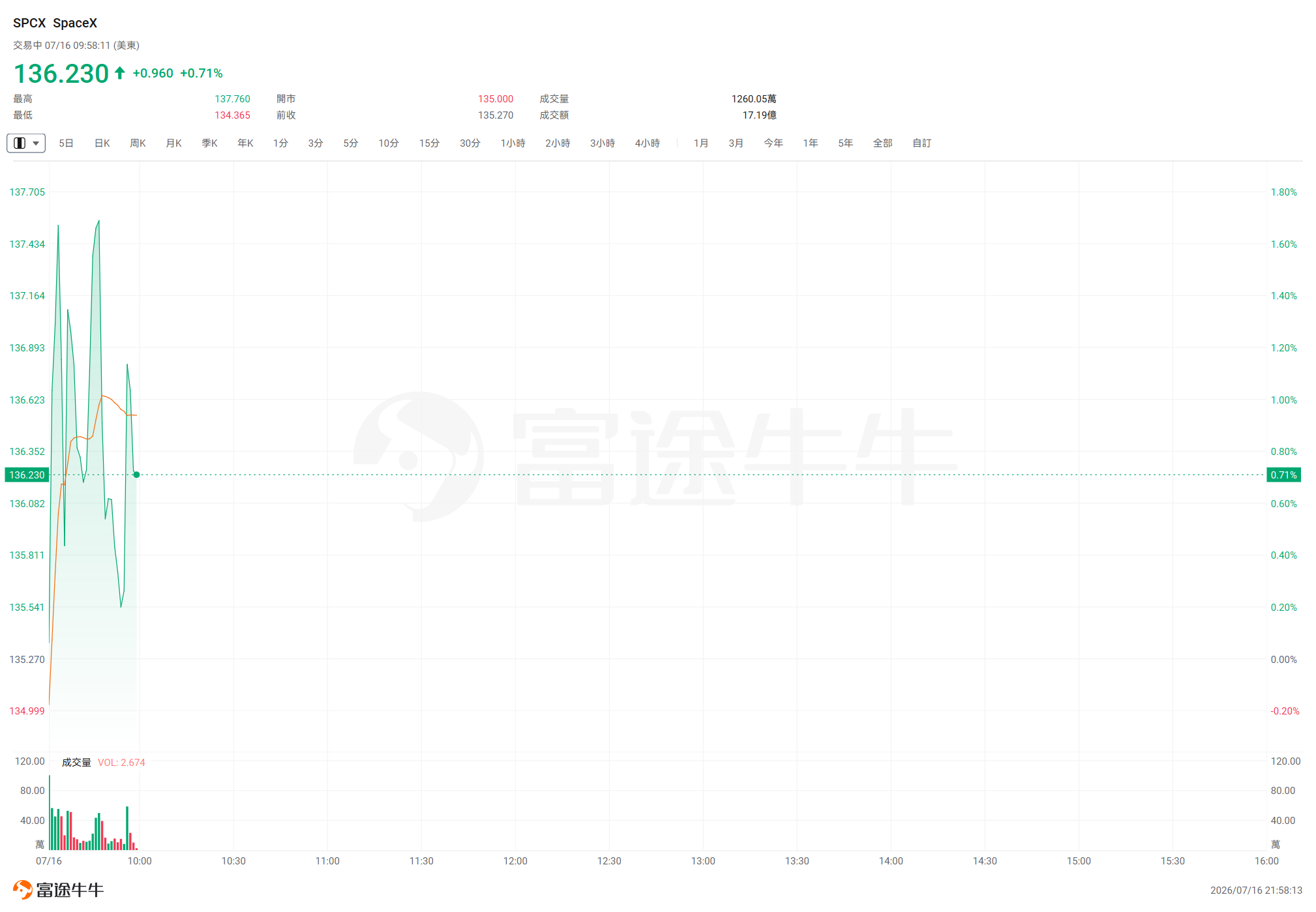
However, the test flight unfolds against a complex market backdrop. Since peaking at the June 16 close, SpaceX’s share price has declined by approximately one-third, wiping out over $860 billion in market value, and briefly dipping below its IPO price on July 15. The outcome of the Starship test flight and the company’s upcoming inaugural quarterly earnings report will serve as two key catalysts influencing future stock performance.
Test Flight Mission: Second Flight of V3 Version, Targeting Full Reusability
This flight marks the second appearance of the Starship V3 version.
According to the flight plan, the Super Heavy booster will ignite 33 Raptor engines to accelerate Starship to near-orbital velocity, after which the booster will separate and attempt a splashdown in the Gulf of Mexico.
In space, Starship will conduct several tests, including reigniting one engine and deploying 20 Starlink satellites. These satellites will unfurl their solar arrays and attempt to connect to the Starlink network via laser communications before reentering the atmosphere and burning up approximately 20 minutes later. Roughly one hour into the mission, Starship itself will splash down in the Indian Ocean.
SpaceX’s core objective is to achieve full reusability of Starship—meaning both the Super Heavy booster and the Starship spacecraft return intact to Earth for reuse—a technological breakthrough not yet accomplished by any other rocket manufacturer. Elon Musk previously projected that the V3 version could achieve full reusability within this year. SpaceX has invested over $15 billion in Starship development to date.
Issues identified during the previous test flight have been specifically addressed in this iteration.
During its 12th test flight in May, Starship successfully deployed a simulated satellite, but the booster experienced uncontrolled rotation and one engine shut down prematurely.
SpaceX subsequently issued a statement on its official website, indicating that it had implemented hardware and software modifications to address the aforementioned issues.
In a research report dated July 13, Raymond James analyst Brian Gesuale stated, "If SpaceX can keep all primary engines operational, successfully execute the planned relight and landing procedures, and return with more complete thermal protection system and control surface data, Flight 13 would represent a material improvement over Flight 12."
He also emphasized that achieving commercial operations for Starship 'is a critical path in SpaceX’s investment thesis.' Stifel analyst Jonathan Siegmann noted that if this test flight succeeds, the company could attempt orbital insertion for the first time on its next flight.
NASA contract secured, pressure mounts to meet crewed lunar landing timeline
Starship carries not only commercial ambitions but also a $4 billion NASA contract—SpaceX must use Starship to accomplish a crewed lunar landing as early as 2028.
To achieve this, SpaceX needs to demonstrate in-orbit propellant transfer, conduct more than ten consecutive launches, and ensure the spacecraft meets human-rating safety standards. However, Starship has yet to complete a single full orbital flight mission, and significant technical challenges remain.
The post-IPO honeymoon period has ended. After an initial surge following its listing, SpaceX’s share price quickly retreated, hitting an intraday low of $132.15 on July 15—the fourth consecutive trading day of declines. As previously reported by Wall Street Journal, approximately 37 million new shares were shorted over the past week, amounting to roughly $5 billion in market value. Short sellers have since recorded unrealized gains of $3.88 billion, with a short interest ratio of 28%—historically high for a newly listed company within its first month.
The market now faces dual pressures: uncertainty surrounding Starship’s test flight outcomes and the impending expiration of lock-up agreements following the release of the company’s first quarterly earnings report, which could unleash a flood of shares into the market. Despite recent downward pressure on the stock price, Wall Street analysts overall maintain a bullish stance on the shares.
 Want to select stocks or get a stock diagnosis? Curious about the opportunities and risks in your portfolio? For all your investment questions,Just ask Futubull AI!

Editor/rice