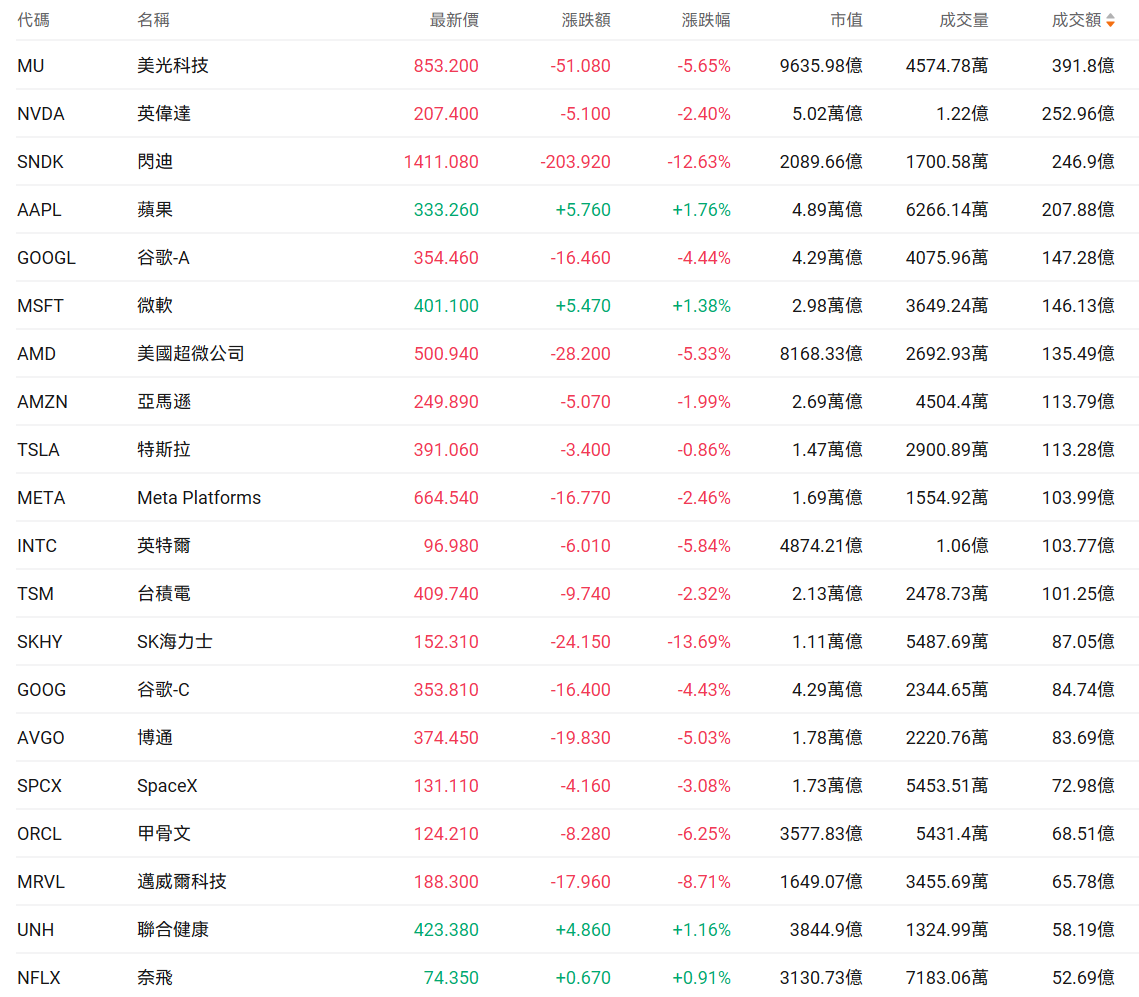
Top by trading volume on U.S. stock markets on Thursday$Micron Technology (MU.US)$Closed down 5.65%, with trading volume of USD 39.18 billion.
Memory stocks listed in the U.S. declined on Thursday, pushing Micron’s market capitalization below $1 trillion.
South Korea’s tightening of regulations on leveraged ETFs served as the immediate trigger for this market correction. On July 16, South Korea’s Financial Services Commission (FSC) officially announced stricter regulatory measures targeting single-stock leveraged ETFs, including: raising the minimum margin requirement from KRW 10 million to KRW 30 million; requiring margins to be funded exclusively in cash; limiting purchases of single-stock leveraged instruments to a maximum of 20 shares per transaction; and prohibiting the launch of new single-stock leveraged products.
 2nd place$NVIDIA (NVDA.US)$Closed down 2.4%, with trading volume of USD 25.296 billion.
On Wednesday, NVIDIA launched a new AI model tailored for robotics and visual agents, further intensifying its investment in Japan’s embodied artificial intelligence sector.
The new model, named Cosmos 3 Edge, is a world model designed to enable intelligent systems to perceive physical environments in real time and perform autonomous navigation. Unlike large language models (LLMs), world models can learn from multidimensional data inputs. This release closely follows the launch of the base version of Cosmos 3 in May this year.
NVIDIA stated that Jensen Huang, CEO of NVIDIA, has commenced a two-day visit to Japan, with regional business expansion as the central focus of the trip. The Silicon Valley chip giant will form an industry alliance to expand its physical artificial intelligence footprint in Japan,$Fujitsu (6702.JP)$、$Hitachi (6501.JP)$、$Kawasaki Heavy Industries (7012.JP)$and leading Japanese industrial companies are all planning to join the alliance.
Japan plans to procure 27,500 units of NVIDIA’s (NVDA.O) next-generation Rubin chips to develop a domestic foundational robot AI model. The newly established company Noetra has received JPY 387.3 billion in government funding and will oversee the project and build a large-scale data center.
3rd place$SanDisk (SNDK.US)$Closed down 12.63%, with trading volume of USD 24.69 billion.
SanDisk's stock has recently experienced consecutive sharp declines, with some analysts attributing the immediate trigger to$Taiwan Semiconductor (TSM.US)$the announcement of second-quarter earnings that included capital expenditures exceeding USD 60 billion—far above expectations—sparking market concerns over oversupply in the semiconductor industry.
Although Taiwan Semiconductor's expansion in AI chip production is expected to boost NAND flash memory demand over the long term, benefiting Western Digital's business growth, industry-wide capacity expansion has intensified concerns about a future supply-demand reversal, downward price pressure, and narrowing profit margins. Even though excess capacity has not yet materialized, markets have already priced in these forward-looking cyclical risks, placing sustained downward pressure on Western Digital's share price.
Some analysts noted that Western Digital faces uncertainty tied to the memory chip cycle, delivered earnings guidance that exceeded expectations, and exhibits clear divergence between institutional bullish and bearish positions.
4th place$Apple (AAPL.US)$ Closed up 1.76%, reaching a new record high, with trading volume of USD 20.788 billion.
The new OLED version of the iPad mini is scheduled to launch officially around October. OLED technology delivers higher-quality visual performance and marks the first major upgrade for this product since 2021. New models of the entry-level iPad and iPad Air series are also planned for release next year. Apple’s iPad sales have exceeded expectations for two consecutive fiscal quarters, and these product upgrades are expected to further solidify the ongoing recovery of its iPad business.
5th place $Alphabet-A (GOOGL.US)$ Closed down 4.44%, with trading volume of USD 14.728 billion.
According to informed sources, Google has delayed the launch of its flagship Gemini model due to its technical capabilities falling short of target expectations.
Sources indicate that the release of Google’s most advanced flagship AI model, Gemini 3.5 Pro, has been postponed by several months from the original schedule as the company allocated additional time to enhance the model’s capabilities, particularly in programming.
According to ten current and former employees, the delay in launching Gemini 3.5 Pro has sparked frustration among Google engineers, AI researchers, and management, who worry that as Anthropic and OpenAI roll out models surpassing Gemini in performance, Google may lose its market leadership.
These sources stated that Google requires approval from multiple internal stakeholders prior to model launches and must also integrate AI capabilities into products such as Search, Maps, and YouTube—factors that collectively slow down product release timelines. The individuals requested anonymity due to the sensitive nature of internal company matters.
7th place $Advanced Micro Devices (AMD.US)$ Closed down 5.33%, with trading volume of USD 13.549 billion.
KeyBanc analyst John Vinh maintained an 'Overweight' rating on Advanced Micro Devices (AMD.US) and significantly raised the price target from $530 to $725, reflecting continued market confidence that AI-driven performance enhancements and data center business will fuel the company’s long-term growth momentum.
Ranked 11th $Intel (INTC.US)$ Closed down 5.84%, with trading volume of USD 10.399 billion.
On Thursday, Intel announced it would integrate advanced, Gemini-powered generative artificial intelligence across its global workforce.
12th place $Taiwan Semiconductor (TSM.US)$ Closed down 2.32%, with trading volume of USD 10.125 billion.
Taiwan Semiconductor reported second-quarter net profit above expectations, raised its full-year growth forecast, and increased capital expenditures.
The company’s second-quarter results, released on July 16, significantly exceeded market expectations. During the period, Taiwan Semiconductor posted a net profit of NT$706.6 billion (approximately $22 billion) with a gross margin approaching 68%. Fueled by exceptionally strong AI demand, Taiwan Semiconductor plans to allocate additional funds toward capacity expansion, raising its full-year capital expenditure guidance by $8 billion to a range of $60–64 billion. Additionally, Taiwan Semiconductor confirmed an additional $100 billion investment in its Arizona operations, further strengthening its commitment to the U.S. market.
C. C. Wei, Chief Executive Officer of Taiwan Semiconductor, stated that driven by robust AI demand, he has raised the company’s full-year sales growth forecast to above 40%. Wei noted that outside the AI segment, smartphone chip sales have declined and are not experiencing shortages; virtually all demand growth currently stems from AI and data centers supporting AI applications. He expressed strong optimism, projecting that the coming years will be 'very good business' for Taiwan Semiconductor.
13th place$SK hynix (SKHY.US)$ Closed down 13.69%, with trading volume of USD 8.705 billion.
Memory stocks on Wall Street continued to decline on Thursday, led by SanDisk and SK Hynix.
Ranking 16th $SpaceX (SPCX.US)$ Closed down 3.08%, with trading volume of USD 7.298 billion.
$SpaceX (SPCX.US)$The 13th Starship test flight is imminent, marking the first major technical milestone following the IPO. If the V3 rocket successfully completes critical tasks such as satellite deployment and engine restart, it will validate the fully reusable launch architecture, paving the way for the first orbital insertion and NASA’s lunar landing program, and potentially serving as a key catalyst to bolster its recently pressured share price.
Ranking 17th$Oracle (ORCL.US)$ Closed down 6.25%, with trading volume of USD 6.851 billion.
Weighed down by concerns over high capital expenditures, Oracle has been steadily weakening since June 1 and is now down approximately 50% from its recent peak of $248.15. However, Wall Street remains bullish on the stock, with analysts assigning a 12-month price target implying more than 68% upside from current levels.
On July 6, Piper Sandler reiterated its 'Buy' rating for Oracle with a price target of $225. The firm expressed continued optimism about Oracle, forecasting that its cloud infrastructure business will exceed market expectations in fiscal year 2027. The firm also noted that the company's increased capital expenditures will translate into greater cloud computing capacity, ultimately driving overall revenue growth.
19th place$UnitedHealth (UNH.US)$ Closed up 1.16%, with trading volume of USD 5.819 billion.
UnitedHealth raised its full-year earnings outlook and reported quarterly profits well above Wall Street expectations, helping to solidify the company's profit recovery following a historic crash. The financial report showed that the company generated $112 billion in revenue for the second quarter, an increase of 0.3% year-over-year and $11.4 billion above expectations; adjusted earnings per share came in at $6.38, surpassing expectations by $1.46.
Want to select stocks or get a stock diagnosis? Curious about the opportunities and risks in your portfolio? For all your investment questions,Just ask Futubull AI!

Editor/Liam