
① UBS Group forecasts that capital expenditures by hyperscale cloud service providers will surge by 76% this year, moderate to 25% next year, and further decline to 6% by 2028; ② analysts remain divided on future asset allocation strategies.
Caixin Global, July 17 (Editor: Li Ying) — UBS Group expects the pace of capital spending by hyperscale cloud service providers to undergo a sharp deceleration over the next three years, yet the absolute scale of such spending will remain substantial. How should investors respond?
UBS Group forecasts that capital expenditures by hyperscale cloud service providers will soar by 76% this year to USD 673 billion, but growth will slow to 25% next year and further ease to just 6% by 2028.

 Note: Each colored bar corresponds to the annual capital expenditures of individual hyperscale cloud providers from 2025 to 2028.
After initially funding their early AI infrastructure investments with internal cash flows, hyperscale cloud service providers are increasingly turning to external financing. This year, the corporate bond market has absorbed tens of billions of dollars in debt issued by major technology firms.
However, Torsten Slok, Chief Economist at Apollo Global Management, noted that the subscription multiples for these bonds have declined from nearly 5x in February to below 2x in July.
Industry observers also point out that rising local opposition in the United States to data center construction could impede spending growth.
Investors now face a critical question: if the absolute scale of AI-related spending remains robust but its growth rate can no longer support the high expectations previously priced into AI infrastructure trades, how should asset allocations be adjusted?
The Philadelphia Semiconductor Index (.SOX) has doubled over the past year, despite recently falling nearly 18% from its June peak. By comparison, the S&P 500 Equal Weight Index (.EWGSPC) has risen only 11%, while the Europe Stoxx 600 Index (.STOXX)—which lacks major computing hardware leaders—has gained just 8%.
According to data from Morningstar, a fund rating agency, chip-focused funds attracted a record net inflow of USD 10 billion as of May.
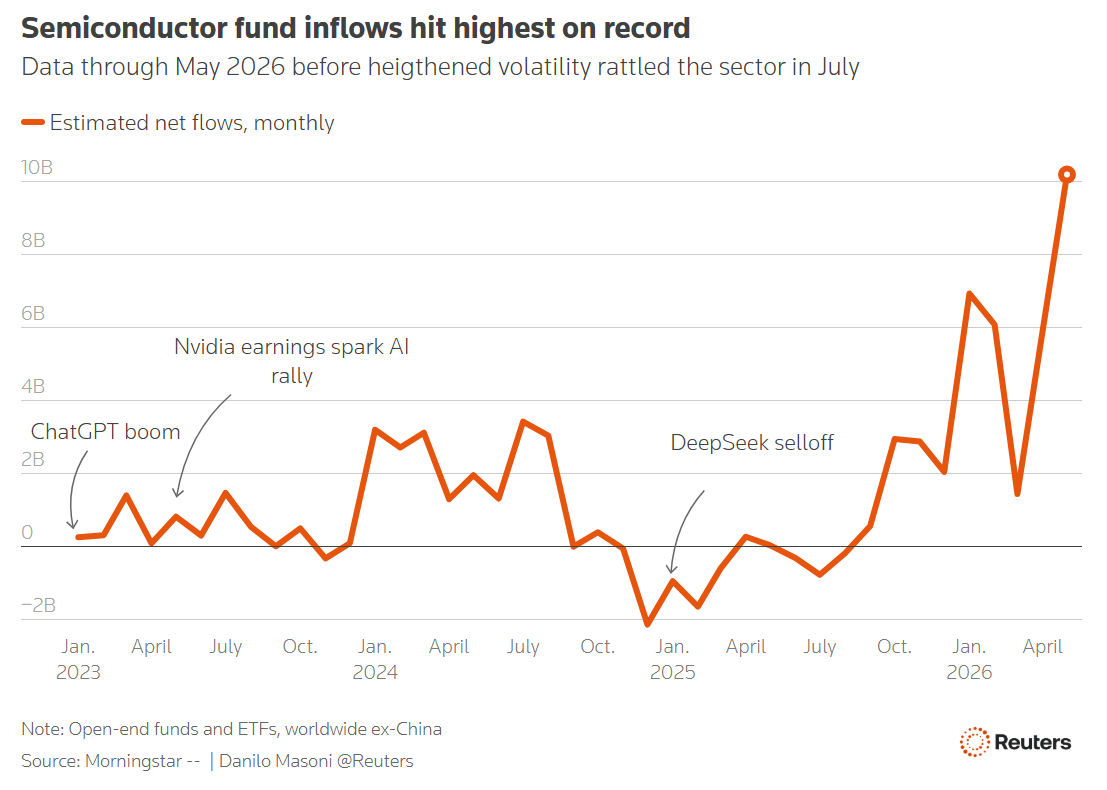
Note: The orange line represents the estimated monthly net fund flows for global semiconductor open-end funds and ETFs.
Opinions are divided on whether to buy or short.
Alexis Bossard, Global Equity Portfolio Manager at Edmond de Rothschild Asset Management in Europe, stated:
“Once they stop ramping up capital expenditures, the cloud hyperscalers will certainly breathe a sigh of relief—but it’s a negative signal for the semiconductor industry.”
Empirical Research, a U.S. equity quantitative research firm, noted an increasingly evident mismatch between the moderating pace of capital expenditure growth among hyperscale cloud providers and the elevated revenue expectations for semiconductor and other AI infrastructure suppliers. The firm stated:
“Either the capital expenditure trajectory of cloud hyperscalers will be revised upward again, or the revenue growth embedded in their suppliers’ forecasts must materialize from other sources.”
Alberto Conca, Chief Investment Officer at Swiss asset manager LFG+ZEST, said he has significantly reduced positions in memory chip and equipment manufacturers, while establishing positions in hyperscale cloud providers and healthcare stocks, and purchasing put options on select semiconductor equities.
Madeleine Ronner, Senior Portfolio Manager at DWS, Deutsche Asset Management Group, expects that hyperscale cloud providers’ commentary during earnings season will continue to support further investment.
“It would be surprising if that weren’t the case,” she said, adding that buy-side 2027 spending forecasts remain significantly above consensus sell-side analyst expectations.
After a strong rally, DWS has partially taken profits on semiconductor stocks but maintains an overweight position; some of its funds have added industrial and power equipment equities following recent price pullbacks.
Jurrien Timmer, Global Head of Macro at asset management firm Fidelity Investments, stated that market demand for computing power remains robust and that recent volatility may simply represent another round of market reshuffling. He also noted that during the late 1990s internet boom, leading stocks experienced multiple declines of 20% to 30% before resuming their upward trajectory.
Nevertheless, he still believes investors should diversify their risk. He pointed out that, over time, beneficiaries of AI application deployment—such as financial stocks—will be just as important as those benefiting from AI infrastructure development. Timmer concluded:
“I want to participate in this boom, but I also want to protect myself if it overheats.”