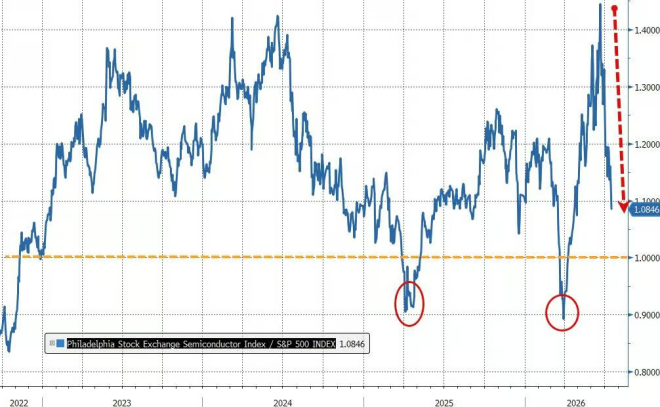
Friday's$PHLX Semiconductor Index (.SOX.US)$fell 1.6%, bringing its cumulative decline from the record high to 20%, entering bear market territory. The sell-off in semiconductor stocks weighed on the index.$NASDAQ-100 Index (.NDX.US)$fell 1.5%,$S&P 500 Index (.SPX.US)$fell 1%, while the Dow Jones Industrial Average dropped 0.8%. Escalating conflict between the U.S. and Iran pushed West Texas Intermediate crude up 4.3% to $82.34 per barrel. The yield on the 10-year U.S. Treasury note remained essentially flat at 4.55%.
Kimi K3 has reignited a 'DeepSeek moment,' reviving market concerns over the sustainability of AI-related capital expenditure returns and chip demand, triggering a sell-off in the high-valuation, crowded AI sector.
Meanwhile, the U.S. and Iran exchanged fresh strikes on Friday, heightening energy supply risks and pushing oil prices higher, resulting in a divergent market pattern with technology leading losses and energy gaining strength.
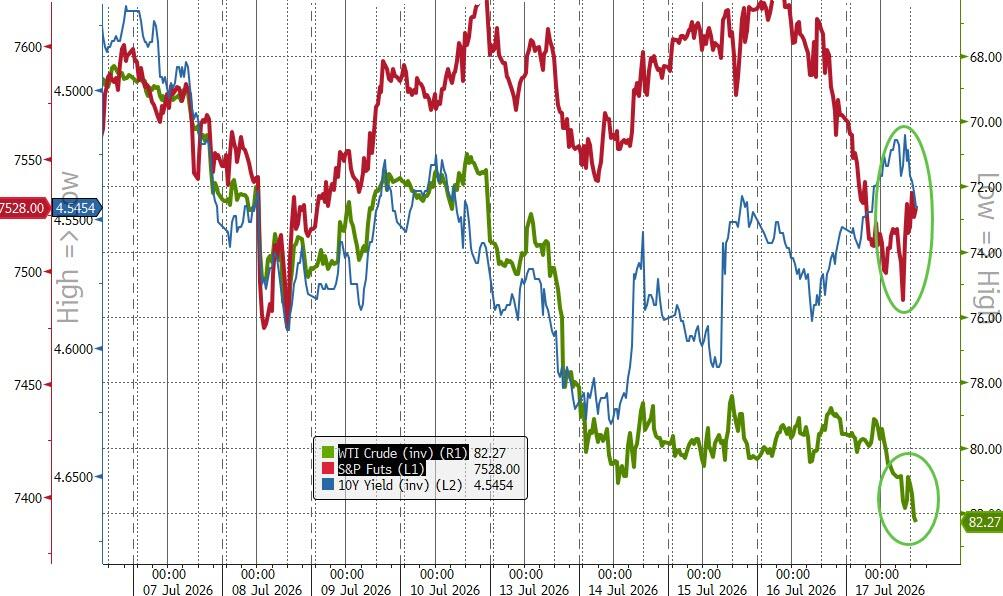
 On Friday, the Philadelphia Semiconductor Index fell 1.6%, marking a cumulative 20% decline from its record high and entering bear market territory. The semiconductor selloff dragged the Nasdaq 100 down 1.5%, the S&P 500 down 1%, and the Dow Jones Industrial Average down 0.8%.
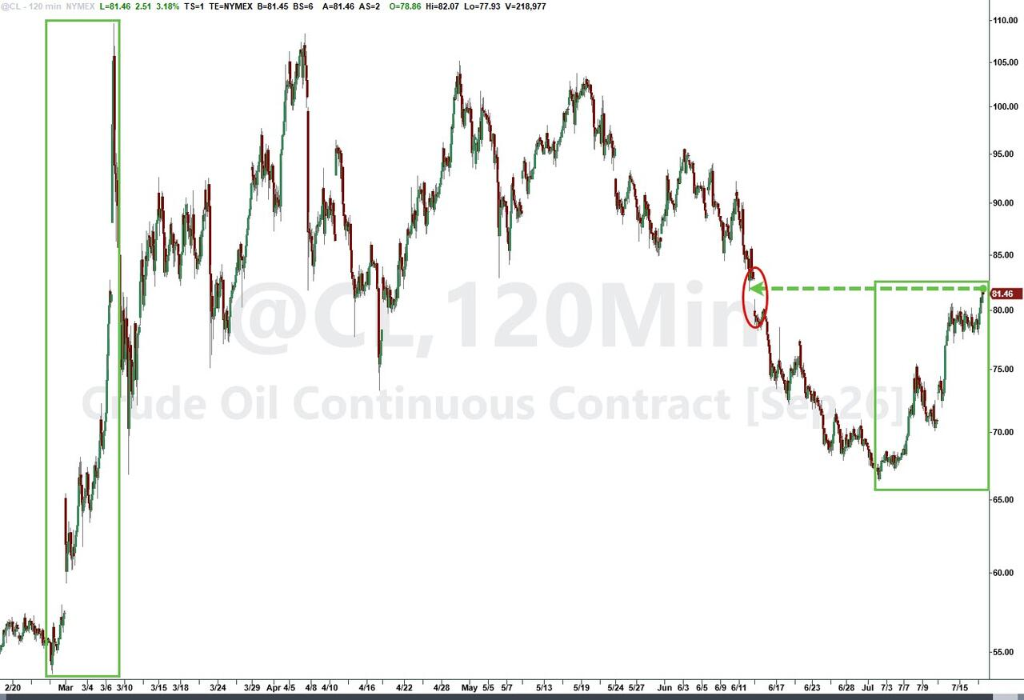
Escalating tensions between the U.S. and Iran drove West Texas Intermediate crude up 4.3% to $82.34 per barrel. The sharp rise in oil prices did not trigger a corresponding selloff in long-end U.S. Treasuries, with the 10-year Treasury yield remaining essentially flat at 4.55%, indicating markets have not yet fully priced the energy shock into sustained inflation expectations.
Chip-driven panic continues; AI investment thesis under scrutiny
Semiconductor futures plunged sharply in pre-market trading on Friday, followed by a panic-driven selloff across the AI hardware supply chain after the market opened.
Moonshot AI has launched its new model, Kimi K3, leveraging a low-cost, open-source strategy to once again challenge the market’s core assumptions about massive AI compute investments. Global technology and semiconductor stocks plummeted in response, as investor concerns over a repeat of the 'DeepSeek moment' spread rapidly.
Although memory chip stocks staged a modest intraday rebound and AI software infrastructure names held up relatively well, panic sentiment dominated trading throughout the session.
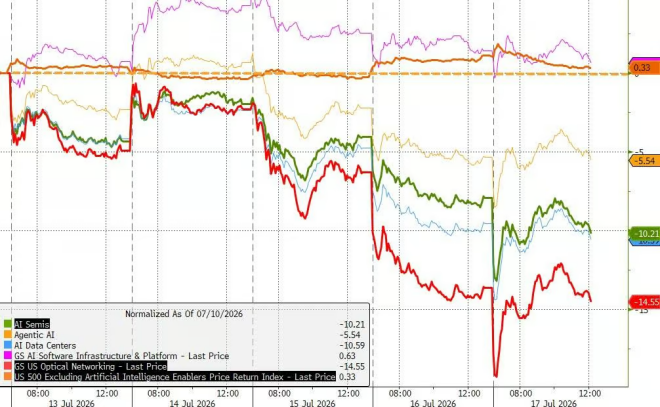
Goldman Sachs TMT trading specialists noted that investor anxiety has risen markedly over the past 48 to 72 hours, with growing unease surrounding the ongoing pullback in AI and semiconductors.
Since its late-June peak, the Philadelphia Semiconductor Index has underperformed the broader market by approximately 20 percentage points, posting its worst weekly performance since April 2025 this week.
From an options market perspective, major semiconductor ETFs saw extreme bearish demand this week, with put-to-call volume ratios exceeding three times the norm—far above historical averages. The MenthorQ model detected synchronized momentum breakdowns across key semiconductor stocks, a broad deterioration in options sentiment, and widespread breaches of technical support levels.
A deeper concern is the emerging anxiety over boom-bust cycles in AI investment. The U.S. Department of Commerce’s Bureau of Industry and Security (BIS) annual report has already warned of such cyclical risks in AI investment.
Previously$Taiwan Semiconductor (TSM.US)$Although capital expenditure guidance was raised, the market interpreted it as bearish, as capacity expansion implies potential future oversupply. Divergent views from institutions such as Barclays and Brown Brothers Harriman (BBH) on the return on investment for AI hardware have further heightened market anxiety.
Nomura's Charlie McElligott summarized that all previously effective strategies this year have reversed, and any further deterioration could trigger a sell-off with perfect correlation (correlation of 1), forcing longs to liquidate while shorts add to their positions.
In a negative gamma environment, dealers are forced to chase weakness, turning selling pressure into a mechanical feedback loop. Momentum indicators have now tested a head-and-shoulders top technical pattern.
Oracle's five-year CDS spread hits an all-time high, as markets worry that its large-scale AI-related borrowing could heighten default risk.
According to Bloomberg, Oracle's five-year CDS surged intraday to 198.58 basis points, surpassing the previous record of 198.18 bps set during the 2008 financial crisis—the highest level since the company went public. This implies that hedging against a $10 million exposure to Oracle’s five-year debt would cost approximately $198,000 annually in premiums.
Credit markets view Oracle’s five-year CDS as a key barometer of AI-related capital expenditure risks, with concerns mounting that its multi-billion-dollar investments in AI data centers are continuously eroding cash flow and driving further debt accumulation.
Escalating U.S.-Iran tensions drive oil prices sharply higher, closing the ceasefire gap.
Middle East tensions deteriorated further on Friday. The United States conducted airstrikes against Iran for the sixth consecutive day, targeting Iranian missile and drone facilities as well as defensive positions. In retaliation, Iran struck water and power infrastructure in Kuwait.
According to Xinhua News Agency, citing a statement from Iran’s military, Iran announced on Friday, July 17 local time that it had struck U.S. military bases in Kuwait and U.S. targets at al-Tanf in Syria. Media reports noted this marks the first time since the regional conflict erupted earlier this year that Iran has publicly acknowledged directly attacking targets inside Syria.
Geopolitical escalation fueled a sharp rise in crude oil. WTI crude climbed above $82 per barrel on Friday, reaching a one-month high and fully retracing the losses incurred since the ceasefire gap opened approximately one month ago.
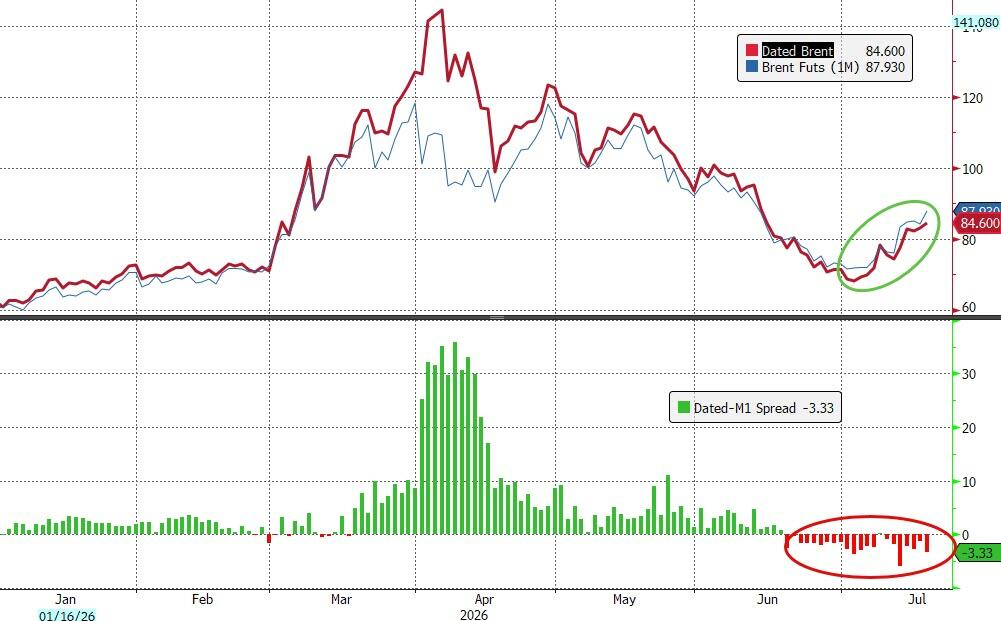
Spot Brent crude prices have rebounded above $84.60, reaching a five-week high. Crude oil posted its largest weekly gain since the outbreak of the conflict.
Refined product markets are similarly tight. Diesel markets in the U.S. and Europe are experiencing record supply tightness, with crack spreads surging to all-time highs and refining margins highly profitable.
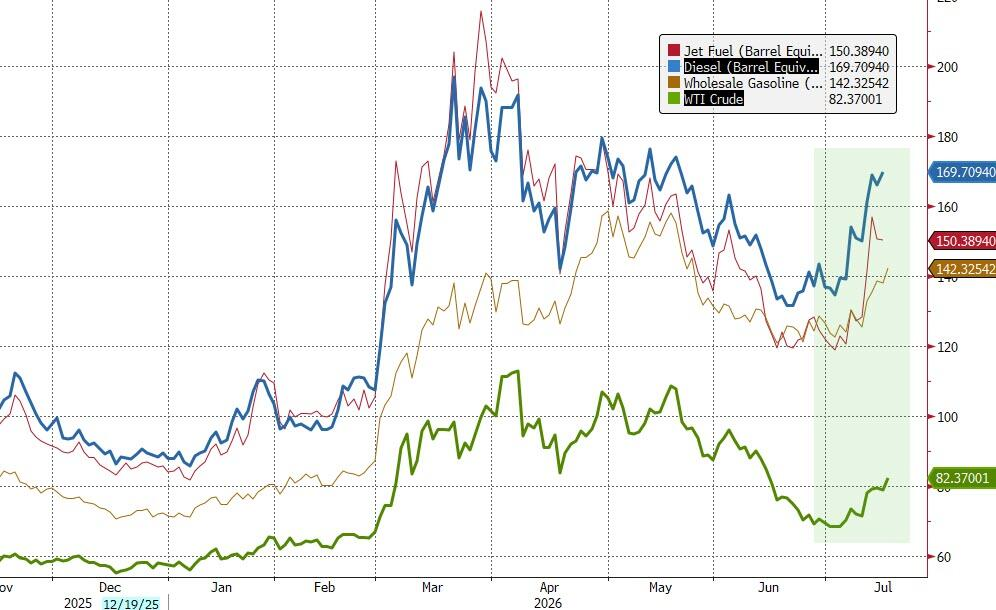
This mismatch in the supply chain—ample crude but downstream bottlenecks—benefits refiners in the near term but keeps energy costs elevated, potentially triggering ripple effects on inflation and economic growth.
Goldman Sachs energy analyst Privorotsky warned that this represents a meaningful escalation, with a more complex risk backdrop ahead of the weekend, making defensive stocks appear to offer an asymmetric risk-reward profile.
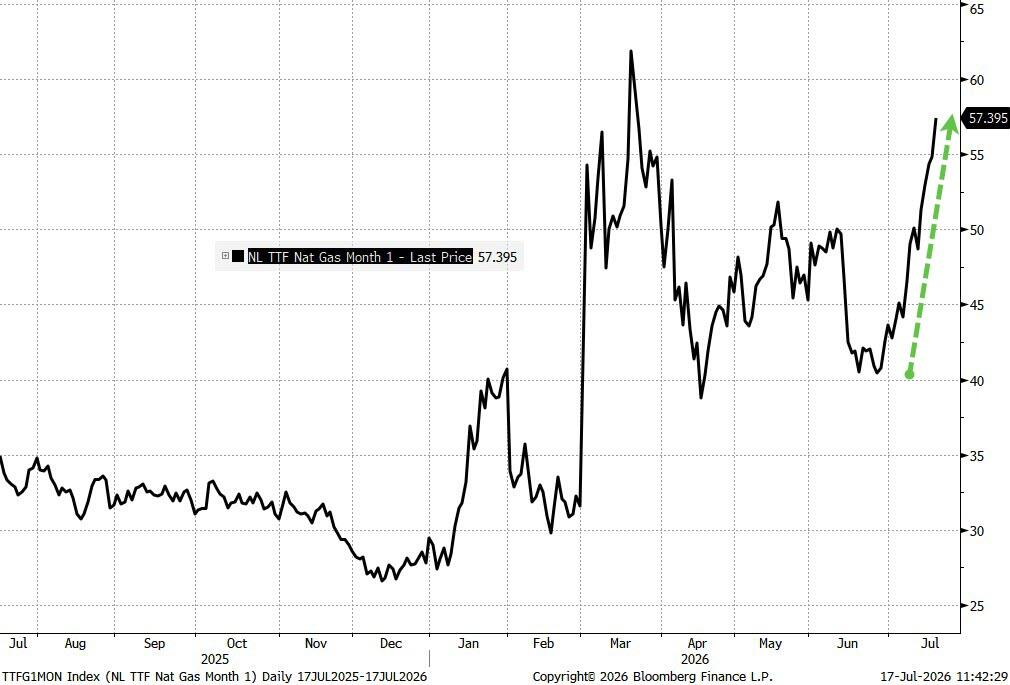
European natural gas futures also surged sharply this week, hitting their highest level since March amid concerns over disruptions to LNG tanker traffic through key shipping lanes.
U.S. Treasury yields exhibit a distorted pattern as rate hike expectations collapse.
On Friday, the U.S. Treasury market showed a clear divergence in price action.
As oil prices rose, the 2-year yield climbed sharply during U.S. equity trading hours, while medium- to long-end yields declined throughout the day, pushing the 2s/10s and 5s/30s spreads close to their flattest levels of the year.
This stands in stark contrast to the market dynamics observed during the first four trading days of the week. Previously, weaker-than-expected CPI and PPI data triggered a 'bull flattening' in Treasuries—where both short- and long-end yields fell, with long-end yields declining more sharply, resulting in a flatter yield curve.
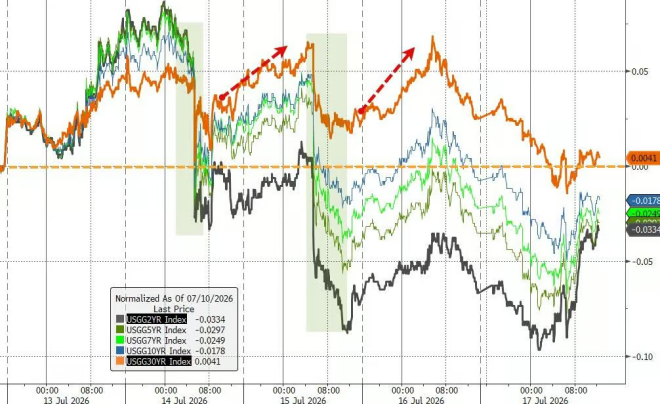
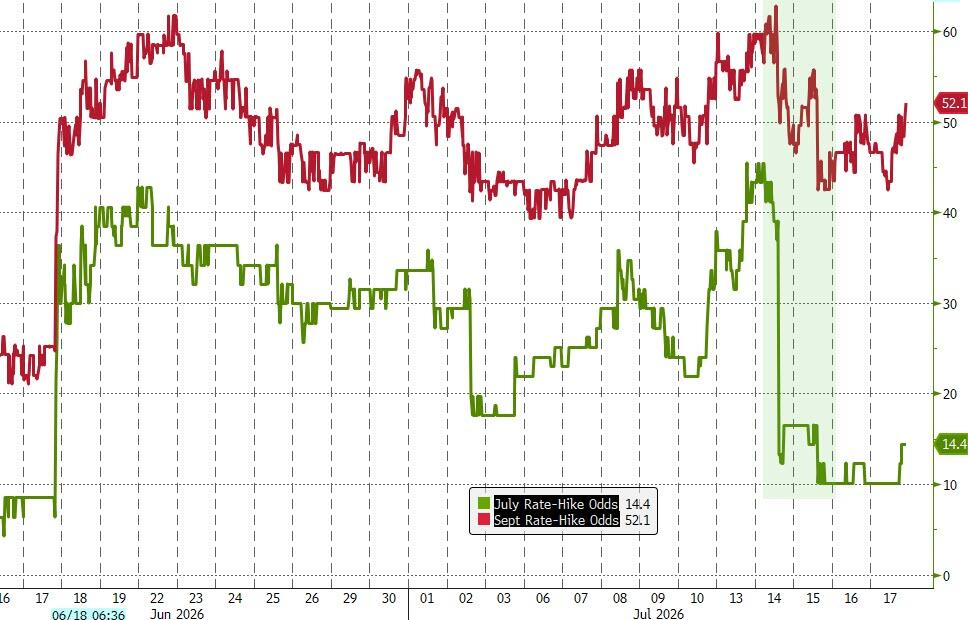
Over the week, U.S. Treasury yields fell across all maturities, led by the front end. The July rate hike premium has dropped to just about 2.5 basis points, effectively pricing out a July hike, while the odds for a September hike stand at roughly 50-50.
This week, both CPI and PPI data came in weaker than expected, and the University of Michigan’s inflation expectations also undershot forecasts, forcing markets to reprice duration risk.
Bloomberg analysts noted that although WTI crude prices surged significantly this week, the U.S. Treasury market not only avoided losses but actually rallied—an outcome starkly at odds with the traditional negative correlation observed early in geopolitical conflicts, where rising oil prices fuel inflation concerns and trigger bond sell-offs.
Market participants’ trading behavior has also shifted: rather than selling into rallies to lock in gains, investors are now actively buying on dips.
However, Kevin Zhao of UBS Asset Management plans to short U.S. Treasuries, betting that robust U.S. economic growth will erode the safe-haven appeal of government bonds.
Looking back at the week: a harrowing one for tech stocks
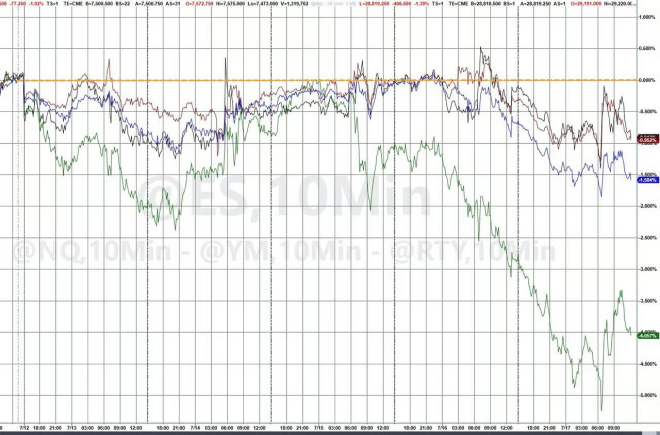
At first glance, U.S. equities didn’t appear too bad this week—the small-cap Russell 2000 and the Dow Jones Industrial Average both closed lower for the week but held up relatively well. However, tech stocks endured their worst week of the year.
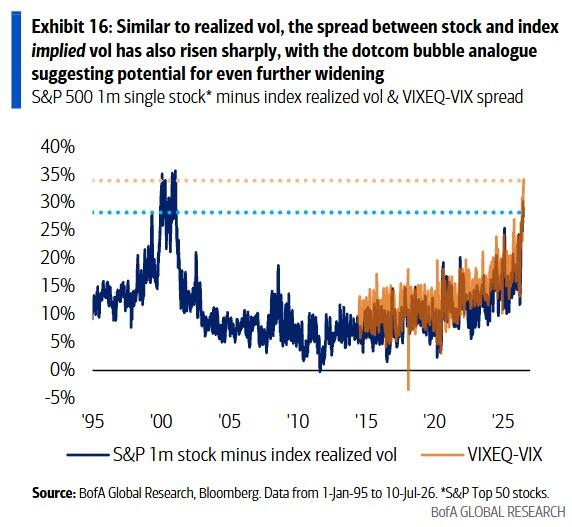
Semiconductor volatility spiked to the 92nd percentile of its historical range, reaching extremes last seen during the dot-com bubble. Kimi’s sudden emergence was merely the final straw that broke the camel’s back.
Amid the tech selloff, a contrasting narrative unfolded: the S&P 500 Equal Weight Index hit a record high this week, widening its divergence from the market-cap-weighted index. This is not a broad-based defensive rotation but rather a structural reallocation of capital across sectors.
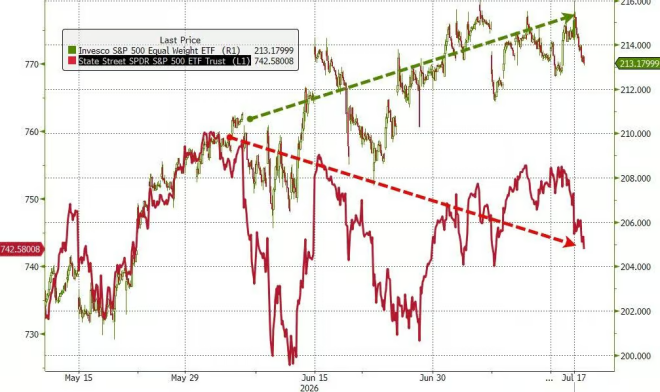
Bloomberg macro strategist Michael Ball noted that the healthcare, financials, industrials, and transportation sectors are now attracting capital flows previously directed toward the technology sector.
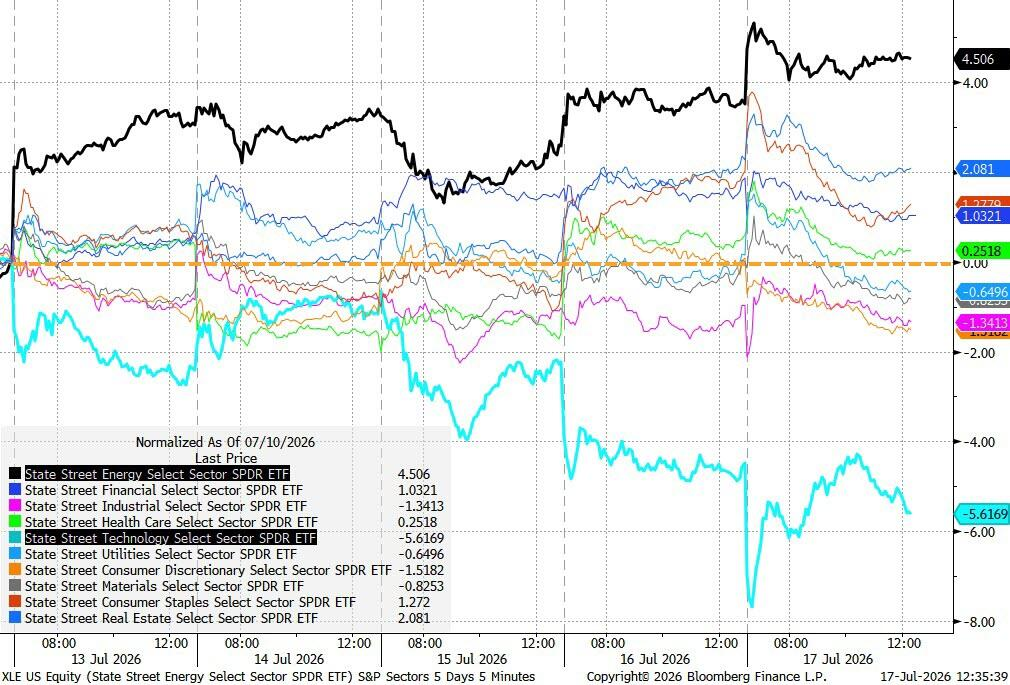
The Dow Jones Transportation Average has broken out of a cup-and-handle pattern, adding a cyclical tilt to this rotation and signaling market confidence in economic growth and broader earnings momentum.
Goldman Sachs’ TMT trading specialists summarized: 'It has been an exhausting week. However, amid the wreckage of the semiconductor selloff, cybersecurity and data infrastructure software stocks held firm.'$CrowdStrike(CRWD.US)$up 9% this week,$Palo Alto Networks (PANW.US)$up 10%.
Bulls argue that these sectors stand to benefit in the AI inference era and are less dependent on semiconductor bottlenecks or model leaderboard rankings.
Performance of Other Major Asset Classes
The U.S. dollar traded sideways this week but ultimately closed lower.
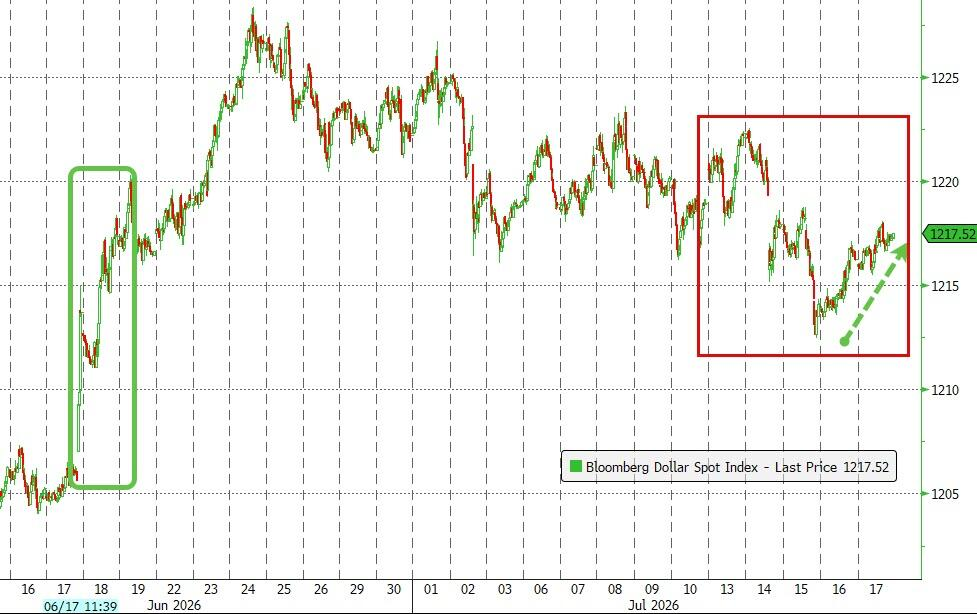
The cost of hedging against U.S. dollar volatility has fallen to its lowest level this year, suggesting that traders see little likelihood of a major catalyst disrupting the world’s reserve currency, despite an uncertain Federal Reserve outlook and renewed Middle East tensions.
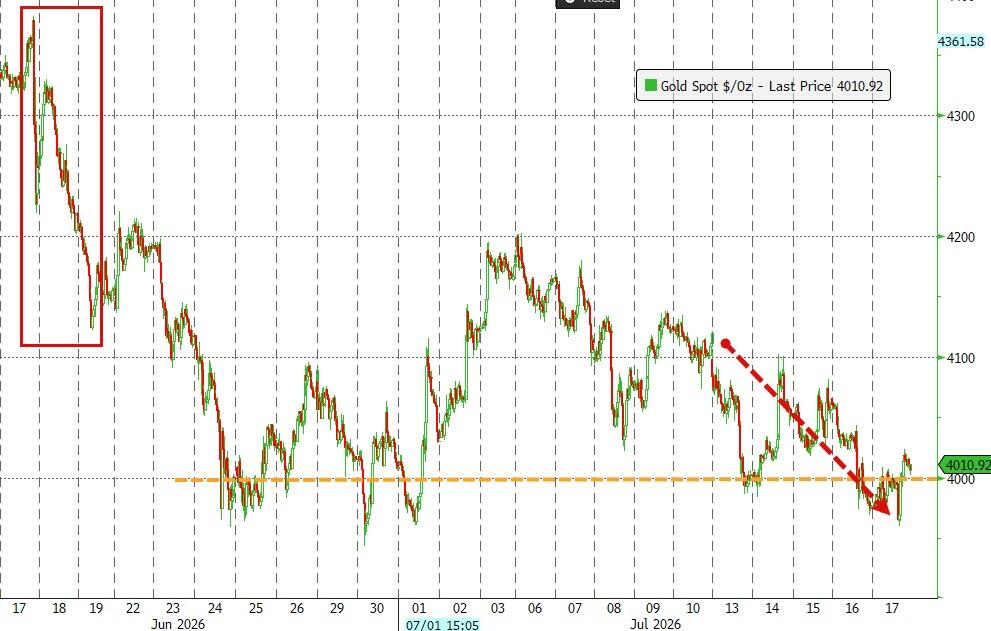
Despite a weaker U.S. dollar, gold prices continued to decline, struggling to hold above the $4,000 per ounce mark.
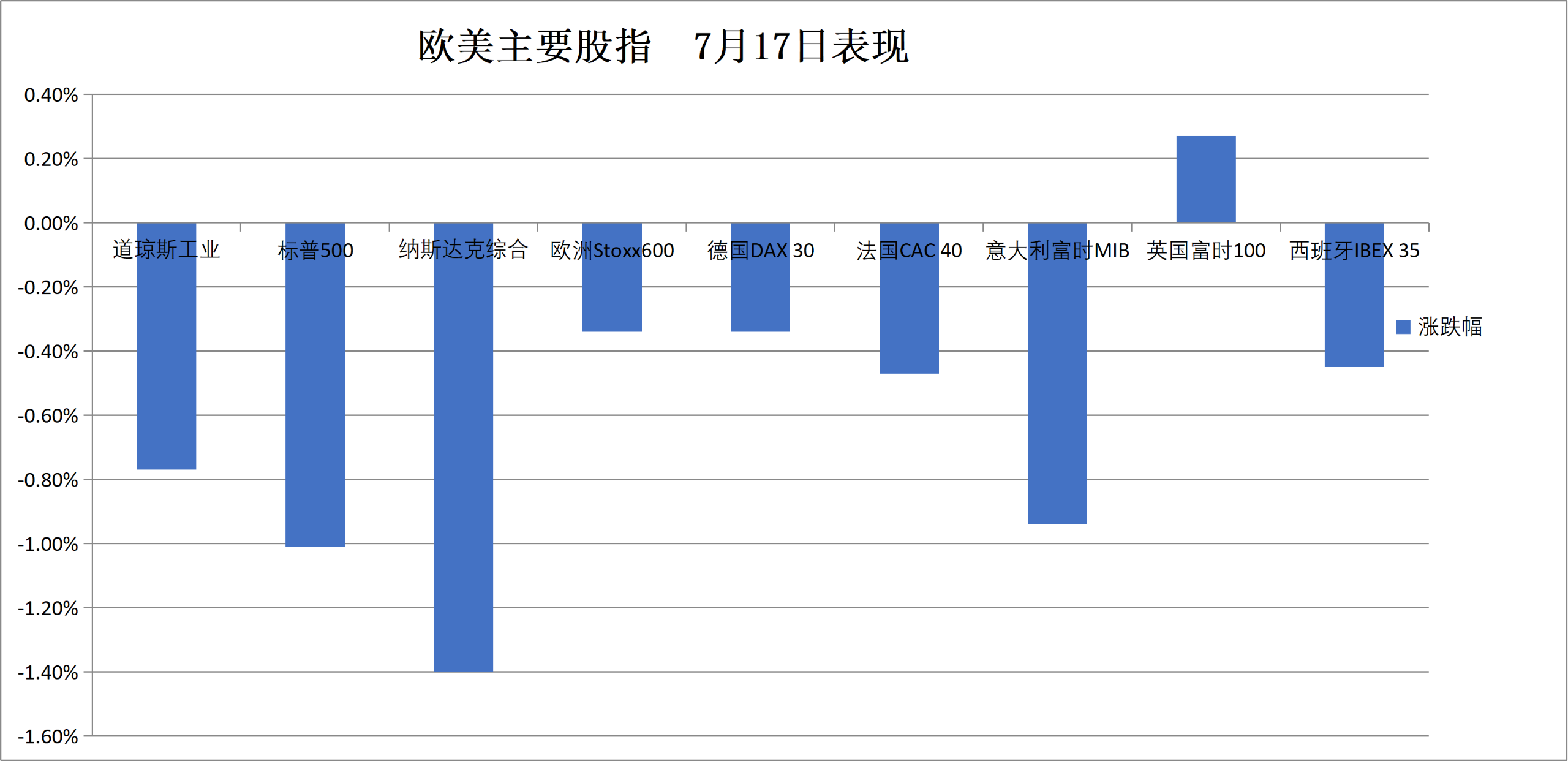
The S&P 500 fell 1% on Friday, the Nasdaq 100 dropped 1.5%, and the Dow Jones Industrial Average declined 0.8%. The Philadelphia Semiconductor Index slid 1.6%, with this key gauge of the chip sector now down 20% from its record high, meeting the technical threshold for a bear market.
U.S. equity benchmark indices:
The S&P 500 closed down 76.08 points, or 1.01%, at 7,457.69, posting a weekly loss of 1.55%.
The Dow Jones Industrial Average closed down 406.55 points, or 0.77%, at 52,146.42, marking a weekly decline of 0.93%.
The Nasdaq Composite closed down 361.703 points, or 1.40%, at 25,520.244, falling 2.90% for the week. The Nasdaq 100 closed down 433.111 points, or 1.49%, at 28,592.659, with a weekly loss of 4.13%.
$Russell 2000 Index (.RUT.US)$It closed down 0.42% at 2,962.217, declining 0.52% for the week.
The CBOE Volatility Index (VIX) closed up 12.01% at 18.74, rising 24.68% for the week. After gapping higher on July 13, it stabilized around 16.50 before gapping up again on July 17.
U.S. stock sector ETFs:
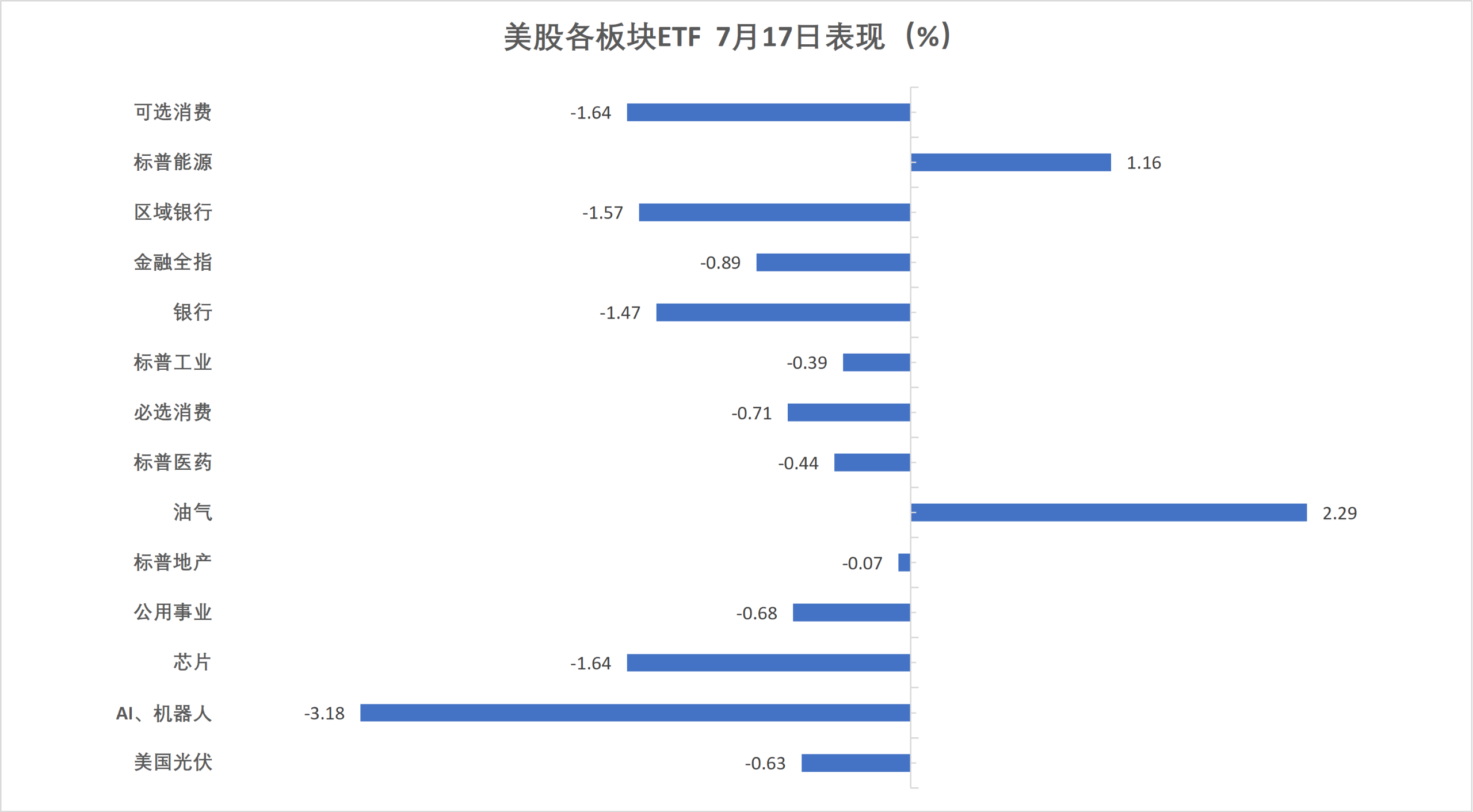
U.S. equity sector ETFs broadly declined, with the Global Airlines ETF down 2.53%, the Semiconductor ETF down 2.18%, the Consumer Discretionary ETF down 1.62%, and the Regional Banking ETF retreating 1.58%. Global Technology, Internet, and Technology Sector ETFs fell by as much as 1.31%, while the Energy Sector ETF gained 1.16%.
Semiconductor stocks:
The Philadelphia Semiconductor Index closed down 193.615 points, or 1.63%, at 11,673.889, marking a decline of over 20.23% from its record closing high of 34,634.720 points reached on June 22—entering bear market territory—and posting a weekly loss of 9.97%.
The U.S. equity index tracking memory chip and hardware supply chain companies fell 0.77% to close at 189.38, representing a cumulative decline of more than 31.12% from its record closing high of 274.95 points set on June 22, with a weekly drop of 17.61% and consistent losses throughout the week.
ConstituentsApplied Materials (AMAT.US)closed down 5.57%,SanDisk (SNDK.US)down 3.99%, and Lam Research declined 2.39%,Micron Technology (MU.US)down 0.50%,$Teradyne(TER.US)$、$Rambus(RMBS.US)$closed up 0.02%,$Western Digital (WDC.US)$up 2.23%,$Seagate Technology (STX.US)$up 5.66%.
U.S.-listed Chinese stocks:
The Nasdaq Golden Dragon China Index closed down 1.81% at 6,280.72, posting a weekly gain of 2.61% and rising continuously on July 15–16.
Among actively traded Chinese ADRs,Baidufell 4.8%, with Meituan, XPeng, Tencent, and Li Auto down more than 3%,$PDD Holdings (PDD.US)$、$ASE Technology Holding (ASX.US)$and Alibaba down more than 2%,$NetEase (NTES.US)$rose 0.7%,$Canadian Solar (CSIQ.US)$gained 1.5%,$Daquan New Energy (DQ.US)$climbed 2.2%,$JinkoSolar (JKS.US)$advanced 3.1%.
Other stocks:
$Circle(CRCL.US)$declined 0.21%, bringing its cumulative loss for the week to 8.51%.
Semiconductor equipment and materials, airline services, and cryptocurrency-related stocks declined, with Applied Materials,$Robinhood(HOOD.US)$down more than 5%,American Airlines (AAL.US)down nearly 4%,$KLA Corp (KLAC.US)$、$SkyWest (SKYW.US)$、$JetBlue Airways (JBLU.US)$,fell by more than 3%,$ASML Holding (ASML.US)$down over 2%.
lithium mining, oil and gas, and energy storage sectors rose,$Sociedad Química y Minera de Chile (SQM.US)$Up more than 5%,$TotalEnergies (TTE.US)$rose by more than 3%, whilePetroleo Brasileiro SA Petrobras (PBR.US)、$Shell (SHEL.US)$rose over 2%.
Company News
[Traders Reportedly Offered Early Access to Trump’s Posts for $100,000 per Month]
According to media reports on Friday, former U.S. President Trump's social media company has discussed charging traders and investors up to $100,000 per month for faster access to posts made by the U.S. president on his Truth Social platform. The news triggered a sharp intraday rebound in shares of Trump Media & Technology Group (DJT), which closed higher. The stock has declined approximately 27% year-to-date. A DJT spokesperson stated that the service would provide clients with content from the top 10 most influential accounts on Truth Social, delivered significantly faster than standard notifications received by regular users through the platform.
[ASML to Distribute €20,000 Bonuses to All Employees]
In the latest example of employee incentive programs introduced by companies benefiting from the 'AI boom,' lithography equipment manufacturer ASML Holding will grant equity incentives equivalent to €20,000 to all employees globally. According to internal company communications, ASML announced this policy via an all-staff email and plans to award the shares on January 1 next year. The incentive is subject to a vesting condition: employees must remain with the company until at least January 1, 2030, to gain full ownership and be permitted to sell the shares. With approximately 44,500 employees worldwide, this one-time incentive is valued at nearly €900 million.
[Anthropic Reportedly in Talks with Meta Over Leasing Computing Capacity]
According to media reports on Friday, artificial intelligence startup Anthropic is engaged in very preliminary discussions with Meta regarding the potential leasing of the latter’s computing capacity. Sources familiar with the matter revealed that the two sides are negotiating a potential deal valued at approximately $10 billion. The news briefly pushed Meta’s share price up by about 2% during Friday’s trading session. It is understood that Anthropic proposed the collaboration to Meta in June this year, and Meta is currently evaluating the proposal. According to insiders, although specific terms are still being refined, under the current framework, Anthropic would make monthly payments to Meta over a two-year period.
[Apple Engaged in Early Settlement Talks with U.S. Department of Justice Over Antitrust Lawsuit]
Apple is holding early settlement discussions with the U.S. Department of Justice regarding a 2024 antitrust lawsuit alleging that the iPhone maker violated antitrust laws. The negotiations are ongoing, but neither party can guarantee a final agreement, and no trial date has yet been set. Apple has submitted multiple settlement proposals to the Department of Justice to resolve the case and has already implemented changes addressing certain allegations, including introducing a small app mechanism and opening its iMessage application ecosystem.
Shares of ASML Holding closed down more than 3.8% in Europe. The European oil and gas sector rose over 3.6% this week, while the technology sector declined approximately 3.3%. Italian banking stocks ended down more than 1.9%. German equities fell over 0.9% this week, and Italy’s benchmark index dropped about 1.4%.
Pan-European Equities:
The pan-European STOXX 600 Index closed down 0.34% at 641.53 points, posting a weekly gain of 0.07%.
The Eurozone’s STOXX 50 Index closed down 0.84% at 6,230.87 points, marking a weekly decline of 0.62%.
National stock indices:
Germany's DAX 30 index closed down 0.34% at 24,830.98 points, marking a weekly decline of 0.94% amid an ongoing downward trend.
France's CAC 40 index closed down 0.47% at 8,338.81 points, with a weekly loss of less than 0.01%.
$FTSE 100 Index (.FTSE.GB)$It rose 0.27% to close at 10,600.37 points, posting a weekly gain of 0.98%.
Sector and individual stock performance:
Among eurozone blue-chip stocks, Prosus fell 4.75%, ASML Holding declined 3.84%, and financials such as Deutsche Bank dropped 2.67%, UniCredit slid 2.48%, Adyen lost 2.45%, and BBVA decreased by 2.35%.
Among all constituents of the STOXX Europe 600 Index, AAK declined 13.03%, Sandvik fell 9.33%, AT&S dropped 7.22% (the third-largest decline), Burberry slipped 6.38%, and BE Semiconductor Industries NV fell 4.53%, among the steepest losses.
For the week, sector performance showed the STOXX 600 Oil & Gas Index gaining 3.65%, Personal & Household Goods up 2.64%, Automobiles & Parts rising 1.17%, Food & Beverage advancing 1.15%, and Personal Care, Drugs & Grocery Retailers climbing 1.97%.
Want to select stocks or get a stock diagnosis? Curious about the opportunities and risks in your portfolio? For all your investment questions,Just ask Futubull AI!

Editor/Liam