
Bond traders and Federal Reserve Chair Kevin Warsh agree on one key point: the Fed's efforts to combat inflation appear far from over.
The U.S. Bureau of Labor Statistics reported that U.S. consumer prices declined month-over-month in June for the first time since 2020, offering financial markets some relief—last week, investors swiftly unwound bets that the Fed might begin raising interest rates later this month.
But this reprieve is likely only temporary. Oil prices have risen again following the collapse of the U.S.-Iran ceasefire agreement. Despite bubble concerns weighing on some tech stocks, massive spending in artificial intelligence continues to inject stimulus into the economy. Warsh, who succeeded as Fed chair two months ago, has made it clear that the central bank’s top priority is to bring down inflation—which has remained above its 2% annual target for the past five years.
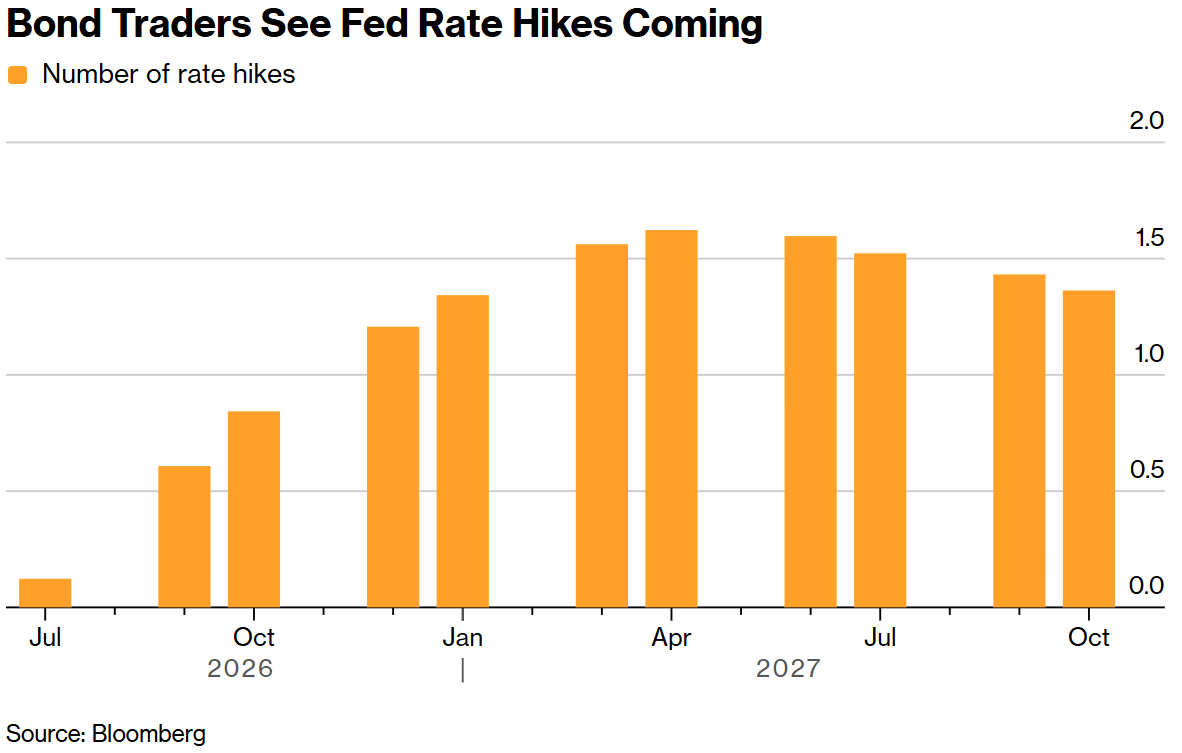
 As a result, traders still expect the Fed to almost certainly begin raising rates by year-end, possibly as early as September.
“If you do nothing, are you confident inflation will return to 2% or 2.5%? The answer is no,” said Ed Al-Hussainy, portfolio manager at Columbia Threadneedle Investments, who is betting that long-dated bonds will outperform short-term bills—a position that would benefit from a more hawkish central bank stance. “The Fed should feel more comfortable hiking rates without worrying as much as before about downside risks.”
Since its last rate cut in December last year, the Fed has held monetary policy steady—employment rebounded from February’s slump, and the war Trump launched against Iran delivered a fresh wave of inflationary shocks to the global economy. These two developments shattered earlier widespread expectations that the Fed would resume cutting rates, even after Trump appointed Warsh to replace Powell—the president had repeatedly criticized Powell for not lowering borrowing costs more quickly.
Warsh has since signaled his eagerness to preserve the Fed’s political independence and resist pressure from Trump.
At his first post-meeting press conference as chair last month, Warsh repeatedly stressed the need to curb inflation. He reinforced that message again last week on Capitol Hill, stating that June’s Consumer Price Index data does not mean the Fed’s mission is complete. Three regional Fed presidents—Jeff Schmid, Lorie Logan, and Beth Hammack—echoed similar sentiments.
While traders currently see little chance of a July hike, they still assign high probability to a 25-basis-point increase in September or October and view a rate hike before December as nearly certain.
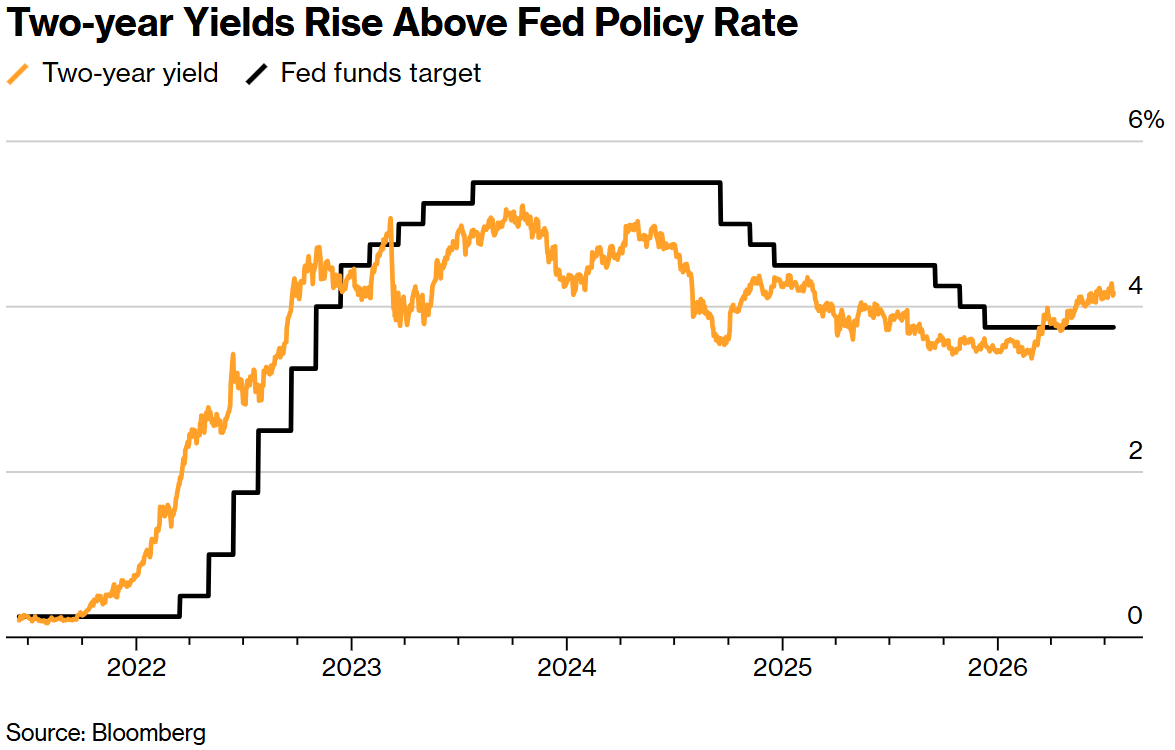
Even so, the impact on financial markets may be relatively muted, as U.S. Treasury yields have already risen in anticipation. Since late February, the yield on two-year U.S. Treasuries has jumped by about 75 basis points to nearly 4.2%, well above the Federal Reserve’s current policy rate range of 3.5%–3.75%.
The broad-based rise in U.S. Treasury yields, in turn, has pushed up the cost of mortgages and other types of loans, effectively doing part of the Fed’s work by applying brakes to the economy.
Chi Chen, co-manager of BlackRock’s $18 billion Total Return Fund, stated, 'If our view that inflation will ease and growth will slow in the second half of the year is correct, then the market is pricing in a path for the Fed that is more hawkish than we anticipate.' 'The Fed may remain in a hawkish stance, waiting for incoming data to eventually show signs of moderation.'
As a result, her firm favors intermediate- and short-duration bonds—whose yields rose during the sell-off following the Iran conflict. 'Valuations are certainly more attractive than before.'
Wassh has not yet indicated when the Fed might act and tends to downplay the central bank’s forward guidance on interest rates, arguing that such guidance could lock policymakers into a course they might later be reluctant to change. This week, Fed officials will issue few new data or comments, as they enter the customary blackout period ahead of their two-day meeting starting July 28.
According to strategist Edward Harrison, if the Fed fails to bring inflation under control, its anti-inflation 'tools' will not deliver dividends to investors. With the yield curve continuing to steepen and long-end real yields showing no sign of retreating, Tuesday’s rally in Treasuries still ominously resembles a 'relief rally.'
Economists at Bank of America expect the Fed to hike rates consecutively at its September, October, and December meetings. In a client note following the release of June CPI data, they stated, 'Given that inflation remains well above the Fed’s target, we would need to see several more readings like this before reconsidering our current outlook.'
Al-Hussaini, portfolio manager at Columbia Threadneedle, said that in an environment of uncertainty, a cautious stance is warranted, and investors should avoid taking large positions heavily sensitive to Fed actions. 'Now is not the time to stick your neck out,' he remarked.
Editor/lambor