Macroeconomic Highlights
U.S.-Iran conflict escalates sharply; U.S. military fatalities rise to 17 as oil prices surge
Military tensions between the United States and Iran escalated dramatically over the weekend. According to Bloomberg, the two sides engaged in a series of rapid, tit-for-tat attacks within the past 48 hours. U.S. Central Command announced that another American service member was killed in an Iranian strike on Jordan, bringing the number of U.S. military fatalities over the past two days to three. CNBC reported that U.S. forces subsequently struck Iranian coastal surveillance and air defense facilities. Reports also indicated that Iran attempted to disrupt shipping through the Strait of Hormuz and attacked a key oil facility. As of the latest tally, the total number of U.S. military personnel killed in this round of conflict has risen to 17.
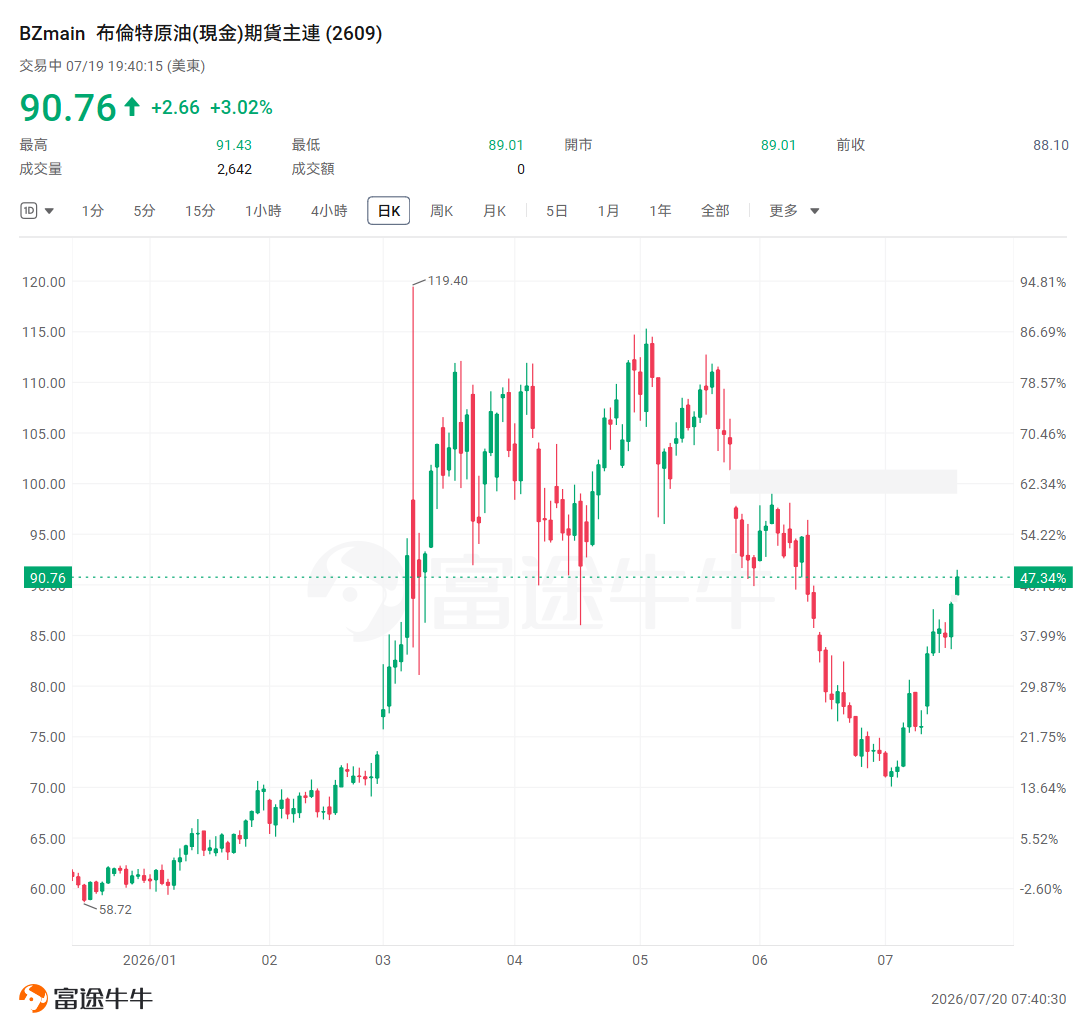
The sharp deterioration in Middle East tensions has directly impacted energy markets. Brent crude surged during early trading as concerns mounted over potential large-scale disruptions to the Strait of Hormuz—the world’s most critical oil transit corridor. Additionally, the Caspian Pipeline Consortium (CPC) halted loading operations at its terminal on Russia’s Black Sea coast following a drone attack, prompting Kazakhstan’s government to call for an immediate end to such assaults. With multiple supply risks converging, crude markets face sustained upward pressure. President Trump has yet to clarify his stance on the future course of U.S. military action against Iran, and markets are closely watching for the White House’s next move.
 Another Fed official turns hawkish: inflation remains the primary concern
Hawkish voices within the Federal Reserve are growing louder. Beth Hammack, President of the Federal Reserve Bank of Cleveland, recently signaled that the Fed may need to raise interest rates to rein in persistently high inflation. This sets the stage for a heated debate at the July FOMC meeting, where Fed Chair Kevin Warsh—presiding over only his second policy meeting since taking office—could face dissenting votes. In a LinkedIn post last Friday, Hammack wrote: “For the first time since I took office, I’m hearing businesses say they believe we need to act to curb inflation, and for the first time, I’m hearing financially strained consumers express deepening despair.”
Bank of America warns: if Mag7 capex is cut, a broader market correction may be unavoidable
Michael Hartnett, Chief Investment Strategist at Bank of America, has once again raised a warning flag. After successfully predicting the market bottom in March, he notes that extremely crowded positioning and frothy sentiment have pushed markets into a new high-risk zone, suggesting that reducing exposure to risk assets over the summer may be prudent. In Hartnett’s view, the biggest tail risk lies in this scenario: if mega-cap tech firms announce cuts to AI-related capital expenditures—and such cuts fail to propel the Mag7 stocks to new highs—“the resulting significant negative shock to growth and asset prices would trigger widespread short selling in bank, brokerage, and industrial stocks.” This week,Google-C (GOOG.US) 、 $Tesla (TSLA.US)$earnings reports will be released on the same day (early morning Beijing time on the 23rd).

Stored 'New Ghost Stories': Is the U.S. About to Seize Funds?
U.S. Deputy Trade Representative Rick Switzer explicitly argued that the substantial procurement by U.S. companies has driven…$Samsung Electronics (005930.KR)$ 、 $Samsung Electronics (005930.KR)$Deputy U.S. Trade Representative Rick Switzer explicitly argued that because substantial purchases by U.S. companies have driven profits, the United States is entitled to a share of those earnings. CICC, citing historical precedents from Japan’s semiconductor industry and Taiwan’s panel sector, warned that once high profits earned by foreign firms are redefined by U.S. authorities, political intervention often follows. Two key signals warrant attention: whether U.S. tech giants shift from securing supply to openly opposing price hikes, and whether Washington invokes allegations of “monopoly” or “price manipulation” to justify intervention.
China's Securities Regulatory Commission held a special meeting on market stabilization, and two major central state-owned enterprises announced plans to increase their holdings of A-share equities.
China's Securities Regulatory Commission held a special meeting on market stabilization. It is reported that numerous market institutions have received notices from regulators inviting them to attend a CSRC symposium. The purpose of this meeting is to solicit opinions and suggestions from various stakeholders on promoting stable and healthy market development. On the evening of July 19, China Reform Holdings Corporation (CRHC) announced that it had already utilized over RMB 50 billion from special relending facilities for share repurchases and related funds to support market stability. On the same day, China Chengtong Holdings Group announced that it had recently cumulatively purchased nearly RMB 10 billion worth of Chinese equity assets. Both CRHC and China Chengtong stated they will continue to fully support the stable operation of the capital markets. These two central SOEs are demonstrating their confidence in the resilience and intrinsic value of Chinese assets through substantial financial commitments.
The full version of DeepSeek V4 is expected to launch as early as today and will adopt a peak-and-off-peak pricing mechanism.
The full-featured official release of China’s open-source large language model DeepSeek V4 is expected to debut as early as July 20. Currently, some developers have already been granted access to grayscale testing. The new version comes in two variants: V4-Pro and V4-Flash. Benchmark results indicate that V4’s overall performance approaches that of Claude Opus 4.8, while its coding capabilities rival those of GPT-5.6 Sol. Additionally, the official release introduces a peak-and-off-peak pricing mechanism: during peak hours, API usage costs will be double the standard rate. At the end of last month, DeepSeek sent an email to all API users announcing that the official V4 release would go live in mid-July.
Goldman Sachs comments on Kimi K3: Intense competition in high-end models
Goldman Sachs noted that Kimi K3, launched with 2.8 trillion parameters, has raised its API pricing to USD 2.3 per million tokens—a new high for Chinese models—signaling that domestic AI firms are formally shifting from a 'price war' to a battle for 'pricing power.' However, on the flip side, $Zhipu AI (02513.HK)$ a single-day drop of 28%, $MINIMAX-W(00100.HK)$ and a 16% decline reveal deep-seated market concerns about the sustainability of competitive moats among AI model companies amid intensifying competition in the high-end programming segment.
U.S. Stock Market Update
All three major U.S. indices closed lower; the Philadelphia Semiconductor Index entered bear market territory, and the memory sector reversed earlier gains.
On Friday in New York, all three major U.S. stock indices closed lower as artificial intelligence (AI)-related stocks—which had driven market gains earlier this year—continued to retreat, gradually evolving into broader risk-off sentiment. Chip stocks, which had recently led market movements, became the primary target of selling pressure, and as trading progressed, the selloff spread to wider market sectors.
At the close, the Dow Jones Industrial Average fell 406.55 points, or 0.77%, to 52,146.42; the Nasdaq Composite dropped 361.70 points, or 1.40%, to 25,520.24; and the S&P 500 declined 76.08 points, or 1.01%, to 7,457.69.

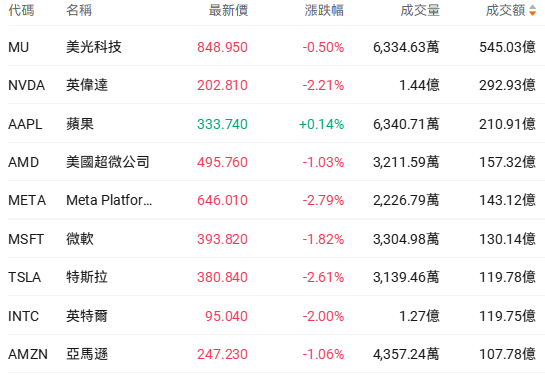
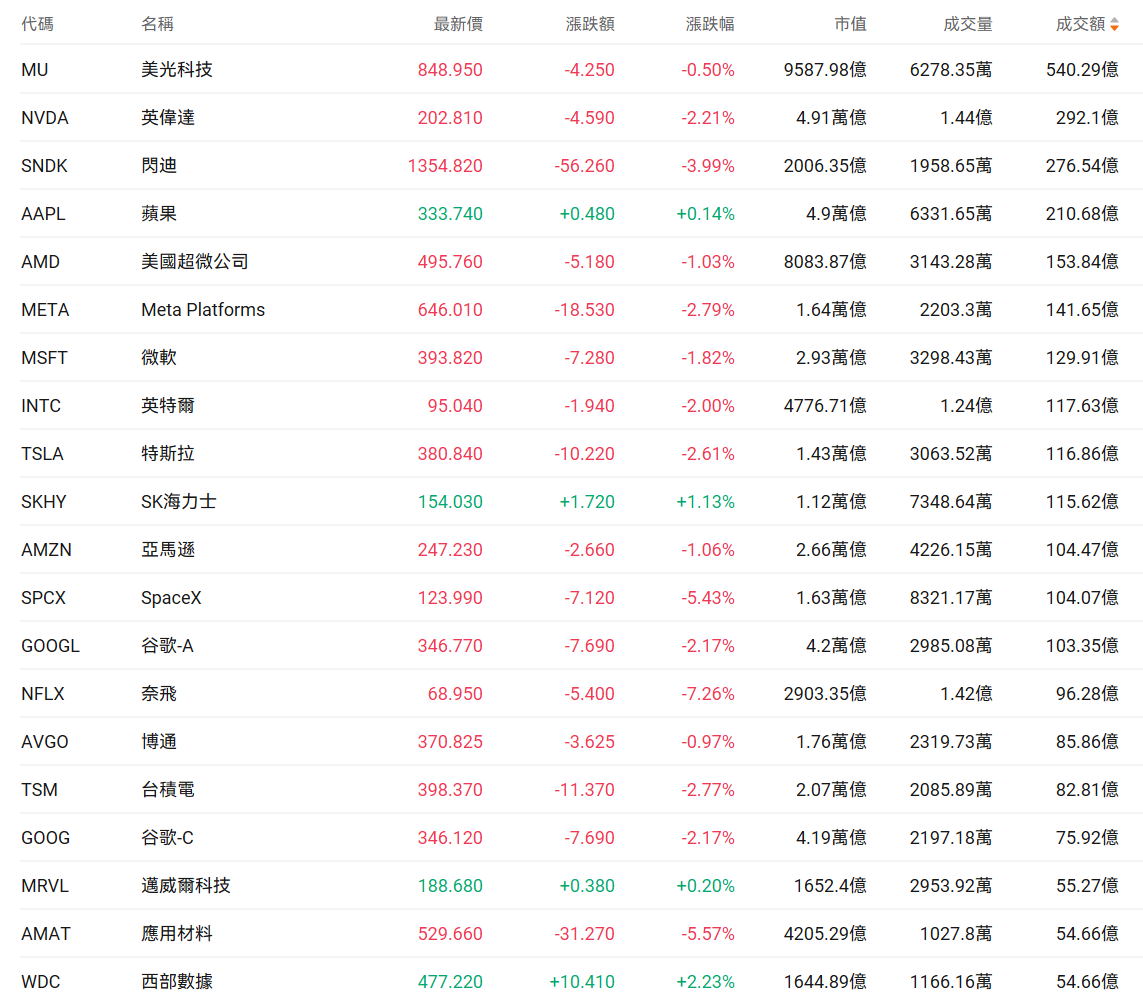
$Star Tech Stocks (LIST2518.US)$ Broad-based declines were observed, with Alphabet A down 2.17%, Meta Platforms down 2.79%, NVIDIA down 2.21%, Amazon down 1.06%, Tesla down 2.61%, Microsoft down 1.82%, and Apple up 0.14%.
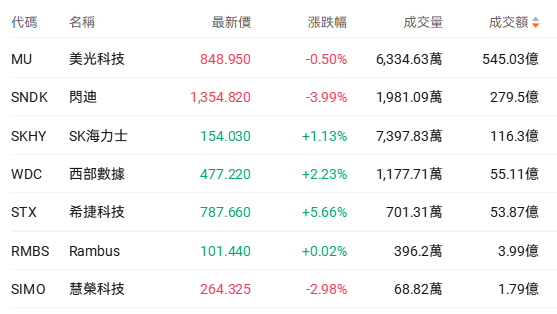
$Storage Concept (LIST23925.US)$ Stocks rebounded significantly during trading but pared gains toward the close, with SK Hynix up 1.13%, Western Digital (SanDisk) down 3.99%, Seagate Technology up 5.66%, and Western Digital up 2.23%.
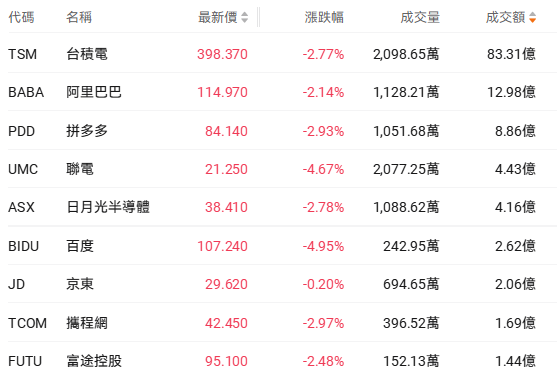
$Popular Chinese ADRs (LIST2517.US)$ Most Chinese stocks listed in the U.S. declined, with the Nasdaq Golden Dragon China Index closing down 1.8%, though it posted a weekly gain of 2.6%. Baidu closed down 4.95%; Meituan ADR, Tencent ADR, and Li Auto all fell more than 3%; PDD Holdings and Alibaba both dropped over 2%; and NetEase rose 0.74%.
Stock-specific news
NVIDIA: From 'one-time training' large models to 'post-training refinement' agents, compute demand is evolving
NVIDIA (NVDA.US) In an official blog post, NVIDIA explained that with the rise of Agentic AI, post-training for models has evolved from a one-time final step into a continuous, core workload. Unlike traditional generative models, agentic models must plan, invoke tools, and autonomously correct errors during execution, operating in environments that can change weekly—leading to continuously accumulating compute demands for post-training. NVIDIA stated that the Vera Rubin platform is co-designed specifically for this workload and requires only one-quarter the number of GPUs compared to the previous-generation Blackwell platform when training the largest-scale models.
SK Chairman Choi Tae-won: Semiconductor demand to rise by at least 50% next year; planning new U.S. fab
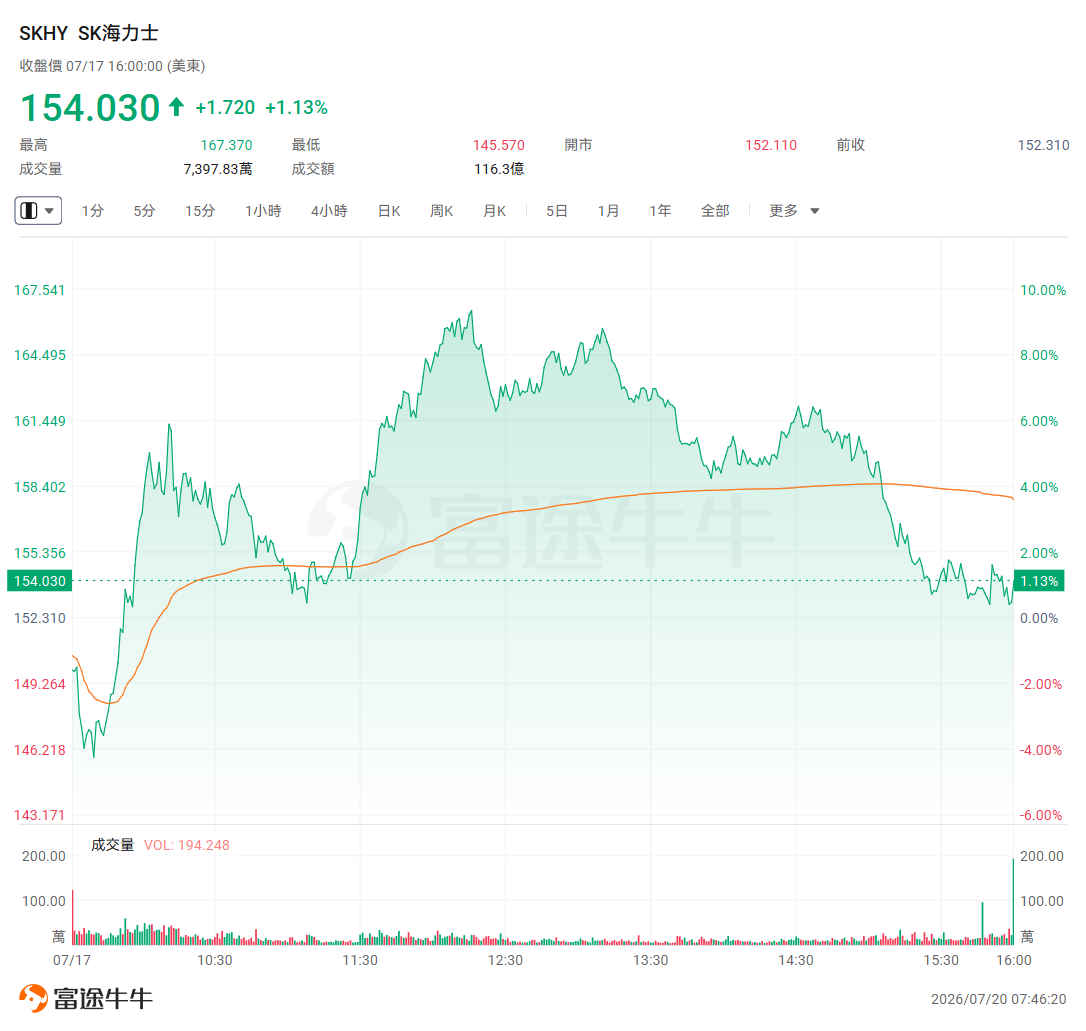
Choi Tae-won, Chairman of SK Group and President of the Korea Chamber of Commerce and Industry, stated during a media briefing on the sidelines of the Jeju Forum that global semiconductor demand will surge next year, with artificial intelligence (AI)-related demand projected to increase by 60% to 100% compared to this year, and overall semiconductor product demand expected to grow by at least 50% to 60%. However, virtually no new supply is expected to come online next year, likely widening the supply-demand gap further.
Given that demand for memory chips far exceeds supply, SK Group Chairman Choi Tae-won stated, $SK Hynix (SKHY.US)$ he is scouting locations in the United States for a new chip fabrication plant aimed at boosting supply capacity and curbing prices. As a major industry participant, he believes current price levels are excessively high and constitute an “abnormal” situation. Choi remarked, “I believe we need to build [chip fabs] not only in Gwangju and the Jeolla region but also in the United States.” “If conditions permit, I think construction should proceed. Trade pressures and other factors requiring careful consideration are involved, so we are currently evaluating this option.”
Taiwan Semiconductor adds $10 billion to Arizona fab investment, citing strong demand, says CFO
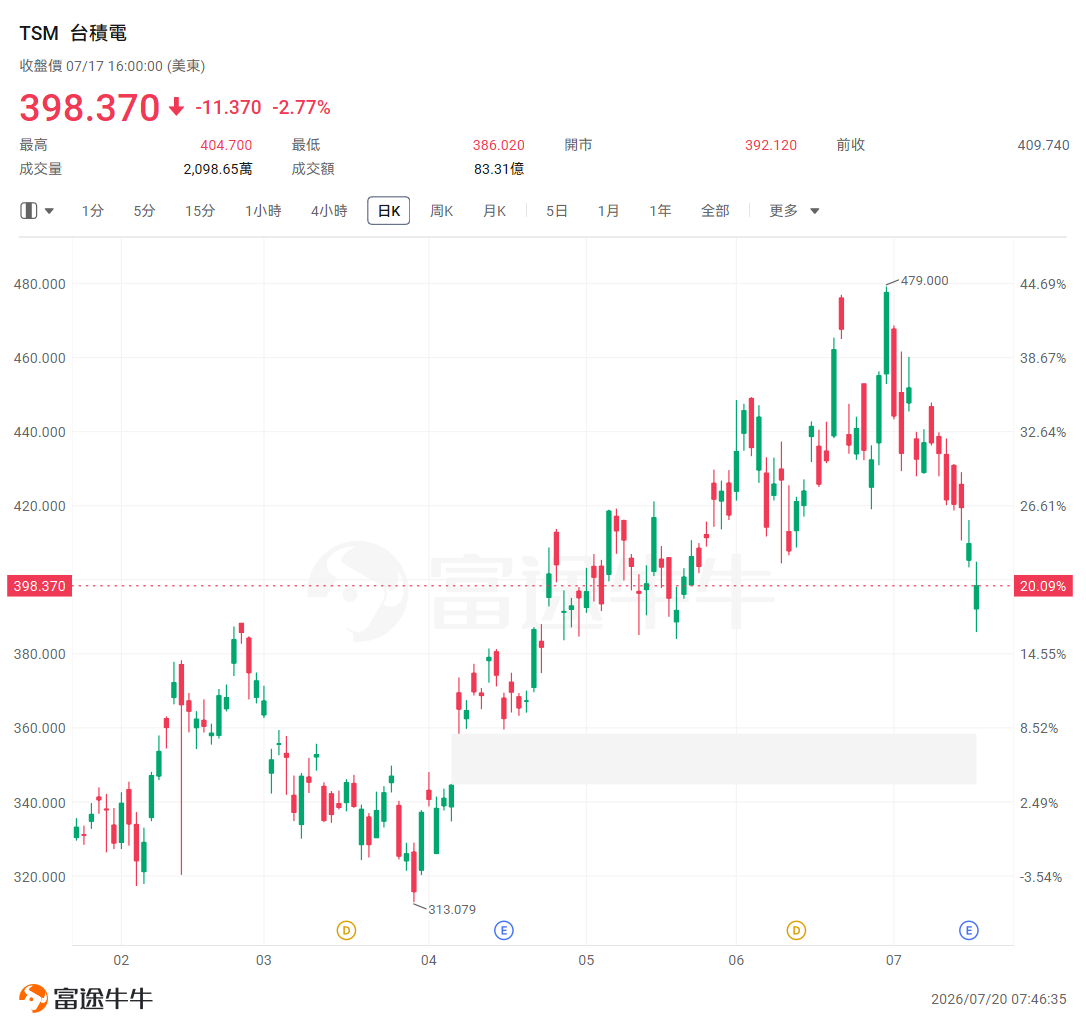
$Taiwan Semiconductor (TSM.US)$ CFO Huang Renzhao, in an exclusive interview with CNBC, stated that the company is accelerating construction of its Arizona fab to capitalize on opportunities presented by the AI "mega-trend." According to Bloomberg, Taiwan Semiconductor’s total investment in the U.S. has increased to $265 billion, with an additional $100 billion allocated to meet strong demand from U.S. clients and counter ambitious competitors. Despite this positive fundamental development, Taiwan Semiconductor’s shares closed down 2.77% on Friday, as broad-based selling pressure in tech stocks overshadowed the利好.
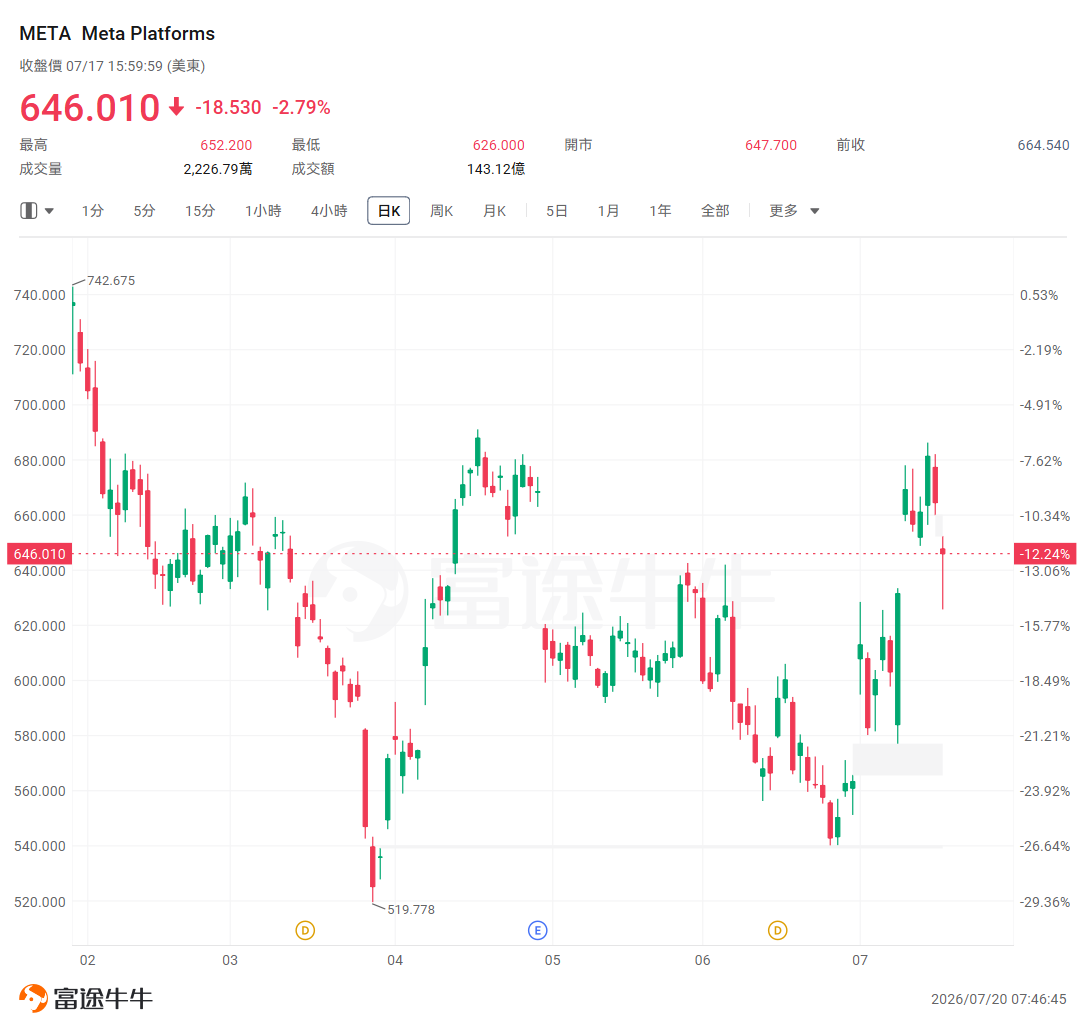
Meta Plans to Lease AI Compute Capacity to Anthropic, Seeking Commercial Returns on $100 Billion Capital Expenditure
According to reports, $Meta Platforms (META.US)$It is considering leasing its AI compute capacity to AI firm Anthropic. Against the backdrop of Meta’s cumulative AI infrastructure capital expenditure reaching the $100 billion scale, renting out idle compute capacity to external AI firms is seen as one avenue to achieve commercial returns. Meta’s shares closed down 2.79% on Friday and fell a further 0.89% in after-hours trading, as markets remain skeptical about whether its massive AI spending can translate into tangible revenue.
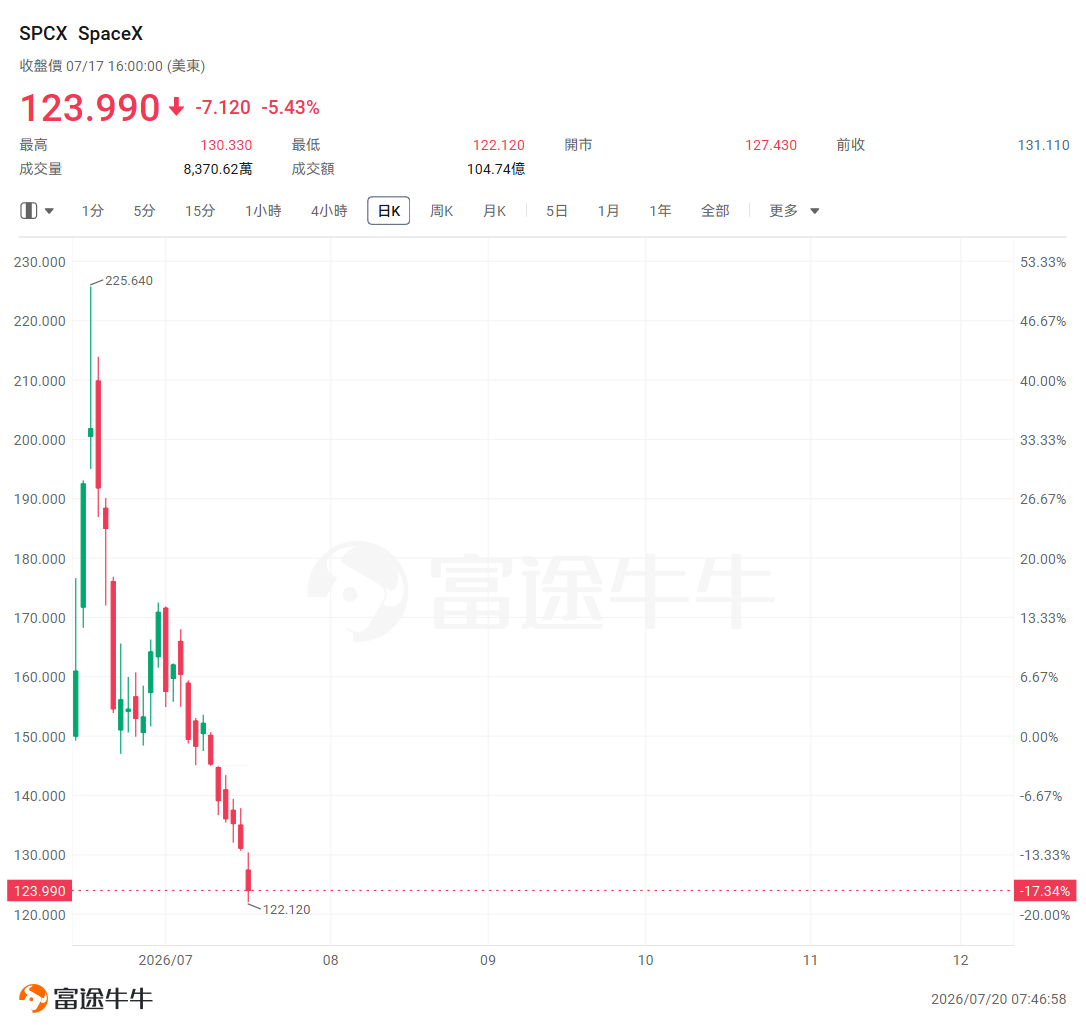
SpaceX Plans to Supply AI Compute Capacity to the Pentagon, Potential Contract Value in the Billions
According to media reports on Friday, $SpaceX (SPCX.US)$ is in negotiations with the U.S. Department of Defense regarding the provision of data center compute capacity, proposing to supply billions of dollars’ worth of computing power for running AI models. This move would further deepen the partnership between Elon Musk’s company and the Pentagon. Sources familiar with the matter revealed that the two sides are discussing an agreement under which SpaceX would provide computing capacity to the Department of Defense, with a potential contract value reaching several billion dollars. However, negotiations are ongoing, and the deal could still fall through. It is reported that SpaceX has signed similar compute supply agreements with Anthropic and Google in recent months and is now planning a significant expansion of its cloud computing business.
Top 20 by Trading Volume
Hong Kong Market Outlook
Southbound capital reduced holdings of Hong Kong-listed stocks by over HK$14 billion, with Alibaba and Meituan seeing net sales of over HK$24 billion and HK$20 billion, respectively.
On Friday, July 17, southbound capital recorded net sales of HK$14.57 billion in Hong Kong-listed equities.
$Ying Fu Fund (02800.HK)$、The Southern Hang Seng Technology (03033.HK)、$Xiaomi Group-W(01810.HK)$received net purchases of HK$29.75 billion, HK$9.71 billion, and HK$3.22 billion, respectively;
$Alibaba-W (09988.HK)$、$Meituan-W(03690.HK)$、$Huahong Hongli (01347.HK)$were net sold by HK$2.451 billion, HK$2.036 billion, and HK$1.939 billion, respectively.
Alibaba's Tongyi Qianwen has released a preview version of its flagship model, Qwen3.8 Max.
$Alibaba-W (09988.HK)$ Its Tongyi Qianwen (Qwen) has launched a preview version of its flagship model, Qwen3.8 Max. Alibaba stated that the model’s performance is on par with globally leading frontier AI models, second only to Anthropic’s Fable 5. This launch underscores Chinese tech giants’ continued intensification of efforts in the large-model race, as Alibaba seeks to solidify its position in the global AI landscape through iterative enhancements to its model capabilities.
Tianshu ZhiXin unveiled its new-generation general-purpose GPU flagship product, TianGai 300, at WAIC.
During the 2026 World Artificial Intelligence Conference (WAIC 2026), $Tiandu Zhixin (09903.HK)$ it officially launched its new-generation general-purpose GPU flagship product, TianGai 300. The TianGai 300 is now ready for large-scale deployment and has been deeply integrated with domestic cloud providers, server manufacturers, interconnected ecosystems, and hyper-node systems, supporting scalable deployment from single machines to large clusters.
Moonshot AI is reportedly expected to list on the Hong Kong Stock Exchange within as little as six months.
According to reports, leading large-model company Moonshot AI has sent an IPO proposal to investors and is expected to complete its Hong Kong listing within as little as six months. With annual recurring revenue (ARR) reaching USD 300 million in June and experiencing several-fold growth following the release of its K3 model, the company believes the timing is ripe. It is reported that Moonshot AI’s ARR tripled within three months, and its new Kimi K3 model surpasses all competitors except Claude Fable 5 and GPT-5.6 in overall capability. The pricing of Kimi K3 is roughly comparable to Anthropic’s Sonnet. The market is closely watching the subsequent impact of K3 on the global large-model competitive landscape and valuations of technology firms.
Zhongji Xuchuang has passed the Hong Kong Stock Exchange Main Board listing hearing.
On July 17, $Zhongji Xuchuang (300308.SZ)$ It has passed the listing hearing on the Main Board of the Hong Kong Stock Exchange, with Goldman Sachs, CICC, Morgan Stanley, and GF Securities acting as its joint sponsors. According to the prospectus, Zhongji Xuchuang is a global leader in optical interconnect solutions. Per CIC Consulting, the company has been the world’s largest provider of optical interconnect solutions by revenue for five consecutive years since 2021, capturing 21.2% of the overall optical interconnect solutions market in 2025.
YOFC: Demand for polarization-maintaining fiber is expected to grow tenfold to twentyfold over the next one to two years.
At the thematic forum titled “A New Paradigm for AI Infrastructure Driven by Optical Computing and Optical Interconnect” held on July 18 during the 2026 World Artificial Intelligence Conference (WAIC), $Yangtze Optical Fibre and Cable Joint Stock Limited Company (06869.HK)$ Zhuang Dan, Executive Director and President, stated that the polarization-maintaining fiber market is currently extremely hot, with demand expected to increase tenfold to twentyfold over the next one to two years. The company is expanding polarization-maintaining fiber production together with partners across the industrial chain. Zhuang noted that historically, Datacom (data communications) accounted for less than 10% of global fiber optic cable demand. However, based on current trends, it is projected to represent over 50% of total optical connectivity demand by 2030. “Going from less than 10% to more than 50% represents a very significant shift.”
Today's Focus
Keywords: U.S. June Conference Board Leading Economic Index (MoM); Japanese stock markets closed; AMC Entertainment earnings report
On the economic data front, at 09:00, China’s one-year Loan Prime Rate (LPR) as of July 20 will be released; at 22:00, the U.S. will publish the June Conference Board Leading Economic Index (MoM).
Regarding earnings, $AMC Entertainment (AMC.US)$、Domino's Pizza (DPZ.US)will release its earnings during the U.S. pre-market session;$Zions Bancorporation (ZION.US)$ will report earnings after the U.S. market close.
On the financial events front, the World Artificial Intelligence Conference (WAIC) concludes today.
Market holiday: The Tokyo Stock Exchange in Japan is closed today for Marine Day.
 Looking to select stocks or analyze your holdings? Want to understand the opportunities and risks in your portfolio? For any investment-related questions,just ask Futubull AI!

Editor/Rocky