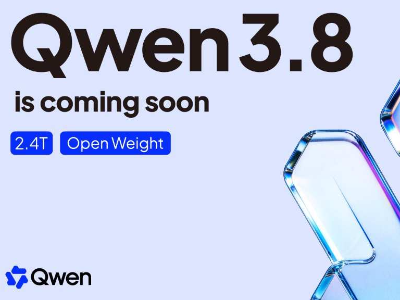
The model supports multimodal processing, including images, videos, and documents, and has already been launched on platforms such as Qoder, with full model weights to be openly released "very soon." Notably, Moonshot AI—a company backed by Alibaba—has just set a new record with Kimi K3, a model featuring 2.8 trillion parameters, intensifying the internal competition within Alibaba's investment portfolio over the title of the 'largest open model.'
Alibaba has officially entered the global parameter arms race among leading large AI models, extending the competition into its own investment portfolio.
On July 19, Alibaba released a preview version of its flagship large model, Qwen3.8 Max, with a parameter count as high as 2.4 trillion. The company stated that its overall capabilities rank second globally only to Anthropic’s Fable 5. Alibaba also pledged to release the full model weights “very soon.”
 Notably, the timing of this release is intriguing—just days earlier, Moonshot AI, a venture backed by Alibaba, had shaken global tech stocks with its 2.8-trillion-parameter Kimi K3 model, briefly claiming the title of “largest open model in history.” The high-profile debut of Qwen3.8 Max has intensified the internal rivalry within Alibaba’s investment ecosystem over the title of “largest open model.”
Currently, the preview version has been launched on Alibaba's code development platforms Qoder, QoderWork, and Token Plan, with the public conversation version also now available. Today $BABA-W (09988.HK)$ Hong Kong-listed shares opened 3% higher, $Alibaba (BABA.US)$ and U.S. stocks rose nearly 3% in overnight trading.
Preview version launched ahead of schedule; timing for weight release pending
Alibaba disclosed this announcement through official channels and social media posts from the Qwen team, positioning Qwen3.8 Max as “one of the most powerful models today, comparable to leading frontier AI models.”
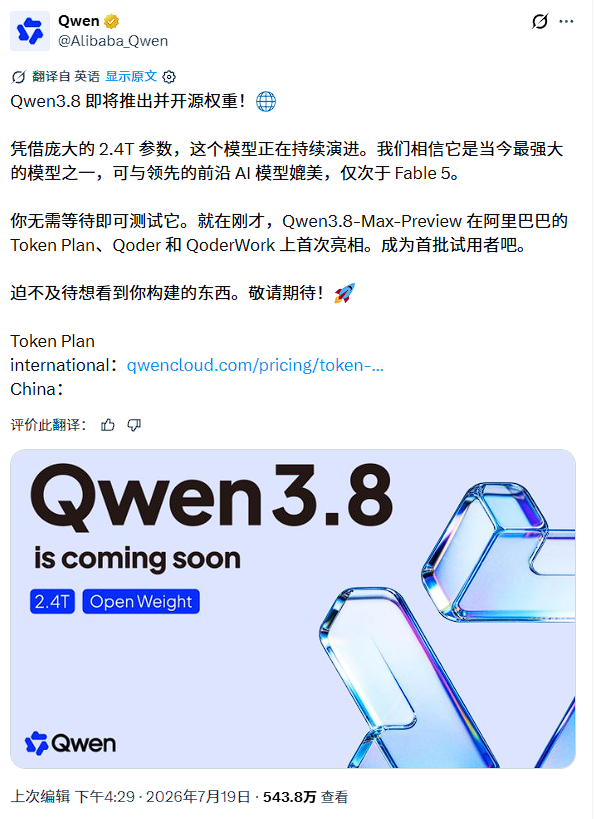
Developers can already access the preview version via platforms such as Qoder, and the public conversational interface is also now live. Alibaba stated it will release the full open weights “very soon,” though no specific date was provided.
According to reports, Bai Shuai, a developer involved in the project, stated that Qwen3.8 Max is the team’s first multimodal model to exceed one trillion parameters, capable of processing diverse content types—including images, videos, and documents—within a single system.
He anticipates that the model will significantly outperform its predecessor, Qwen 3.7-Max, across complex productivity scenarios such as code generation, full-stack development, data analysis, and office automation.
Although the 2.4-trillion-parameter scale is eye-catching, analysts have cautioned investors and developers to remain prudent.
In an interview, analysts noted that the total parameter count does not directly reflect the number of parameters actually involved in computation per token, nor does it allow for reliable estimation of true inference costs. To date, Alibaba has not released any benchmark evaluation results, nor disclosed the number of activated parameters, licensing terms, or a complete model card.
Notably, earlier Qwen series models extensively employed a Mixture-of-Experts (MoE) architecture—wherein only a small subset of weights is activated during inference—enabling actual computational demands and costs to remain far below those suggested by the nominal parameter count. If Qwen3.8 Max adopts a similar design, the gap between its stated 'total parameters' of 2.4 trillion and its actual inference overhead could likewise be substantial.
Internal Competition Within Alibaba's Investment Portfolio
Analysts believe that the context surrounding this launch reflects profound shifts in the competitive dynamics within China’s AI ecosystem.
Just days before the unveiling of Qwen3.8 Max, Moonshot AI—another venture backed by Alibaba—launched Kimi K3. With a parameter count of 2.8 trillion, this model delivered standout performance in head-to-head comparisons against offerings from Anthropic and OpenAI, briefly triggering volatility across global tech stocks and setting a new record as the 'largest open model ever released.'
The emergence of Kimi K3 signals that China’s large-model labs no longer treat open-weight access as an optional add-on but instead regard it as a core strategic asset in competing for developer ecosystems. Given Alibaba’s extensive equity stakes in leading domestic AI ventures, the rivalry over the title of 'largest open model' within its own portfolio has effectively evolved into internal competition among its investee companies.
Whether Qwen3.8 Max can fulfill the ambition conveyed in its preview version after the full release of its weights remains subject to verification through benchmark evaluations and market validation.