
Global electric vehicle giant $Tesla (TSLA.US)$ will release its second-quarter 2026 earnings after the U.S. market close on Wednesday, July 22, U.S. time. Against a backdrop of slowing EV deliveries, intensifying competition, and sustained margin pressure, market attention has shifted from vehicle sales alone to more visionary growth narratives such as autonomous ride-hailing, the Optimus humanoid robot, and artificial intelligence (AI) infrastructure. Investors are now looking to this earnings report for clear signals on whether Elon Musk can reignite sustainable growth momentum for the company.
Ahead of this earnings release, market expectations have been notably revised upward following disclosures of delivery figures and business progress: Wall Street currently forecasts revenue of USD 26.4 billion, earnings per share (EPS) of USD 0.52, and an automotive gross margin (excluding regulatory credits) slightly above 18%. Under these latest estimates, revenue would represent approximately a 17% year-over-year increase compared to the same period in 2025, while EPS could see a nearly 30% year-over-year gain, despite a potential slight 1% decline in pre-tax profit to USD 1.88 billion.
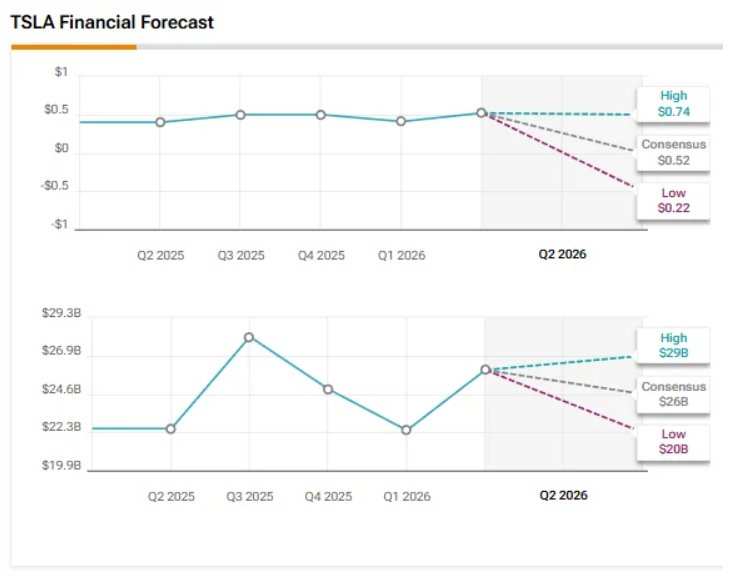
On the eve of the earnings announcement, Tesla’s share price remains about 20% below its recent all-time high, reflecting investor concerns over weak EV demand, ongoing price wars, and uncertainty regarding the timing of its next phase of growth.
Deliveries have stabilized, but competitive pressures remain unabated
 Tesla has already disclosed global deliveries of 480,126 vehicles and production of 451,758 units for the second quarter. The delivery figures exceeded some pessimistic expectations, temporarily boosting market sentiment, yet they have not fully alleviated external concerns about the stability of Tesla’s market position.
Competition continues to intensify in the world’s two largest EV markets—the United States and China—where legacy automakers and Chinese domestic brands like BYD (01211.HK) are launching increasingly price-competitive electric models. Although Tesla remains one of the world’s largest pure-electric vehicle manufacturers, BYD has firmly secured the title of global leader in new energy vehicles (including plug-in hybrids) and has surpassed Tesla in pure-electric sales across multiple quarters.
As the EV market matures, defending market share is becoming increasingly challenging. Investors will closely monitor management’s outlook on second-half production plans, order trends, and end-market demand, particularly against a macroeconomic backdrop where interest rates in major economies remain relatively elevated and consumers are growing more cautious about discretionary big-ticket spending.
Margins: Cost reduction and diversification are key
Over the past two years, Tesla has frequently cut vehicle prices to stimulate demand, placing continuous downward pressure on automotive gross margins. Although declining raw material costs have provided some relief, the market is more focused on whether improvements in manufacturing efficiency, expansion of software revenue, and a more favorable vehicle mix can drive margins into a recovery trajectory.
Second-quarter operating margin and free cash flow will serve as critical metrics for assessing Tesla’s ability to balance growth with profitability. Notably, the possibility of free cash flow turning negative due to sharply rising capital expenditures has drawn significant attention. Morgan Stanley analyst Andrew Percoco explicitly noted that, with capital expenditures more than doubling, investors are increasingly scrutinizing whether this spending is genuinely strengthening Tesla’s moat in the realm of 'physical AI.'
Autonomous Robotaxis: Scaling Progress Takes Center Stage
Fully autonomous driving software and the Robotaxi business are central pillars underpinning Tesla’s long-term valuation. Currently, the actual deployment and expansion pace of its autonomous taxi service has become one of the most anticipated updates from this earnings call.
Bank of America analyst Alexander Perry noted that this earnings report is expected to provide further details on Robotaxi deployment, particularly regarding fleet expansion timelines and plans for entering new markets. Since launching service in Miami on July 3, Tesla has begun operations in five markets and has four additional markets in preparation. Its ability to scale will directly test market skepticism toward Tesla’s vision-only approach.
The analyst also pointed out that on safety metrics, 22 incidents have been reported cumulatively from service launch through mid-June, with no serious injuries or fatalities recorded—a factor providing some support for regulatory engagement and public acceptance. Any updates on the commercialization timeline for driverless operations, regulatory approval progress, or changes in FSD subscription rates could serve as significant catalysts for the stock price.
Optimus: Transitioning from Grand Vision to Tangible Production
The humanoid robot Optimus is moving from Elon Musk’s repeatedly articulated long-term vision toward a critical milestone of actual production. Over the past two years, Musk has set highly aggressive production targets for Optimus, and this quarter may mark the beginning of a credibility test for his execution capability.
According to the latest information, Tesla plans to initiate initial Optimus production at its Fremont factory between late July and August, potentially unveiling the third-generation Optimus concurrently. More concrete signals are emerging from the supply chain: Tesla has already issued clear procurement guidance to suppliers, requesting component production capacity be scaled to approximately 1,000 units per week by September and further increased to 2,000–2,500 units per week by year-end.
Morgan Stanley expects Musk to elaborate during the earnings update on Optimus’ final design, production ramp-up trajectory, and early use cases within Tesla’s own manufacturing operations. If execution proceeds smoothly, Optimus could evolve from a long-term optionality into a visible growth trajectory.
Energy and AI: Diversified Growth Pillars Taking Shape
Beyond automotive operations, energy generation and storage are becoming increasingly significant contributors to profitability. As utilities and enterprises intensify investments in grid-scale energy storage systems to support the energy transition, demand for Tesla’s Megapack large-scale battery systems remains robust. Revenue and profit growth in the energy segment provides Tesla with valuable diversification beyond vehicle manufacturing.
AI investment serves as an underlying theme throughout this earnings report. Musk has repeatedly emphasized that AI capabilities constitute Tesla's core competitive advantage—not only powering autonomous driving but also acting as the brain behind the Optimus robotics program. The market will be looking for concrete details on AI infrastructure investments, computing capacity, and how these will translate into future revenue. Against a backdrop of surging capital expenditures and pressure on free cash flow, investors need to hear a compelling return-on-investment rationale for Tesla’s 'physical AI' strategy directly from management.
Editor/Jeffy