After the U.S. semiconductor sector entered a bear market, Goldman Sachs advised investors to move beyond AI-related trades and focus on three alternative areas: consumer experience stocks, compound growth companies, and potential M&A targets, in order to diversify exposure to AI-driven volatility and capture new market opportunities.
The semiconductor sector’s deep entrenchment in bear market conditions has significantly diminished the appeal of AI-related trades. In response, Goldman Sachs’ analyst team has promptly introduced three alternative investment themes to offer new strategic directions for investors seeking to avoid the volatility risks associated with AI.
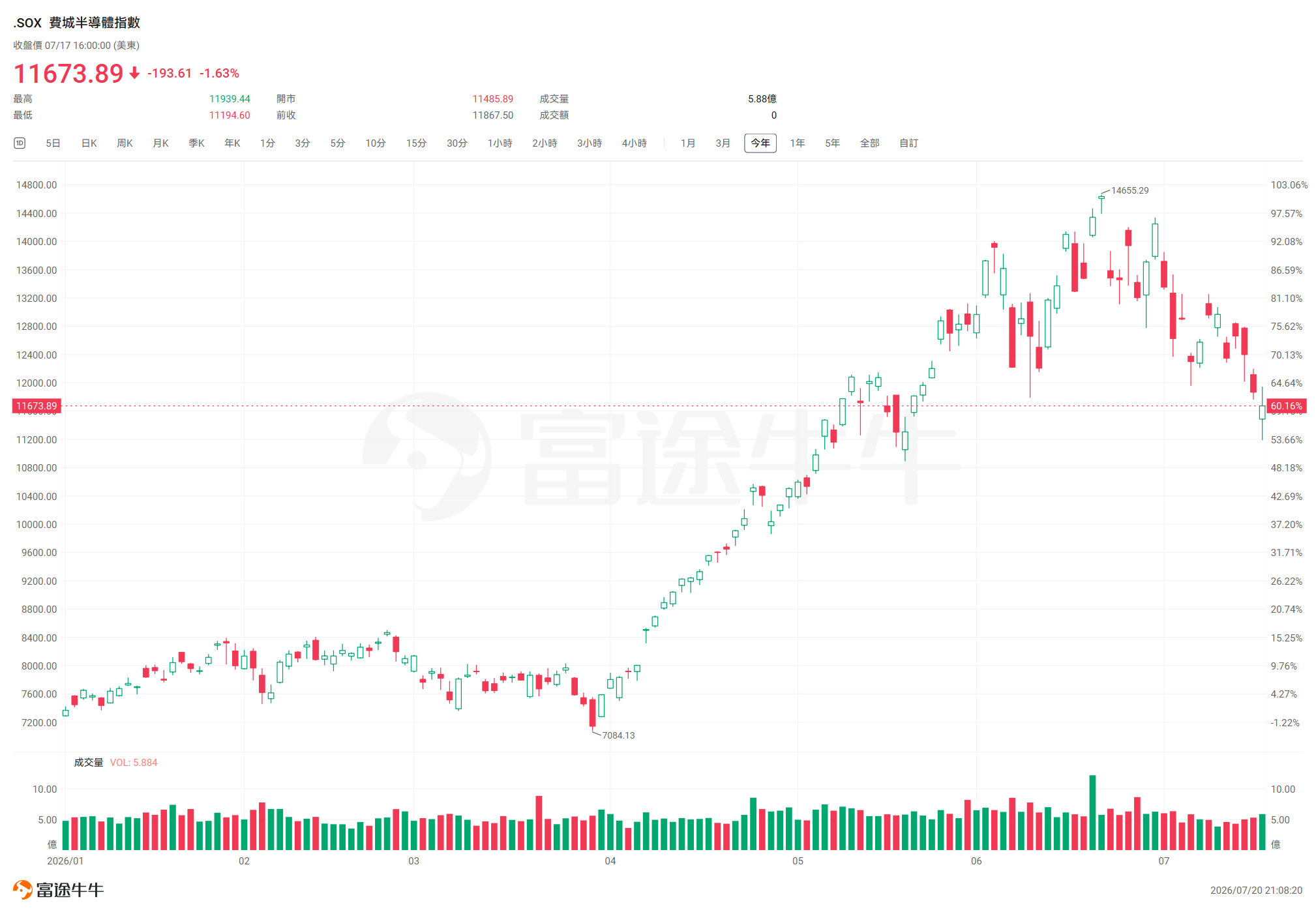
with AI chip stocks such as NVIDIA and Micron Technology as core components,$PHLX Semiconductor Index (.SOX.US)$has declined more than 20% from its intraday peak reached approximately one month ago, officially entering bear market territory. According to MarketWatch, Goldman Sachs analysts noted in a research report released last Friday that the 'painful volatility' in AI infrastructure stocks has prompted investors to shift their focus beyond AI-related themes.
 The Goldman Sachs analyst team, led by Ben Snider, has thus proposed three alternative investment avenues: consumer experience stocks, compounders, and potential M&A targets. These three asset categories differ in valuation, growth rationale, and risk profiles, collectively forming Goldman Sachs’ non-AI investment framework under current market conditions.
Consumer Experience Stocks: Resilient to AI Disruption and Attractively Valued
The first theme recommended by Goldman Sachs is consumer experience stocks.
Goldman Sachs believes these stocks "offer exposure to robust long-term growth in consumer spending on experiences at reasonable valuations, with limited risk of disruption from AI."
Data shows that spending on experiential consumption has accelerated markedly—growth in experience-related expenditures, covering sectors such as fitness centers, parks, theaters, museums, and gaming, surged from 1% in Q1 2025 (compared to 2% growth in broad services consumption) to 6% in Q1 2026 (while broad services consumption remained at 2%).
Goldman Sachs notes that this type of consumption is skewed toward higher-income groups, and the physical nature of experiences makes them more resilient to AI-driven disruption compared to other service categories. The firm has identified 36 candidate stocks from companies with market capitalizations exceeding $2 billion. Key risks to this theme include a deterioration in consumer health, such as rising oil prices or a weakening labor market.
Compounders: Quality Premium at a Decade-Low Level
The second theme focuses on what Goldman Sachs refers to as 'compounders'—companies that can consistently deliver earnings growth, maintain high returns on capital, and generate strong free cash flow conversion.
Goldman Sachs constructed a basket of 15 individual stocks by applying a composite screening methodology based on multiple growth and quality metrics within the Russell 1000 Index, including historical and forward earnings-per-share growth rates, free cash flow conversion rates, and return on invested capital. The firm explicitly excluded 'stocks most directly linked to AI, including beneficiaries of infrastructure spending and companies perceived to face disruption risks.'
In terms of valuation, the median stock in this basket trades at a price-to-earnings (P/E) ratio of 22x, higher than the 16x P/E of the equal-weighted S&P 500. However, Goldman Sachs estimates that this relative valuation is nearing its lowest level in ten years. The firm believes that both the macroeconomic environment and earnings growth outlook will support valuations for these stocks, though a dovish pivot by the Federal Reserve or a broad-based improvement in economic growth prospects would represent key risks to this theme.
Potential M&A Targets: Deal Wave Creates Arbitrage Opportunities
The third theme focuses on potential merger and acquisition (M&A) targets.
According to Goldman Sachs data, M&A activity has surged significantly this year, with announced deal value reaching $1.2 trillion—up 32% compared to the same period in 2025—and the number of announced deals rising by 12%. Of these, 40% are concentrated in the computer and electronics and healthcare sectors, although overall activity has expanded across multiple industries.
Goldman Sachs attributes the sustained momentum in M&A activity to supportive macro conditions, including accommodative financial conditions, solid economic growth, elevated CEO confidence, and a favorable regulatory environment. The basket includes 71 companies, each assessed by Goldman Sachs analysts as having an acquisition probability exceeding 15%. The primary risk to this theme lies in deteriorating market sentiment, which could threaten the current M&A cycle.
AI Trades Cool Off as Capital Seeks Rebalancing
The introduction of these three themes reflects ongoing structural shifts in the market.
The bearish signal from the Philadelphia Semiconductor Index marks a phase of testing for the AI-driven market narrative that has dominated over the past two years, prompting some capital to actively seek diversified allocations.
From a broader market perspective,$S&P 500 Index (.SPX.US)$is still up approximately 8.94% year-to-date,$Nasdaq Composite Index (.IXIC.US)$with a year-to-date gain of about 9.80%, but both have declined by 0.57% and 3.76%, respectively, over the past month, indicating significant pressure on the technology sector. Goldman Sachs’ introduction of a non-AI alternative framework aligns closely with this subtle shift in market sentiment and offers investors a practical rebalancing strategy amid heightened volatility in AI-related trades.
Editor/melody