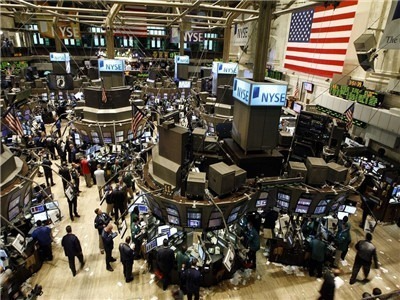
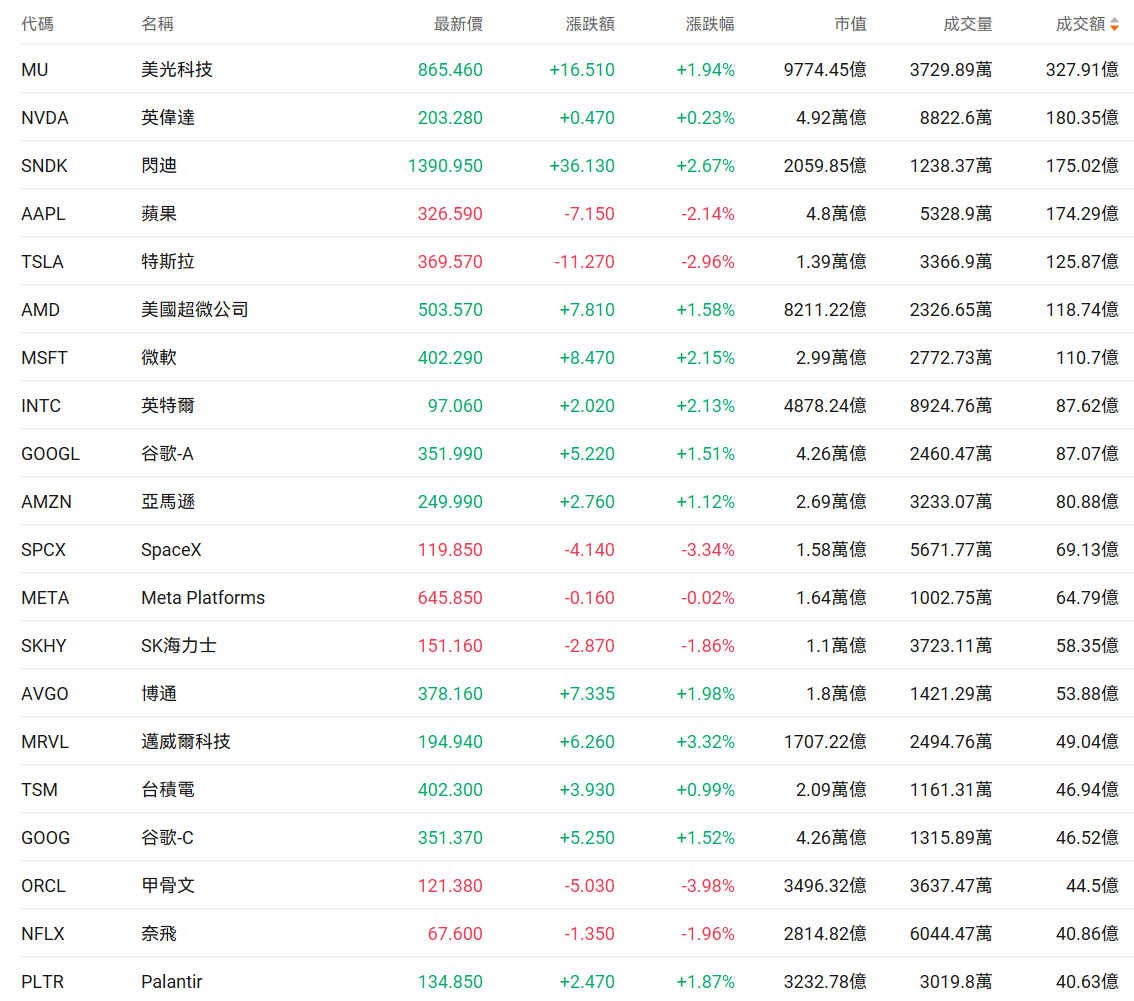
Ranked No. 1 by trading volume on U.S. stock markets on Monday$Micron Technology (MU.US)$Closed up 1.94%, with trading volume reaching USD 32.791 billion.
Analysts noted that the memory chip industry is experiencing intensified supply-demand dynamics, with capacity expansion and AI-driven demand pulling in opposite directions, raising concerns about cyclical risks.
Shares of major global memory chip companies have recently undergone significant corrections, with Samsung and$SK hynix (SKHY.US)$Micron Technology both down over 30%, reflecting deep market concerns about a potential return to oversupply. Despite robust demand for high-end memory such as HBM from AI data centers, the three industry giants have already announced massive capacity expansion plans—$SK Hynix (000660.KR)$Samsung plans to invest KRW 1100 trillion,$Samsung Electronics (005930.KR)$SK hynix intends to invest KRW 2100 trillion, and Micron has committed over USD 250 billion, sparking fears of supply glut risks beyond 2028.
 Analysts point out that HBM, due to its high degree of customization, carries a lower risk of oversupply, but commodity DRAM could face pressure by 2029. Meanwhile, the rise of China’s memory industry is seen as the biggest variable; Morgan Stanley forecasts that China will account for 30% of global incremental DRAM capacity by 2028, potentially reshaping the industry’s supply-demand landscape.
2nd place$NVIDIA (NVDA.US)$Closed up 0.23%, with trading volume reaching USD 18.035 billion.
On Monday, reports emerged that Advanced Micro Devices launched Helios to challenge NVIDIA,$Microsoft (MSFT.US)$with Microsoft joining its customer roster.
Advanced Micro Devices (AMD) officially launched its first rack-scale AI system, Helios, on Monday, directly targeting NVIDIA's Grace Blackwell and Vera Rubin systems. Microsoft announced it will deploy the system in Azure data centers, becoming the latest buyer following Meta and OpenAI,$Oracle (ORCL.US)$as the newest customer.
AMD’s Helios system integrates AMD’s proprietary GPU, CPU, networking chips, and ROCm software, and is scheduled to begin shipping later this year. AMD emphasized that Helios offers significant advantages in inference and memory bandwidth, with a strong focus on reducing the total cost per token.
Currently, NVIDIA controls over 95% of the data center GPU market, while AMD holds approximately 4.5%. However, analysts believe Helios could help AMD increase its market share to 20%–25%. AMD aims to achieve tens of billions of dollars in data center AI revenue starting in 2027. Although Helios’ hardware performance is reportedly on par with NVIDIA’s offerings, analysts note that AMD’s software ecosystem remains a weakness, and CUDA’s lead is unlikely to be challenged in the near term.
3rd place$SanDisk (SNDK.US)$It closed up 2.67%, with trading volume at $17.502 billion.
U.S. listed memory chip stocks rose broadly on Monday.
4th place$Apple (AAPL.US)$It closed down 2.14%, with trading volume at $17.429 billion.
A survey of Apple users found that more than 90% of respondents indicated they would adjust their purchasing behavior in response to higher product prices, with “reducing upgrade frequency” being the most common strategy. Only 9% of users reported being unaffected.
Price increases for certain Apple products have already exceeded 50%, with memory and storage upgrades doubling in price. Analysts report that supply chain pricing is unlikely to see significant improvement before 2028, suggesting current high prices may persist for several years. The findings indicate that even loyal, highly engaged Apple customers have limits to their tolerance, and rising prices are directly undermining their willingness to upgrade.
Rank 5$Tesla (TSLA.US)$It closed down 2.96%, with trading volume at $12.587 billion.
Tesla plans to increase weekly production at its Grünheide, Germany factory to 7,500 vehicles in fiscal year 2026 (approximately 375,000 vehicles on an annualized basis), representing an increase of about 20%. The expansion will also add 3,500 new jobs and expand battery production capacity to 18 GWh.
This expansion stands in sharp contrast to the wave of layoffs currently affecting traditional German automakers such as Volkswagen and Mercedes-Benz. Although the plant’s capacity utilization was only 54% in 2025, net profit still rose 36% year-over-year to €771 million. The confidence behind this capacity expansion stems from a strong recovery in European market demand—Model Y registrations in Germany surged fourfold year-over-year in March 2026, and global deliveries increased 25% year-over-year to 480,000 units in the second quarter.
However, Tesla also faces 'significant challenges' in European battery production and geopolitical risks. The Grünheide facility is Tesla’s sole vehicle manufacturing base in Europe, and its long-term role may expand to include production of the Cybercab and Optimus humanoid robots.
6th place$Advanced Micro Devices (AMD.US)$ Rose 1.58%, with trading volume of $11.874 billion.
On Monday, AMD officially launched its first rack-scale AI system, Helios, directly competing with NVIDIA’s Grace Blackwell and Vera Rubin systems. Microsoft announced it will deploy the Helios system in its Azure data centers, becoming the latest customer following Meta, OpenAI, and Oracle.
AMD’s Helios system integrates AMD’s proprietary GPU, CPU, networking chips, and ROCm software, and is scheduled to begin shipping later this year. AMD emphasized that Helios offers significant advantages in inference and memory bandwidth, with a strong focus on reducing the total cost per token.
9th place$Alphabet-A (GOOGL.US)$ Rose 1.51%, with trading volume of $8.707 billion.
$Alphabet-C (GOOG.US)$ It is developing a new server chip specifically tailored for its Gemini AI model, directly hardcoding the model architecture into silicon to significantly enhance AI inference efficiency. According to informed sources, the chip, internally referred to as "Frozen v2," could achieve 6 to 10 times the efficiency of its current in-house chips and may be deployed as early as 2028.
Rank 11$SpaceX (SPCX.US)$Declined 3.34%, with trading volume of $6.913 billion.
Reports earlier indicated that SpaceX’s 13th Starship test flight has been postponed to July 23. On July 19, SpaceX stated it plans to attempt another launch of the Starship rocket on July 23.
On July 16, SpaceX’s originally scheduled 13th Starship test flight was automatically aborted during engine ignition due to some engines failing to start. This test flight was intended to be SpaceX’s first launch mission following its June listing this year.
Following the cancellation of the test flight, SpaceX's market capitalization briefly evaporated by approximately $100 billion.
Regarding the new launch date, SpaceX officially announced a planned launch on July 23, although Musk had previously stated that the next launch attempt would occur 'this Friday.'
SpaceX will release its second-quarter earnings report on August 4.
Rank 15$Marvell Technology (MRVL.US)$Rose 3.32%, with trading volume reaching $4.904 billion.
18th place$Oracle (ORCL.US)$ Declined 3.98%, with the share price falling to its lowest level since April 2025, and trading volume amounting to $4.45 billion.
Oracle’s $16.5 billion AI data center project in New Mexico, stalled by environmental permitting issues, was forced to switch from a self-built natural gas power plant to fuel cells, causing costs to surge by several billion dollars. Meanwhile, its Wisconsin project incurred additional expenditures exceeding $100 million due to regulatory rulings on transmission cost allocation and credit ratings. S&P’s recent downgrade of Oracle’s rating highlights the widespread challenges tech giants face with hidden costs related to environmental compliance, water resources, and community approvals in AI infrastructure development.
Want to select stocks or get a stock diagnosis? Curious about the opportunities and risks in your portfolio? For all your investment questions,Just ask Futubull AI!

Editor/Liam