
The U.S. equity market’s 'good news is bad news' dynamic resurfaces: Citi's Economic Surprise Index soars to 50.3, potentially triggering a three-week correction period for the S&P 500.
Zhitong Finance APP has learned that the U.S. economy is demonstrating stronger-than-expected resilience—marked by a robust labor market, solid retail sales, and a recovery in regional manufacturing. However, for U.S. equity investors, this 'good news' is turning into tangible 'bad news.' A recent study by Leuthold Group has uncovered a troubling market pattern: whenever the Citi U.S. Economic Surprise Index surpasses the critical threshold of 40, the S&P 500 tends to post negative returns over the following three weeks, on average requiring three months to recover its losses. Currently, the index stands at 50.3—the 'good news is bad news' curse is once again playing out on Wall Street.
Historical Pattern: The 'Three-Week Curse' Validated 28 Times
 Since Citigroup launched the Economic Surprise Index in 2003, data tracked by Leuthold Group shows that on 28 occasions when the 'Main Street economy' indicator reached 40 or higher, the S&P 500 recorded negative returns over the subsequent 21 trading days. Each time, the market took an average of three months to recoup those losses.
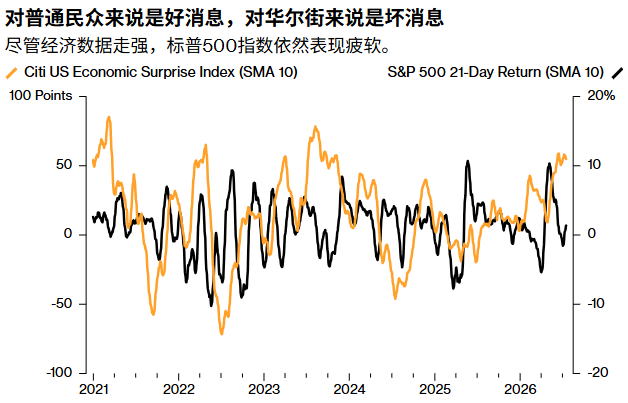
Chun Wang, Director of Multi-Asset Strategy at Leuthold, stated plainly: 'We have indeed observed this shift in market dynamics, particularly over the past two to three months, where positive economic news has often coincided with weak stock market performance.' This 'good news is bad news' scenario stems from the interplay of multiple forces.
The Citi Economic Surprise Index has remained in positive territory throughout this year, but recent declines in oil prices have further elevated the index. In June, it briefly surged above 63, reaching its highest level since 2023. This indicates that the degree to which U.S. economic data has exceeded expectations has reached a strength rarely seen in recent years.
This research offers a method to track investor sentiment, as investors attempt to strike a balance—ensuring economic data is neither so hot that it stokes inflation (and thereby triggers a strong response from the Federal Reserve) nor so weak that it dampens economic growth momentum.
Iran War: The 'Extra Noise' Disrupting Historical Patterns
Wang specifically highlighted the Iran war as the most notable variable in the current 'good news is bad news' phenomenon. The 'additional disruption' caused by U.S.-Iran military tensions represents the greatest deviation from historical patterns to date, significantly impacting both oil prices and breakeven inflation rates.
Rising oil prices themselves constitute a form of policy pressure—Leuthold’s Chief Investment Strategist Jim Paulsen previously found a strong negative correlation (with a correlation coefficient as high as 0.7) between the Citi Economic Surprise Index and a policy pressure index that measures rising oil prices, higher 10-year Treasury yields, and a stronger U.S. dollar. Moreover, changes in the policy pressure index typically lead movements in the Economic Surprise Index by three months. This suggests that today’s strong economic data may be a lagged reflection of oil-driven price pressures and accumulated policy strain from three months ago.
Triple Logic: Why Strong Data Has Become Poison for Equities
Argument One: Overheating Economy Triggers Inflation and Rate Hike Concerns
Strong economic data is a double-edged sword. Bob Lang, founder and chief strategist at Explosive Options, warned, “Monetary policy could shift next week and into the fall, reflecting a more aggressive stance by policymakers in combating inflation.” Markets fear that persistently stronger-than-expected economic data will complicate the Federal Reserve’s task of anchoring inflation within its 2% target range.
Although both June CPI and PPI data came in weaker than expected—temporarily dampening rate hike expectations—Fed officials remain cautious. Chair Waller stated that a single soft CPI reading should not be interpreted as ‘mission accomplished,’ while Governor Waller cautioned that if core inflation shows signs of overheating again, the Fed may need to tighten policy soon. Economists at Bank of America still expect the Fed to raise rates at its meetings in September, October, and December.
Argument Two: Valuations Already Price in the Most Optimistic Scenario
Ken Mahoney, CEO of Mahoney Asset Management, noted that equities have rallied approximately 17% since late March, and current valuations may already reflect the most optimistic outlook. “The best-case outcome may already be priced into stocks, and now solid economic reports could actually exert downward pressure on equities,” Mahoney said. “There has been an asymmetric shift in how investors interpret news.”
Valuation-related stress signals are particularly pronounced. On July 14, 2026, the S&P 500’s trailing price-to-earnings (PE-TTM) ratio stood at 28.35x, placing it at the 79.12th percentile over the past decade. If S&P 500 profit margins revert to their 2019 levels, the index’s current forward P/E would be approximately 27x—already exceeding the peak of roughly 26.5x seen during the March 2000 dot-com bubble. The S&P 500’s cyclically adjusted price-to-earnings (CAPE or Shiller P/E) ratio has surpassed 42x, about 2.4 times its long-term average of approximately 17.4x.
Argument Three: Compounding Effects of Tech Sector Rotation and Position Rebalancing
Sameer Samana, head of global equities and real assets at Wells Fargo & Co.’s Investment Institute, suggested that the S&P 500’s recent underperformance may be more closely tied to ongoing rotation out of technology and AI-related stocks. Citi strategist David Chew’s team noted that recent selling in AI and tech names has triggered broad-based de-risking, with overwhelming bearish positioning in large-cap U.S. equities. Position adjustments in the S&P 500 have primarily involved long unwinding, while Nasdaq positioning reflects a more aggressive combination of long liquidation and new short positions.
Citi warned that equity position unwinding is far from complete; Nasdaq 100 long positions are now universally underwater and remain elevated, implying further potential for forced liquidations.
Investment Recommendation: Striking a Balance Between Caution and Optimism
Faced with a market environment where 'good news is bad news,' Wang advised investors to remain 'especially cautious.' He stated, 'We have always believed that the stock market is the economy at present; therefore, due to the wealth effect, the stock market represents the greatest risk to the economy. In terms of asset allocation, we should adopt a balanced approach toward risk assets.' He added that although the short-term outlook is 'not too bad,' investors should still remain 'especially cautious' given the current circumstances.
However, not all market participants share a pessimistic view. HSBC strategists previously warned that overheated market sentiment, diminishing effects of fiscal stimulus, and uncertainties surrounding the U.S. midterm elections could trigger a stock market correction. At the same time, they noted that current positioning and sentiment indicators are already approaching levels seen during the 2021 economic reopening rally.
For investors, the current market environment raises a fundamental question: as stronger economic data increasingly leads to greater market fragility, the traditional logic that 'growth is good for equities' is being upended. Until the Citi Economic Surprise Index retreats from its recent high of 50.3, U.S. equities may remain trapped in the 'good news is bad news' dynamic.
Editor/Deng