
Gold has declined approximately 22% cumulatively since the end of February, butTechnical Analysisweekly chartsRSIare approaching oversold territory, with daily charts showing a bullish RSI divergence and a wedge pattern forming, signaling potential upward momentum. On the macro front, the Federal Reserve's policy path remains unclear, and real rates may decline—both factors that could provide underlying support for gold. Insufficient equity risk premiums further highlight gold’s hedging appeal. However, whether a short squeeze can materialize still hinges on clearer policy signals.
After months of deep correction, gold now stands at a critical juncture where technical and fundamental factors converge.
Since late February, gold prices have fallen by approximately 22% cumulatively, but multiple indicatorstechnical indicatorsIndicating selling pressure is waning. Weekly chartRSIhas approached oversold territory, while the daily chart shows an RSI bullish divergence signal.
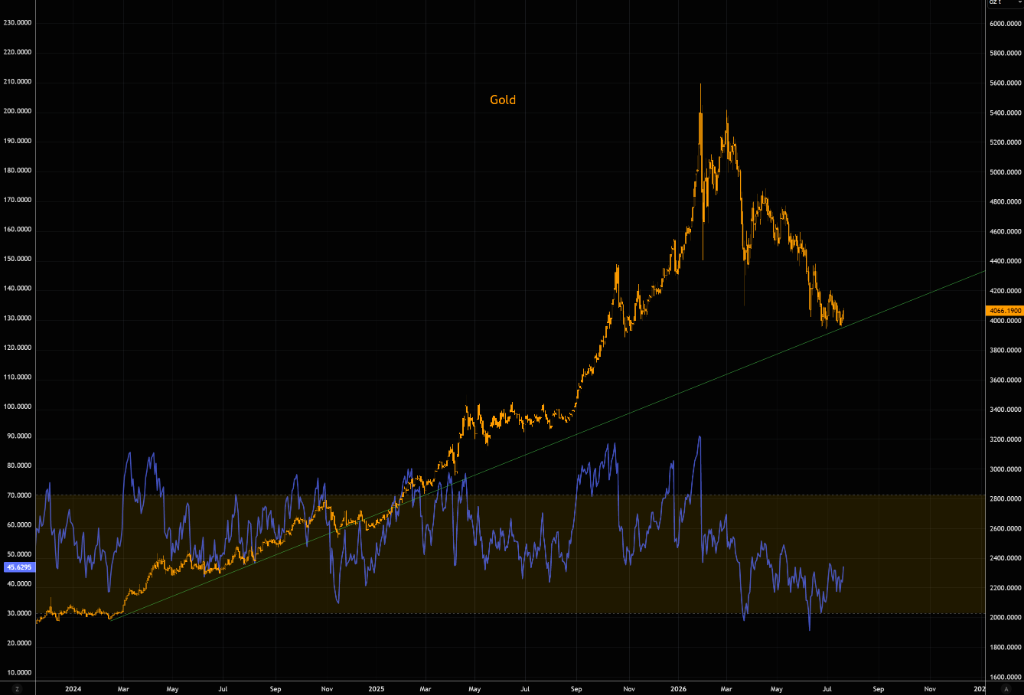
 Meanwhile, physical demand remains resilient, speculative long positions are at historically low levels, and overall market sentiment has turned apathetic. This combination is setting the stage for a potential short squeeze.
However, Giovanni Staunovo, commodities strategist at UBS Chief Investment Office, noted that historically, gold has performed best during periods of declining real interest rates, while the current Federal Reserve policy path remains highly uncertain.
Technical Perspective: Wedge Narrowing, Direction Imminent
From a chart structure perspective, gold is currently confined between two key trendlines: one is the long-term rising support line, and the other is the declining resistance line that has consistently capped prices since early March.
The wedge formed by these two lines is progressively narrowing, and the direction of the breakout will carry decisive significance.
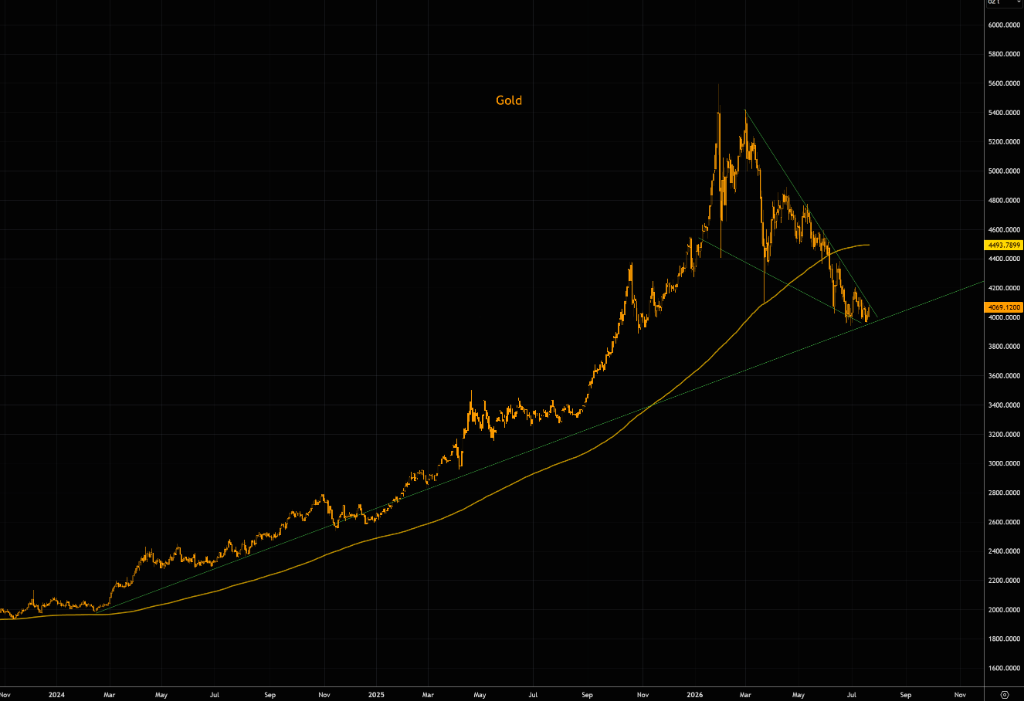
If gold prices break convincingly above resistance, the resulting technical short squeeze could be particularly forceful.
Notably, after months of persistent weakness, the weekly RSI for gold has now neared oversold levels—a threshold that historically often coincides with intermediate-term lows.
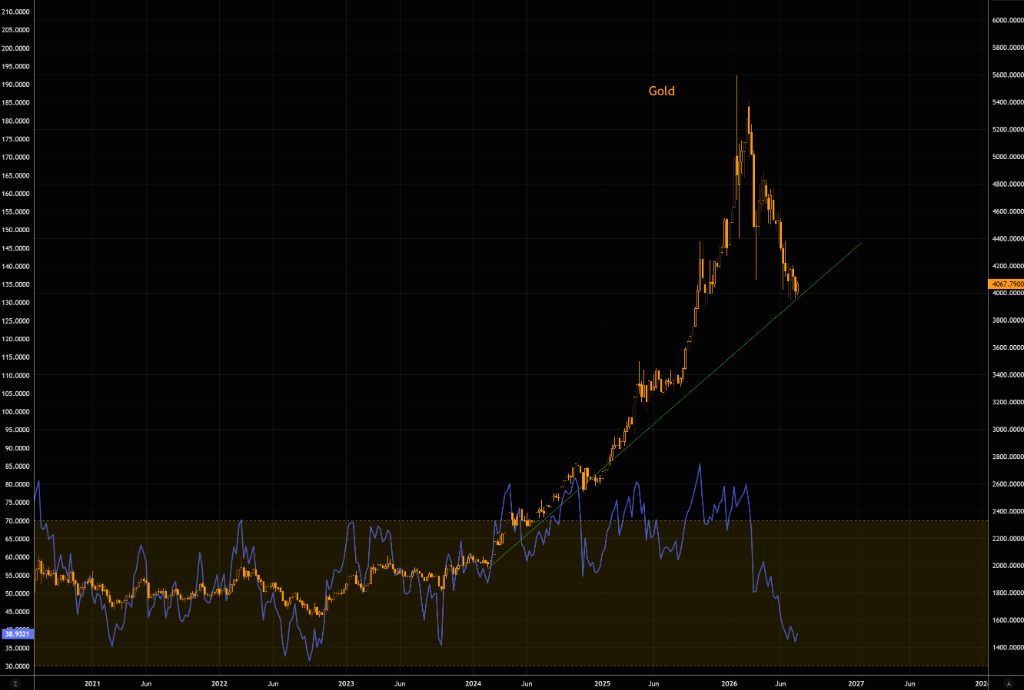
Additionally, gold prices remain below the 200-day moving average, and market sentiment has turned indifferent. Analysts believe that most weak-handed traders and short-term speculative positions have already been flushed out; thus, a confirmed breakout above resistance could trigger a wave of systematic buying, potentially driving a rally that exceeds expectations.
Options Signal: Market Still Hedging Against Downside; Skew Suggests Room for Reversal
The pricing structure in the options market provides another dimension of observation.
Currently, gold options exhibit negative skew—market participants are paying a significantly higher premium for downside protection than for upside calls.
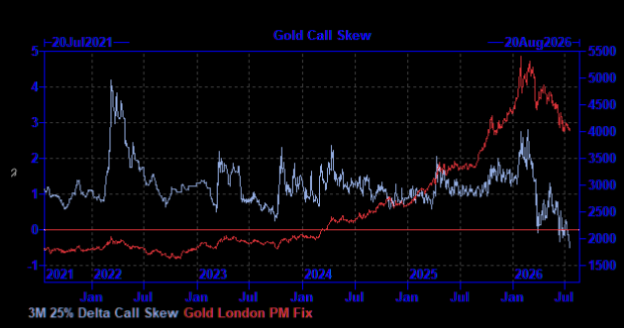
This contradicts gold’s typical pricing pattern. Under normal conditions, gold usually displays positive skew, as its safe-haven appeal during crises leads investors to pay more for upside exposure.
The emergence of this negative skew indicates that investor anxiety is now more focused on the risk of further declines.
However, it is precisely this prevailing 'one-way thinking' that forms the psychological foundation for a potential short squeeze.
Analysts note that, from an options strategy perspective, using a call spread to capture a potential short squeeze is attractive—it offers limited cost exposure while providing nonlinear upside payoff if gold prices break higher.
Macro Context: Fed’s Policy Path Unclear; Real Interest Rate Trajectory Remains Uncertain
The macro rationale behind gold’s recent decline stems partly from market expectations that the Federal Reserve will raise rates to combat inflation. Investors fear that higher interest rates will enhance the attractiveness of cash relative to non-yielding assets like gold.
However, the Fed’s actual policy trajectory remains highly uncertain. According to CME Group data, the market currently prices in approximately a 50% implied probability of a rate hike by September.
The newly appointed Federal Reserve Chair, Worshe, has expressed skepticism toward forward guidance and, to date, has only issued principled statements on maintaining price stability, offering very limited substantive policy signals.
He has also convened multiple working groups to study topics such as the drivers of inflation and the impact of artificial intelligence on productivity; related reports may not be released until year-end.
This uncertainty has given rise to multiple scenarios:
If the Federal Reserve responds sluggishly to an oil price shock, broader inflationary pressures could build up;
If a cooling in the AI investment boom forces the Fed to ease monetary policy while geopolitical factors keep oil prices elevated, real interest rates could also decline.
Both of these scenarios present potential tailwinds for gold.
Allocation rationale: Elevated equity market optimism underscores gold’s hedging value
From an asset allocation perspective, the current investment case for gold has not been fundamentally undermined.
Equity markets have remained broadly resilient during this round of geopolitical conflict, with equity investors maintaining strong optimism about AI prospects and exhibiting relatively low vigilance toward geopolitical and other potential risks.
This market condition—characterized by 'insufficient risk premium'—precisely justifies retaining gold positions as a hedge against tail risks.
Giovanni Staunono, commodities strategist at UBS Chief Investment Office, noted that gold carries the cost of generating no yield, yet maintaining a certain allocation to gold to hedge against unforeseen risks makes reasonable portfolio sense for investors during periods of heightened uncertainty.
Currently, the confluence of technical indicators, positioning structures, and physical demand has created conditions conducive to a potential directional breakout in gold. However, whether a short squeeze can truly materialize still hinges on further clarity regarding Federal Reserve policy signals, the trajectory of the U.S. dollar, and evolving geopolitical developments.
 How to invest in gold quickly? Visit the Futubull ETF section for direct access to all gold ETFs!
Open Futubull > Market > ETFs > Thematic ETFs > Gold ETFs to explore all available gold ETFs!

Editor/lambor