
Author: Vaidik Mandloi; Source: TokenDispatch; Translated by: Shaw, Jinse Finance
Paradigm, one of the largest crypto-focused funds ever established, recently closed a $1.2 billion fundraising round and plans to invest in startups in artificial intelligence, robotics, and aerospace. The firm has even completely removed all references to 'crypto' from its official website. Its investment rationale is that while crypto was the first frontier it explored, a wave of compelling new opportunities has now emerged elsewhere.
Framework Ventures also closed a $400 million fund in June, marking its expansion beyond crypto-specific investments—a strategic shift shared by numerous other firms. Over the past year, nearly all leading crypto-dedicated venture capital funds have begun broadening their investment mandates to encompass wider thematic and sectoral scopes. In Q1 2026, only eight newly launched venture funds exclusively focused on crypto were established, the lowest number since 2020.

 Today, I will examine in depth whether crypto-dedicated venture capital—as a distinct fund category—is truly on the path to obsolescence. If so, how might this industry-wide realignment interact with the natural lifecycle of such funds? And what does this mean for crypto startups, which will now compete for investor attention within diversified, cross-sector portfolios?
The Lifecycle of Thematic Funds
Crypto-dedicated funds emerged primarily because these firms were willing to invest time to build competitive advantages and were, for a period, the only capital providers prepared to bear the sector’s unique risks. In 2017, growth equity partners at Tiger Global struggled to deeply understand the underlying mechanics of Solidity smart contracts or to establish working relationships with anonymous developers building within Discord communities.
To assess whether crypto-focused venture capital as a fund category is indeed fading, it is instructive to review the historical trajectories of other thematic funds—similar dynamics have played out multiple times before.
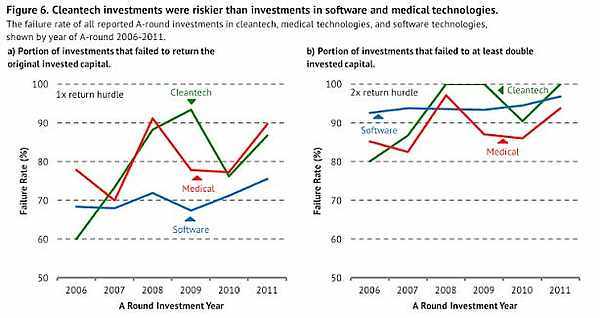
Between 2006 and 2011, climate tech became a mainstream investment theme, prompting venture capital firms to launch dedicated clean energy funds. The rationale mirrored that of early blockchain-focused crypto funds: firms believed they had identified a generational technological shift, sought to act ahead of generalist investors, and aimed to construct comprehensive investment strategies around this conviction.
Over $25 billion in capital flowed into clean energy startups during that period, with more than half ultimately resulting in losses. Intriguingly, the underlying technologies were viable—the clean energy market today is vast, and solar power costs plummeted by 85% over that timeframe. However, venture investors fell prey to a cognitive bias: they applied software startup investment logic, deploying $5 million seed rounds, despite these ventures actually requiring $200 million in project financing and needing fifteen years to reach profitability.
A subsequent post-mortem study by the MIT Energy Initiative concluded that the traditional venture capital model was fundamentally mismatched for this sector. Thematic VCs assumed technological risk, funded experimental phases, supported early R&D, and lent credibility to the field—thereby catalyzing larger pools of capital. Yet once the technology matured to meet the underwriting standards of infrastructure lenders and project finance institutions, the information advantage that sustained specialized funds disappeared.
Special Purpose Acquisition Companies (SPACs) have followed a similar trajectory. To provide brief context: SPACs, also known as blank-check companies, raise capital through an initial public offering (IPO) but do not operate any actual business. They subsequently use the proceeds to merge with a private company, thereby facilitating its public listing—a process significantly faster than a traditional IPO.
Between 2020 and 2021, many investors viewed SPACs as a replicable financing instrument and established dedicated firms focused on this sector. Chamath Palihapitiya raised a SPAC-focused fund amounting to USD 1.6 billion. However, by 2022, two-thirds of the SPACs launched in 2021 had failed to complete a merger, forcing Chamath to return the capital to investors. This entire cycle lasted less than 24 months, vividly illustrating how rapidly industry dynamics can reverse once specialized investors lose their informational edge.
This recurring pattern across vastly different industries stems from a deeper underlying logic. Carlota Perez, analyzing 250 years of technological revolutions, codified this dynamic into what she terms a techno-economic paradigm. She argues that every major new technology undergoes an early phase during which only insiders truly understand it; participants closest to the technology become the most valuable investors because only they can discern genuine opportunities from speculative ventures. As the technology matures, it gradually integrates into existing institutional frameworks.
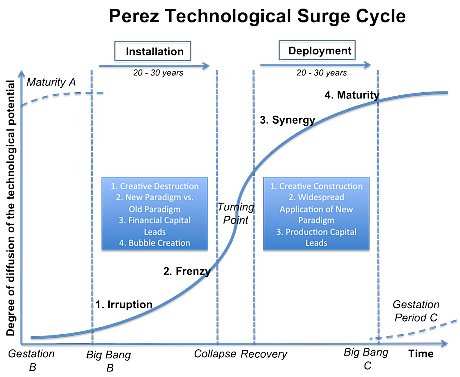
At this stage, the insider information advantage that initially fueled specialized investment firms ceases to matter. The reason is that diversified, large-scale capital providers now comprehend the asset class and possess far greater financial resources. Fred Wilson anticipated this shift for the crypto industry long ago. In a 2015 article, he predicted that crypto would reach a critical 'financial inflection point'—corresponding in Perez’s theory to the transition from the installation phase to the deployment phase.
That inflection point has now arrived, and we can clearly observe multiple signs indicating that the crypto industry has entered its deployment phase: fintech firms like Stripe have acquired Bridge and launched their own stablecoin blockchains; institutions such as BlackRock and Fidelity have introduced tokenized money market funds; even traditional payment giants like Visa and Mastercard are building settlement layers based on stablecoin rails.
These giants no longer require crypto-specialized venture capitalists to explain concepts like Maximum Extractable Value (MEV) capture or validator economic models—such crypto-native knowledge is no longer a core barrier for them. What they truly need is regulatory approval, distribution channels, and banking partnerships—elements essential for any fintech company seeking to scale. Today, generalist investors at firms like Sequoia Capital and Founders Fund evaluate crypto projects using the same analytical frameworks they apply to companies like Stripe or Plaid.
Polarization and Capital Reallocation
With the informational edge of specialized firms now eroded, what lies ahead for funds built upon that advantage? Their fate hinges entirely on the business logic dictated by their fund size.
For years, the venture capital industry has exhibited a barbell-shaped polarization. On one end are massive platforms like a16z, Sequoia Capital, and Founders Fund, capable of incorporating entire asset classes into their portfolios as vertical strategies. On the other end are small, boutique funds that leverage deep expertise to make concentrated, high-conviction bets—often recouping an entire fund’s capital through a single breakout success. Mid-sized firms have fallen into a 'dead zone,' and most current crypto-focused funds happen to occupy precisely this precarious middle ground.
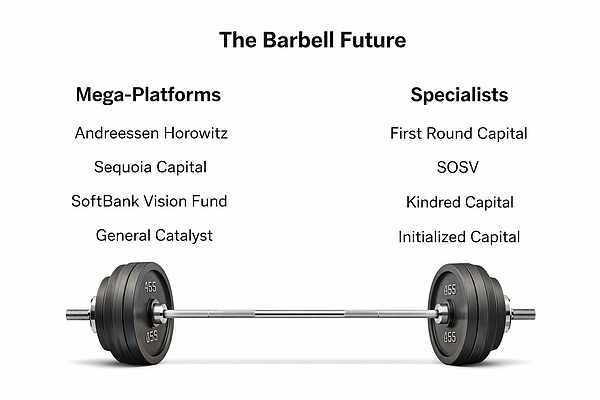
A USD 500 million fund must generate approximately USD 15 billion in exit proceeds to deliver a 3x net return to its limited partners. Achieving this solely through seed-stage investments is extremely difficult, as seed portfolios rarely produce enough large-scale breakout companies. Meanwhile, in competition for growth-stage deals, these mid-sized funds cannot match USD 5 billion mega-funds that can effortlessly write USD 100 million checks. For example, in the first half of 2025, Founders Fund alone raised 1.7 times the total capital secured by all emerging fund managers combined. Capital continues to concentrate at the two extremes.
This barbell structure also explains why Framework Ventures and Paradigm Funds may appear to act similarly on the surface, yet operate under fundamentally different underlying logics. Framework Ventures manages a $400 million fund: large enough that it cannot recoup the entire fund through just a few seed-stage bets, yet too small to compete with mega-funds for growth-stage deals. Within this size range, investing solely in crypto cannot generate sufficient exit opportunities, necessitating a broadening of investment boundaries. In contrast, Paradigm’s $1.2 billion fund is large enough to evolve into a cross-sector, generalist investment platform—highlighting an essential strategic divergence. In short, fund size determines your position within the barbell structure, which in turn dictates your viable strategic pathways.
Even crypto-focused venture capital firms that claim to remain dedicated to the sector have thoroughly redefined what 'crypto' actually means. Dragonfly closed a $650 million fundraising round in February, oversubscribed by 30%. Despite strong investor demand, the firm explicitly stated that non-financial crypto verticals have failed, and will henceforth focus exclusively on stablecoins and prediction markets. a16z’s latest $2.2 billion crypto fund closed in May 2026—only half the size of its $4.5 billion fund raised in 2022. Moreover, Chris Dixon’s investment thesis has shifted: he no longer frames crypto as a new computing paradigm, but instead argues that finance is the foundational layer upon which all applications in the space must be built.

What these firms now refer to as 'pure-play crypto' investments essentially amounts to betting on financial infrastructure built atop blockchain base layers—a category that large, generalist funds with significant capital also actively pursue.
A key driver behind these shifts lies in the behavior of limited partners (LPs). The venture capital industry is currently facing a distribution-to-paid-in (DPI) crisis: funds launched in 2021 have so far returned only about 0.08x of invested capital. Many LPs suffered massive losses during the 2022 crypto market crash and have since identified a clear alternative—artificial intelligence. This year, 70% of global venture capital funding is flowing into AI.
If fund investors face four consecutive years of illiquidity and unrealized losses, while watching AI companies deliver the returns they once expected from crypto, fund managers have no choice but to proactively allocate capital to AI to gain relevant exposure.
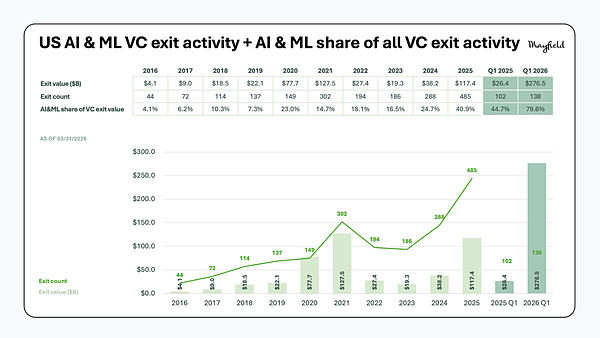
For crypto founders who continue building projects, the situation is concerning: the pool of investors who truly understand their businesses and are willing to support them long-term is rapidly shrinking. Faced with fewer potential backers, the most straightforward response might seem to be raising capital from generalist funds. In theory, this makes sense—firms like Sequoia and Founders Fund can write larger checks and offer channel resources that native crypto funds simply cannot match.
Yet a practical challenge remains. Today, the vast majority of top-tier deal flow is directed toward AI companies. Crypto projects included in a generalist fund’s portfolio must compete internally for attention against AI ventures. Only exceptionally outstanding crypto projects will make it onto investment committee agendas—a completely different game compared to pitching to specialized investors who are fully immersed in and committed to the crypto ecosystem.
Another challenge concerns the broader development of the crypto ecosystem itself. Specialized VCs do more than provide capital—they actively fund foundational infrastructure that enables next-generation applications. For example, Paradigm has supported MEV-related research, and Dragonfly has invested in cross-chain tools. Individually, such projects rarely yield significant commercial returns, yet they collectively form the public infrastructure upon which the entire ecosystem depends. Generalist funds will never invest in these types of initiatives, as their evaluation criteria focus strictly on whether a project can independently generate returns.
I believe that in a few years, calling oneself a 'crypto investor' will be as meaningless as calling oneself an 'internet investor.' Crypto has become foundational infrastructure—a底层通道 supporting a wide array of financial products. No one builds an investment thesis around infrastructure itself; instead, they invest in applications built on top of it. If Perez’s techno-economic paradigm holds true, we are witnessing precisely this transition: crypto is no longer a standalone investment category, but rather the underlying infrastructure for diverse investment opportunities.
This does not mean specialized crypto funds will vanish entirely. As new asset classes such as tokenization and on-chain securities continue to emerge, numerous niche segments will arise that generalist funds are unwilling to enter. Each cycle will see the formation of small, specialized funds focused on these areas. What is declining, however, is the current generation of large crypto-focused funds—their scale is too big to sustain themselves solely through niche crypto opportunities. The sector’s structure will continue to reconfigure along a barbell model: large deals will be handled by generalist funds, while frontier, high-risk bets will be left to small, specialized players.
Early specialized funds launched between 2017 and 2018 financed Uniswap, Ethereum, and various tools that enabled the deployment of stablecoins. Times have changed; recently, several leading crypto projects—such as Hyperliquid and MegaETH—have completed their fundraising entirely through community-led rounds, pioneering a venture capital-free model. Specialized funds have brought clarity and intelligibility to the crypto sector, attracting diversified institutional capital. At the same time, an increasing number of founders have realized that success is achievable without relying on venture capital.