
Tao Zhu, Jinse Finance
Summary: Last week, Trump held a meeting with Republican Senators Bernie Moreno and Cynthia Lummis, as well as White House crypto advisor Patrick Witt, regarding the ethics provisions of the CLARITY Act, at which time Trump did not agree to include the ethics clause. However, reports this morning indicate that Trump has now agreed to incorporate an ethics clause into the cryptocurrency bill. Additionally, White House crypto advisor Witt’s scheduled military training has been postponed, and he will remain in his role. With these two developments, the outlook for the CLARITY Act has suddenly brightened.
I. Trump Agrees to Include Ethics Clause
The ethics clause has long been viewed as the final hurdle for the CLARITY Act to secure bipartisan support in the Senate.
 Democrats have consistently demanded restrictions on elected officials’ involvement in digital asset activities, with their concerns primarily centered on Trump’s cryptocurrency investments. Democrats argue that, given Trump’s and his family’s deep involvement in the cryptocurrency industry, the absence of adequate conflict-of-interest safeguards could lead the bill to be perceived as tailor-made for the president’s personal and commercial interests. According to the president’s financial disclosures, his income from crypto-related investments last year amounted to $1.4 billion. Senator Elizabeth Warren has also called on Trump to provide updated financial disclosure information.
Last week, when Trump met with White House officials to discuss the ethics provisions related to the CLARITY Act, he had not yet agreed to include such a clause.
But this morning, the situation changed.
According to an industry source, Trump has agreed to include an ethics clause in a broader cryptocurrency bill. Another source indicated that the legislative text could be released as early as Monday evening but is likely to be delayed further, adding that the longer the wait, the more likely the bill is to gain bipartisan support.
The ethics clause aims to restrict the president, vice president, members of Congress, and other senior officials from profiting from digital assets while in office. The core controversy centers on Trump’s meme coin and his family’s company, World Liberty Financial. Although the official text has not yet been released, the focus appears to be on the scope of digital asset involvement by officials and their immediate family members, permissible holding structures, and mechanisms for avoiding conflicts of interest.
This signals a breakthrough in what had previously been the CLARITY Act’s most significant political obstacle. Since Republicans still need support from some Democratic senators to overcome the 60-vote procedural threshold in the Senate, mutual acceptance of the ethics clause will directly determine whether the bill can complete the legislative process before the August recess. Trump’s shift in stance significantly increases the likelihood that the bill will soon proceed to a Senate floor vote.
II. White House Crypto Advisor Witt to Remain in Role
Patrick Witt, the White House cryptocurrency advisor, has had his scheduled military training postponed and will remain in his position, meaning the administration’s lead negotiator on the CLARITY Act will stay in Washington during the final weeks before the Senate’s summer recess. Notably, Witt had previously delayed his Judge Advocate General (JAG) training with the Georgia Army National Guard once already due to negotiations over the CLARITY Act; the latest deferral is widely seen as a strong signal that the White House prioritizes enacting legislation on crypto market structure.
Witt confirmed the news in a post on X:
Over the past year, I have worked tirelessly to advance the CLARITY Act and fulfill President Trump’s vision of making America the global capital of cryptocurrency.
Last week, reports emerged that I was about to depart for mandatory training with the Georgia Army National Guard just as the CLARITY Act was poised for Senate consideration.
While I remain committed to fulfilling my military service obligations, I am pleased to report that my training has been postponed, enabling me to see this effort through to completion.
Thank you to @POTUS and @DavidSacks for giving me the opportunity to continue this critical work, and to everyone who reached out to me last week. Let’s get this done.
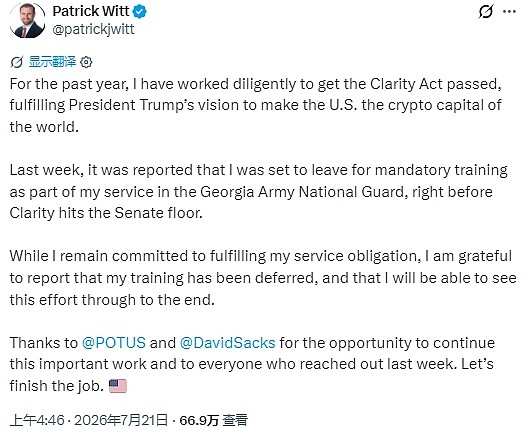
Witt’s continued tenure as a key White House coordinator on digital asset legislation ensures continuity in negotiations between the executive branch and Congress.
As Witt adjusts his schedule, Harry Rong is preparing to leave government service. Rong, Deputy Director of the President’s Digital Asset Advisory Committee, announced on July 21 that he would depart in two weeks. He had been expected to assume many of Witt’s responsibilities during Witt’s planned military leave.
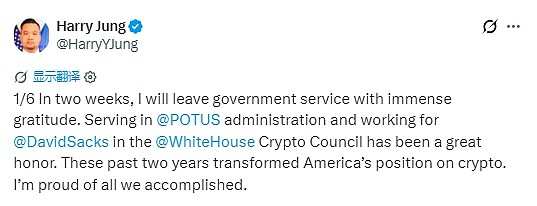
Rong stated he was proud of the committee’s work, describing the past two years as transformative for U.S. cryptocurrency policy. His departure will not create a leadership gap at the White House, as Witt will remain in his role. The committee continues to focus on implementing the CLARITY Act, establishing a strategic Bitcoin reserve, and shaping cryptocurrency tax policy.
Witt’s continued presence eliminates staffing uncertainty, but passage of the bill still hinges on lawmakers resolving contentious issues such as ethics provisions, consumer protections, and other disputed elements. The Senate has not yet scheduled a final vote, meaning the bill’s fate depends on whether legislators can reach agreement before leaving Washington in August.
III. Why August Is a Critical Timing
The three weeks before the U.S. Congress adjourns for its August recess represent a critical window for this bill. The U.S. Senate is scheduled to begin its summer recess on August 11 and reconvene in mid-September. However, with the November midterm elections approaching, members of Congress will return to their home states to campaign, resulting in an extremely tight political schedule that would hinder legislative debate.
Brian Gardner, Chief Policy Strategist at Stifel, stated, “Passing this bill during the post-election lame-duck session would be extremely difficult—the congressional calendar itself is the biggest obstacle to this legislation.” Moreover, because the Senate is expected to first hold a procedural vote to end debate, the bill typically requires 60 votes to advance, meaning Republicans would need support from at least approximately seven Democratic senators in addition to their own caucus to move the bill forward.
Summer Mersinger, CEO of the Blockchain Association, predicted that a vote on the CLARITY Act could take place this week. However, ethical provisions, consumer protection rules, and certain regulatory jurisdictional boundaries remain among the final contentious issues to be resolved, so the final timeline may still shift depending on negotiation progress.
Therefore, the next two to three weeks will not only determine whether the CLARITY Act can seize the most favorable legislative window in the current Congress but could also decide whether U.S. crypto market structure legislation must be deferred until after the midterm elections for renewed negotiation.
IV. What Will the CLARITY Act Change?
The CLARITY Act is widely regarded as the cornerstone legislation that will truly shape the direction of the U.S. digital asset industry over the next decade. Once enacted, it will resolve the regulatory uncertainty currently facing the crypto sector.
1. Clarifying the Regulatory Jurisdictions of the SEC and CFTC
The U.S. Securities and Exchange Commission (SEC) maintains that most crypto assets qualify as securities and should therefore be regulated under the Securities Act of 1933 and the Securities Exchange Act of 1934. In contrast, the Commodity Futures Trading Commission (CFTC) argues that Bitcoin, Ethereum, and numerous tokens exhibiting commodity-like characteristics are more akin to commodities and thus fall under its regulatory purview.
The CLARITY Act aims to end this ambiguity: assets meeting decentralization criteria and exhibiting characteristics of crypto commodities will primarily fall under CFTC oversight, while digital assets retaining securities attributes will remain subject to SEC regulation. Additionally, the bill mandates the establishment of a joint coordination mechanism between the SEC and CFTC to prevent future regulatory overlap and jurisdictional conflicts.
2. DeFi Developer Protections
The CLARITY Act represents the first institutional design addressing whether DeFi protocols should be regulated like traditional financial institutions:
Truly decentralized software developers, node operators, and non-custodial protocols will not automatically be deemed financial intermediaries solely for developing, publishing, or maintaining open-source software; however, platforms that effectively control user assets or provide centralized financial services remain subject to corresponding regulatory obligations.
This marks one of the most significant institutional advances in developer protections in recent years and is also a core issue in long-standing discussions on blockchain regulation.
3. Greater Regulatory Clarity
Over the past few years, nearly all major U.S. crypto firms have undergone regulatory investigations.
The SEC has previously sued Ripple, Coinbase, Kraken, and others, prompting numerous innovative projects to relocate outside the United States.
The greatest significance of the CLARITY Act lies in elevating issues previously resolved through administrative enforcement to clearly defined legal rules. Whether the bill passes will determine if the U.S. can move away from its longstanding reliance on administrative enforcement and transition toward a regulatory framework grounded in congressional legislation.
4. Institutional Capital Inflows
With clearer legal status for digital assets, pension funds, insurance companies, and investment funds will be more willing to enter the market. The Senate Banking Committee stated that one of the bill’s objectives is to establish “clear, enforceable, and consistent rules” for the U.S. digital asset market while protecting consumers. Publicly listed firms such as Coinbase, Robinhood, and Galaxy Digital will also be able to offer a broader range of digital asset trading, custody, and institutional service products.
Stuart Alderoty, Chief Revenue Officer at Ripple, urged lawmakers to support the CLARITY Act and warned that voting against this cryptocurrency bill would allow bad actors to exploit its loopholes. Ryan VanGrack, Deputy Chairman at Coinbase, stated that the bill would establish the first comprehensive federal cryptocurrency framework in the United States, enhance consumer protections, close the FTX loophole, and strengthen measures against insider trading.
5. What other obstacles remain for the CLARITY Act?
Although Trump agreed to include ethics provisions in the bill and White House cryptocurrency advisor Patrick Witt will remain in his role—two developments that have significantly increased the likelihood of the CLARITY Act’s passage—it does not mean the bill is guaranteed to pass.
1. Ethics provisions have not yet been finalized
Although Trump agreed to incorporate ethics provisions into the bill, the legislative text has not been finalized. In particular, regarding the Trump family’s involvement in World Liberty Financial and related digital asset projects, many Democratic lawmakers still believe that merely adding principle-based restrictions is insufficient to mitigate conflicts-of-interest risks. Therefore, the final text may undergo multiple rounds of revisions.
2. Will Democrats provide sufficient support?
The CLARITY Act must first pass a procedural vote to end debate, requiring 60 votes to proceed to the final passage vote.
Specifically, Republicans hold only 53 seats; even if all 53 Republican senators support the CLARITY Act, at least seven Democratic senators or independents who caucus with Democrats would need to break ranks and support the bill.
Democrats are not uniformly opposed to establishing a regulatory framework for digital assets. Senators such as Kirsten Gillibrand and Angela Alsobrooks have previously supported creating a clearer regulatory structure during stablecoin legislation efforts. However, a faction of Democratic lawmakers, led by Elizabeth Warren, has long advocated strengthening the SEC’s regulatory authority and emphasized consumer protection, anti-money laundering measures, and conflict-of-interest concerns.
3. Time constraints
As discussed above, August represents a critical juncture for the CLARITY Act. According to the current U.S. congressional schedule, the Senate is expected to begin its summer recess on August 11. Shortly after the recess concludes, lawmakers will quickly move into negotiations over the federal budget, government funding bills, and the final sprint toward the midterm elections. If this window is missed, the CLARITY Act’s legislative priority will decline significantly. Should no meaningful progress be made by August, regulatory uncertainty in the crypto industry will persist.
Summary
Factors such as Trump’s acceptance of the ethics provision and Senator Wicker’s continued tenure are creating favorable conditions for the CLARITY Act, making the next three weeks a crucial window for the legislation. More profoundly, the CLARITY Act may serve as a pivotal turning point—marking the transition of U.S. crypto asset regulation from an era dominated by enforcement to one shaped by comprehensive legislation.