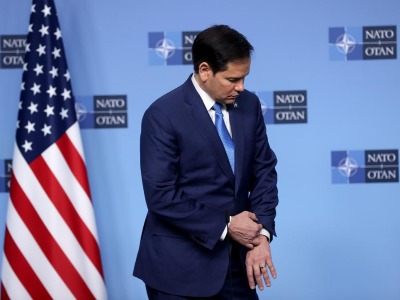
U.S. Secretary of State Marco Rubio said on Wednesday that the United States remains willing to resolve the Iran issue through negotiations.
U.S. Secretary of State Marco Rubio said on Wednesday that the United States remains willing to resolve the Iran issue through negotiations, but Tehran has shown a lack of sincerity toward dialogue. Meanwhile, escalating conflicts have disrupted two of the world’s most critical energy transit chokepoints.
Rubio made the remarks during a meeting of foreign ministers from Southeast Asian nations. The day before, three oil tankers carrying Saudi crude oil, originally destined for Asia, turned back in the Red Sea—a move widely seen as a response to recent threats from Yemen’s Houthi militants. The Houthis, who control coastal areas along the Red Sea’s exit route, announced on Monday a naval blockade against Saudi Arabia, potentially opening a new front in the conflict. Since the U.S. and Israel launched attacks on Iran on February 28, the conflict has already caused thousands of deaths across the Gulf region.
 Against the backdrop of Iran’s threats to block the Strait of Hormuz—the sole maritime outlet connecting the Persian Gulf—the Red Sea has become the primary alternative route for Saudi Arabia’s daily exports of millions of barrels of crude oil.
On Monday, a senior Iranian official revealed that Tehran had received a 10-day ceasefire proposal from mediators aimed at salvaging the interim ceasefire agreement signed between the U.S. and Iran in June, which replaced an earlier arrangement reached in April. Another sign that diplomatic efforts have not entirely stalled is that Iran’s Interior Minister Eskandar Momeni has visited Pakistan—the mediating party—and urged Islamabad to continue its mediation efforts.
Rubio stated that Washington is “always committed to diplomacy,” but expressed skepticism about whether Tehran is equally serious about negotiations. “The issue we face now is that they are not taking negotiations seriously. If they are serious, so will we be; if they are not, we will take necessary measures to protect our interests and those of our allies,” Rubio said in Manila.
With no diplomatic breakthrough in sight, U.S. forces carried out airstrikes on targets inside Iran for the eleventh consecutive night on Tuesday. According to Iran’s semi-official Fars News Agency, residents of Tehran reported hearing explosions early Wednesday morning, prompting Iran to activate its air defense systems over the capital. Iran’s official IRNA news agency also reported explosions in the southeastern coastal cities of Chabahar and Konarak, as well as two blasts near Bushehr, home to Iran’s only nuclear power plant.
Previously, Iran had launched attacks on U.S. military targets in Bahrain, Kuwait, and Jordan, and a tanker was struck in the Strait of Hormuz. Iran claimed it had hit Amazon (AMZN.US) infrastructure in Bahrain, where the company operates a regional data center. Amazon declined to comment.
Additionally, on the 22nd, Iran’s military issued a statement saying its forces had used numerous drones to strike Al-Dhafra Barracks, a U.S. military base in western Kuwait, targeting ammunition depots and logistical equipment at the ground forces’ command center. The statement noted that Al-Dhafra Barracks serves as a support hub for U.S. forces in West Asia, hosting a significant number of U.S. personnel and equipment.
U.S. President Trump confirmed that 18 American service members have died in the war so far, including four killed in recent Iranian attacks on U.S. bases in Jordan and Iraq over the past few days.
Oil prices rose more than 2% on Tuesday amid Houthi threats and continued climbing during Asian trading hours on Wednesday.$Brent Last Day Financial Futures (SEP6) (BZmain.US)$Hovering around $93 per barrel, U.S. gasoline prices have risen back above $4 per gallon.
"The Gate of Tears"
In a letter addressed to shipping companies on Tuesday, the Houthis threatened to attack any vessel loading or unloading Saudi oil. Trump stated that the Houthis had not yet blocked the Bab el-Mandeb Strait—the narrow passage leading to the Red Sea, also known as "The Gate of Tears"—and warned that the U.S. would respond if they did. "It hasn't happened yet," Trump said. "If it does, we’ll handle it."
On Tuesday, three tankers carrying Saudi crude oil, originally destined for China and India, turned back in the Red Sea and rerouted toward the Suez Canal instead of risking passage through waters near Yemen’s coast at the southern entrance to the Red Sea. Throughout the conflict, Saudi Arabia has partially redirected oil shipments via pipelines to its Red Sea port of Yanbu to avoid shipping disruptions. However, if the Houthis were to completely block this alternative route, the majority of Saudi crude exports would be stranded, significantly impacting global oil supplies.
On Tuesday, Trump again threatened to launch an attack "very soon" on Iran’s Natanz nuclear facility—a site he claimed had been "completely destroyed" following a U.S. military strike in June 2025 against the underground bunker complex. Iran vowed retaliation at the time. Iran’s top military command, the Khatam al-Anbiya Central Headquarters, issued a stern warning that if the U.S. were to strike Iranian nuclear facilities or other sensitive targets, Tehran would broaden its retaliatory actions, targeting U.S. and allied interests across the entire region.
Editor/melody