
HSBC believes the market has already priced in tightening expectations, and gold prices may gradually rise; however, a surge in oil prices driven by geopolitical tensions represents the biggest downside risk. JPMorgan, on the other hand, noted that the resistance zone between USD 4,197 and USD 4,264 remains intact, and the medium-term bearish outlook is unchanged—the recent rally appears more like a technical correction than a trend reversal. The medium-term resistance lies near USD 4,500. Should gold prices resume a sharp downward move, the next key support level could be around the USD 3,600 area.
Gold has demonstrated rare resilience, rising strongly despite a triple headwind of a stronger U.S. dollar, higher yields, and elevated oil prices. However, the latest research reports from HSBC and JPMorgan both point to the same conclusion: this rally appears more like a technical rebound following an oversold condition rather than a trend reversal, with limited upside potential remaining.
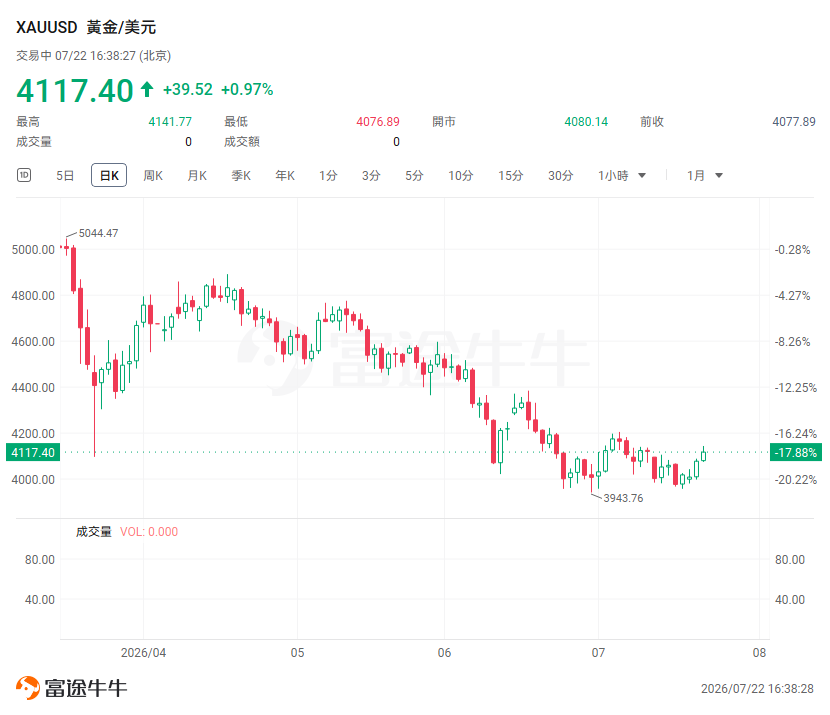
This round of gold price gains originated during Asian and London trading hours on Tuesday, extended into the U.S. market, and breached the $4,100 mark in Asian trading on Wednesday, reaching an intraday high of $4,117.40, all without clear fundamental drivers.
 According to James Steel, HSBC’s Head of Precious Metals Research, in a report dated July 21, the premium on the Shanghai Gold Exchange rose to $6–8 per ounce, indicating a modest recovery in domestic physical demand, and a large concentrated buy order may have been the immediate catalyst for this rally. Meanwhile, U.S. private-sector employment data (ADP) declined for the fourth consecutive week, showing a net addition of just 16,500 jobs; however, the extent to which this weak signal supported gold prices remains difficult to quantify.
The bank also noted that markets have already largely priced in expectations of tighter monetary policy, suggesting gold could continue to edge higher gradually. Nevertheless, geopolitical risks—particularly an escalation in Middle East tensions and further increases in oil prices—remain the biggest threat.
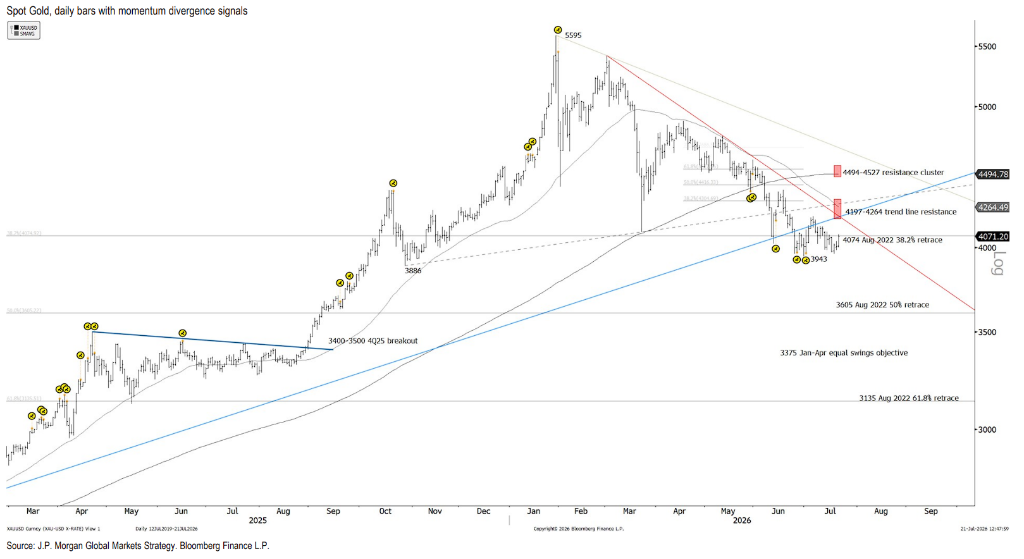
JPMorgan’s technical strategist Jason Hunter offered a more cautious view from a chart perspective. He pointed out that gold is currently seeking support near $4,074 (the 38.2% Fibonacci retracement level from August 2022), and the emergence of a momentum divergence buy signal suggests the market may be entering a prolonged consolidation phase. However, until gold convincingly breaks above the resistance cluster between $4,197 and $4,264, its medium-term bearish structure remains intact.
Anomalous Rally Amid Triple Headwinds
This rally in gold prices has drawn market attention precisely because it occurred against an extremely unfavorable macro backdrop. A stronger U.S. Dollar Index, rising U.S. Treasury yields, and persistently high oil prices—three factors historically bearish for gold—were all exerting downward pressure simultaneously, yet gold prices moved higher against this tide.
HSBC’s James Steel interprets this phenomenon as a signal of underlying strength. In his report, he wrote that after an extended period of sideways consolidation around $4,000, investors judged the timing for an upside breakout to be ripe. This rally may therefore represent more than just a simple technical rebound, as markets might have already largely priced in expectations of monetary tightening, while other risk factors provide additional support to gold prices.
However, James Steel emphasized that this does not mean the path upward is unobstructed. He believes that if geopolitical tensions escalate further—driving a sharp rise in oil prices alongside concurrent increases in the dollar and yields—gold would face downward pressure, representing the primary downside risk at present.
Middle East tensions currently represent the most significant variable influencing gold’s trajectory, though their directional impact is not unidirectional.
HSBC's report noted that the Middle East conflict continues to escalate. The International Energy Agency (IEA) also warned that "there is no room for complacency on oil security," adding that an intensification of hostilities could further deplete global oil inventories.
The bank believes that geopolitical tensions typically provide a safe-haven boost for gold, but the current situation is more complex. If oil shipments through the Strait of Hormuz are disrupted, a sharp surge in oil prices would heighten inflation expectations, thereby compelling the Federal Reserve to maintain a tighter monetary stance for longer. The resulting simultaneous strengthening of the U.S. dollar and yields could, in turn, exert downward pressure on gold prices. HSBC considers this transmission channel the largest tail risk currently facing gold.
Notably, the Federal Reserve is currently in its 'blackout' period, leaving markets without fresh policy guidance from the central bank, which has somewhat heightened uncertainty around gold price movements.
Technical Perspective: Medium-term bearish structure remains intact
JPMorgan’s technical analysis offers a more cautious interpretive framework for this recent rally.
In his report, Jason Hunter noted that spot gold prices are currently seeking support near $4,074 (the 38.2% Fibonacci retracement level from August 2022) and $3,886 (the October 2025 low). Recent clustering of bullish momentum divergence signals suggests potential for further consolidation, though this does not constitute sufficient evidence of a trend reversal.
He identified three structural factors limiting gold’s upside potential:
First, the chart lacks a medium-term accumulation pattern; second, the U.S. Dollar Index is trading above its annual range breakout level, exhibiting a bullish technical setup; third, the 2-year U.S. Treasury yield has broken below its multi-quarter range support and is now in a bearish position.
Against this backdrop, JPMorgan maintains that the medium-term bearish bias remains valid until gold breaks above the confluence of trendline resistance between $4,197 and $4,264. Medium-term resistance lies near $4,500. Should gold resume a sharp downtrend, immediate support levels are seen at $3,605 (the 50% retracement from August 2022) and the $3,400–$3,500 zone, which marked the Q4 2025 breakout area.
Upside potential is limited, yet downside risks are also constrained
According to the combined views of HSBC and JPMorgan, gold prices are currently in a delicate equilibrium range—supported from below but facing resistance from above.
HSBC's James Steel leans toward the view that gold prices will 'gradually rise,' arguing that markets have largely priced in expectations of tighter monetary policy, while other risk factors overall lean supportive of gold. He also noted that previous pessimistic expectations regarding demand for semiconductors and electronic products may have been overpriced, and ETF demand is showing signs of recovery—factors that together form a floor of support for gold prices.
JPMorgan, however, remains more cautious, believing that upside potential will be notably constrained during the summer months and identifying the $4,197–$4,264 range as a key near-term resistance zone. Only a decisive breakout above this range would alter the current medium-term bearish outlook.
 How to invest in gold quickly? Visit the Futubull ETF section for direct access to all gold ETFs!Open Futubull > Market > ETFs > Thematic ETFs > Gold ETFs to explore all available gold ETFs!

Editor/rice