Authors: Song Xuetao, Li Mengying
Source: Xuetao Macro Notes
The United States is rebuilding country-specific tariffs and expanding sectoral tariffs through Section 301, Section 338, and Section 232 investigations.
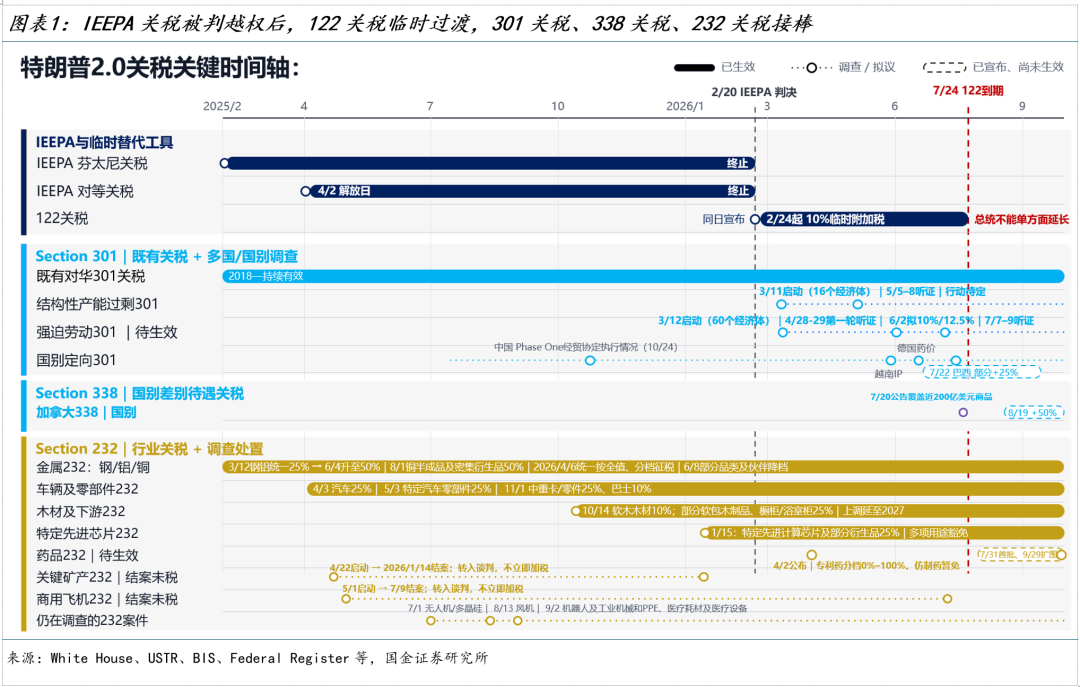
The Section 122 tariffs, implemented by the Trump administration as a transitional measure, will expire on July 24. However, tariff policy remains a central pillar of Trump’s core economic agenda. Based on actions already taken by the Trump administration, the U.S. is utilizing Section 301, Section 338, and Section 232 investigations to rebuild country-specific tariffs and expand sectoral tariffs, respectively.
I. After the expiration of Section 122, how will Trump’s new tariffs be implemented?
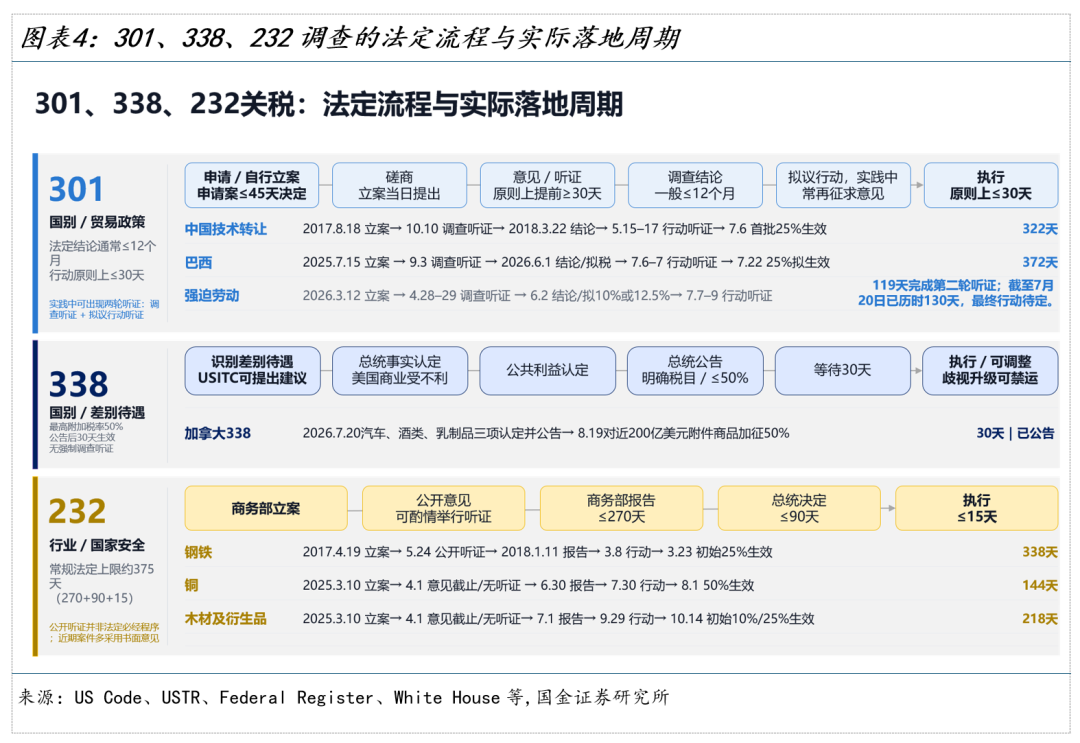
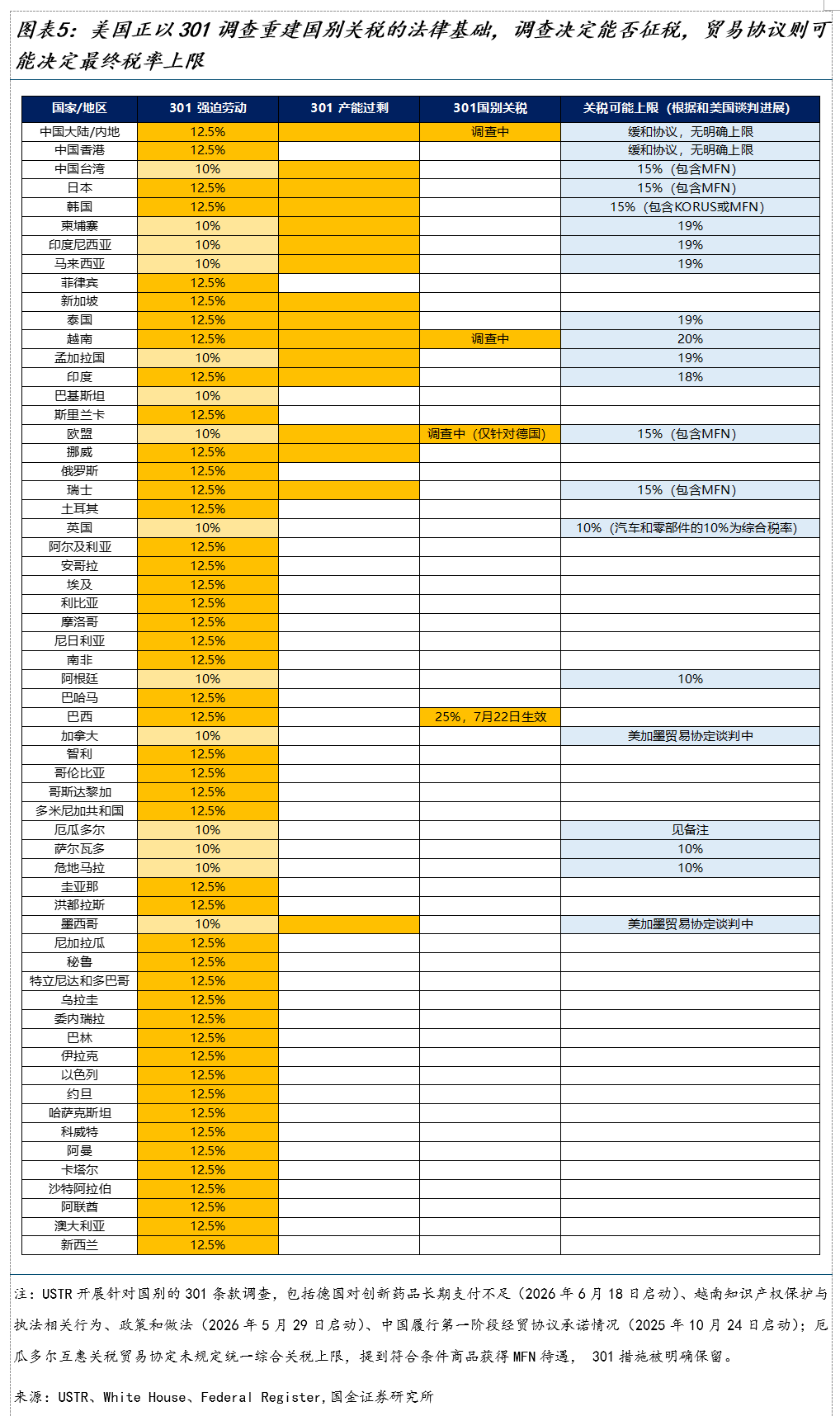
 Section 301 investigations primarily target specific countries’ trade policies and practices. The most recent country-specific case concerns Brazil. The Office of the U.S. Trade Representative (USTR) has completed its investigation and decided to impose a 25% tariff on Brazilian goods effective July 22, while granting exemptions for certain products. Broader Section 301 actions are also underway simultaneously. The USTR has launched structural overcapacity investigations targeting 16 economies and forced labor investigations targeting 60 economies. Proposed actions under the forced labor investigations include imposing tariffs of 10% or 12.5%, although final measures have not yet been announced; the structural overcapacity investigations remain ongoing.
Section 338 is emerging as a new tool for country-specific retaliation. On July 20, Trump signed three presidential proclamations under Section 338 of the Tariff Act of 1930, citing Canada’s discriminatory treatment of U.S. goods in the automotive, alcoholic beverages, and dairy sectors as justification for imposing a 50% tariff on nearly $20 billion worth of Canadian goods. The tariffs are scheduled to take effect on August 19 and will cover products such as wine, hockey sticks, and cement, with no exemptions granted even if the goods meet USMCA rules of origin.
Section 232 investigations are based on whether imports threaten U.S. national security and primarily cover strategic sectors such as steel, automobiles, semiconductors, and pharmaceuticals. Building upon existing steel and aluminum tariffs and additional tariffs on automobiles and auto parts, the U.S. initiated 12 new Section 232 investigations in 2025. Tariffs on copper, lumber, medium- and heavy-duty vehicles, and certain advanced computing chips have already been implemented; pharmaceutical tariffs have been announced but are not yet in effect. Following the conclusion of investigations into critical minerals and commercial aircraft, no immediate tariffs were imposed, while final measures for drones, polysilicon, wind turbines, industrial robots, and medical devices have not yet been announced.
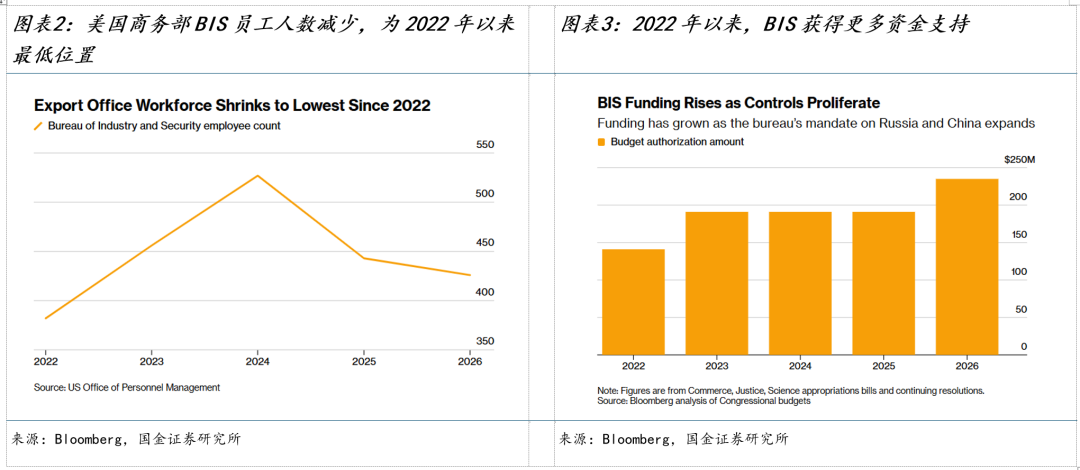
Compared with IEEPA and Section 122 tariffs—which can be swiftly implemented via presidential executive order—Section 301 and Section 232 tariffs, though grounded in solid legal authority, require investigation, consultation, and implementation procedures. For example, USTR’s more than 200 staff members must simultaneously handle trade negotiations, Section 301 investigations, and agreement enforcement. Meanwhile, the Bureau of Industry and Security (BIS) at the Department of Commerce, responsible for Section 232 investigations, is facing staff reductions. According to Bloomberg, as of April 2026, BIS had 101 fewer employees than in 2024—a reduction of approximately 19%—while its responsibilities have expanded to include export controls and multiple sectoral tariff investigations.
Section 338 offers a faster supplementary pathway that does not require the initiation, public comment, and hearing procedures typical of Section 301 investigations. Once the President determines that a foreign country discriminates against U.S. commerce and thereby places it at a disadvantage relative to third countries, a proclamation may be issued, and an additional duty of up to 50% may be imposed on goods from that country 30 days later. However, Section 338 has a narrow scope of application and must address identifiable discriminatory treatment. The U.S. application of Section 338 measures against Canada in the automotive, dairy, and alcoholic beverages sectors demonstrates that this provision is better suited for addressing disputes involving specific countries and concrete issues.
Therefore, in the short term, Sections 301 and 232 tariffs are unlikely to seamlessly replace the expiring global 10% surtax, and Section 338 cannot serve as a comprehensive substitute either. The United States is more likely to apply Section 301 tariffs to key trading partners, use Section 232 tariffs for strategic sectors, and deploy Section 338 to swiftly respond to discriminatory or retaliatory measures by specific countries, gradually expanding the coverage of the new tariff regime as investigations progress.
II. Impact of the New Tariff Regime on Global Economies and Sectors
First, tariff rates will differ across economies, generally continuing the previously applied rates.
The Section 301 investigation on forced labor covers 60 economies, with proposed tariff rates of 10% or 12.5%. Among them, 16 economies are also included in the structural overcapacity investigation, and countries such as China, Vietnam, Germany, and Brazil face additional country-specific investigations. The greater the number of investigations an economy is subject to, the higher its potential risk of additional tariffs, although these tariffs may not simply stack cumulatively.
Trade agreements are a critical constraint on final tariff rates. According to Greer, the United States will adhere to the agreed aggregate tariff ceilings with economies such as the European Union and Japan. Under existing agreements, the potential ceiling for the United Kingdom is 10%, while that for the EU, Japan, and South Korea is 15%, India’s is 18%, and certain Southeast Asian economies face ceilings of 19% or 20%. For economies with which agreements have already been reached, Section 301 investigations may still provide a basis for new tariffs, but any additional duties would likely be incorporated within the agreed tariff ceiling rather than imposed on top of it.
Economies that have not yet finalized agreements—those with only temporary arrangements or ongoing negotiations—face less clarity regarding tariff ceilings and thus greater policy uncertainty. China is simultaneously subject to investigations on forced labor, structural overcapacity, and compliance with the Phase One trade agreement. Moreover, the current U.S.-China arrangement does not establish an aggregate tariff ceiling, leaving significant room for future adjustments to tariff rates.
Section 338 introduces additional risks for economies that impose discriminatory treatment against the United States. Although the U.S. has not yet released a list of potential targets, three Section 338 notices concerning Canada have determined that Canada imposes tariffs and quotas exclusively on U.S. automobiles, restricts U.S. alcoholic beverages in procurement, distribution, and retail channels, and grants the European Union more favorable treatment than the U.S. in cheese tariff-rate quota allocations. These measures have all been deemed to place U.S. commerce at a disadvantage relative to third countries. The White House also specifically noted that, over the past 18 months, only China and Canada have chosen to retaliate against U.S. tariffs rather than resolve disputes through negotiations.
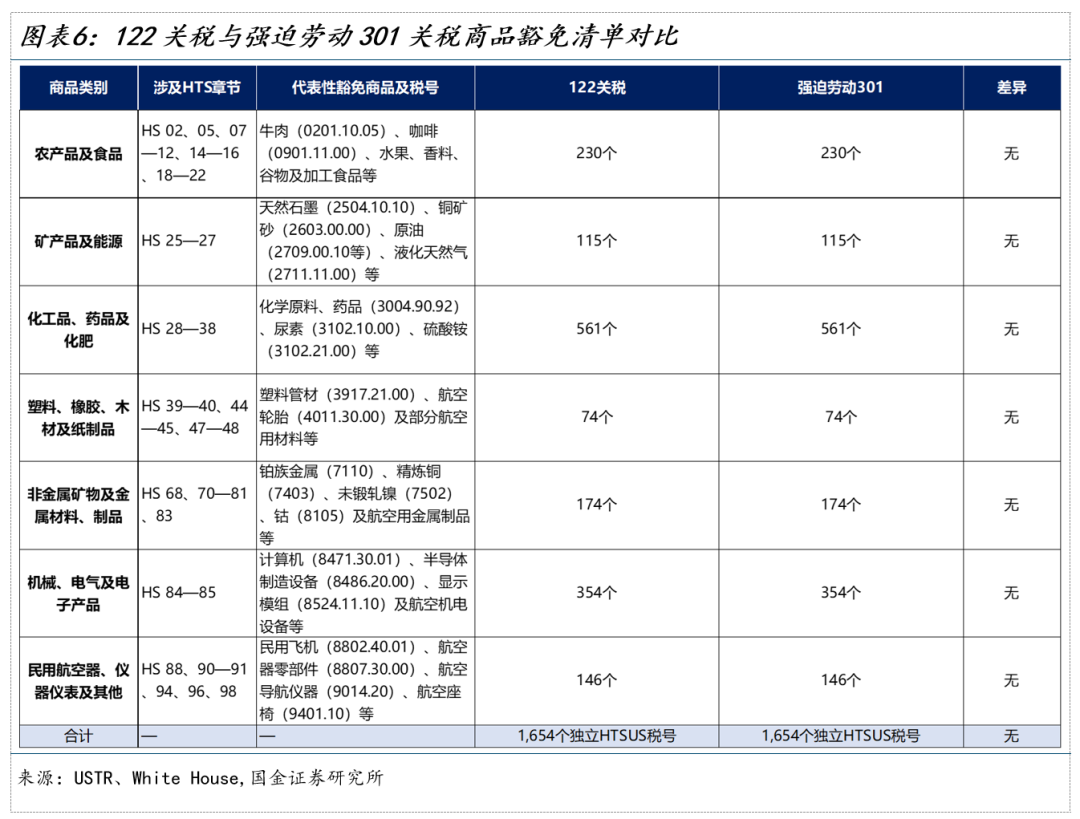
Second, at the sectoral level, tariffs will remain broadly applied with targeted exemptions, consistent entirely with the scope under Section 122. Exemptions will primarily focus on sectors where the U.S. exhibits high import dependency and limited short-term substitution options—such as energy, pharmaceuticals, fertilizers, critical minerals, certain agricultural products, civil aviation supply chains, computers, semiconductor manufacturing equipment, and display modules—or goods whose tariffs would significantly raise production and living costs.
Section 232 tariffs and forced labor-related Section 301 tariffs will not be stacked. Currently, Section 232 tariffs cover steel and aluminum and their derivatives, semi-finished copper products and high-copper-content derivatives, passenger cars and light trucks and their parts, medium- and heavy-duty vehicles and their components, buses, lumber and certain wood products, and specific advanced computing chips. These sectors will not be subjected to additional forced labor-related Section 301 tariffs. Although Section 232 investigations have been completed for critical minerals and commercial aircraft, tariffs have not yet been imposed; whether related products are exempt from Section 301 duties will depend on whether their specific tariff classifications appear on the exemption list.
Future sectoral tariff burdens will also depend on the progression of Section 301 and 232 investigations. The scope of tariffs under the structural overcapacity Section 301 investigation has not yet been announced, but it is highly likely to follow the same approach as the forced labor Section 301, using the same exemption list. Country-specific Section 301 investigations, however, will not be governed by a uniform exemption framework; their scope will depend on the findings of the investigations and outcomes of bilateral negotiations. Section 232 tariffs on pharmaceuticals have been announced but are not yet in effect, and investigations into polysilicon, drones, wind turbines, industrial robots, and medical devices have not yet resulted in tariffs, leaving these sectors exposed to potential new Section 232 duties.
III. The New Tariff Regime Has Limited Impact on China
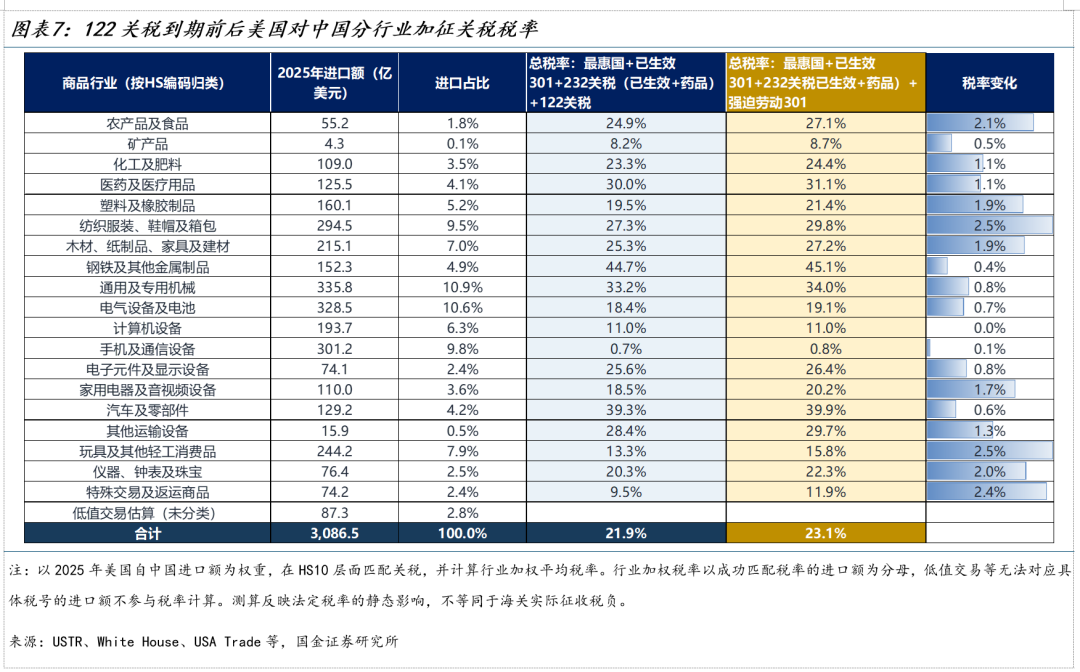
If the Section 301 tariffs targeting forced labor are implemented at 12.5%, replacing the existing 10% tariffs under Section 122, the U.S. weighted average tariff rate on Chinese goods would rise from 21.9% to 23.1%, an increase of 1.2 percentage points.
The sectors facing the highest tariff rates are steel and other metal products, automobiles and parts, general-purpose and specialized machinery, pharmaceuticals and medical supplies, and textiles and apparel, with rates reaching 45.1%, 39.9%, 34.0%, 31.1%, and 29.8%, respectively. Although steel, automotive, and machinery sectors already bear relatively high tariff burdens, their incremental tariff increases amount to only 0.4–0.8 percentage points.
Sectors most affected at the margin include textiles and apparel, agricultural products, instruments, watches, and jewelry, plastics and rubber products, and wood products and furniture, with tariff rates rising by approximately 1.9–2.5 percentage points.
Future adjustments to U.S. tariffs on China will primarily depend on two factors. First, ongoing Section 301 investigations into structural overcapacity and compliance with the Phase One trade agreement could lead to new tariff measures against China. Second, tariff reductions agreed upon following a meeting between the Chinese and U.S. heads of state may expand the scope of tariff exclusions for Chinese goods. Both sides have established a framework for reciprocal tariff reductions covering at least $30 billion worth of each other’s goods and have clarified market access arrangements for certain agricultural products. However, since the specific product lists have not yet been released, it remains to be determined through further negotiations which goods will qualify for Most-Favored-Nation (MFN) rates or even lower tariff rates.
Note: As of July 21, 2026, the U.S. Senate has formally introduced S.5025, the 'Russia Sanctions Act,' which proposes imposing additional tariffs of up to 100% on the top five economies importing Russian crude oil and natural gas and those most actively assisting in circumventing oil sanctions—a significant reduction from the original proposal of 500%. The bill has been referred to the Senate Banking Committee and has not yet been voted on or enacted.
Risk Disclosure
U.S. tariff policy adjustments exceed expectations; China-U.S. trade negotiations progress falls short of expectations; calculation results may deviate from actual tariff burdens.
Editor/melody