
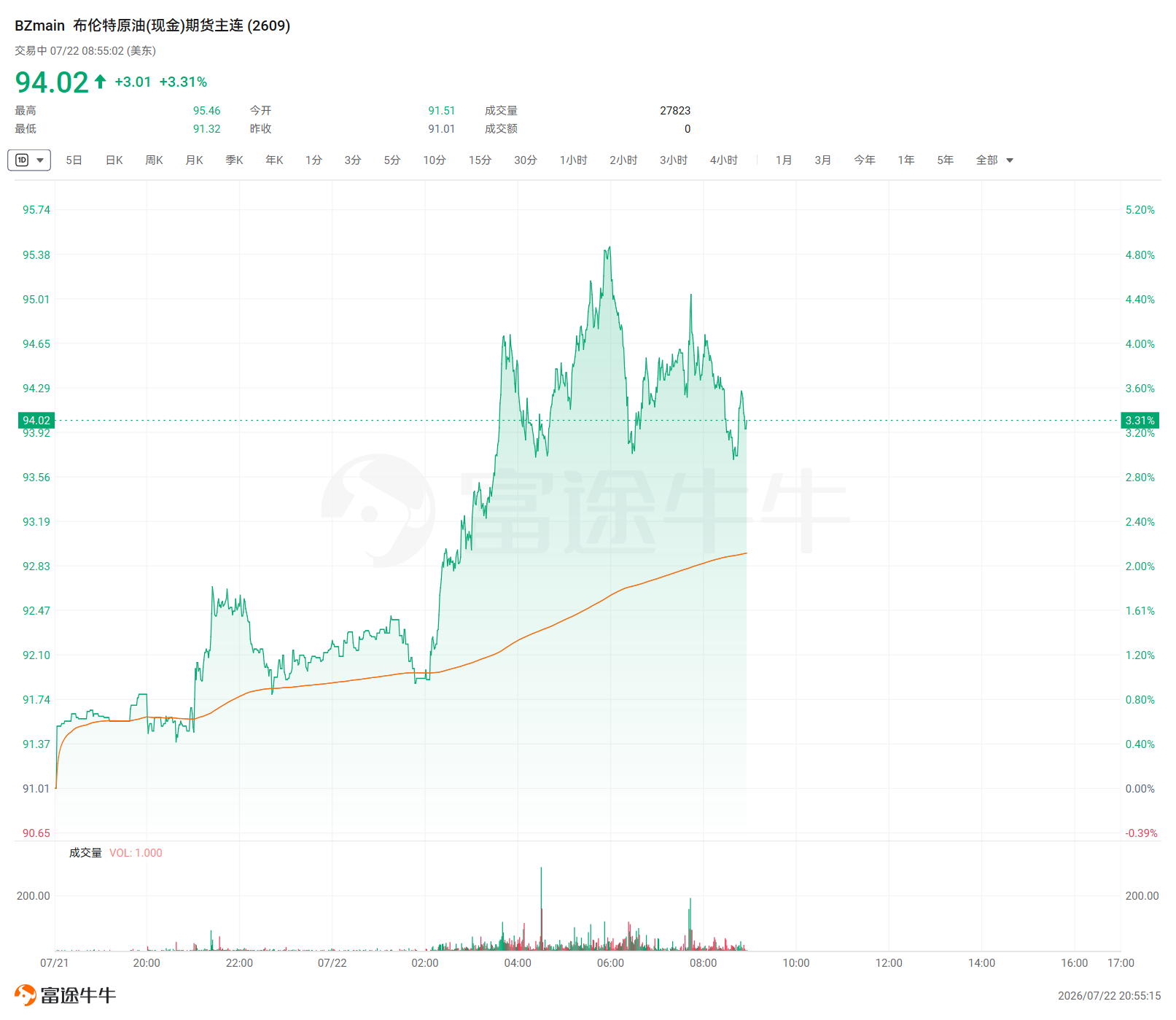
Escalating U.S.-Iran tensions and the near-collapse of negotiations have prompted markets to reprice the risk of prolonged energy supply disruptions. Brent crude has surged past $95 per barrel, as fears of a potential blockade of the Strait of Hormuz have driven up oil and gas prices, inflation expectations, and U.S. Treasury yields in tandem. Geopolitical risk premiums are now becoming the new core pricing factor in global energy markets.
The escalating U.S.-Iran conflict is prompting global energy markets to reprice in anticipation of a prolonged supply shock.
Brent crude surged nearly 5% in a single day, briefly surpassing $95 per barrel on Wednesday—the highest level in six weeks. Meanwhile, both the United States and Iran have clearly signaled their unwillingness to negotiate, effectively eliminating market expectations of an imminent ceasefire. Oil price increases are no longer driven solely by supply-demand fundamentals; geopolitical risk premiums are becoming a structural anchor in the pricing framework.
 According to CCTV News, on the evening of the 21st local time, the U.S. military stated it had launched a new round of airstrikes against Iran, marking the 11th consecutive night of U.S. attacks on Iranian targets. The strikes extended for the first time to military sites near Tabriz in northwestern Iran, as well as to Abdanan and Chavdar in western Iran near the Iraqi border. Iran immediately retaliated with drones and missiles targeting U.S. military bases in Kuwait, Bahrain, and Jordan.
A spokesperson for Iran’s Ministry of Interior explicitly stated, "There are currently no negotiations—only possible exchanges of information." Iranian lawmaker Qashqavi also denied Trump’s claim that Iran was seeking talks. The surge in oil prices has spilled over into bond markets, pushing yields on U.S. 10-year and 30-year Treasury securities to their highest levels in approximately two months and intensifying market bets on a Federal Reserve rate hike.
Escalating conflict heightens risk of Strait of Hormuz blockade
U.S.-Iran military confrontations have entered their 11th consecutive night of active hostilities, with the front lines continuing to expand.
This round of U.S. strikes expanded to Tabriz—a region struck for the first time since tensions intensified two weeks ago—signaling that American bombing operations are now advancing deeper into Iran’s interior.
U.S. Central Command (CENTCOM) stated that the latest strikes targeted Iranian military command centers, maritime warfare capabilities, aircraft hangars, drone storage facilities, and military logistics infrastructure, aiming to further degrade Iran’s ability to threaten commercial shipping through the Strait of Hormuz. CENTCOM also claimed that since early May, U.S. forces have facilitated the safe passage of approximately 900 vessels carrying a total of 450 million barrels of crude oil through the Strait.
However, Iranian Armed Forces Chief of Staff Amir Hatami declared unequivocally that Iran controls the Strait of Hormuz and will fire upon U.S. forces. According to Kpler data, only three cargo vessels transited the Strait that day, indicating actual shipping disruptions far exceeding official statements. Meanwhile, Iran-backed Houthi forces announced they have deployed assets near the Bab el-Mandeb Strait at the southern end of the Red Sea, preparing to launch maritime attacks against vessels attempting to dock at Saudi ports. Global container shipping faces the risk of dual chokepoint blockades. CMA CGM, the world’s third-largest container shipping company, announced it will impose an emergency bunker surcharge effective August 1.
Diplomatic impasse: negotiation window effectively closed
Diplomatic mediation efforts have failed to achieve any substantive progress. On Tuesday, Iranian Interior Minister Eskandar Momeni visited Pakistan—one of the primary mediators in this conflict—but tensions between the two sides showed no sign of easing following the visit. Iran subsequently stated that the current situation was limited to 'information exchange' and accused the United States of violating the temporary ceasefire agreement signed on June 17, describing the accord as 'effectively null and void.'
In response to reporters’ questions, Trump downplayed the prospects for negotiations, stating, 'They are eager to meet, but we have no interest until they are ready to meet in a meaningful way.' He also suggested that U.S. forces might strike Iran’s suspected nuclear facility at Fordow and reiterated that military operations would continue. U.S. Secretary of State Rubio accused Iran on Wednesday of failing to uphold the Strait of Hormuz agreement, citing Iran’s insistence on control over the strait as the central obstacle to negotiations, while simultaneously affirming that the U.S. remains 'committed to diplomatic channels.'
Iran, for its part, warned that it would respond with 'forceful retaliation' if the United States attacked its nuclear facilities or other sensitive infrastructure, adding that should U.S. troops set foot on Iranian soil, they would face 'the full resistance of millions.'
Energy prices rose across the board, reigniting inflationary pressures.
The surge in oil prices is spreading to broader energy and financial markets.
Brent crude oil reached an intraday high of $95.24 per barrel, $Crude Oil Futures (SEP6) (CLmain.US)$ also rose to around $88.25 per barrel, with both benchmarks posting gains of over 4% in a single day. Prices of refined fuels in Europe rose in tandem, with wholesale diesel prices climbing significantly.
The natural gas market faced similar pressure. The front-month contract for the Dutch TTF benchmark—the European natural gas reference—rose above €62 per megawatt-hour, up from below €60 the previous day. Goldman Sachs has revised its TTF price forecasts upward for the third and fourth quarters to €60 and €53 per megawatt-hour, respectively, from earlier projections of €41 and €40, citing expectations that the resumption of normal liquefied natural gas exports from the Persian Gulf will be delayed until October 2026.
Rising inflation expectations directly impacted bond markets. The yield on the 10-year U.S. Treasury note climbed to 4.63%, reaching its highest level in approximately two months, while the 30-year real yield rose to 2.93%, the highest since 2008. Market-implied probabilities of a Federal Reserve rate hike in July briefly rebounded to 26%. Gold prices surpassed $4,100 per ounce, with silver and copper prices also rising in tandem, and short-term inflation swap rates moved higher across the curve.
Editor/KOKO