
Bond vigilantes refer to investors exerting fiscal pressure on governments by engaging in large-scale sell-offs of government bonds, compelling them to restore fiscal discipline. The yield on the U.S. 30-year Treasury note has remained above 5% for 12 consecutive trading days this year, reaching a record high. So far this year, the yield has exceeded 5% on 27 trading days, accounting for approximately 19% of all trading days. Amid persistently elevated long-end yields, portfolio managers have broadly shifted toward 5- to 7-year bonds to mitigate exposure to long-duration risk.
The yield on the 30-year U.S. Treasury note has continued to rise this year, triggering deep market concerns over a breakdown in fiscal discipline.
As of Wednesday, the 30-year Treasury yield has traded above 5% for the 12th consecutive session, surpassing the previous record of 11 consecutive days set in May.
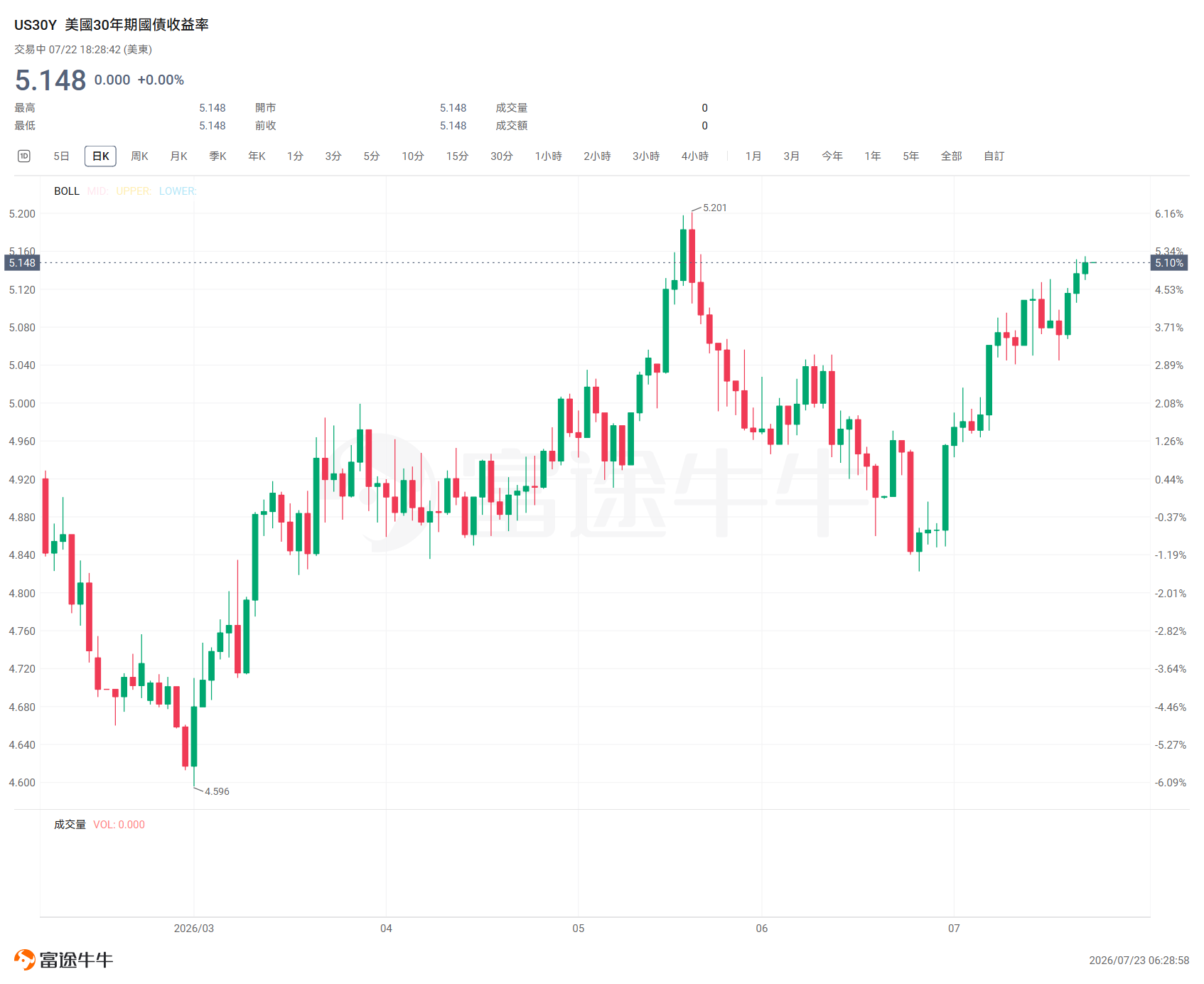
 So far this year, the yield has closed above 5% on 27 trading days, representing approximately 19% of all trading days.
Meanwhile, the inflation-adjusted real yield on the 30-year Treasury has risen by about 50 basis points this year, approaching 3%—a level last seen in 2008.
Persistently elevated long-end yields have led portfolio managers to shift toward 5- to 7-year bonds to avoid duration risk, while some traditionally long-positioned institutional investors have reversed their stance. Concerns over the resurgence of the so-called 'bond vigilantes' now represent the largest tail risk hanging over the market.
Rising Risk Premiums: Key Differences from 2007
This year, the number of trading days on which the 30-year Treasury yield exceeded 5% is second only to the 50 days recorded in 2007, but the underlying contexts differ fundamentally.
In 2007, the Federal Reserve’s benchmark interest rate was approximately 150 basis points higher than current levels. This implies that, compared with the early phase of the subprime crisis, investors today are demanding a substantially higher risk premium.
Tony Rodriguez, Head of Fixed Income Strategies at Nuveen Asset Management, noted:
Of greater significance is the fact that sovereign debt and fiscal deficits are at extremely elevated levels, which is keeping long-term rates high.
Since 2007, the size of the U.S. Treasury market has expanded from $4.5 trillion to $31 trillion, with debt as a share of GDP more than doubling to over 100%, and the U.S. Treasury’s annual interest expense surpassing $1 trillion.
Fitch Ratings recently warned that the U.S. debt burden is 'significantly higher' than that of other countries with an AA rating.
Fiscal pressures combined with supply shocks have made it difficult to alleviate pressure on the long end.
Pressure on long-dated U.S. Treasuries stems from multiple converging forces.
On one hand, Wall Street dealers expect the U.S. Treasury to begin increasing auction sizes for coupon-bearing Treasuries with maturities ranging from 2 to 30 years as early as May 2027, prompting markets to price in this potential expansion on the supply side.
On the other hand, over $500 billion in AI-related corporate financing is being issued intensively in the corporate bond market, competing for limited investor capital.
Kevin Flanagan, Head of Investment Strategy at WisdomTree, stated:
“When assessing fair value at the long end of the yield curve, factors such as the fiscal deficit, outstanding debt, and the potential increase in future U.S. Treasury auction sizes must all be taken into account.”
Government debt levels have risen sharply across many countries globally since the pandemic began in 2020. However, apart from the UK, U.S. 30-year Treasury yields are now higher than those of other major indebted nations such as Japan and France.
The long-end bullish consensus is weakening, and traditional buyers now have more options.
Debt concerns have prompted some staunch bulls to shift their stance.
Earlier this month, Hoisington Asset Management abandoned its decades-long bullish position on long-term U.S. Treasuries, citing larger fiscal deficits and higher capital requirements that could keep inflation and long-term yields elevated.
Alex Payne, Senior Portfolio Manager at Vanguard Capital Management, noted:
Over the past few years, whenever yields reached 5%, the market quickly bought in. Now, traditional buyers of 30-year Treasury bonds—such as pension funds and insurance companies—have more alternatives than they did in the past.
He added that it remains uncertain whether yields have already peaked.
This assessment is corroborated by current asset allocation trends. Fund managers overall favor bonds with maturities of five to seven years to limit losses amid surging long-term yields.
"Bond vigilantes" may have returned, putting markets under a stress test
In the eyes of market participants, the current situation closely resembles the 1980s era when 'bond vigilantes' dominated, with investors pushing up long-term yields to exert fiscal pressure on governments.
Hank Smith, Director of Investment Strategy at Haverford Trust, said the firm has increased its allocation to short-term U.S. Treasuries in recent months and no longer holds bonds with maturities exceeding 10 years for tax-exempt clients:
In our view, the risk-reward profile is not attractive.
Smith candidly acknowledged that over the past 20 years, clients have repeatedly asked him about the risks of high debt, and his consistent response has been, 'When debt truly becomes a problem for this country, the bond market will tell you.'
He noted that U.S. Treasury auctions have not yet shown signs of weakness but issued a warning:
We believe the greatest risk facing markets—including both the bond and equity markets—is the potential resurgence of the 'bond vigilantes.'
Should severe bond market turmoil triggered by fiscal concerns emerge, everyone will face a test.
Editor/Stephen