
In Q2, Tesla’s revenue exceeded expectations by over 7%, marking its highest growth rate in three years. Its trailing 12-month revenue surpassed $100 billion for the first time. Automotive revenue accelerated by 23%, while services revenue surged 50%, significantly beating expectations. Energy storage revenue returned to year-over-year growth but remained below expectations. EPS was 35% below market forecasts, gross margin came in better than expected at 16.3%, and operating profit was less than one-third of market expectations.Free cash flowFor the first time in two years, it turned negative but still outperformed expectations. FDS subscription users rose 56% year-over-year to 1.48 million, nearly 6% above expectations. AI computing capacity more than doubled in the first half of the year, with Cortex 2 delivering over 115 MW of compute power. The first-generation Optimus production line is currently being installed and is expected to commence production shortly.
$Tesla (TSLA.US)$ Its second-quarter earnings report showed strong revenue growth but weak profitability, reflecting the profit pressure resulting from the company's heavy investments to expand into new businesses in robotics, autonomous driving, and AI—weighing on its share price.
After U.S. markets closed on Wednesday, May 22 (Eastern Time), Tesla reported second-quarter 2026 revenue of $28.236 billion, exceeding analyst expectations by more than 7% and marking the first time in three years that its year-over-year revenue growth surpassed 20%. This performance was partly driven by record-high vehicle deliveries for the quarter in the company’s history. Over the trailing 12 months through the end of the quarter, Tesla’s cumulative revenue surpassed $100 billion for the first time, underscoring continued expansion of its core business.
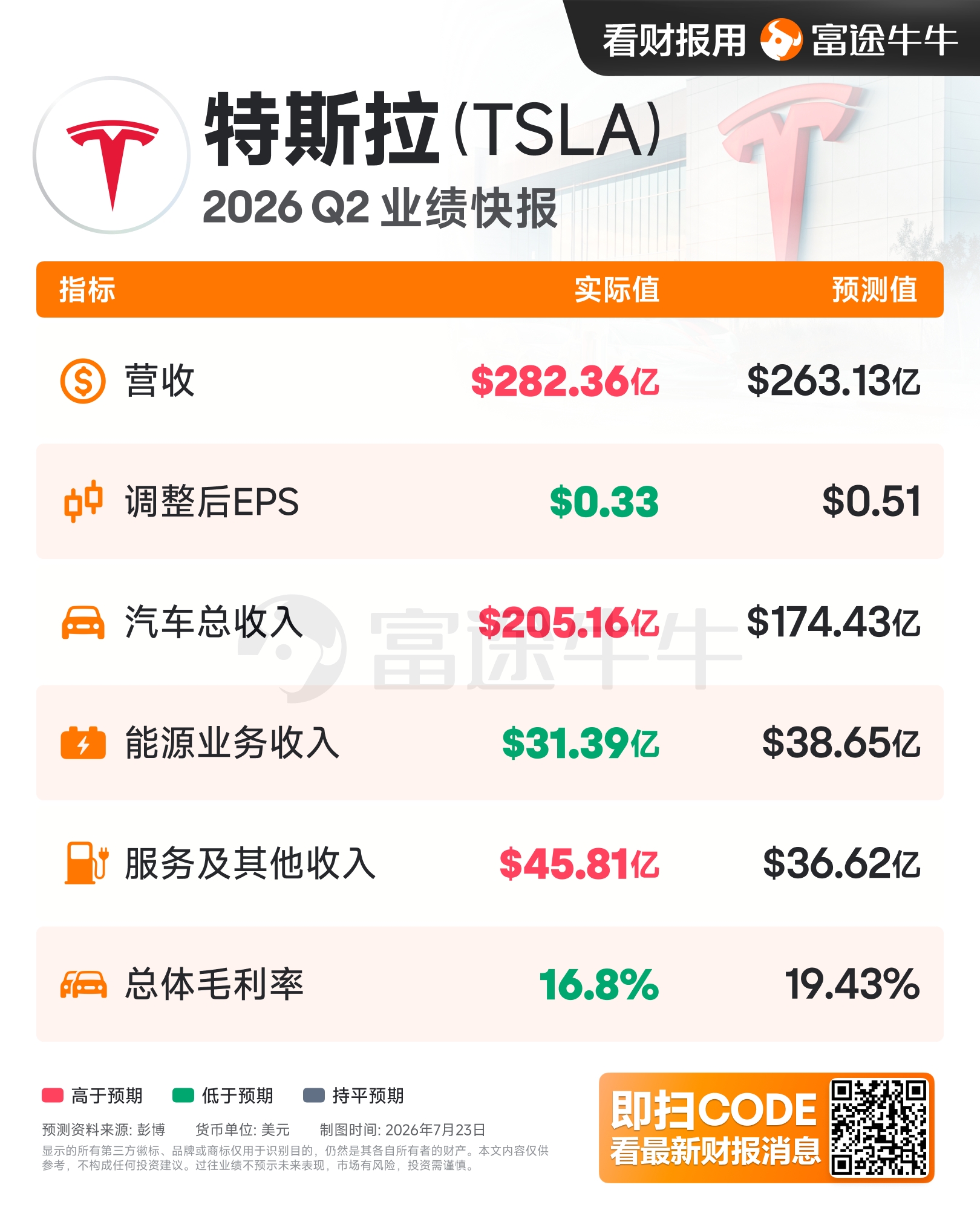
 The automotive segment was the primary driver behind the quarter’s revenue outperformance. Automotive revenue reached $20.516 billion, nearly 10% above market expectations. Revenue from services and other businesses amounted to $4.581 billion, significantly surpassing expectations by approximately 40%, and achieved record profitability and margins. The number of active Full Self-Driving (FSD) subscription users reached 1.48 million, exceeding analysts’ forecast of 1.4 million, indicating continued expansion in the software subscription business.
However, the market is more focused on earnings quality. Tesla’s adjusted earnings per share (EPS) for the second quarter declined 18% year-over-year to $0.33, more than 35% below analyst expectations. Gross margin stood at 16.8%, below the anticipated 19.4%. Operating profit plummeted 57% year-over-year to just $398 million—less than one-third of market forecasts. In other words, although Tesla sold more products and services and generated higher revenue, the efficiency with which each dollar of revenue translated into profit fell significantly short of Wall Street’s expectations.
In its earnings release, Tesla explicitly stated that the company is in its 'largest and most exciting investment phase,' requiring significant ongoing efforts to leverage AI technology to transform transportation, energy, and productivity. 'The scaling of our business will be nonlinear, and we remain fully focused on creating long-term value.' This statement implies that Tesla’s aggressive investment pace will not slow down, and profit-side pressures are likely to intensify further.
Following the earnings announcement, Tesla’s share price—already down more than 1% during regular trading—extended its decline, dropping over 3% in after-hours trading. Analysts noted that the stock’s drop does not reflect a rejection of Tesla’s growth story; rather, investors, while acknowledging strong revenue and delivery figures, are increasingly concerned about pricing pressures in the automotive business, future capital expenditures, the pace of gross margin recovery, and persistently negative free cash flow.
During the earnings call, the stock’s decline widened to over 5%. CEO Elon Musk stated on the call that Optimus is the company’s most challenging product to scale for mass production. Tesla executives reaffirmed that capital expenditures (CapEx) for the year would exceed $25 billion and explained that the negative free cash flow in the second quarter stemmed from a more than doubling of CapEx compared to the prior quarter, with CapEx expected to continue rising over the next two to three years.
Commentators noted that investors had been looking for signals on whether the elevated CapEx trend would extend into next year. Although Tesla did not disclose specific forward-looking figures, its indication that CapEx will keep growing over the next two to three years constitutes the clearest guidance the company has provided. Dec Mullarkey, Head of Investment Strategy and Asset Allocation at SLC Management, commented on the share price decline: 'Investors are gradually realizing that margins are unlikely to improve, which will lead the company to generate negative free cash flow for multiple consecutive quarters.'
Record Q2 Deliveries Drive Revenue Beat and Highest Growth Rate in Three Years
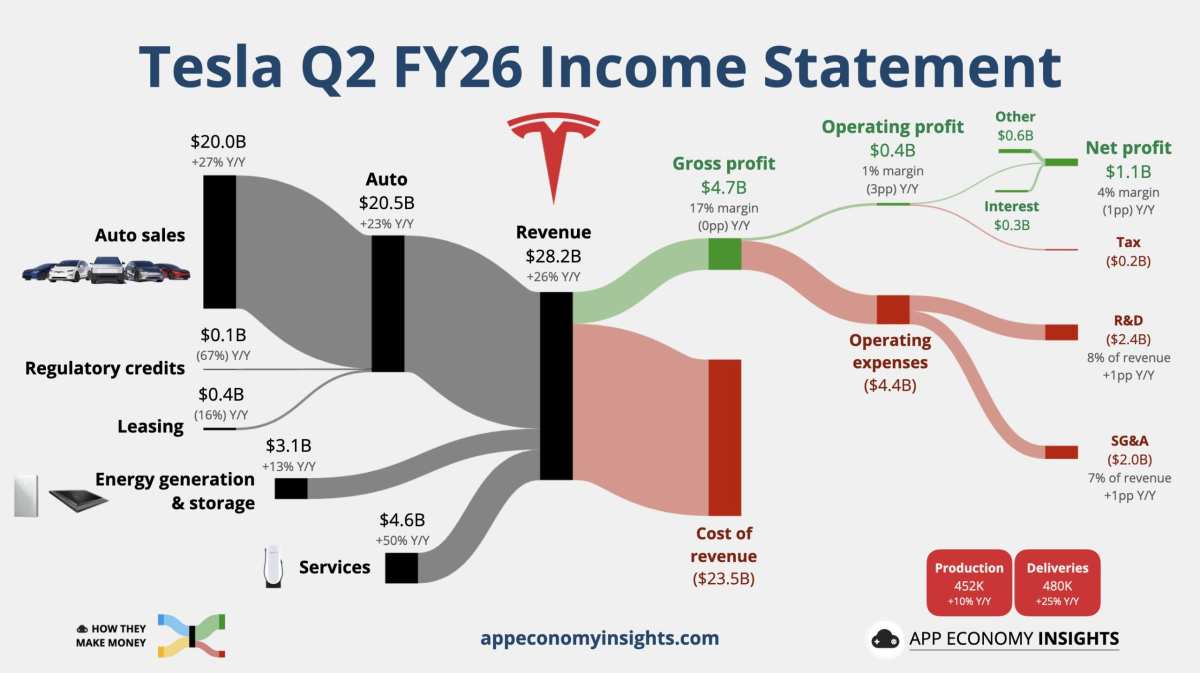
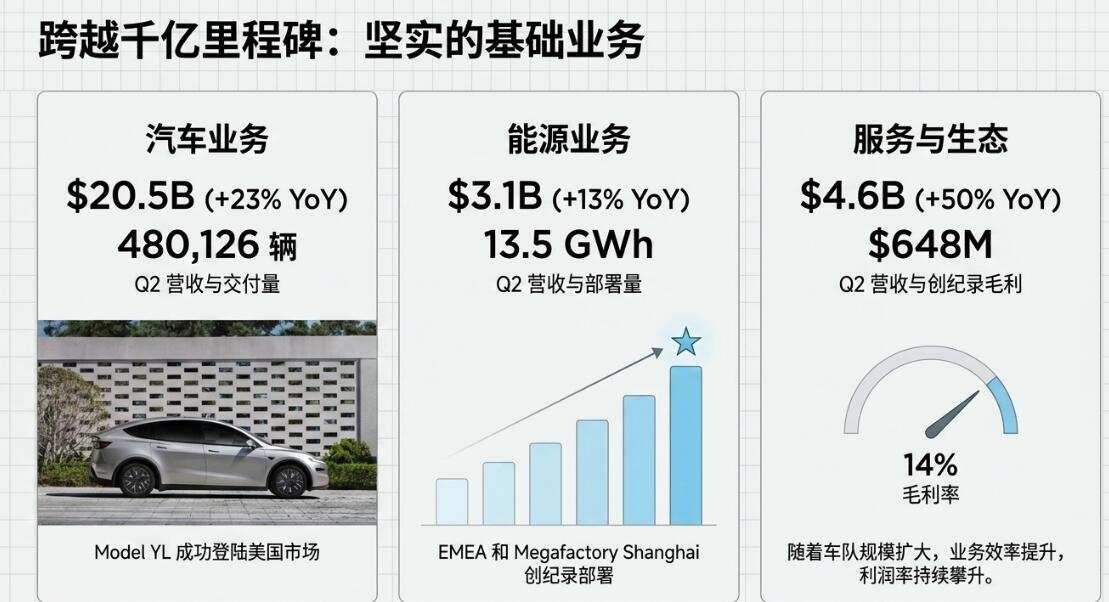
Tesla delivered 480,126 vehicles in the second quarter, up 25% year-over-year, while production totaled 451,758 units, an increase of 10% year-over-year. The notably faster growth in deliveries compared to production suggests that the quarter’s results were supported not only by new output but also by inventory drawdowns.
From the revenue side, Tesla reported total second-quarter revenue of $28.236 billion, approximately $1.923 billion above market expectations, representing an upside surprise of about 7.3%. Revenue increased by 26% year-over-year, marking the fastest growth rate since Q2 2023 for two consecutive quarters and a notable acceleration from the 16% growth recorded in Q1. This represents a particularly strong revenue performance and has driven the company’s trailing 12-month revenue above $100 billion for the first time.
By business segment:
Automotive revenue totaled $20.516 billion, up 23% year-over-year—accelerating from the 16% growth in Q1—and exceeding the expected $17.443 billion;
Services and other revenue reached $4.581 billion, up 50% year-over-year, compared with 42% growth in Q1, and surpassing the expected $3.662 billion;
Energy generation and storage revenue amounted to $3.139 billion, up 13% year-over-year, reversing the 12% year-over-year decline in Q1 but falling short of the expected $3.865 billion.
The automotive segment contributed the largest share of revenue this quarter and accounted for the majority of the revenue beat. A rough calculation shows that automotive revenue represented approximately 73% of total revenue, underscoring its position as Tesla’s core business.
Notably, a rough estimate derived by dividing automotive revenue by vehicle deliveries suggests an average revenue per vehicle of approximately USD 42,700. While this figure cannot be directly equated with average selling price—since automotive revenue may also include items such as leasing income and regulatory credits—it does reflect Tesla’s revenue resilience amid continued growth in delivery volumes.
Gross margin and operating profit were the weakest aspects of the earnings report.
If judged solely on revenue and deliveries, Tesla’s second-quarter performance was solid. However, the stock weakened following the earnings release, primarily due to concerns over profitability.
Tesla reported a second-quarter gross margin of 16.8%, below the analyst consensus expectation of 19.4%—a gap of 260 basis points. This represents a 41-basis-point decline year-over-year and a sharp 430-basis-point drop from the three-year high of 21.1% recorded in Q1.
Based on second-quarter revenue of $28.236 billion and a gross margin of 16.8%, Tesla generated approximately $4.74 billion in gross profit. However, if the gross margin had met market expectations, gross profit would have been meaningfully higher at the same revenue level.
The shortfall in operating profit was even more pronounced. Tesla’s second-quarter operating profit was only $398 million, far below the market expectation of $1.39 billion, resulting in an operating margin of approximately 1.4%. This indicates that despite revenue approaching $30 billion, very little of it translated into operating profit.
Adjusted EPS came in at $0.33, significantly below the expected $0.51—a shortfall of roughly 35%. This suggests the core issue this quarter was not an inability to sell vehicles, but rather insufficient profitability on those sales.
Several factors likely contributed to the profit pressure: ongoing price competition in the automotive market; shifts in product and regional mix affecting margins; continued heavy investment in long-term initiatives such as AI, autonomous driving, manufacturing capabilities, and energy businesses; and the fact that certain new ventures and production capacities remain in their investment phase and have yet to contribute meaningfully to profits. Tesla emphasized in its earnings report that while core business performance remained strong, the company continues to make substantial investments for the future.
Automotive revenue exceeded expectations, but the market is more focused on per-vehicle profitability
Automotive revenue for the second quarter totaled $20.516 billion, surpassing the market expectation of $17.443 billion, making it one of the most significant positive factors in this quarter’s earnings report. Vehicle deliveries rose 25% year-over-year, indicating that demand has not shown the pronounced slowdown previously feared by the market.
However, for Tesla, market attention on its automotive segment has gradually shifted from whether growth can be sustained to whether that growth is profitable. Over recent quarters, investors have closely monitored how price reductions, promotions, financing incentives, and changes in product mix have impacted automotive gross margins. This quarter’s gross margin falling short of expectations has intensified these concerns.
Particularly notable is that despite robust delivery growth, operating profit fell significantly below expectations, indicating that scale expansion has not sufficiently translated into operating leverage. This combination—rapid revenue growth paired with weak profit elasticity—is one that often triggers valuation pressure for growth stocks.
Of course, this does not imply poor performance in the automotive business. On the contrary, automotive revenue exceeding expectations and record Q2 deliveries demonstrate Tesla’s enduring scale advantage and solid demand foundation. However, at its current valuation, the market expects not just volume growth from Tesla, but also stabilization in gross margins and tangible profit realization.
Energy business: High deployment growth, but revenue below expectations
The energy business this quarter exhibited a fairly typical combination of 'strong volume but weak pricing or suboptimal revenue recognition timing.'
Energy storage deployments reached 13.5 GWh in the second quarter, up 41% year-over-year, reflecting strong performance. Revenue from the energy generation and storage segment rebounded into positive year-over-year growth—reversing the double-digit decline seen in the first quarter—to reach $3.139 billion, though this remained below the market expectation of $3.865 billion.
This indicates that the strong growth in energy business installations has not fully translated into revenue exceeding expectations. Potential reasons include project revenue recognition timing, product mix, pricing changes, and quarterly volatility in energy business revenue recognition. Energy storage is inherently project-based, making quarterly revenue and profit susceptible to delivery timing; thus, a single quarter’s underperformance relative to expectations should not be taken as evidence against the long-term growth trajectory.
However, for earnings-driven market reactions, investors focus more directly on outcomes: deployments surged 41% year-over-year, yet revenue came in approximately $630 million below expectations. This reduced the energy business’s contribution to overall performance this quarter.
Services and Other: Evolving from a 'supporting segment' to a profit contributor
Revenue from services and other businesses totaled $4.581 billion in the second quarter, substantially exceeding the expected $3.662 billion. The company also disclosed that this segment achieved record profitability and margins.
This is an important yet often overlooked highlight of the quarter’s earnings report. As Tesla’s vehicle fleet continues to expand, the revenue base for services, repairs, used cars, charging, insurance, and other aftermarket businesses is also growing. Historically, the Services and Other segment was often viewed as low-margin or even a drag on profitability, but this quarter’s 'record profitability and margins' signal meaningful improvement.
This development carries positive implications for Tesla’s long-term financial model: as the installed vehicle base grows, aftermarket revenue could become a more stable source of cash flow and help smooth out cyclicality in automotive sales.
Nevertheless, the improvement in the Services and Other segment was insufficient this quarter to offset the pressure from declining automotive gross margins and high operating investments.
Free cash flow turned negative for the first time in two years—but remained better than expected.
Tesla reported a free cash flow of negative $1.09 billion in the second quarter, marking its first quarterly negative result since Q1 2024, but significantly better than analysts’ expectations—less than one-third of the projected outflow of $3.64 billion. In other words, its cash flow performance was considerably stronger than the market’s worst-case scenario.
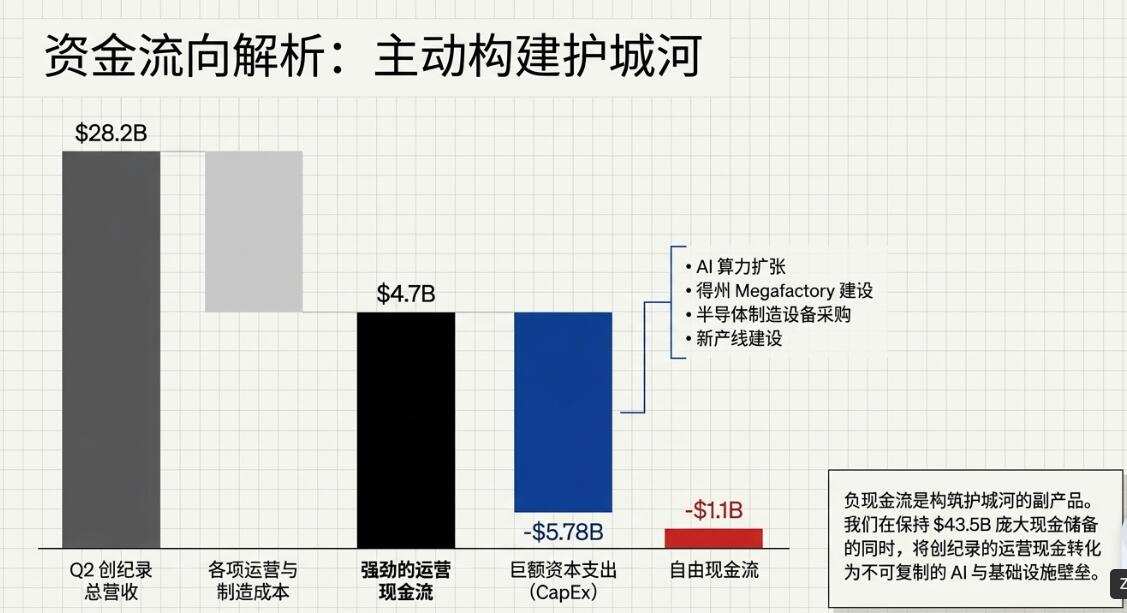
This data should not be interpreted negatively in a simplistic manner. For a company still making large-scale investments in manufacturing, energy, AI infrastructure, and autonomous driving, temporary negative free cash flow is not uncommon. More importantly, Tesla’s free cash outflow this quarter was approximately $2.55 billion less than expected, suggesting that working capital management, capital expenditures, or cash collection may have performed better than previously estimated by the market.
However, the issue lies in the fact that Tesla’s current valuation still hinges on its ability to demonstrate that high growth, high profitability, and strong cash flow can coexist. Although this quarter’s free cash flow was ‘better than expected,’ it remained negative in absolute terms, and combined with operating profit falling significantly short of forecasts, investors are naturally placing greater emphasis on whether cash flow can turn positive in the coming quarters.
Notably, even in a quarter marked by strong delivery growth and record-high revenue, free cash flow has yet to turn positive—indicating substantial ongoing investment intensity and implying that both the income statement and cash flow statement may remain under pressure in the near term.
AI Business: FSD Subscribers Exceed Expectations, a Key Metric for Software Monetization
Regarding AI-related business, the clearest quantitative indicator this quarter was the number of active Full Self-Driving (FSD) subscribers. Tesla reported 1.48 million active FSD subscribers in Q2, up 56% year-over-year and exceeding the market expectation of 1.4 million by approximately 5.7%.
This figure is significant because FSD represents one of the most direct commercialization channels for Tesla’s AI capabilities. Unlike one-time vehicle sales, FSD subscriptions reflect a more sustainable revenue model and signal that Tesla is successfully integrating vehicle hardware, driving data, software capabilities, and AI training systems.
From a financial perspective, the growth in FSD subscribers carries three key implications: First, it demonstrates that Tesla customers remain willing to pay for advanced driver-assistance features; second, the subscription model enhances long-term revenue visibility; and third, if FSD capabilities continue to improve, software revenue could meaningfully enhance the lifetime value of each vehicle.
Yet the short-term challenge is clear: AI investments are front-loaded, while revenue realization is back-end loaded. Significant resources and time are required for training compute capacity, data infrastructure, autonomous driving R&D, and safety validation. The below-expectation margins and operating profit in Q2 partly reflect Tesla absorbing these upfront costs for future businesses.
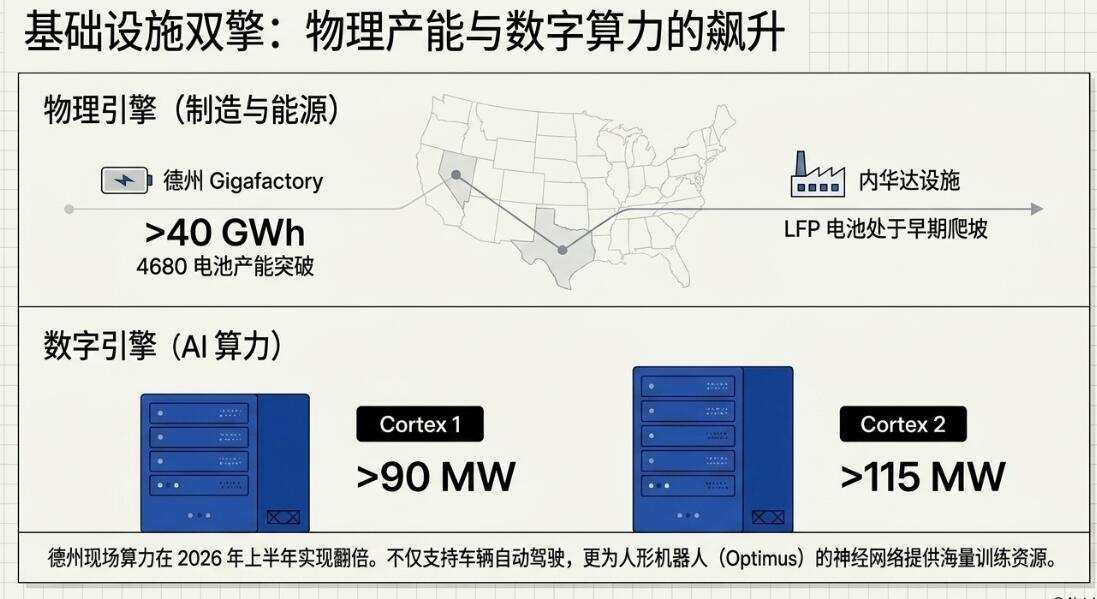
On AI training compute, Tesla stated that, measured in megawatts (MW) of power consumption, on-site computing capacity at its Texas Gigafactory more than doubled in the first half of 2026. Its second-generation AI training supercomputer cluster, Cortex 2—which came online this year and consumes over 115 MW—supports the development of autonomous driving software for both vehicles and humanoid robots. Tesla plans to further scale up its computing capacity through the remainder of the year to ensure sufficient resources for its AI ambitions.
Therefore, the number of FSD users exceeding expectations is a positive signal, but the market will still ask: When will FSD meaningfully contribute to profits? Can subscription penetration continue to rise? Do regulatory and safety boundaries support broader-scale commercialization?
Robots and Robotaxi: Valuation potential remains, but financial contribution has yet to become a central driver.
Robots and Robotaxi represent the most imaginative component of Tesla’s long-term valuation. Tesla continues to emphasize significant investment in future businesses—Robotaxi, autonomous driving, and robotics-related initiatives—remaining key differentiators from traditional automakers.
Tesla disclosed that in the second quarter, it conducted engineering test drives of its mass-production Robotaxi service vehicle, Cybercab, on public roads. Additionally, in July, Tesla offered employees rides in Cybercab within its Gigafactory campus in Texas, stating these steps are critical preparatory measures ahead of Cybercab’s official deployment into the Robotaxi fleet.
In the second quarter, Tesla expanded the operational area for its fully unsupervised Robotaxi service in Austin, Texas, and launched unsupervised Robotaxi ride services in Miami, Orlando, and Tampa in July. Meanwhile, preparations to extend the Robotaxi service to additional major U.S. metropolitan areas are ongoing, including testing, regulatory approval applications, and training programs for emergency responders.
The business logic behind Robotaxi lies in Tesla’s ambition to evolve from ‘selling cars’ to providing ‘autonomous mobility services.’ If Robotaxi achieves large-scale deployment, Tesla’s revenue structure could expand from one-time hardware sales to include fleet operations, ride-sharing commissions, software services, and platform-based income—a key reason why the market has historically assigned Tesla a premium valuation.
The robotics business is even more long-term in nature. While its potential market size is enormous, there remains uncertainty regarding when it will generate verifiable scale revenues and profit contributions. For investors, the robotics segment currently functions more like a long-dated option rather than a core variable supporting near-term earnings.
Tesla confirmed that it officially commenced preparations for mass production of its Optimus robot in the second quarter, noting it has decommissioned the Model S and Model X production lines at its Fremont, California factory and is now installing the first-generation production line for Optimus, with production expected to begin shortly. The initial batch of Optimus robots will be deployed at the ‘Optimus Academy’ to collect training data and further develop functionalities.
Additionally, Tesla continues advancing construction at its Texas Gigafactory, with facility development now fully underway. Regarding product outlook, Tesla stated that the first-generation Optimus production line is also being installed, preparing for production ramp-up in 2026.
In the second-quarter earnings report, Robotaxi and robotics appeared more as justifications for ‘future investments’ rather than contributors to current performance. The issue is that when profitability falls short of expectations, the market pays closer attention to whether these investments have clear milestones. Without sufficiently quantifiable progress toward commercialization in Robotaxi and robotics, investors may be inclined to revise down near-term earnings expectations first.
Why did the stock price fall after hours instead of rising?
Tesla's after-hours stock price decline following its earnings release was primarily not due to disappointing revenue or deliveries, but rather because profitability fell significantly short of expectations.
First, the quality of the better-than-expected revenue was undermined by margins. Revenue for the second quarter exceeded expectations by approximately $1.9 billion, yet gross margin came in 2.6 percentage points below consensus, and operating profit was only $398 million—less than one-third of market expectations. For investors, revenue growth that fails to translate into profit growth weakens its support for valuation.
Second, EPS significantly missed expectations. For a stock like Tesla—highly sensitive to valuation and carrying elevated market expectations—disappointing EPS often triggers more immediate selling pressure than stronger-than-expected revenue.
Third, the automotive segment continues to face questions about profitability. While record deliveries are important, the market no longer rewards companies solely for high volume. Investors now seek evidence that Tesla can stabilize per-vehicle profitability, improve gross margins, and restore operating leverage amid intensifying competition. This quarter’s results failed to provide a sufficiently compelling answer.
Fourth, energy business revenue also fell short of expectations, weakening the diversification narrative. Although energy storage deployments grew strongly, revenue underperformed, indicating that the energy segment remains volatile in the near term and did not serve as a consistent source of positive earnings or revenue surprises this quarter.
Fifth, although free cash flow was better than expected, it remained negative. The market may accept Tesla investing for the future, but negative free cash flow—combined with below-expectation gross margins and weak operating profit—amplifies investor concerns about near-term earnings quality.
Therefore, this earnings report represents a mix of 'impressive growth metrics but insufficient earnings quality.' The after-hours decline does not signal that the market is rejecting Tesla’s long-term story; rather, at current valuations and expectations, investors are reacting to shortcomings in margins, EPS, and cash flow.
 AI-Powered Earnings Insights: Build Your Options Strategy in Three Steps! Open Futubull > Stock Page > Tap [Company] >Earnings Update

Editor/lambor