
① The Federal Reserve under Kevin Warsh has already begun leaving its mark on financial markets—just days before the Fed’s next meeting, traders remain divided on whether the central bank will raise interest rates... ② Data from the interest rate swaps market shows that traders now estimate a roughly 31% probability that the Fed will hike its benchmark rate by 25 basis points at next week’s policy meeting, and a 69% probability that it will hold rates steady.
The Federal Reserve, led by Kevin Warsh, has already begun leaving its mark on financial markets—just days before the Fed’s next meeting, traders remain divided on whether the central bank will raise interest rates…
Data from the interest rate swaps market shows that traders now estimate a roughly 31% probability that the Fed will hike its benchmark rate by 25 basis points at next week’s policy meeting, and a 69% probability that it will hold rates steady.
 Such pronounced divergence in market pricing ahead of a Fed rate decision is extremely rare in recent years—under former Fed Chair Powell, market participants typically entered meetings with near-certainty about what action the Fed would take.
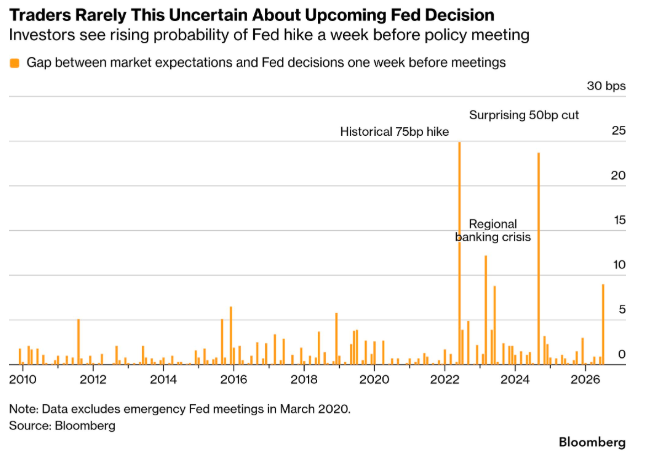
However, many industry insiders expect that this pre-meeting ‘fog’ could become more common under Warsh, who has broken with his predecessors’ practice of offering advance hints about the Fed’s next move.
“Without forward guidance, ambiguous probabilities like 20%, 30%, or 40% will become the norm,” said Jim Bianco, president and macro strategist at Bianco Research. “The market is transitioning to this new way of thinking.”
Looking back at Fed history, the last time markets faced such significant uncertainty over a Fed meeting outcome was in September 2024—though at that time, the debate wasn’t whether the Fed would change rates, but rather whether it would cut rates by 25 or 50 basis points. Then-Chair Powell ultimately opted for the larger cut to bolster a weakening labor market.
Has Warsh successfully made the market guess wrong?
Since taking office in May, Warsh has consistently pledged to abolish the Fed’s long-standing practice of signaling the likely direction of future interest rates.
He believes that such forward guidance could unnecessarily constrain policymakers as economic conditions evolve.
However, this approach has also significantly increased risk for traders: those who ultimately succeed in predicting the Federal Reserve's moves stand to gain substantially more, while those who misjudge face steeper losses.
Indeed, in several recent statements, Wallsh has clearly indicated that it is necessary to curb inflation, which has remained above the Fed’s target since the pandemic began—a view that has led traders to believe the Fed is at least likely to raise interest rates by year-end. The only question is when…
Interestingly, economists are more confident than market traders in their forecasts for next week’s Fed decision. All 76 economists surveyed by the media unanimously expect the Federal Reserve to keep borrowing costs unchanged within the 3.5%–3.75% range at its meeting on July 28–29.
However, such media surveys often lag behind market developments. Last week, after inflation data showed the U.S. CPI posted its first month-over-month decline in six years in June, interest rate market traders briefly held a similar view. But since then, escalating tensions between the U.S. and Iran have driven oil prices higher again, reigniting expectations of rate hikes.
Currently, interest rate swap contracts fully price in a 25-basis-point rate hike by the Federal Reserve by the end of September and imply at least two rate increases by the end of March next year.
“I still think the Fed won’t raise rates next week,” said John Brady, Managing Director at RJ O'Brien. “But the market is signaling to me that the vote on whether to hike will be closer than I had imagined.”
Editor/lambor