
During Tesla's earnings call, Elon Musk stated that Tesla is undergoing the fastest industrial expansion in the U.S. since World War II, with capital expenditures exceeding $25 billion, and is seeking $30 billion in debt financing. Robotaxis have already driven 380,000 miles across six cities with zero accidents. Mass production of Optimus is extremely challenging, as the supply chain is being built almost from scratch. The company’s in-house AI chip has been upgraded from AI4 to AI6, with AI4 chips expected to enter mass production around mid-next year. Musk declined to comment on potential merger discussions with SpaceX but noted that the two companies are deepening their collaboration.
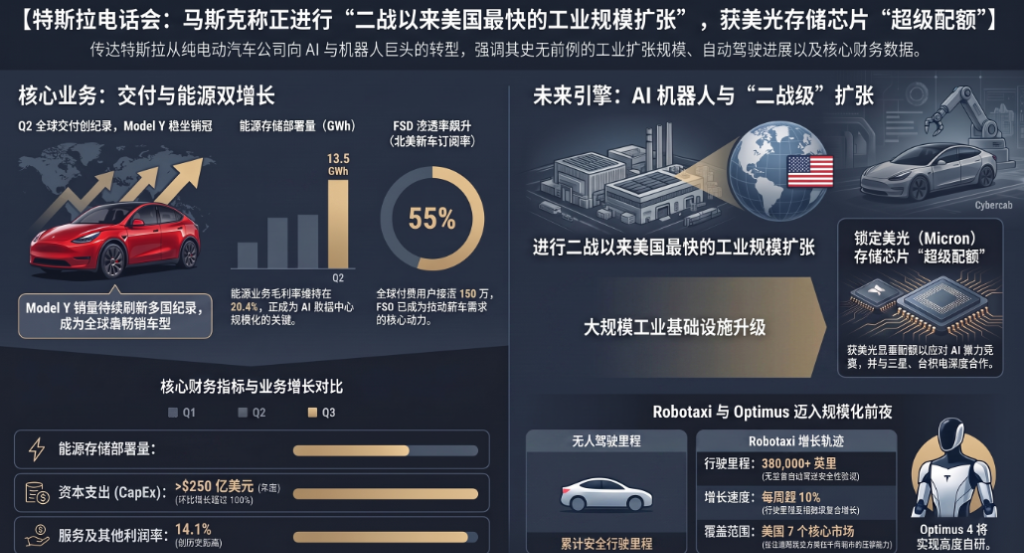
Faced with record-breaking second-quarter delivery figures and soaring capital expenditures, Musk painted a grand vision for Wall Street of an empire built on Robotaxis, humanoid robots, and massive AI computing capacity, seeking to reshape market expectations through breakneck expansion.
After U.S. market hours on the 22nd (Eastern Time), Tesla released its second-quarter financial results, reporting revenue of $28.24 billion—over 7% higher than analysts’ expectations and marking the first time in three years that its year-over-year revenue growth has exceeded 20%.
 However, adjusted earnings per share for the second quarter declined 18% year-over-year to $0.33, more than 35% below analyst expectations, while gross margin for the quarter stood at 16.8%, below the expected 19.4%.
Despite declining gross margins in both its automotive and energy storage businesses and negative free cash flow, Tesla’s management showed no signs of pulling back during the earnings call.
Tesla CEO Elon Musk stated that the company is undergoing the fastest industrial-scale expansion in the United States since World War II, reaffirming that capital expenditures this year are expected to exceed $25 billion and will continue growing over the next two to three years. Musk emphasized:
"This is an exceptionally large year for capital expenditures, but I am confident that all the projects we are investing in will generate incredible returns. This could be the best return on capital expenditures we’ve ever seen."
CFO Vaibhav Taneja added that Tesla is in a 'massive investment cycle' and is seeking to establish a debt financing facility of up to $30 billion to accelerate these investments.
Additionally, during the call, Musk thanked Micron Technology for providing Tesla with memory chip allocations—including allocations for the next several years—particularly amid tight supply conditions in the current memory market. He noted that Micron’s allocation to Tesla was substantial and offered under reasonable terms.
An unprecedented capital expenditure cycle: raising $30 billion in debt to support expansion
Free cash flow turned negative this quarter due to capital expenditures more than doubling compared to the previous quarter.
CFO Vaibhav Taneja stated that the company expects capital expenditures to increase further in the second half of 2026, with full-year capital expenditures exceeding $25 billion.
To support this expansion, the company is arranging debt financing on an "opportunistic" basis, targeting a borrowing capacity of up to $30 billion. These funds will be allocated across multiple initiatives, including expanding the Robotaxi fleet, scaling up Optimus production lines, constructing semiconductor wafer fabs, installing solar panel manufacturing capacity, and building AI computing infrastructure.
Musk stated that the company’s principle for capital expenditure is to 'spend as fast as possible without being wasteful,' characterizing the balance between efficiency and speed as a superior decision-making approach compared to pursuing capital efficiency alone.
Vaibhav Taneja added that Tesla acts as the general contractor on nearly all its construction projects to ensure rapid execution. Musk likened the current scale of industrial expansion to the fastest such effort in the United States since World War II.
Robotaxi expansion accelerates, achieves 380,000 miles with 'zero incidents,' and rejects third-party ride-hailing platforms
During the earnings call, Tesla provided clear safety data on its highly anticipated Robotaxi business.
Ashok Elluswamy, Vice President of AI Software at Tesla, revealed that unsupervised Robotaxis are currently operating in six cities across two states. Elluswamy stated:
We have already driven over 380,000 miles with unsupervised Robotaxis and recorded zero noteworthy incidents.
Tesla views this data as strong validation of its vision-only approach. Regarding future expansion, Musk set an exceptionally high safety standard:
If we harm even a single person, it will become global front-page news, and regulators will immediately restrict our operations. So we don’t want to hurt anyone—not even a pet.
In response to investor questions about whether Tesla would collaborate with third-party ride-hailing platforms such as Uber, Musk gave a negative answer, clearly stating that the company would maintain absolute vertical integration:
Our profitability is extremely strong, and our products sell effortlessly—we can easily integrate the entire upstream and downstream supply chain. The only factor currently constraining growth is our stringent reliability requirement of 99.999999%.
He also noted that the deployment pace of Cybercab is limited by the progress in accumulating vehicle-specific driving data, and mass deployment will only commence after modified Cybercabs equipped with steering wheels and pedals have accumulated sufficient mileage.
Optimus faces immense production challenges, with its supply chain being built almost from scratch.
At the event, Musk provided an unusually detailed explanation of the difficulties involved in mass-producing Optimus and explicitly warned investors not to underestimate this challenge.
He stated that Optimus will be the most difficult product Tesla has ever mass-produced, as nearly all of its components are newly designed, leaving no existing supply chain—everything must either be built internally or brought in-house.
Musk indicated that Optimus production would follow an S-curve, but due to the high degree of component novelty, the initial ramp-up phase would be “quite long and gradual.”
The company is currently building an Optimus production line at its Fremont factory (formerly used for Model S/X production).
For the next-generation Optimus 4, the company aims to achieve a tenfold increase in output compared to Optimus 3 and pursue even greater vertical integration, including internalizing a significant portion of printed circuit board manufacturing.
Karn Budhiraj, Vice President of Supply Chain, added that Samsung’s upcoming wafer fabrication plant will be dedicated primarily to supporting future projects like Optimus, and the company is simultaneously seeking strategic suppliers for robot-specific components such as metal injection-molded parts and flexible printed circuits.
When discussing the supply chain, in light of the current shortage and elevated prices of memory chips caused by the expansion of AI systems, Musk specifically mentioned Micron Technology. He said:
They have to make extremely tough decisions regarding memory allocation, and we are truly very grateful to Micron for making room for Tesla over the next few years and providing us with an exceptionally generous allocation under very reasonable terms, especially given today’s extremely volatile memory pricing.
TeraFab and In-House Chip Development: The Roadmap from AI4 to AI6
To support the training and generalization capabilities of its robots, Musk expressed strong confidence in Tesla’s future in-house chip development:
The upgraded AI4 chip is expected to enter mass production around mid-next year; AI5 is progressing very smoothly and will initially be used in Optimus; as for the Tesla AI6 chip design, I believe it will become the world’s best edge computing chip.
Regarding the semiconductor wafer fabrication project TeraFab, Musk declined to disclose its location during the earnings call, citing that it 'deserves a spotlight all to itself for an entire day,' but confirmed that equipment orders have already been placed for the pilot fab in Austin.
The facility will integrate photomask production, logic, memory, packaging, and chip testing under one roof to enable rapid iteration and validation of chip designs.
He stated that TeraFab is essential for scaling Optimus, 'otherwise we won’t have enough AI chips.'
Musk declined to comment on potential merger discussions with SpaceX but noted that the two companies are deepening their collaboration.
In response to analysts’ questions about the potential merger between Tesla and SpaceX, Musk noted that collaboration between the two companies is deepening, but any merger-related matters 'must go through the appropriate process,' and he referred the topic to the legal team.
Brandon Ehrhart, Chief Legal Officer of the company, stated that earlier this year, both parties further deepened their collaboration through investment and framework agreements to advance projects such as TerraFab and Digital Optimus.
Musk subsequently disclosed several specific cooperation milestones:
Grok AI has been integrated into Tesla’s vehicle operating system and is assisting in driving Digital Optimus;
Starlink will be integrated into Cybercab and gradually rolled out to all Tesla vehicle models entering markets covered by Starlink, addressing cellular dead zones in certain regions.
He noted that even in Silicon Valley, cellular signals on certain road segments remain highly unstable and cannot meet the continuous connectivity requirements of Robotaxis. He also suggested that future Cybercab vehicles equipped with Starlink terminals could potentially serve as mobile ground relay nodes, providing Wi-Fi connectivity to nearby devices.
Full Transcript of Tesla’s Q2 Earnings Call (AI-Assisted Translation):
Good afternoon, everyone, and welcome to Tesla’s live webcast for the second-quarter 2026 financial results Q&A session. I’m Travis Axelrod, Head of Investor Relations. Joining me today are Elon Musk, Vaibhav Taneja, and several other executives.
The second-quarter financial results were released at approximately 3:00 p.m. Central Time in the United States. The accompanying earnings update materials will be posted under the same link used for this webcast. During today’s call, we will discuss our business outlook and make forward-looking statements. These remarks are based on our current expectations and forecasts as of today, and actual events or outcomes may differ materially due to various risks and uncertainties, including those detailed in our most recent filings with the U.S. Securities and Exchange Commission (SEC).
During today’s Q&A session, please limit your inquiry to one primary question plus one follow-up. If you would like to ask a question, please use the “Raise Hand” button to join the question queue.
Before we begin the Q&A session, Elon will deliver opening remarks. Elon, please go ahead.
Elon Musk, CEO of Tesla:
Thank you. This quarter’s performance was exceptional. We achieved record deliveries in the second quarter. I believe the Model Y is now the world’s best-selling vehicle, breaking records across the board and seeing significantly increased market popularity.
In regions where Full Self-Driving (FSD) has received regulatory approval, adoption rates are very high. In fact, I believe that for many customers, FSD itself has become the primary reason for purchasing a Tesla—not merely an add-on feature. Customers walk into our U.S. stores explicitly stating they want FSD; the specific vehicle model is secondary. This is clearly a significant driver of demand. As FSD gains regulatory approval in more countries, I expect to see similar growth momentum in demand.
Our energy business is also growing at an extremely rapid pace, and I believe it is critical to the large-scale expansion of AI data centers. We have made substantial investments in both our core business growth and future strategic initiatives, making this year a major capital expenditure year. However, I am confident that all our investments will yield strong returns—potentially the highest return on capital in our history.
Tesla’s team execution has been impressive. Cybercab has officially entered production; Optimus is about to begin production; Tesla Semi has started production; Megapack 3 is soon to enter production; our lithium refining plant and cathode materials refining plant have already commenced operations; and we are simultaneously scaling up our cell manufacturing capacity.
Additionally, we are preparing for large-scale solar cell and module manufacturing, creating an integrated supply chain that extends from silicon refining through solar cell production to final solar deployment. This is because future electricity demand will be enormous, driven by transportation electrification and artificial intelligence. We are advancing what we believe to be the most ambitious plan in human history for building advanced infrastructure and manufacturing capacity—a project of profound significance.
Regarding Robotaxi, our ambitions are very high, but we must remain extremely cautious about safety to avoid any accidents or harm to individuals. Although approximately 30,000 to 40,000 people die annually in traffic accidents in the U.S.—incidents that rarely attract widespread media attention—if we were to injure even one person, it would immediately become global headline news, and regulators would swiftly impose restrictions on our business. We do not wish to harm anyone.
Therefore, while we are moving as fast as humanly possible to scale Robotaxi, we always maintain 'do no harm' as our fundamental principle—ideally, not even running over a pet. That is our core constraint: advance as quickly as possible without harming anyone.
Whenever we launch service in a new city, we immediately post real-time updates on X—please follow Tesla’s official account. Currently, we have launched service in multiple cities in Florida and Texas, as well as the Bay Area, and we will continue expanding. In terms of miles driven, growth has already exceeded 10% per week, with a highly impressive compound growth rate.
Now, regarding Optimus: as I’ve mentioned many times before, I believe Optimus will become the most important product in our history. Yet it is also an extraordinarily complex and challenging endeavor—to build an autonomous humanoid robot capable of performing tasks without explicit programming, simply by receiving verbal instructions or watching a demonstration video. This has never been achieved in human history.
There are numerous challenges in the electromechanical design of robots: achieving sufficient dexterity while ensuring high reliability and durability—it must operate continuously in the field without failure. Otherwise, a 70-kilogram robot collapsing on the ground would be extremely difficult to move, which is something we absolutely want to avoid.
Therefore, getting the design right and then scaling it to mass production involves an enormous amount of work. I want to emphasize particularly that the production ramp-up for Optimus presents exceptionally severe challenges—this will be Tesla’s most difficult product to mass-produce to date, as every single component on the robot is entirely new, and the difficulty of production ramp-up scales directly with the novelty of the components.
Electric vehicles, at least in non-electric drivetrain components, can still rely on existing supply chains—for example, wheels, side mirrors, glass, and body panels all have mature suppliers. Optimus, however, has no pre-existing supply chain whatsoever; we must either build an entirely new supply ecosystem from scratch or internalize production ourselves.
In fact, we have already internalized a significant number of processes. We are currently constructing the Optimus production line at the former Model S/X production site in the Fremont factory—the scene there is truly spectacular and awe-inspiring.
I want to clarify this point: Optimus’s production ramp-up will follow the typical S-curve pattern, but due to the high degree of component novelty, the initial phase of the ramp will be a prolonged period of slow growth. The various robot demonstration videos you see online are all either pre-programmed or remotely controlled; currently, no humanoid robot in the world can genuinely perform general-purpose tasks autonomously. Optimus will be the first robot with this capability—not just a demonstration, but a genuinely useful product in everyday life.
Optimus is designed to achieve full human-level hand dexterity—even matching or exceeding the fine motor control capabilities of human hands. The human hand is extraordinarily sophisticated—the deeper one studies it, the more astonishing it becomes, far beyond simple thumb opposition. Optimus will possess this capability and ultimately surpass human dexterity.
Regarding TeraFab, we expect to announce details such as its location, but this news warrants a dedicated launch event and should not be compressed into an earnings call. TeraFab is a strategically critical and indispensable initiative—without it, our ability to scale Optimus production would face severe constraints, as AI chip supply would become a bottleneck. We must simultaneously advance breakthroughs in memory, logic chips, and packaging to support Optimus’s expansion. We have already placed equipment orders for our R&D wafer fab in Austin. This R&D fab features a standout design: photomask manufacturing, logic chips, memory, packaging, and chip testing are all co-located under one roof, enabling extremely rapid iteration cycles and swift validation of new chip designs. I believe no such facility currently exists anywhere on Earth, and it will greatly empower our pursuit of high-risk, high-reward AI chip innovations.
Our research focus remains on maximizing Optimus’s value, and we are also developing a 'Digital Optimus'—in simple terms, this means 'driving' a computer screen much like driving a car. For vehicles, it’s 'photon input, control output'; the same principle applies to Digital Optimus. We are confident that the Tesla AI technology developed for autonomous driving can be adapted to create an 'autonomous computer.' A low-cost Tesla AI4 computer will handle real-time video control tasks, driving the computer screen at high frame rates in real time rather than through screenshot-based operations. Digital Optimus is equally essential for the physical Optimus, as the physical robot must be able to operate computers and cannot be left helpless in front of a touchscreen. Progress in this direction is going well, and the project is being advanced in collaboration with SpaceX.
We are also developing a Megapod design that integrates the Tesla AI4 computer with x86 architecture—combining an x86 computer and a Tesla AI4 computer within a single chassis, forming a 'Digital Optimus all-in-one unit.' Multiple such units will be integrated into large cabinets using a packaging approach similar to Megapack, deployable across the country and globally, thereby expanding AI computing capacity through distributed power delivery.
Currently, Tesla’s Supercharger network covers approximately 7 gigawatts of power capacity and continues to grow. We can deploy Megapods at many Supercharger stations to enable AI-oriented distributed power delivery—a layout that will be quite significant.
In summary, we are very excited about the roadmap for autonomous driving and robotics, with a great deal of compelling content on the horizon. As I mentioned, it’s simply not possible to cover everything in a single earnings call, and there will be more product launches ahead. This year will be extraordinary for Tesla—perhaps one of our best ever—and I believe next year will be even better.
Finally, I’d like to thank the Tesla team for their exceptional execution and all our supporters for joining us on this journey. Thank you.
Travis Axelrod, Head of Tesla Investor Relations:
Thank you, Elon. Now I’ll turn it over to Vaibhav for his opening remarks.
Vaibhav Taneja, Chief Financial Officer of Tesla:
Thank you, Travis. The second quarter continued the trend seen at the end of Q1, with a strong global recovery in vehicle demand. We achieved record global deliveries in Q2, with sequential growth of 60% in the Americas, 27% in Asia-Pacific, and 12% in Europe, the Middle East, and Africa. Additionally, Model Y set sales records in several key markets, including the Netherlands, Australia, and New Zealand.
Tesla’s efforts to deliver high-quality vehicles with autonomous capabilities at reasonable prices are yielding results. We ended Q2 with the largest vehicle order backlog since 2023. To meet this sustained demand growth, we are focused on ramping up production across all factories.
Production growth is currently constrained by supply chain limitations, which affect not only batteries but also electronic components. We’ve encountered similar situations before, and the Tesla team is actively working with suppliers on strategic collaborations to overcome these bottlenecks.
FSD is one of the key drivers of vehicle demand. Sales data shows that many customers visit our stores specifically because of FSD. In Q2, approximately 55% of vehicles delivered in North America had FSD subscriptions activated at delivery. Overall, FSD attach rates continue to rise, with nearly 1.5 million paying users globally—55% through outright purchases and 45% via subscriptions. Since we have discontinued the one-time purchase option in most markets, we expect future FSD monetization growth to come primarily from subscription services.
Excluding regulatory credits, automotive gross margin declined from 19.2% last quarter to 16.3%. It should be noted that Q1 benefited from a $230 million warranty reserve reversal and certain tariff reductions, neither of which recurred in Q2. Excluding these factors, automotive gross margin was essentially flat, reflecting Tesla’s effectiveness in pricing discipline and cost control. Rising commodity prices and interest rate changes continue to exert upward pressure on costs. Notably, interest rate subsidy costs are recognized upfront as a reduction of revenue, so the increase in interest rates this year has directly led to higher subsidy costs, negatively impacting automotive gross margin.
As we previously noted, the energy business is inherently uneven, with project deployments tied to customer timelines and largely outside our control. In the second quarter, we deployed 13.5 gigawatt-hours of energy storage capacity, a 53% increase sequentially, marking the second-largest single-quarter deployment in the history of the energy business. Nevertheless, energy gross margin declined from 39.5% to 20.4%.
This decline resulted from several factors: first, the quarter included a warranty reserve charge of approximately $240 million related to supplier issues associated with certain legacy projects; second, the over $200 million tariff benefit recognized in the first quarter did not recur this quarter; and third, as previously indicated, intensifying competition continues to drive down average selling prices for utility-scale energy storage products. Over the long term, we expect the energy business’s gross margin to stabilize in the low-20% range, slightly above 20%. Order backlog for this business remains robust, and we are actively expanding manufacturing capacity in line with current demand and anticipated future demand driven by data center growth and broader economic electrification.
Gross margin for services and other businesses improved from 9.2% to 14.1%, reaching a record high, primarily driven by higher sales volumes and cost optimization across used vehicles, Supercharging, service centers, and insurance. This segment also includes early-stage infrastructure investments to support the future scale-up of Robotaxi, which currently represent a small portion but reflect a clear strategic direction.
Tesla’s Robotaxi fleet continues to expand and now operates in seven U.S. markets. We expect the fleet size to accelerate throughout the year and continue expanding into new markets.
As previously indicated, operating expenses increased sequentially, primarily due to significant R&D-related activities, including pre-production ramp costs for new products such as the Semi truck, Optimus, and Cybercab, depreciation and amortization of AI-related initiatives and newly deployed computing infrastructure, and litigation-related expenses recorded this quarter. We recognize that we are in a period of substantial investment, and we anticipate that R&D-driven operating expenses will continue to grow through 2026 and beyond.
Net income this quarter benefited positively from a $1 billion gain related to the mark-to-market valuation of our SpaceX equity stake, partially offset by approximately $300 million in foreign exchange losses and $100 million in Bitcoin losses.
As previously indicated, free cash flow was negative this quarter, primarily due to a more than doubling of capital expenditures on a sequential basis. We expect capital expenditures to increase further in the second half of the year, with full-year capital expenditures projected to exceed $25 billion.
Over the next two to three years, capital expenditures will continue to rise as we expand the Robotaxi fleet, scale up Optimus production, invest in semiconductor wafer fabrication capacity, build solar manufacturing capacity and AI computing infrastructure, and pursue other automotive manufacturing-related expansions. In addition to internal funding, we are actively pursuing debt financing with the goal of establishing a debt facility with total borrowing capacity of up to $30 billion to accelerate these investments. We firmly believe this is the right strategic path and will execute all investments with a strong focus on capital efficiency.
The path to a better future has always been challenging, requiring bold strategic bets—progress is inherently nonlinear. Yet the opportunities ahead are vast, and we are ready to meet these challenges. Finally, thank you to the Tesla team, our customers, investors, and suppliers for your trust and support on this journey.
Travis Axelrod, Head of Tesla Investor Relations:
Thank you very much, Vaibhav.
Attentive listeners may have already noticed that we addressed several questions from Say.com in our opening remarks, including those related to Optimus production, TeraFab, and Digital Optimus. Today, we are also joined by Ashok, Vice President of Artificial Intelligence, who will address questions regarding Robotaxi. Ashok, please.
Ashok Elluswamy, Vice President of Artificial Intelligence Software at Tesla:
Thank you, Travis. There have been numerous questions on Say.com concerning the deployment and scaling of Robotaxi, and we will provide a comprehensive update on our current progress and future plans.
First, I would like to emphasize that the Robotaxi program is performing exceptionally well, particularly in terms of safety, maintaining an impeccable safety record. To date, we have completed over 380,000 miles of unsupervised Robotaxi operations across six cities in two states, with zero serious incidents. All reported incidents involved our vehicles being struck while stationary by other parties.
Let me reiterate: over 380,000 miles with zero serious incidents. Historically, so-called 'experts' have claimed that safe autonomous driving requires LiDAR, radar, high-definition maps, and various complex hardware systems. The facts demonstrate otherwise—vision-only technology can indeed deliver safe, comfortable, and cost-effective autonomous driving. This record strongly validates Tesla’s overall AI strategy.
Second, regarding scaling: we launched the Robotaxi program in Austin approximately one year ago, initially with safety operators onboard. By the end of last year, Austin saw its first fully unsupervised Robotaxis. Since the beginning of this year, the weekly growth rate of unsupervised miles driven by our fleet has consistently remained in double digits, and this high compound growth rate has persisted for several months. We expect this pace to continue throughout the remainder of the year.
Another noteworthy point is that the difficulty of expanding into new cities continues to decrease. In the future, the time required to launch service in a new city will approach zero, eventually enabling simultaneous statewide coverage without the need for city-by-city rollouts. This is made possible by continuous breakthroughs in cutting-edge AI by our world-class engineering team.
The current Robotaxi fleet is running an early version of the previously mentioned V15 FSD software. V15 outlines approximately seven major improvement tracks, all progressing in parallel. The early V15 version currently deployed in the fleet incorporates roughly 40% of these improvements. Once the full version is rolled out, vehicle safety and capabilities will reach an extremely high level. Internally, we are already observing positive results across all technical improvement areas, and the anticipated returns will be substantial—this serves as the core driver sustaining our current growth trajectory.
Regarding Cybercab, it is an extraordinary product—everyone who has experienced it loves it deeply. We have aligned our manufacturing targets with the projected growth rate of unsupervised miles. The same V15 model powering Model Y and other vehicles is also fully applicable to Cybercab.
In summary, Robotaxi has achieved truly exponential growth while maintaining an impeccable safety record. Our technology bets are paying off and will support the continued evolution of this exponential trajectory in the foreseeable future, and Cybercab will be exceptional.
Travis Axelrod, Head of Tesla Investor Relations:
Very good, thank you very much, Ashok. There’s also a question regarding Optimus training data collection—please address that as well.
Ashok Elluswamy, Vice President of Artificial Intelligence Software at Tesla:
Certainly. Regarding Optimus, particularly Generation 3, its design objective is not only to resemble humans in form but also to match human capabilities and flexibility across all functional dimensions. A key reason for adopting a humanoid form is that such robots can directly learn how to perform various tasks by observing humans, thereby unlocking a global source of data for Optimus training.
Similar to FSD, we have access to extensive human behavioral data—every worker in our factories contributes training material for Optimus by demonstrating tasks that the robot can observe and learn from. Additionally, we maintain a dedicated data collection team that provides a smaller volume of exceptionally high-quality demonstration videos specifically for fine-tuning the model. All of this builds upon vast amounts of internet-sourced data, including videos showing humans performing diverse tasks in both industrial and household settings.
The second flywheel is the 'Optimus Academy'—as large numbers of Optimus robots repeatedly practice tasks there, the real-world experience they accumulate helps bridge any potential morphological gaps between robots and humans. This is also where the reinforcement learning loop begins to take effect: robots initially attempt tasks, experiencing both failures and successes, and continuously learn from both until they master these tasks at a level surpassing human performance.
Our AI strategy for Optimus is identical to the end-to-end approach powering FSD—'photon in, control out.' Just as FSD achieves generalized driving capability, Optimus will achieve generalized task execution—you simply issue a command, and it autonomously completes the entire task without requiring any intervention during the process. The same team that developed FSD software versions V12, V13, V14, and now V15 is now fully engaged in Optimus development. I am confident that Optimus will become an exceptionally capable robot.
Q&A Session
Travis Axelrod, Head of Tesla Investor Relations:
Thank you very much, Ashok. All questions on Say.com have been addressed, and we’ll now move to the analyst Q&A session. The first question comes from Tom at RBC. Tom, please unmute yourself.
Tom, we see that you’ve unmuted, but we’re not receiving your audio at the moment. We’ll proceed to Andrew’s question and circle back to Tom shortly to reinsert him into the queue. Andrew, please feel free to unmute yourself.
Analyst (Andrew): Can you hear me?
Travis Axelrod: Yes.
Analyst (Andrew): Great, thank you. Regarding Optimus, Elon, you mentioned earlier that there is essentially no existing supply chain right now and that many components must be produced internally. I’d like to understand whether, in this process, you’ve seen any suppliers willing to co-locate manufacturing domestically with you to help accelerate scale-up in the U.S.
The context behind this question is twofold: on one hand, you naturally want to control your own destiny and ramp up as quickly as possible; yet from a capital efficiency perspective, bringing in partners to share the investment burden might be more rational over the investment cycle. How are you thinking about this trade-off? And what has your engagement with external suppliers looked like so far?
Elon Musk, CEO of Tesla:
Our suppliers have been outstanding—they have made, and continue to make, significant investments to support projects like Optimus and Robotaxi. Samsung and Taiwan Semiconductor are actively building wafer fabs—Taiwan Semiconductor in Arizona and Samsung in Texas—with combined investments amounting to tens of billions of dollars to establish the AI compute infrastructure for Optimus and Robotaxi. Panasonic has also invested several billion dollars to expand its cell production capacity.
I’m not feeling well today—I’m a bit under the weather—so I apologize. Overall, our partners have been incredibly supportive, and we deeply appreciate their commitment, investment, and hard work.
Analyst (Andrew): Thank you. I have a quick follow-up—
Travis Axelrod: Hold on a moment, Andrew. Let’s first ask Karn to add some details.
Karn Budhiraj, Vice President of Tesla Supply Chain:
To build on Elon’s point: Samsung’s wafer fabrication facility will be heavily focused on future projects—a multi-billion-dollar investment. We are also seeing investments of comparable scale in memory, metal injection molding components, and flexible printed circuits—technologies uniquely suited for robotics and fundamentally distinct from the traditional automotive supply chain. In areas where we cannot find suitable partners, we do not hesitate to bring production in-house, supported by our highly capable manufacturing engineering and design teams.
Elon Musk, CEO of Tesla:
Yes, and I’d also like to take this opportunity to thank Karn for securing memory allocation for us. Micron made a difficult decision to reserve a significant memory allocation for Tesla under very reasonable terms—something we truly appreciate given the current surge in memory prices.
Analyst (Andrew): Thank you very much for that information. Regarding Robotaxi, the prepared remarks already provided a lot of valuable insights. However, there appear to be emerging regulatory developments at the state level concerning sensor requirements. As you advance the Robotaxi initiative, what kind of regulatory trajectory would you hope to see? While some degree of regulation may be necessary, overregulation should be avoided—what are your expectations in this regard?
Travis Axelrod: Let’s have Lars address this question.
Lars Moravy:
On the regulatory front in the U.S., we’ve made significant progress overall. The federal government has taken proactive steps under FMVSS regulations, demonstrating increasing acceptance of fully autonomous vehicles. NHTSA’s support has been encouraging, and we sincerely appreciate it.
However, there is considerable variation at the state level, and recent developments in New Jersey are regrettable. Ultimately, as Ashok mentioned in his opening remarks, our primary focus remains on the vehicle’s real-world performance—that is the fundamental driver for gaining adoption by both regulators and the public.
I believe the best form of regulation is to set goals or missions for companies and innovators, leaving it to us to determine the solutions. We do not agree with regulatory approaches that emerge before the problem is clearly defined. However, Tesla has consistently let performance speak for itself—a principle that has been thoroughly validated and will remain the foundation of our continued expansion.
Analyst (Andrew): Thank you.
Travis Axelrod: Thank you. Let’s try again, Tom—Tom, please unmute yourself. Tom, we see you’ve unmuted, but there’s still no audio, so we’ll have to place you back in the queue. Our next question comes from Alex at Bank of America. Alex, please unmute yourself.
Alex Perry (Analyst, Bank of America):
Thank you. I have a few follow-up questions regarding Robotaxi.
First, what milestones should investors monitor to assess whether you might accelerate fleet scale-up or deployment into new markets? Is it further validation of safety metrics—such as miles driven per incident—or other indicators?
Second, would you consider establishing distribution partnerships with third-party platforms—such as ride-hailing services—to enhance fleet utilization? Or are you currently planning to maintain a fully vertically integrated operational model for Robotaxi?
Elon Musk, CEO of Tesla:
We expect the entire service ecosystem to remain vertically integrated, just like our other businesses. The Robotaxi economic model will be extremely compelling, and I don’t believe demand will be an issue at all. The only real constraint on growth is what I call the 'nine-digit reliability odyssey': you need 99.9999...% reliability. Nearly all growth limitations stem from this, and everything we do is focused on steadily advancing along this path toward nine-digit reliability.
Travis Axelrod: Alright, our next question comes from Colin at Wells Fargo & Co. Colin, please unmute yourself.
Colin Langan (Analyst at Wells Fargo & Co):
Thank you. There has been a lot of market discussion recently about some form of integration between SpaceX and Tesla. The two companies already have deep collaboration across many fronts. Elon, do you see synergies that would justify a full merger between the two companies? From your perspective, is this a reasonable long-term option?
Elon Musk, CEO of Tesla:
As everyone can see from the extensive collaboration between the two companies across numerous areas, their intersection is growing ever larger. In particular, TeraFab will be an enormous project. However, discussions about merging the companies are clearly not appropriate here—any such process must follow proper procedures. I’ll defer this question to our General Counsel, Brandon.
Brandon Ehrhart, General Counsel and Corporate Secretary of Tesla:
Thank you, Elon—that’s absolutely correct. We continue to benefit from our partnership with SpaceX; both companies are strong strategic partners and have established multiple mutually beneficial collaborations. Earlier this year, we further deepened our relationship through an investment and a framework agreement, enabling us to jointly advance projects like TeraFab and Digital Optimus that Elon mentioned.
Elon Musk, CEO of Tesla:
Yes, our collaboration extends to many other areas as well. Grok has already been integrated into vehicles and helps power Digital Optimus; Starlink is being integrated into the Cybercab; and Starlink will also be integrated into all our vehicles, at least in markets where Starlink service is available.
For Robotaxis, ubiquitous connectivity is critical. Even in Silicon Valley, there are cellular dead zones—sometimes with no signal at all. On my commute, I often can’t make calls for the first 10 to 15 minutes because the signal is surprisingly poor. We cannot allow Robotaxis to 'disappear' in these communication blind spots. Starlink’s global coverage capability is essential to prevent Robotaxis from losing connection.
Moreover, passengers will naturally expect to work efficiently or enjoy entertainment while in the vehicle. With Starlink, they can stream live 4K sports events in the car at an extremely low cost per gigabyte—something nearly impossible on cellular networks. There are many such use cases.
As Ashok mentioned regarding Cybercab, the experience is truly remarkable. When you don’t need to focus on driving, all the time inside the vehicle can be used for conference calls, watching movies, or doing anything else. That’s also why Cybercab was designed with a large screen. We’ve already begun offering Cybercab test rides within our Austin factory—and in the near future, customers will also have the opportunity to experience it firsthand. At that point, everyone will deeply understand why connectivity is so important.
Travis Axelrod: Colin, do you have a follow-up question?
Colin Langan:
Yes. Looking at the expansion of Robotaxi, the number of cities is increasing, but according to media reports, the actual number of vehicles in operation still appears to be in the dozens rather than hundreds. Why not scale up significantly in Austin or one or two cities first before expanding to new ones? What are the main obstacles currently preventing us from ramping up vehicle numbers in major cities?
Ashok Elluswamy, Vice President of Artificial Intelligence Software at Tesla:
We’ve chosen to expand horizontally across multiple cities rather than deepen our presence in a single city because we want to validate that our technology stack is sufficiently generalizable—we’re proving it both to ourselves and to external observers that deploying across cities doesn’t require significant additional effort, which aligns precisely with what we’ve observed internally.
As Elon previously mentioned, the growth rate is genuinely exponential—it’s just that we’re still at the very beginning of the exponential curve, making it difficult for outsiders to perceive intuitively. Additionally, regarding the metric of 'miles driven' rather than 'number of vehicles': Robotaxi fleet vehicles operate almost continuously, whereas typical private car owners may drive only a few hours per day. This means that even a small number of vehicles can accumulate substantial mileage. Therefore, we measure scale using unsupervised miles driven rather than vehicle count, while simultaneously optimizing operational efficiency to further increase mileage output per vehicle.
Vaibhav Taneja, Chief Financial Officer of Tesla:
To add to that: we are scaling in a disciplined manner while addressing various issues that continue to emerge—not only at the software level but also operationally. Thus, we’ve opted to maintain a broader geographic footprint, identifying and resolving these issues within smaller, manageable fleets before executing large-scale deployment.
Elon Musk, CEO of Tesla:
One additional point regarding Cybercab warrants special mention: as it is an entirely new vehicle platform, we need to accumulate driving data specific to the Cybercab chassis before deploying it at scale. Unlike models such as the Model 3 and Model Y, which already benefit from road-testing data gathered from millions of vehicles, Cybercab requires modified vehicles equipped with steering wheels and accelerator/brake pedals to accumulate mileage first, in order to complete chassis calibration. As we thoroughly validate this data, the number of Cybercabs deployed in each city will increase significantly.
Travis Axelrod: Alright, next question—Lars, please go ahead.
Lars Moravy, Vice President of Vehicle Engineering at Tesla:
I’d like to add one point: traffic regulations vary across cities and states, and there is currently no unified federal framework. One reason we are expanding city by city is precisely to ensure we meet each locality’s regulatory requirements comprehensively and maintain full compliance. We will continue progressing in this manner, aligning with what Ashok and Vaibhav mentioned, while simultaneously advancing our scaled deployment.
Travis Axelrod: Thank you, Lars. Our next question comes from Walt at Light Shed. Walt, please unmute yourself.
Analyst (Walt): Thank you. Continuing on Lars’s topic—NHTSA Administrator Jonathan Morrison just stated on CNBC that he is pushing to eliminate the mandatory requirement for pedals and a steering wheel. This appears to be a critical milestone, but beyond this, what other federal-level factors need to be addressed to truly clear the path for Cybercab’s large-scale deployment?
Lars Moravy, Vice President of Vehicle Engineering at Tesla:
Briefly: there are no other obstacles. We maintain a very strong working relationship with NHTSA and Administrator Morrison. I believe their actions reflect public sentiment and the direction of the times—they are proactively leading rather than merely reacting. Over the past few years, we’ve kept communication open, providing them detailed updates on our plans and progress. I wouldn’t say we’re perfectly aligned, but I do believe we have a genuine partnership and are moving forward collaboratively.
Analyst (Walt): Got it. My next question is about the roadmap, Elon. Starlink has already been integrated into Cybercab, and you’ve discussed use cases like in-vehicle entertainment, but conversely, could Cybercab serve as a mobile relay node for Starlink Mobile? Additionally, regarding the Semi’s roadmap, when do you expect to introduce autonomous driving to the Semi? Given the current shortage of truck drivers, autonomous trucks seem to represent a substantial market opportunity.
Elon Musk, CEO of Tesla:
Yes, as you mentioned, the truck driver shortage is indeed a serious issue—fewer people are willing to become truck drivers, yet trucking is vital to the U.S. economy. Therefore, the autonomous Semi is highly significant in addressing this driver shortage and will also substantially enhance safety and driver comfort.
Given that the current total number of Tesla Semis remains very small—and even by the end of this year will represent only a tiny fraction of our overall fleet—our primary focus should be on high-volume models, namely the Model 3 and Model Y, as well as the Cybercab, advancing their autonomous capabilities toward fully unsupervised, general-purpose autonomy. We expect the Semi’s autonomous capability to be realized by late this year or early next year, but over the next six months, it will take a slight back seat to efforts aimed at improving the safety of autonomous driving for the Model 3, Model Y, and Cybercab. Once the Tesla Semi enters high-volume production, autonomy will become a major highlight.
Regarding the idea of using Starlink as a mobile relay node—the Starlink terminals installed on vehicles could indeed serve as terrestrial signal relays, providing connectivity to nearby mobile phones and Wi-Fi users. This is an interesting potential application. Of course, the same functionality could also be achieved using fixed Starlink terminals.
Travis Axelrod: The next question comes from Will at Truist. Will, please unmute yourself.
William Stein (Analyst at Truist):
Thank you. Elon, you mentioned supply chain challenges related to Optimus, but I’d like to better understand your inclination toward in-house semiconductor development. Specifically, for the microprocessors, microcontrollers, actuators, and other semiconductors required for Optimus, some can be procured off-the-shelf, some can be custom-designed and outsourced to third-party foundries, and others could potentially be fully designed and manufactured in-house at your own wafer fabrication facilities. What is your preference among these three approaches?
Elon Musk, CEO of Tesla:
Optimus incorporates a large number of highly specialized power electronics and circuit boards, all of which are currently designed in-house by Tesla and manufactured by suppliers. Optimus 4 will be produced in Austin and feature a highly vertically integrated supply chain. Our goal is to scale Optimus 4 production by an order of magnitude compared to Optimus 3—roughly speaking, Optimus 3 targets the million-unit scale, while Optimus 4 aims for the tens-of-millions scale—though this is, of course, extremely challenging. Optimus 4 will also internalize more of its circuit board manufacturing processes.
William Stein:
Thank you. A quick follow-up: approximately when is Optimus 4 expected to enter production? Additionally, is Tesla still planning to upgrade vehicles equipped with Hardware 3 to support FSD v15 and future versions?
Elon Musk, CEO of Tesla:
At some point, it will be financially worthwhile to upgrade all vehicles equipped with camera systems and hardware versions below Hardware 4. However, I prefer upgrading them to the next-generation AI compute board—an incrementally improved version of AI4, expected to enter production in mid-next year—and AI5, which is also scheduled for mass production in mid-next year. AI5 will be prioritized for Optimus, and progress there is going very well.
The progress made by Tesla’s chip team on AI5 is extremely encouraging. Additionally, I’m very excited about the design of the AI6 chip—I believe it will become the world’s best edge computing chip. Overall, our progress in the chip domain is excellent, and I’d like to once again thank Taiwan Semiconductor, Samsung, and Micron Technology for their strong support.
Travis Axelrod: We’re approaching the one-hour mark, so let’s squeeze in Dan from Barclays. Dan, please unmute yourself.
Dan Levy (Barclays analyst):
Thank you. I’d like to ask about the timing and trajectory of capital expenditures. Elon, you’ve previously stated that you intend to invest as much capital as possible, but efficiency is the key constraint. To what extent is your current pace of capital expenditure limited by the principle that 'spending even one more dollar would reduce efficiency'? And to what extent is the current pace of capital expenditure the primary determinant of various supply-side constraints?
Elon Musk, CEO of Tesla:
That’s a good question. What I ask my team to do is to deploy capital expenditures as quickly as possible without causing excessive waste. We’re not pursuing absolute capital efficiency, as that would slow us down. It’s a trade-off between capital efficiency and time—if we can modestly sacrifice some capital efficiency to accelerate progress, that’s actually better for the company because it results in a higher net present value (NPV).
Overall, I’m quite satisfied with our current pace of execution. We’re simultaneously advancing construction and production at such a massive scale across so many areas—I don’t believe any company has undertaken anything comparable since World War II.
Vaibhav Taneja, Chief Financial Officer of Tesla:
One additional point: all of our capital expenditures are directed toward productive assets—whether it’s the Optimus factory, the Cybercab factory, the lithium iron phosphate (LFP) battery factory that officially commenced production earlier this year, the Semi factory, the semiconductor wafer fab, or solar manufacturing capacity in the U.S., which we will scale up by an order of magnitude. None of these endeavors is easy—building factories essentially starts from scratch, and we act as our own general contractor on nearly all construction projects, underscoring the immense engineering effort involved. We are advancing so many initiatives simultaneously, and all we can do is exert maximum effort to accelerate their execution.
Elon Musk, CEO of Tesla: Yes, and I believe our capital efficiency is extraordinarily high.
Travis Axelrod: Dan, any follow-up questions?
Dan Levy:
Yes. Regarding energy storage—a core topic—can you clarify whether supply constraints will continue to affect the energy storage business in the foreseeable future? Additionally, what types of customers currently drive deployment demand? Is it primarily utilities’ peak-shaving needs, or the data center power quality solutions mentioned in your materials? What is the current approximate split between data center demand and utility peak-shaving demand?
Elon Musk, CEO of Tesla:
Current demand goes beyond just peak shaving—it’s more about grid balancing, providing ramping support for wind and solar generation. The combination of solar plus storage will become the dominant global method of energy production in the future, which is precisely how satellites are powered: solar panels plus batteries. You can think of Earth as a giant satellite—solar energy is by far the most abundant source, vastly exceeding all other forms combined.
We believe electricity shortages represent a very real and significant bottleneck for AI—even simply powering on AI computing systems is becoming challenging. Demand for AI compute is extremely intense; even 'hyperscale' cloud providers struggle to secure sufficient power and face difficulties managing large power fluctuations during training. During training workloads, power consumption can drop by as much as 70% within 100 milliseconds, requiring fast-responding, advanced power electronics to smooth these abrupt swings. This is precisely why SpaceX is procuring large quantities of Megapack for its data centers—primarily to smooth power fluctuations during training, but also to facilitate securing higher grid connection capacity by informing utilities that they don’t need to guarantee power during peak periods because the batteries can take over, significantly reducing strain on the grid.
In fact, batteries may be the single most effective way to increase the usable energy output of the entire U.S. power system. The U.S. currently has approximately 1.2 to 1.3 terawatts of installed generation capacity, but average electricity demand is only about 0.5 terawatts—meaning generation capacity is roughly 2.5 times average usage. This implies that, with storage alone, the nation’s effectively available energy could potentially double. Therefore, we anticipate exceptionally strong demand for Megapack going forward.
Moderator: That concludes today’s Q&A session. Thank you all for your questions, and we look forward to reconnecting with you next quarter. Thank you everyone.
Editor/lambor