
① Capital is flowing back into gold, partly because short positions were thoroughly unwound in the first half of the year, prompting contrarian buying; and partly because global tech stocks have recently shifted from one-sided gains to high-level consolidation, weakening their capital-siphoning effect. ② Industry insiders note that gold prices are likely to remain in a wide trading range in the near term, with the window for bullish positioning not yet open. A sustained upward trend may only emerge after September, contingent primarily on whether the Federal Reserve signals a dovish shift.
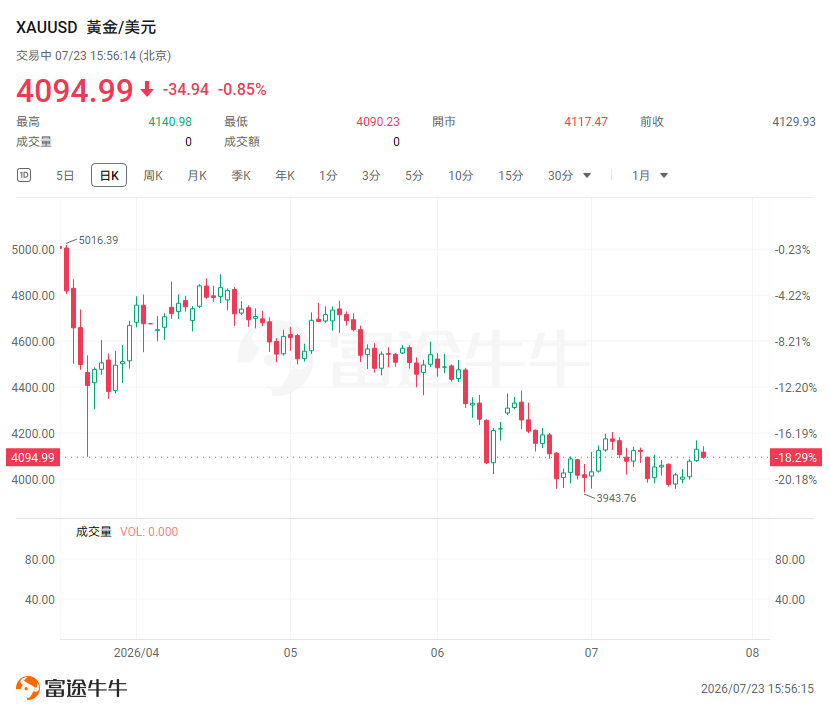
Escalating U.S.-Iran tensions have driven oil prices sharply higher once again, yet the usual inverse relationship between oil and gold—often referred to as the 'oil-gold seesaw'—appears to have broken down recently. Gold prices have staged a strong breakout from recent lows, with international spot gold briefly reclaiming the $4,100 per ounce mark, marking a rare instance this year of simultaneous gains in both oil and gold. Institutional analysts note that after sustained net outflows, trading capital has finally returned to gold, driving its recent recovery.
Following former U.S. President Trump’s announcement on July 8 that the Memorandum of Understanding was no longer valid, U.S.-Iran tensions flared anew, heightening geopolitical risks. As a result, maritime traffic through the Strait of Hormuz plummeted, nearly coming to a standstill. International crude oil prices rebounded from recent lows, with WTI crude futures rising from $68 per barrel to approximately $89 per barrel.
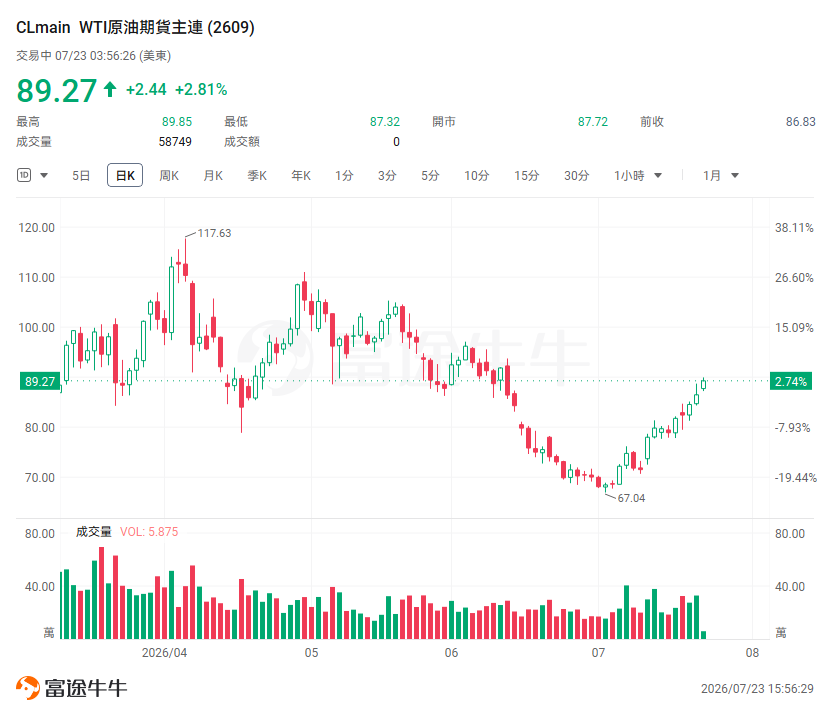
 According to a research report by Cinda Futures, crude oil is expected to maintain a highly volatile upward trajectory, with a core trading range of $78–$90/barrel. The direction will hinge on whether the conflict escalates further to target energy infrastructure. If diplomatic talks resume before the memorandum expires on August 16 and maritime restrictions ease, oil prices could retreat downward.
During the U.S.-Iran conflict escalation in March, surging oil prices alongside broad-based declines in other major asset classes left a deep impression on global investors. Gold, in particular, defied its traditional safe-haven logic; instead, the narrative that 'inflation would dampen—and even reverse—market expectations for Fed rate cuts' dominated, triggering a sharp sell-off in gold from its peak. By end-June, international gold prices had fallen below $4,000/ounce, marking a decline of nearly 30% from their highs.
Notably, the classic 'oil-gold seesaw' appears to have失效 recently. As crude oil prices resumed their upward move, gold quietly began to rebound as well, resulting in a rare 'oil-and-gold rally' this year. After holding above the $4,000 level last week, COMEX gold futures posted consecutive gains this week, reclaiming the $4,100/ounce threshold. Technically, gold has now broken decisively above its 5-day, 10-day, and 20-day moving averages.
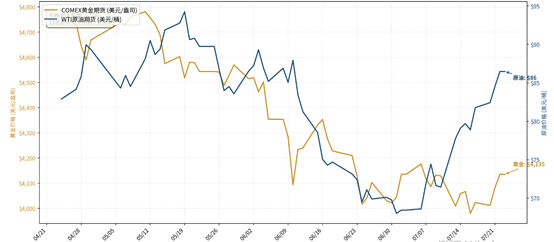
The Fixed Income & Multi-Asset Research Team at Industrial Securities further noted that gold has become significantly desensitized to bearish signals and is showing diminishing sensitivity to 'real interest rates,' its traditional pricing anchor. Rate hike trades continued this week, yet gold prices refused to decline.
Next week, the Federal Reserve will hold its July policy meeting. According to the CME Group’s 'FedWatch Tool,' the probability of at least one rate hike by the conclusion of the September policy meeting has risen to nearly 80%, while the yield on the 30-year U.S. Treasury bond has approached 5.20%.
The Fixed Income & Multi-Asset Research Team at Industrial Securities believes the core reason for gold’s muted reaction to bearish catalysts lies in shifting capital allocation, with tactical funds re-entering long positions in gold. Capital is flowing back into gold for several reasons: first, short positions were thoroughly cleared in the first half of the year, enabling contrarian repositioning—with global gold ETFs recording net outflows of 84.3 tonnes in March and 73.9 tonnes in June; second, global tech stocks have transitioned from one-sided rallies to range-bound trading at elevated levels, reducing their capital-absorbing effect; and third, the bearish impact of potential rate hikes may already be priced in.
As of July 22, the holdings of SPDR Gold Trust, the world’s largest gold ETF, stood at 1,007.87 metric tons, reflecting a net increase of 8.85 metric tons this week.
The FICC team at Zhejiang Commercial Bank expects limited downside potential for precious metals. Since June, both gold and platinum have shown signs of stabilization, and outflows from gold ETFs have slowed. Moreover, gold priced at USD 4,000 demonstrates significantly stronger resilience and appeal than at USD 5,000; investors are advised to patiently await the next market move.
Although trading positions have been partially rebuilt, the sustainability of gold’s upward momentum remains to be tested. Guotai Junan Futures notes that the bullish trend exhibits strong continuity; if gold stabilizes above USD 4,100 per ounce, it could target USD 4,200–4,250 per ounce—only a decisive breakout would warrant following the long-side momentum. In the absence of new catalysts, prices are likely to face downward pressure, making逢 high short-biased strategies the baseline approach.
The Fixed Income & Multi-Asset Research Team at Industrial Securities believes gold is likely to remain in a wide trading range in the near term, with no clear window for going long yet open. A sustained uptrend may not emerge until after September, with the key variable being whether the Federal Reserve can deliver a dovish signal.
Editor/rice