Escalating tensions in the Middle East have reignited concerns over energy-driven inflation, pushing government bond yields higher across Europe and the United States. The yield on Germany's 10-year bund hit its highest level since 2011, while the 10-year U.S. Treasury yield approached 4.69%. Markets swiftly repriced interest rate expectations: the European Central Bank is widely expected to hold rates steady at its Thursday meeting, though analysts note a surprise rate hike cannot be ruled out. Bets are rising that the Federal Reserve will deliver at least two more rate hikes before March next year.
Global bond markets faced another wave of sell-offs. As tensions in the Middle East continued to escalate, oil prices resumed their upward trend, rapidly heightening market concerns about a resurgence of energy-driven inflation. This pushed sovereign bond yields higher across Europe and the United States and prompted investors to reassess the future interest rate trajectories of major central banks.
On Thursday, Germany's 10-year Bund yield rose by 3 basis points to 3.21%, reaching its highest level since 2011. Meanwhile, the U.S. 10-year Treasury yield climbed intraday to 4.68%, approaching the 4.69% peak seen shortly after the outbreak of the Middle East conflict. At the same time, traders have fully priced in expectations for two additional 25-basis-point rate hikes by the European Central Bank (ECB) this year, while bets on the Federal Reserve restarting rate hikes in early next year continue to intensify.
 The core driver behind this reversal in market sentiment is the re-emergence of energy-related risks as the dominant inflation narrative. The escalating conflict between the U.S. and Iran, coupled with diminishing expectations for the swift resumption of normal shipping through the Strait of Hormuz, has reignited supply-side anxiety.
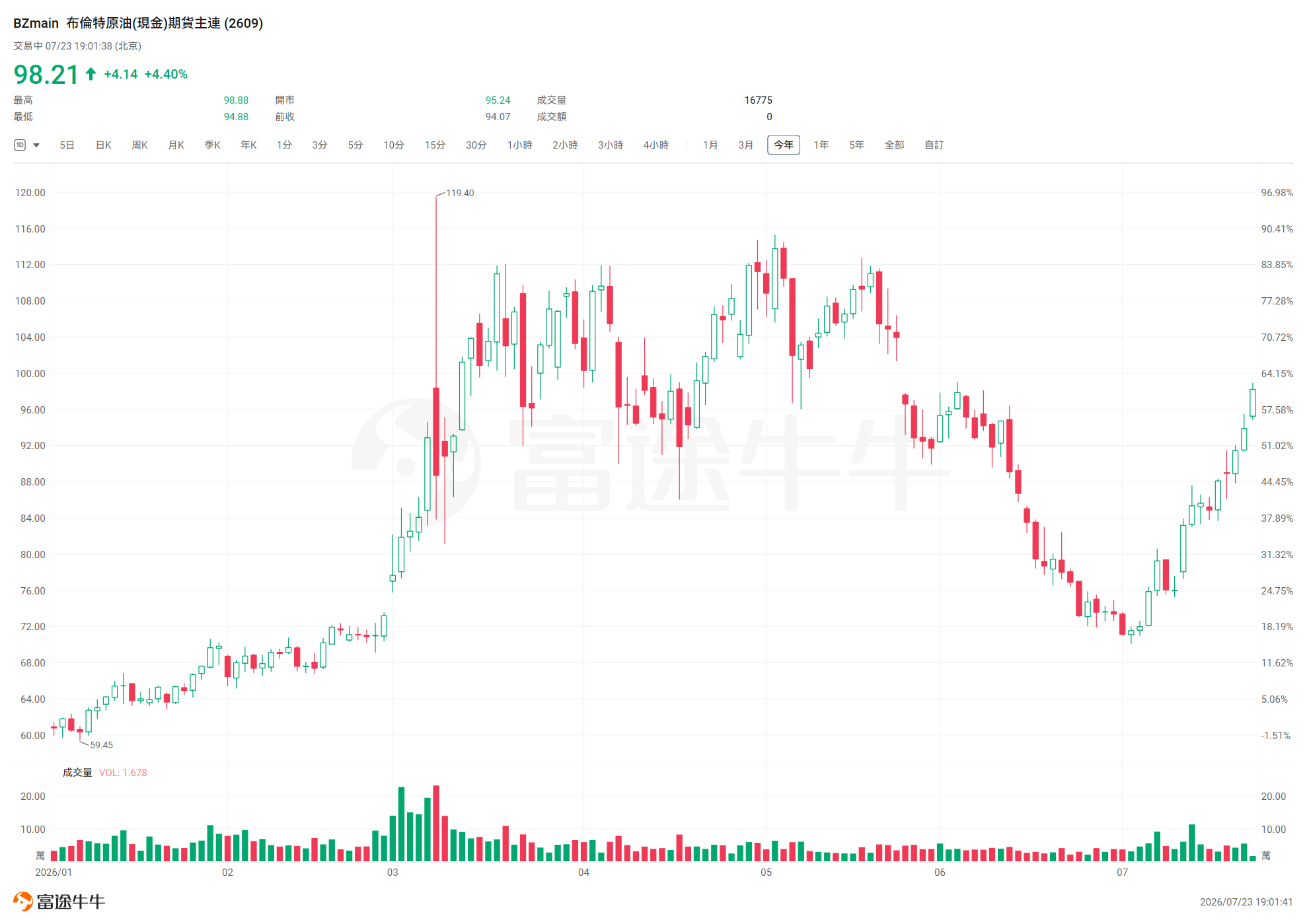
According to Xinhua News Agency, Yemen's Houthi forces stated in the early hours of the 23rd local time that they had attacked two Saudi oil tankers in the Red Sea, claiming the vessels violated the group's recently announced maritime blockade. This announcement significantly heightened market concerns over potential crude oil supply disruptions, driving Brent crude prices up nearly 5% during Thursday’s trading session.
Rising oil prices fuel inflation expectations, driving global bond yields to multi-year highs
This week, government bond yields in major advanced economies generally climbed to multi-year highs. France’s 10-year OAT yield breached 4% for the first time since 2009, while the UK’s 10-year gilt yield rose by 5 basis points to 5.08%—still below its May peak but remaining elevated.
German Bunds have become the focal point of this sell-off. Since early July, the 10-year Bund yield has moved almost in lockstep with the rapid rise in Brent crude prices from above $70 per barrel, reflecting the market’s renewed pricing-in of long-term inflation risks stemming from higher energy costs.
Mike Bell, Chief Market Strategist at RBC BlueBay Asset Management, remarked that investors had hoped the Strait of Hormuz issue would be resolved quickly, but such expectations were overly optimistic from the outset. 'Sticking your head in the sand won’t help you manage geopolitical risk.'
Surging energy prices sharply intensify expectations for ECB rate hikes
Despite the sharp rise in oil and natural gas prices, the European Central Bank is expected to keep its deposit rate unchanged at 2.25% at its policy meeting on Thursday, as it seeks to assess the impact of the Middle East situation on the economy and inflation.
However, market expectations for further policy tightening have clearly intensified. According to Bloomberg, ING strategist Francesco Pesole noted that the possibility of a surprise rate hike cannot be entirely ruled out. He pointed out that a further deterioration in the Middle East situation, combined with European natural gas prices rising faster than crude oil, could reinvigorate the hawkish stance within the ECB Governing Council.
Joachim Nagel, a member of the ECB Governing Council and President of the Deutsche Bundesbank, previously stated that energy price trends would be a key variable determining the inflation outlook ahead, and that the central bank must remain vigilant. This week, European natural gas prices have risen to their highest level since 2023, further reinforcing market bets on another ECB rate hike.
Rapid reversal in Fed policy expectations
U.S. markets have likewise experienced a significant shift in policy expectations.
According to the Financial Times, interest rate derivatives markets indicate that investors now expect the Federal Reserve to raise rates at least twice—by 25 basis points each time—before March next year. Just prior to the outbreak of the Middle East conflict, the prevailing market expectation was for continued rate cuts.
In his first FOMC meeting as the newly appointed Fed Chair last month, Kevin Warsh struck a hawkish tone, stating that further rate hikes would be implemented if necessary and emphasizing that policy decisions would be guided by the inflation target rather than external political pressures.
Meanwhile, short-term U.S. inflation expectations continue to rise. On Thursday, the one-year inflation swap rate climbed to 4.15%, its highest level since January 2025. Jon Hill, head of U.S. inflation strategy at Barclays, remarked that while markets have raised their expectations for rate hikes, inflation expectations are still increasing—suggesting that this bout of inflationary pressure may not be resolvable through monetary policy alone.
Diminished strategic petroleum reserve buffers fuel ongoing market concerns
Compared with previous episodes of rising oil prices, what worries investors more about the current energy shock is that the policy tools available to governments to stabilize oil prices are dwindling.
According to the Financial Times, the Bank of England warned in its latest Financial Stability Report that if the situation in the Middle East deteriorates further, policy tools such as releases from strategic petroleum reserves—which previously served as effective buffers—may now offer only very limited support.
Although Brent crude remains below the $126-per-barrel peak reached in May, persistently rising bond yields indicate that investors have begun preparing for more persistent energy-driven inflation. As diesel, gasoline, and natural gas prices rise in tandem, the energy shock is gradually transmitting to broader segments of the economy.
Want to select stocks or get a stock diagnosis? Curious about the opportunities and risks in your portfolio? For all your investment questions,Just ask Futubull AI!

Editor/Deng