
Market Snapshot
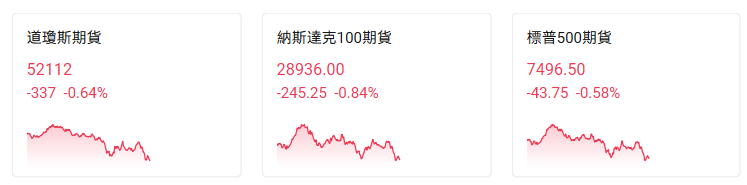
U.S. stock index futures all declined in pre-market trading on Thursday. As of the time of writing, Dow Jones Industrial Average futures were down 0.64%, Nasdaq 100 futures fell 0.84%, and S&P 500 futures dropped 0.58%.
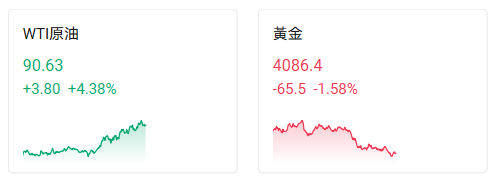
Tensions between the U.S. and Iran remain high. S&P Global noted that insurance costs for shipping through the Strait of Hormuz have surged following attacks on tankers. The Houthi group announced a blockade of Saudi Red Sea ports, which could directly trigger another round of oil price increases, pushing WTI crude up by more than 4%.
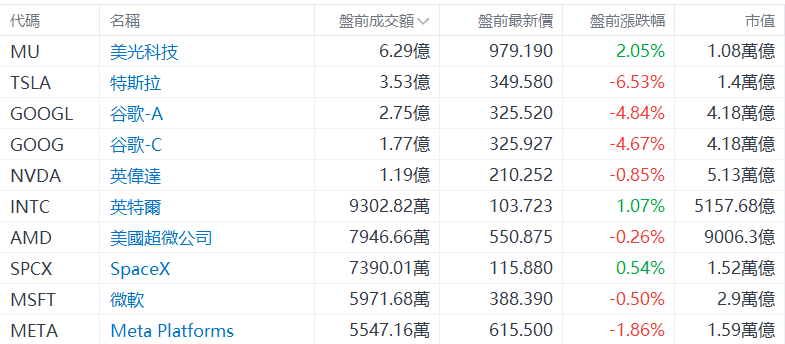
$Star Tech Stocks (LIST2518.US)$Most stocks declined in pre-market trading: Tesla fell over 6%, Google dropped nearly 5%, Meta declined almost 2%, NVIDIA slipped close to 1%, while Micron Technology rose over 2% and Intel gained more than 1%.
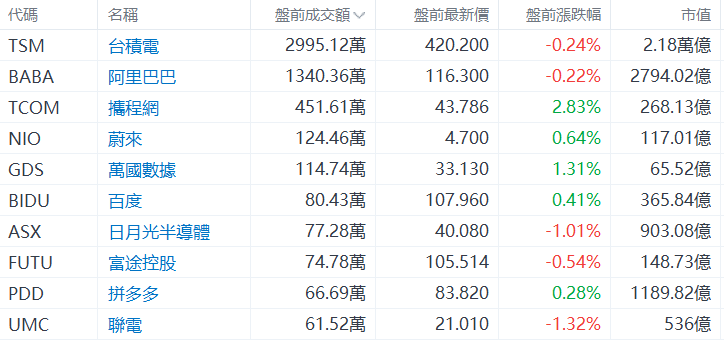
 $Popular Chinese ADRs (LIST2517.US)$Most stocks advanced, with Trip.com rising nearly 3%, GDS Holdings up over 1%, Nio gaining close to 1%, PDD Holdings edging slightly higher, and Alibaba dipping marginally.
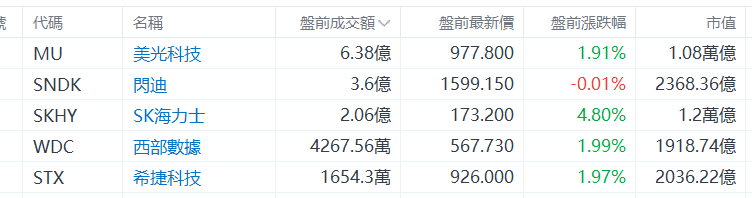
$Storage Concept (LIST23925.US)$ Leading pre-market gainers included SK Hynix, up nearly 5%, and Western Digital, Micron Technology, and Seagate Technology, each rising close to 2%.
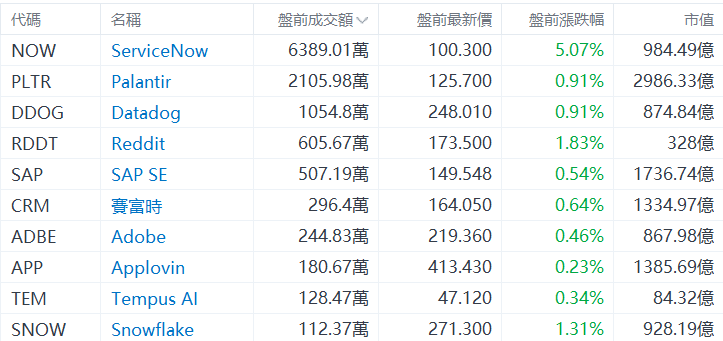
$AI Application Software Stocks (LIST23492.US)$Most software stocks rose in pre-market trading: ServiceNow climbed over 5%, Reddit gained nearly 2%, Snowflake rose more than 1%, and Salesforce, Palantir, and Datadog each increased by approximately 1%. On the news front, Morgan Stanley stated that market pessimism toward the software sector has been overdone.
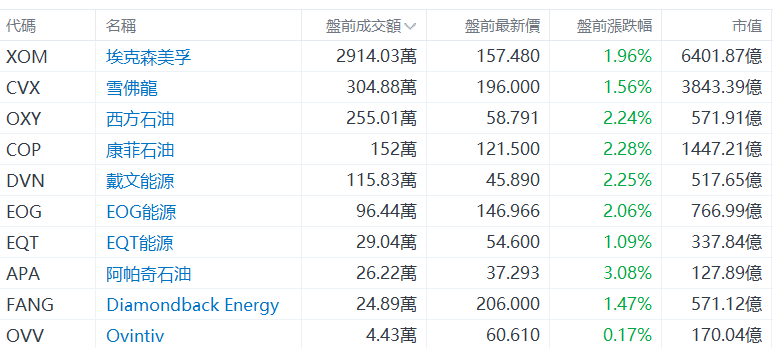
$Shale Oil (LIST2585.US)$Energy stocks rose across the board in pre-market trading: Apache Corporation gained over 3%, Occidental Petroleum, Devon Energy, and ConocoPhillips each rose more than 2%, and Exxon Mobil and Chevron both advanced nearly 2%.
Individual Stock News
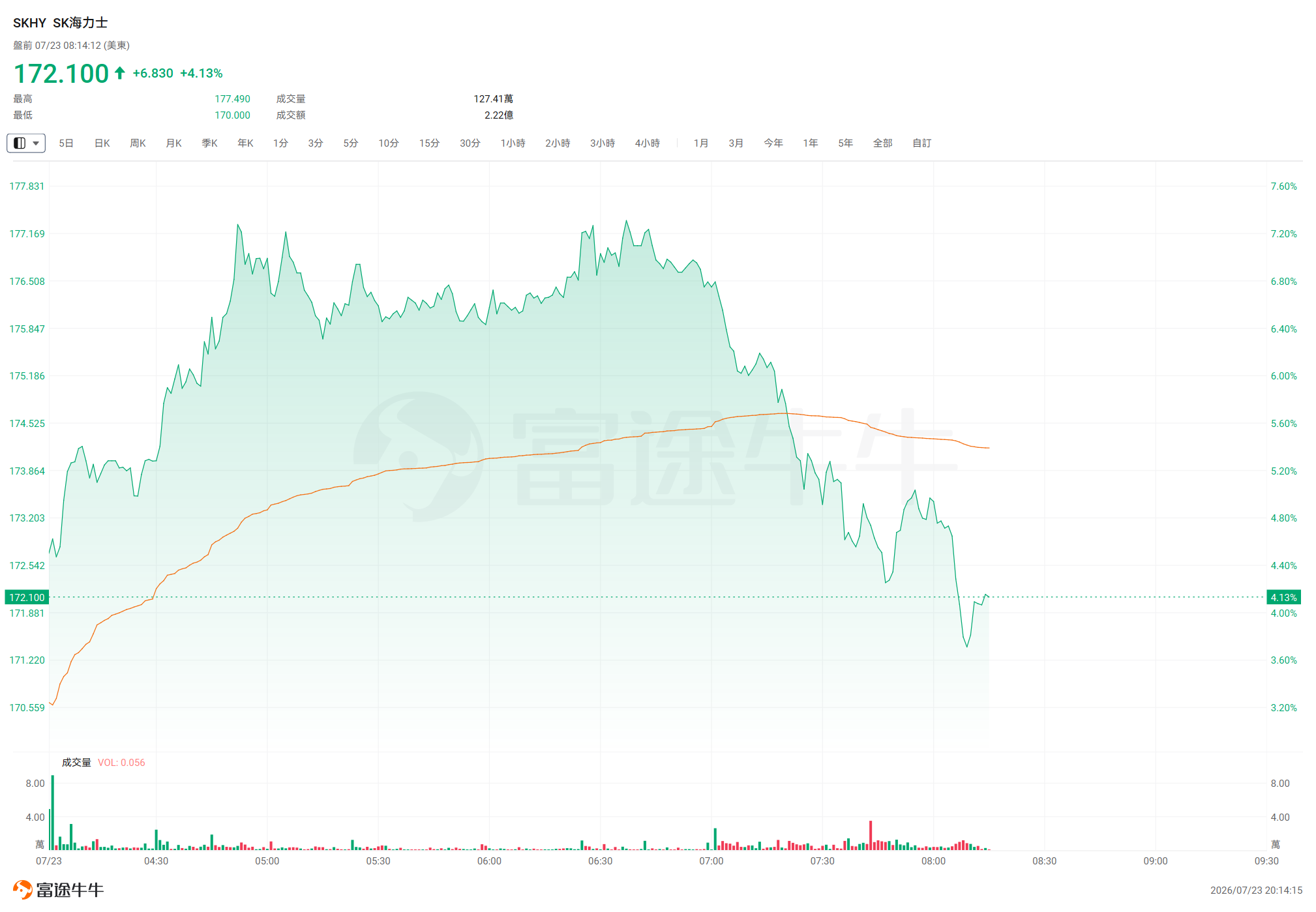
SK Hynix rose over 4% in pre-market trading after reports indicated the company had set a cap of 2.5% on the ratio of its Korean shares convertible into American Depositary Receipts (ADRs).
Rhee Yunsu, CEO of the Korea Securities Depository (KSD), explicitly stated that SK Hynix has limited the total number of its locally listed Korean shares eligible for conversion into ADRs to 2.5% of its total outstanding shares. Rhee noted that this cap was effectively filled upon completion of SK Hynix’s $26.5 billion ADR issuance on July 10.$SK Hynix (SKHY.US)$Unless existing holders voluntarily convert their positions back into locally listed Korean shares—thereby freeing up capacity—external investors cannot package their Korean-listed shares into ADRs for sale on U.S. markets.
Google: SpaceX stake valued at $94 billion, with approximately $80 billion subject to short-term lock-up agreements
Google-C (GOOG.US)Disclosure documents stated that following$SpaceX (SPCX.US)$the completion of its IPO, its holdings include $94.1 billion worth of SpaceX shares. Google was an early investor in SpaceX, a position that has helped boost the company's profits in recent quarters as SpaceX's share price continued to rise.
Google stated that $80 billion of its holdings are subject to short-term lock-up restrictions, while $14.1 billion will remain restricted until the third quarter of next year. Alphabet, Google’s parent company, also holds stakes in Anthropic. The company said on Wednesday that Alphabet’s investment portfolio gained nearly $100 billion in value during the second quarter, contributing to higher net income.
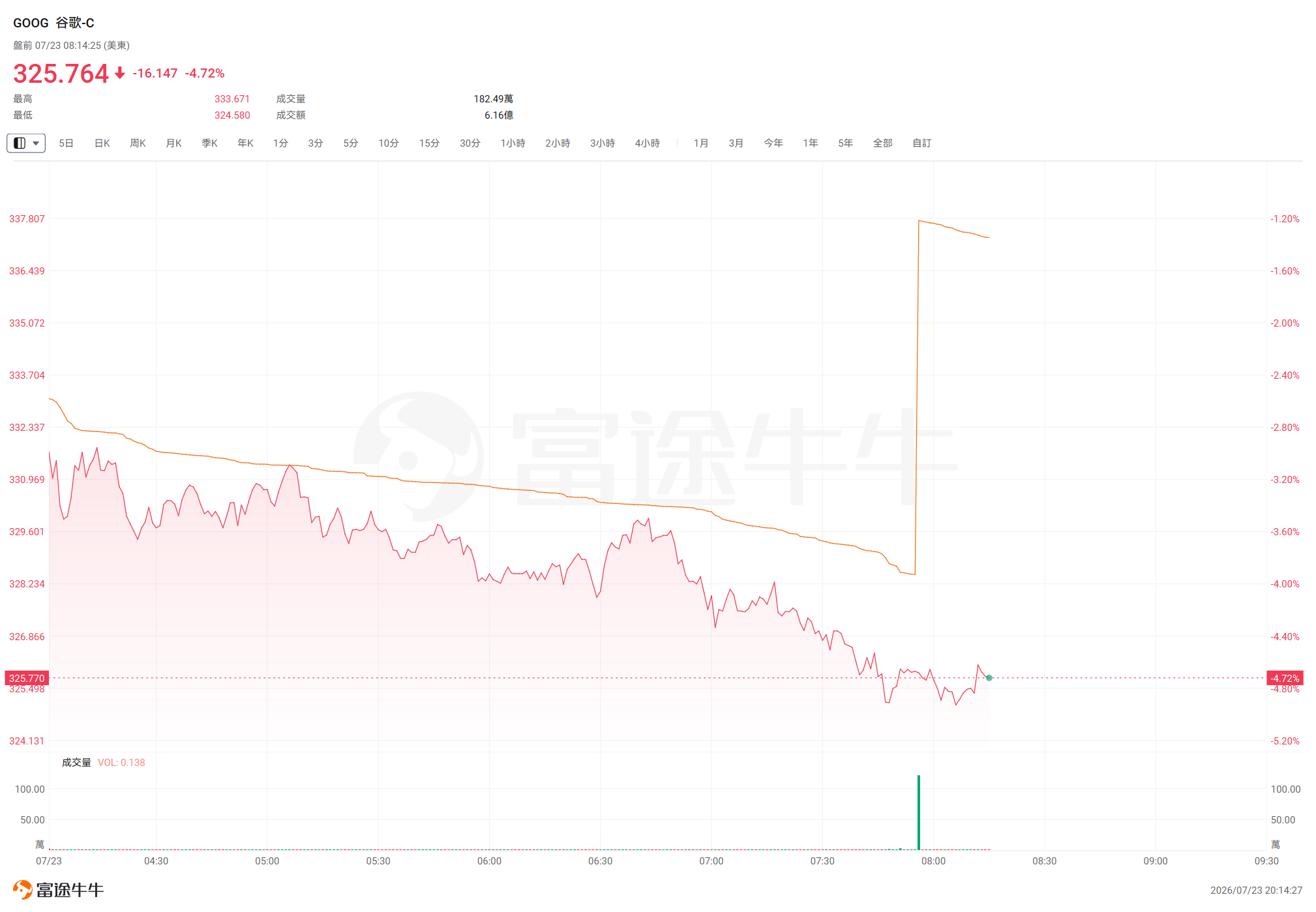
Google fell nearly 5% in pre-market trading as free cash flow turned negative for the first time in decades, and the company raised its full-year capital expenditure guidance
For the second quarter ended June 30,Google-A (GOOGL.US)revenue reached $119.796 billion, up 24% year-over-year; up 23% on a constant-currency basis, marking the 12th consecutive quarter of double-digit revenue growth. Operating profit increased by 30% year-over-year to $40.77 billion, with operating margin improving by 2 percentage points to 34%.
Free cash flow for the quarter turned negative at -$5.855 billion due to significantly higher capital expenditures, though free cash flow over the past 12 months still amounted to $53.273 billion. Google raised its full-year capital expenditure guidance to between $195 billion and $205 billion, up from the previous range of $180 billion to $190 billion. Following the announcement, markets expressed concerns about whether such substantial capital spending would generate commensurate returns.
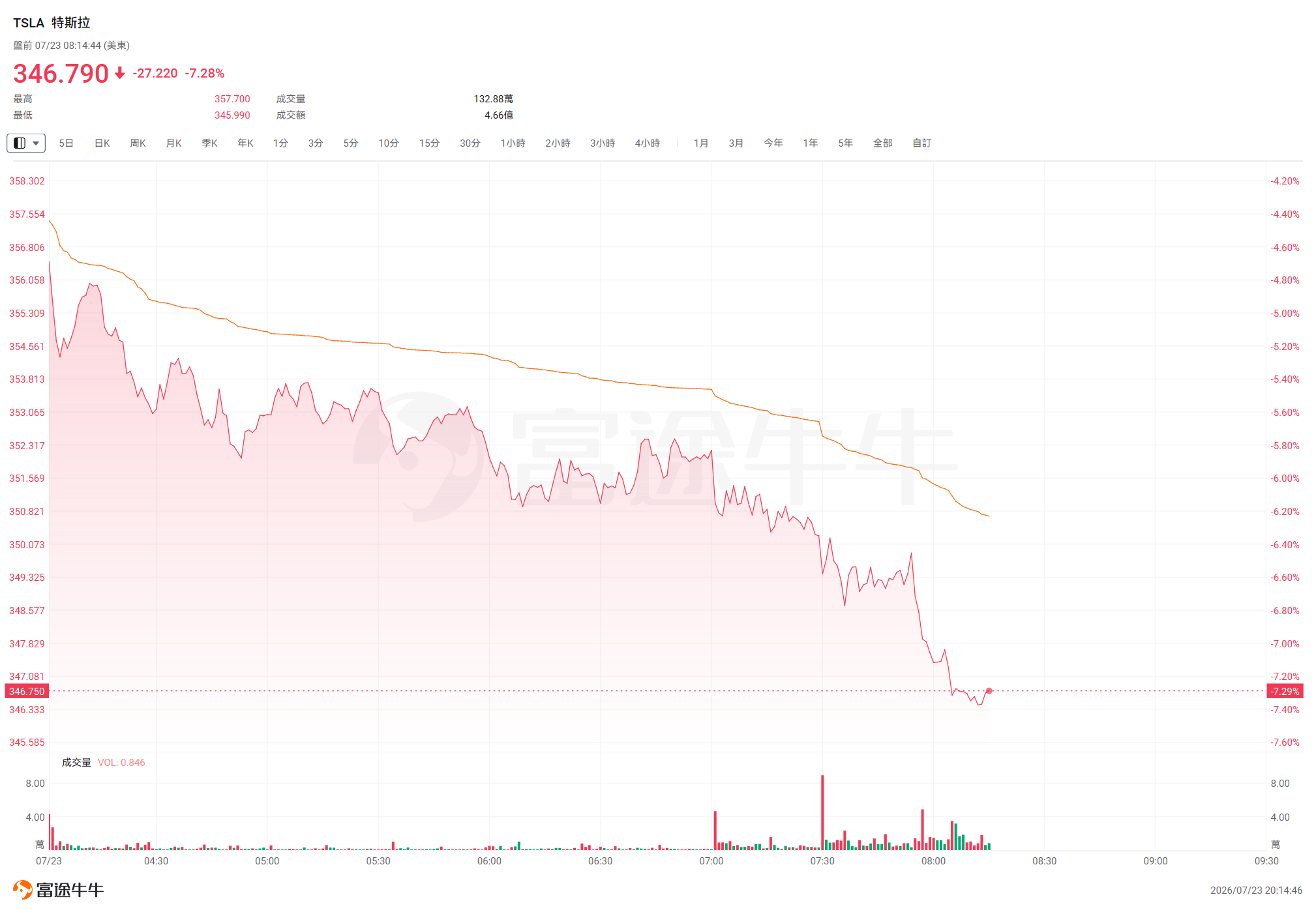
Tesla dropped more than 7% after reporting a 26% year-over-year increase in Q2 revenue but an 18% decline in earnings, far below expectations
after U.S. market hours on Wednesday, July 22 (Eastern Time),$Tesla (TSLA.US)$Second-quarter 2026 revenue reached $28.236 billion, exceeding analyst expectations by more than 7% and marking the first time in three years that year-over-year revenue growth surpassed 20%. This was partly driven by record vehicle deliveries for the quarter in the company’s history. Over the trailing 12 months through the end of the quarter, Tesla’s cumulative revenue surpassed $100 billion for the first time, underscoring continued expansion of its core business.
Tesla’s adjusted earnings per share (EPS) for the second quarter declined 18% year-over-year to $0.33, falling more than 35% below analyst expectations. Gross margin for the quarter stood at 16.8%, below the anticipated 19.4%. Operating profit dropped 57% year-over-year to just $398 million, amounting to less than one-third of market expectations. In other words, although Tesla sold more products and services and generated higher revenue, the efficiency with which each dollar of revenue translated into profit fell significantly short of Wall Street’s expectations.
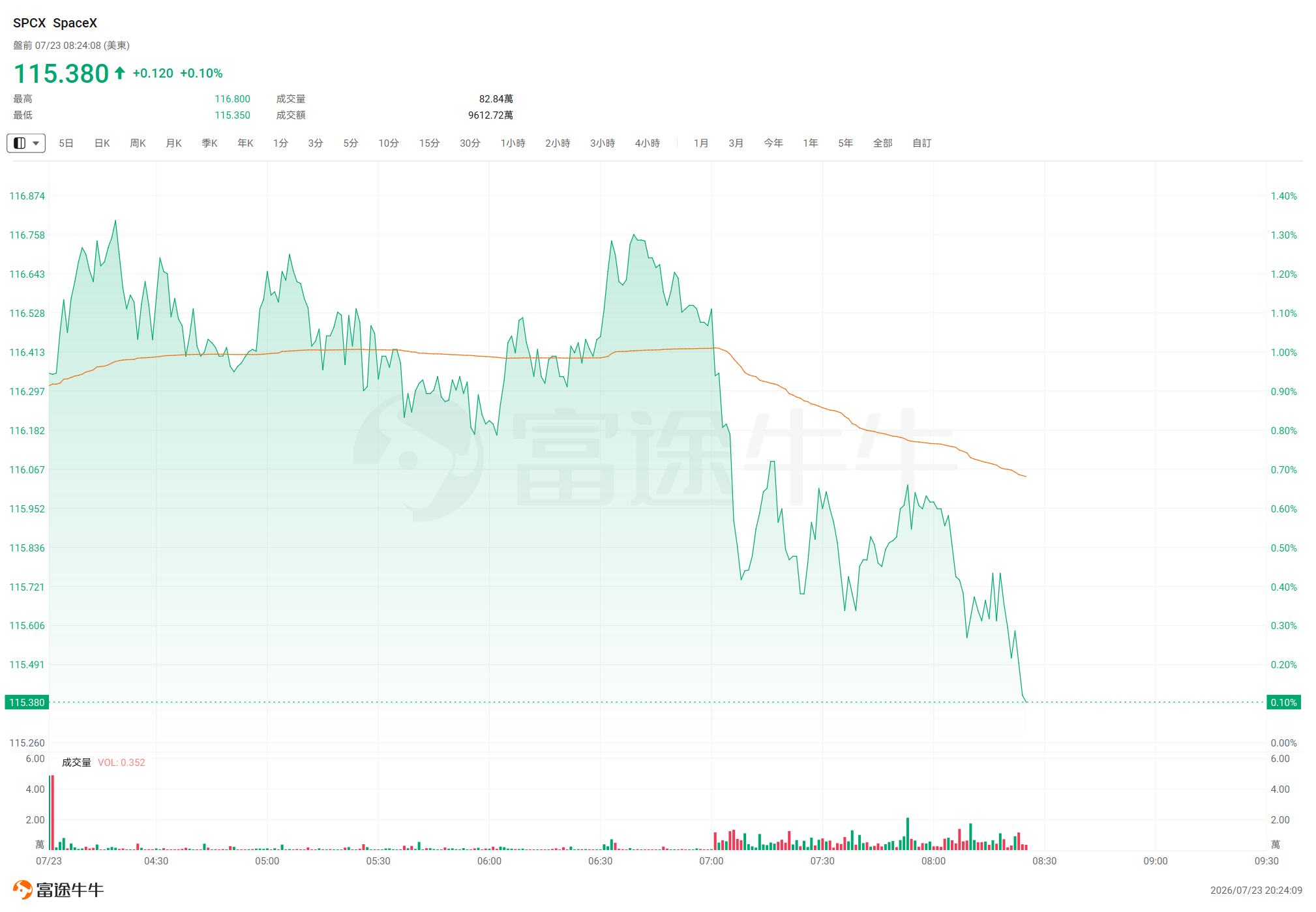
Countdown to SpaceX Starship’s 13th Test Flight
After abandoning a launch attempt last week,$SpaceX (SPCX.US)$It will attempt another critical test of its massive Starship rocket at 5:45 p.m. local time on Thursday. The event will force investors to confront the risks inherent in the company’s turbulent development cycle and further heighten attention on this pivotal milestone.
This Starship flight test marks the rocket’s 13th flight and is SpaceX’s first test flight since completing the largest IPO in history in June. For this 13th Starship test flight, what capital markets truly care about is not merely whether the mission will ultimately be labeled a ‘success’ or a ‘partial success,’ but rather whether previously identified issues have been resolved and whether Starship is gradually approaching operational readiness after successive rounds of testing.
BlackRock: Chip Stock Sell-Off Has Gone Too Far
Over the past few weeks,SanDisk (SNDK.US)、Micron Technology (MU.US)chip stocks have gone from being Wall Street’s biggest AI winners to suffering the steepest declines. However, BlackRock, the world’s largest asset manager, believes investors may have misjudged the situation.
BlackRock stated that the recent sharp sell-off in technology and semiconductor stocks constitutes an 'overreaction' and warned that markets are conflating 'a shift in the AI competitive landscape' with 'a collapse in AI investment.' BlackRock noted that robust economic growth and sustained earnings expansion support its continued 'overweight' stance on U.S. equities and recommended that investors focus on AI bottleneck sectors such as power infrastructure, semiconductors, and data centers.
Morgan Stanley: Market pessimism toward the software sector is overdone; names Microsoft and Palo Alto Networks as overweight positions.
A Morgan Stanley research report indicated that the market’s recent pessimism toward the software sector has become excessive. Although the AI wave has channeled capital flows toward chips, cloud infrastructure, and cybersecurity, software companies’ long-term competitiveness and business models remain attractive. Morgan Stanley maintains its positive view on the software sector and specifically highlighted$Microsoft (MSFT.US)$、$Palo Alto Networks (PANW.US)$、$CrowdStrike(CRWD.US)$、$Cloudflare(NET.US)$、$Datadog(DDOG.US)$, 、 $ServiceNow(NOW.US)$、$Snowflake(SNOW.US)$and$Shopify(SHOP.US)$It is the most confident overweight recommendation for the AI era.
In a recent report, Morgan Stanley analyst Adam Wood introduced the Moat & Journey analytical framework to evaluate software companies’ long-term growth potential and competitive advantages based on two dimensions: economic moat and AI adoption journey. He believes that the aforementioned eight companies—characterized by strong market positions, sustainable revenue models, and AI monetization capabilities—are the most compelling long-term investment opportunities for investors.
Nokia reports 8% year-over-year growth in Q2 net sales, with operating profit exceeding expectations.
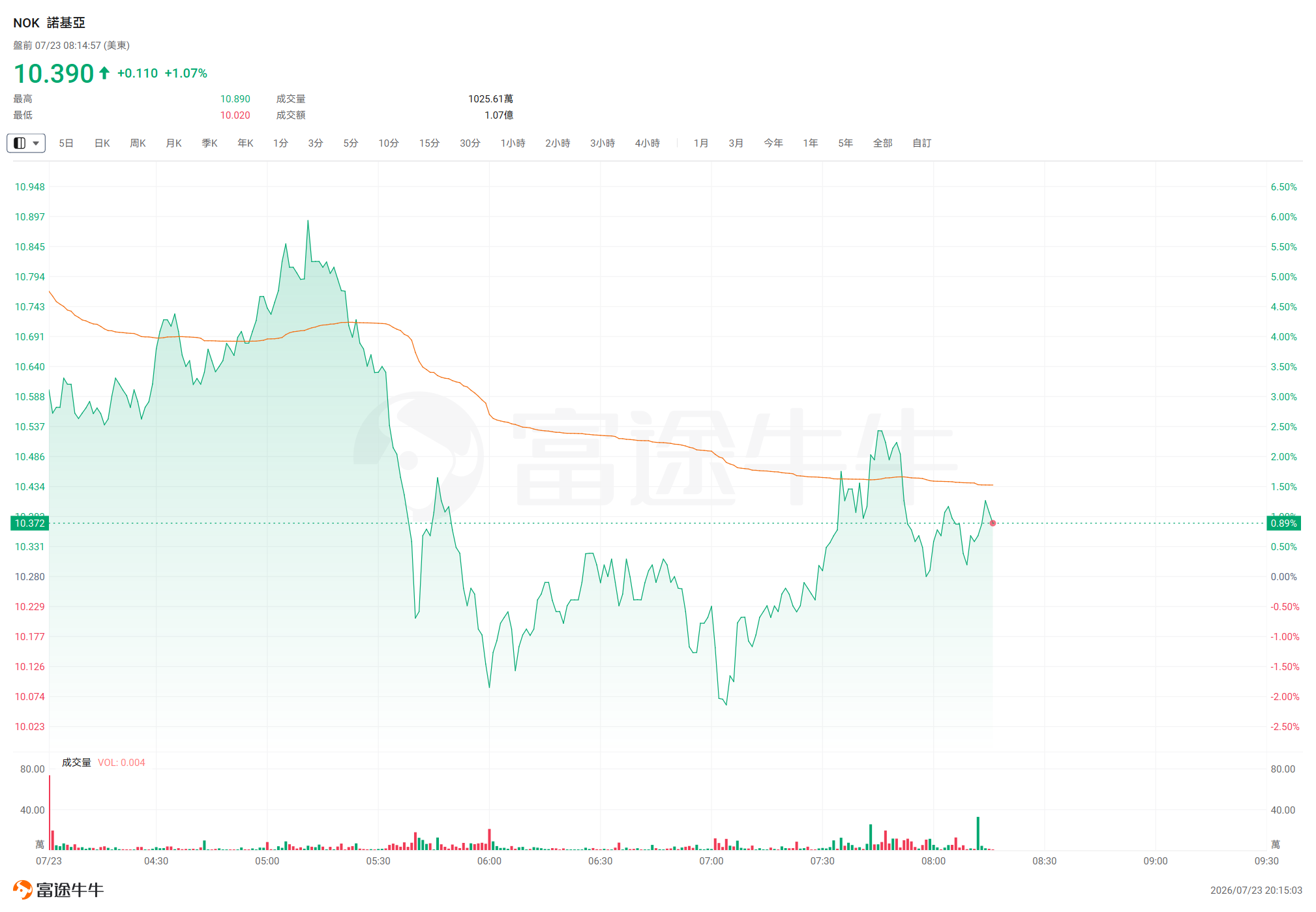
Nokia (NOK.US)Second-quarter revenue rose 8% year-over-year to €4.8 billion; operating profit increased 18% year-over-year to €434 million, surpassing the market expectation of €382 million, primarily driven by demand from AI and cloud customers. During the quarter, network infrastructure sales grew 12% year-over-year on a constant currency basis, while sales to AI and cloud customers surged by 105%.
Nokia has raised its full-year comparable operating profit guidance from €2.0–2.5 billion to €2.1–2.6 billion. CEO Justin Hotard stated that the strong second-quarter performance demonstrates the effectiveness of the company’s strategy, and with positive momentum heading into the second half of the year, comparable operating profit is expected to be slightly above the midpoint of the updated guidance range.
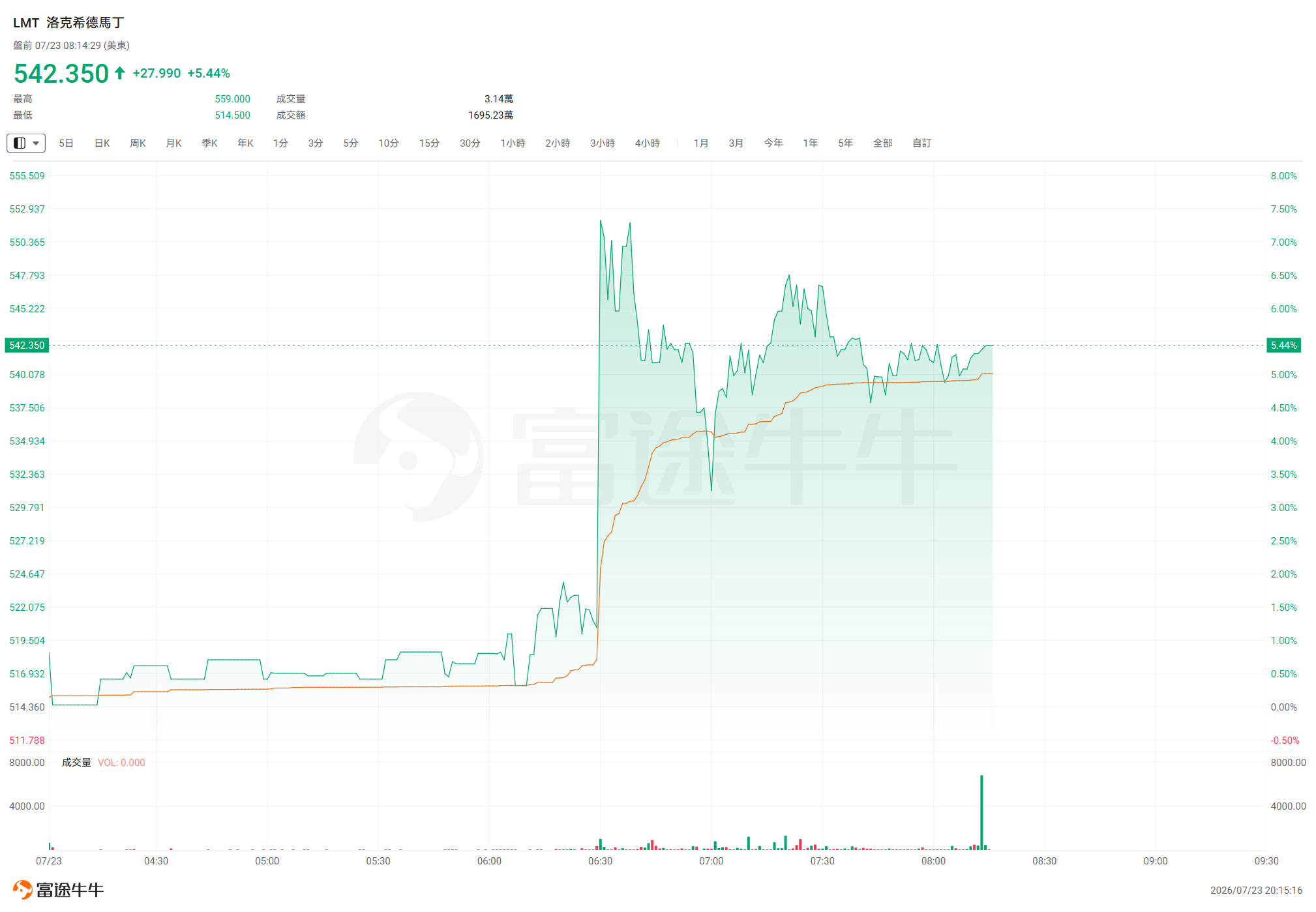
Lockheed Martin shares rose more than 5% in pre-market trading after reporting Q2 sales of $20.063 billion and raising its full-year 2026 revenue and earnings-per-share outlook.
$Lockheed Martin (LMT.US)$Q2 sales amounted to $20.063 billion, compared to $18.155 billion in the same period last year; earnings per share were $7.94, versus $1.46 in the prior-year period. The company raised its full-year 2026 sales forecast to $79.75–81.75 billion, up from the previous range of $77.5–80.0 billion, and increased its full-year 2026 EPS guidance to $29.95–30.65, compared to the earlier estimate of $29.35–30.25.
Blackstone reports 26% profit growth, benefiting from AI-related investments.
Blackstone (BX.US) Second-quarter distributable earnings rose 26% year-over-year, supported by asset sales and gains from artificial intelligence-related investments. Blackstone’s Q2 distributable earnings—the amount available to shareholders—reached $1.97 billion, exceeding analysts’ consensus estimate of $1.66 billion. Earnings per share stood at $1.52, above the average analyst forecast of $1.33.
In an interview, the president of Blackstone stated that artificial intelligence investments continue to drive Blackstone's performance, with nine out of its top ten portfolio holdings related to data centers, energy, power, and large language models.
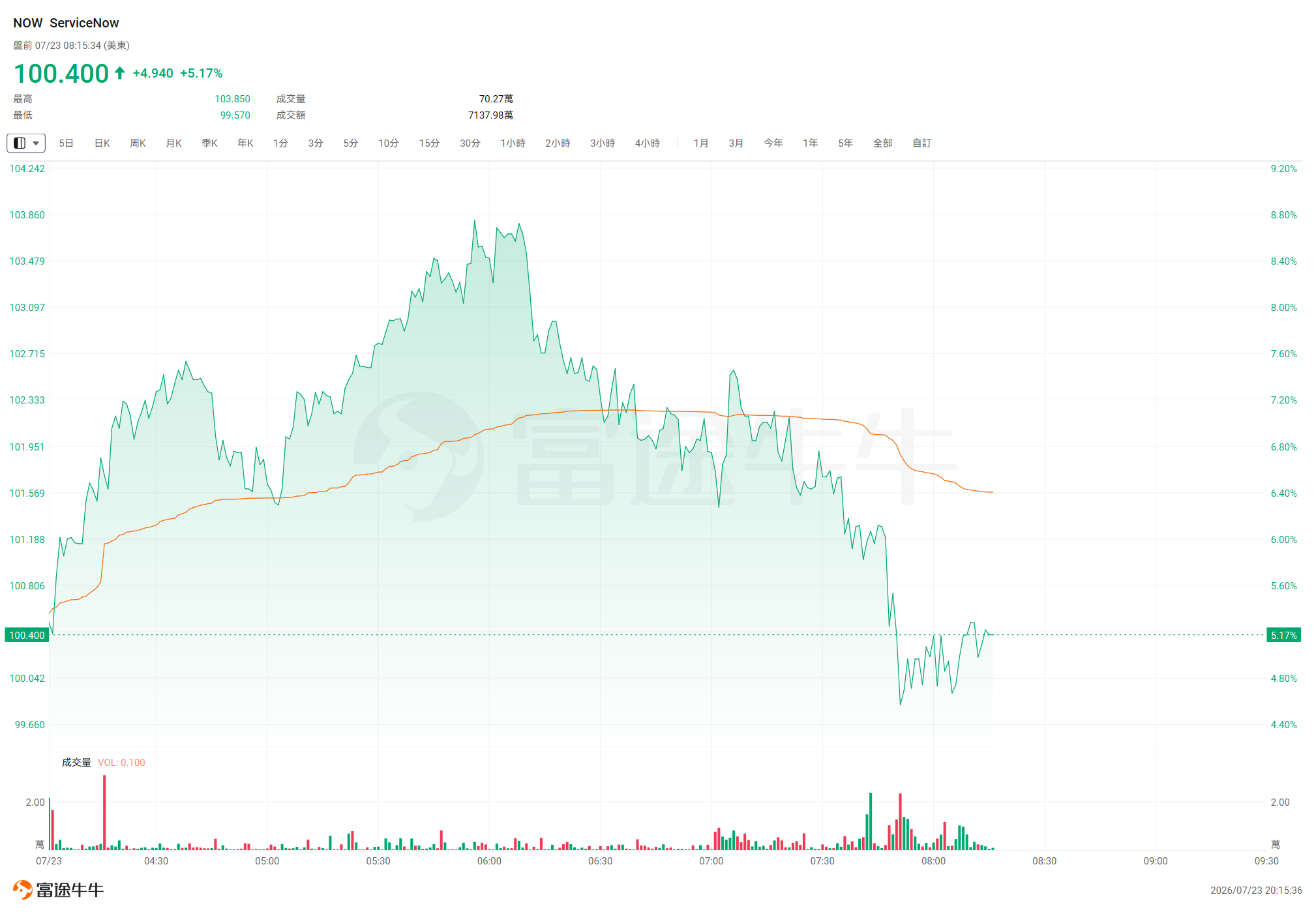
ServiceNow rises more than 5% in pre-market trading after raising its full-year subscription revenue outlook; Morgan Stanley remains bullish on the software sector.
$ServiceNow(NOW.US)$The company reported strong second-quarter results, with subscription revenue increasing 24.5% year-over-year to $3.88 billion; adjusted earnings per share came in at $0.90, exceeding the market consensus estimate of $0.85. Current remaining performance obligations (cRPO), a key metric for future revenue, grew 21% to $13.2 billion, while total remaining performance obligations reached $29 billion. ServiceNow has raised its full-year subscription revenue guidance and now expects it to be in the range of $15.76 billion to $15.78 billion, representing an increase of approximately 22.5%.
Additionally, a Morgan Stanley research report noted that recent market pessimism toward the software sector has been overdone. Although the AI wave has directed capital flows toward chips, cloud infrastructure, and cybersecurity, software companies’ long-term competitiveness and business models remain attractive. Morgan Stanley maintains its favorable view of the software sector and highlighted Microsoft, Palo Alto Networks, CrowdStrike, Cloudflare, Datadog, ServiceNow, Snowflake, and Shopify as its top overweight picks in the AI era.
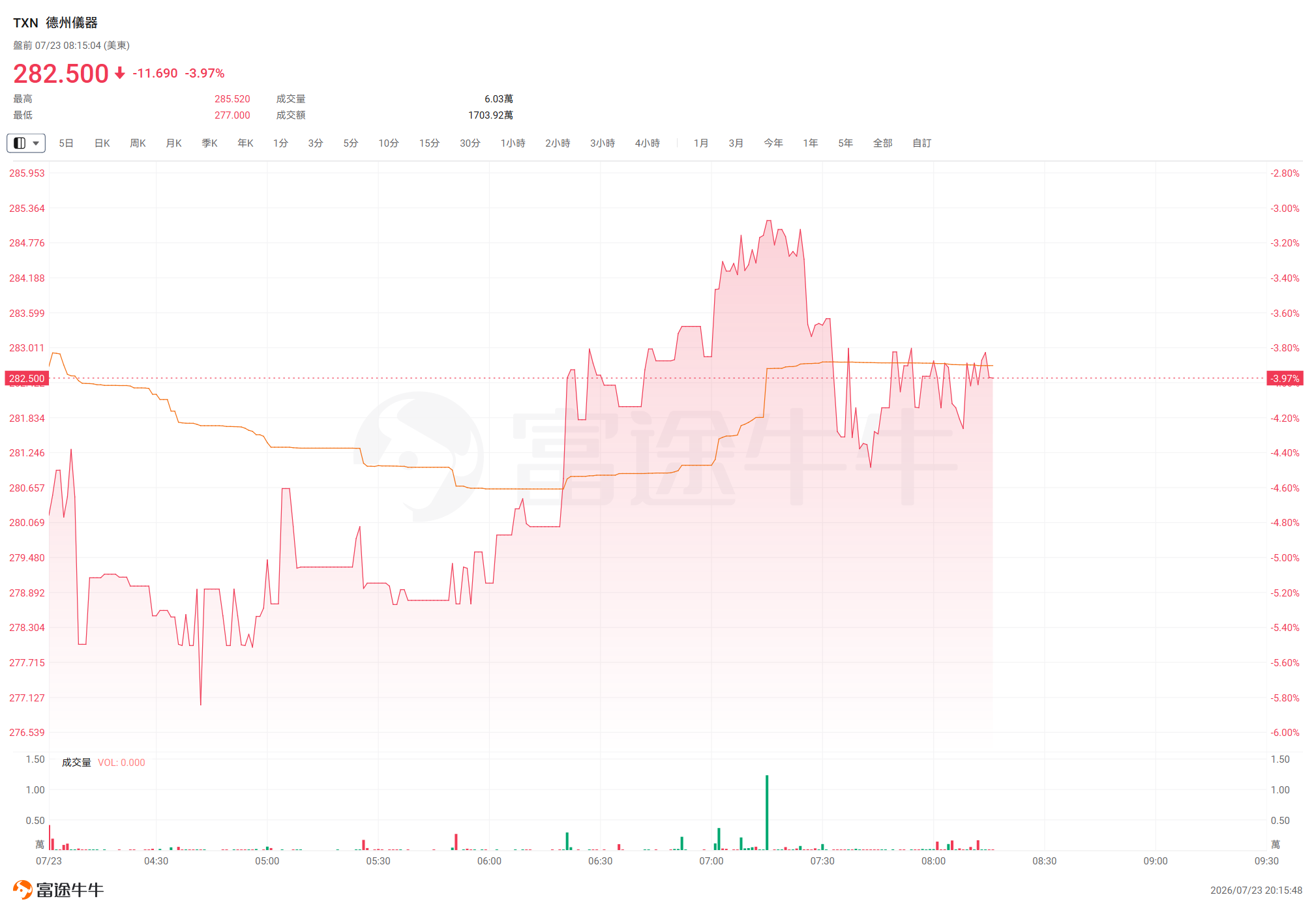
Strong earnings become a profit-taking signal? Texas Instruments falls nearly 4% in pre-market trading.
Texas Instruments (TXN.US)Second-quarter revenue rose 23% year-over-year to $5.46 billion, surpassing the market expectation of $5.24 billion; earnings per share came in at $2.14, also exceeding market forecasts. The company expects third-quarter revenue to be between $5.65 billion and $6.15 billion, compared with the consensus analyst estimate of $5.62 billion, according to compiled market data.
Analysts note that the post-earnings stock decline is primarily due to a 'sell-the-news' effect. Despite both second-quarter results and third-quarter guidance exceeding market expectations, the stock—already up more than 70% year-to-date—had likely priced in these positive developments in advance.
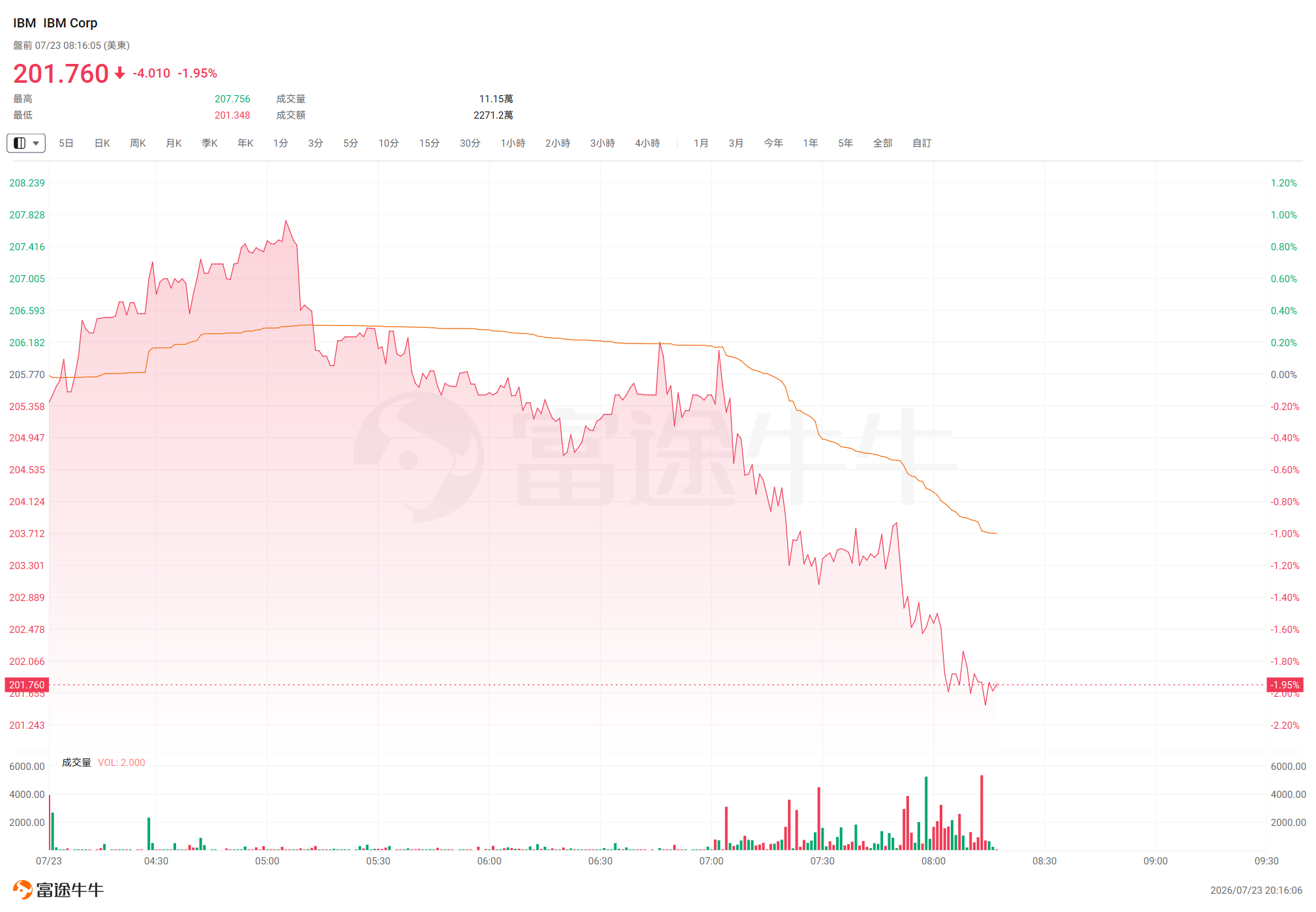
IBM to acquire HRL Laboratories to advance its quantum computing ambitions.
$IBM Corp (IBM.US)$IBM announced today that it has signed a definitive agreement to acquire HRL Laboratories, LLC (HRL), a premier research and development organization. HRL is a privately held company jointly owned by Boeing and General Motors. Following the transaction’s completion, Boeing and General Motors will continue collaborating with IBM on quantum applications and advanced technology development. Financial terms of the deal were not disclosed. The acquisition is subject to customary closing conditions and regulatory approvals and is expected to close by the end of the third quarter of 2026.
Eli Lilly and Co: Retatrutide demonstrated significant weight loss efficacy, achieving primary endpoints across all Phase III trials.
Eli Lilly and Co (LLY.US),Plans are in place to submit a Biologics License Application (BLA) for Retatrutide to the U.S. Food and Drug Administration (FDA) in the first quarter of 2027. Retatrutide demonstrated significant weight loss effects and met its primary endpoints in all Phase III trials.
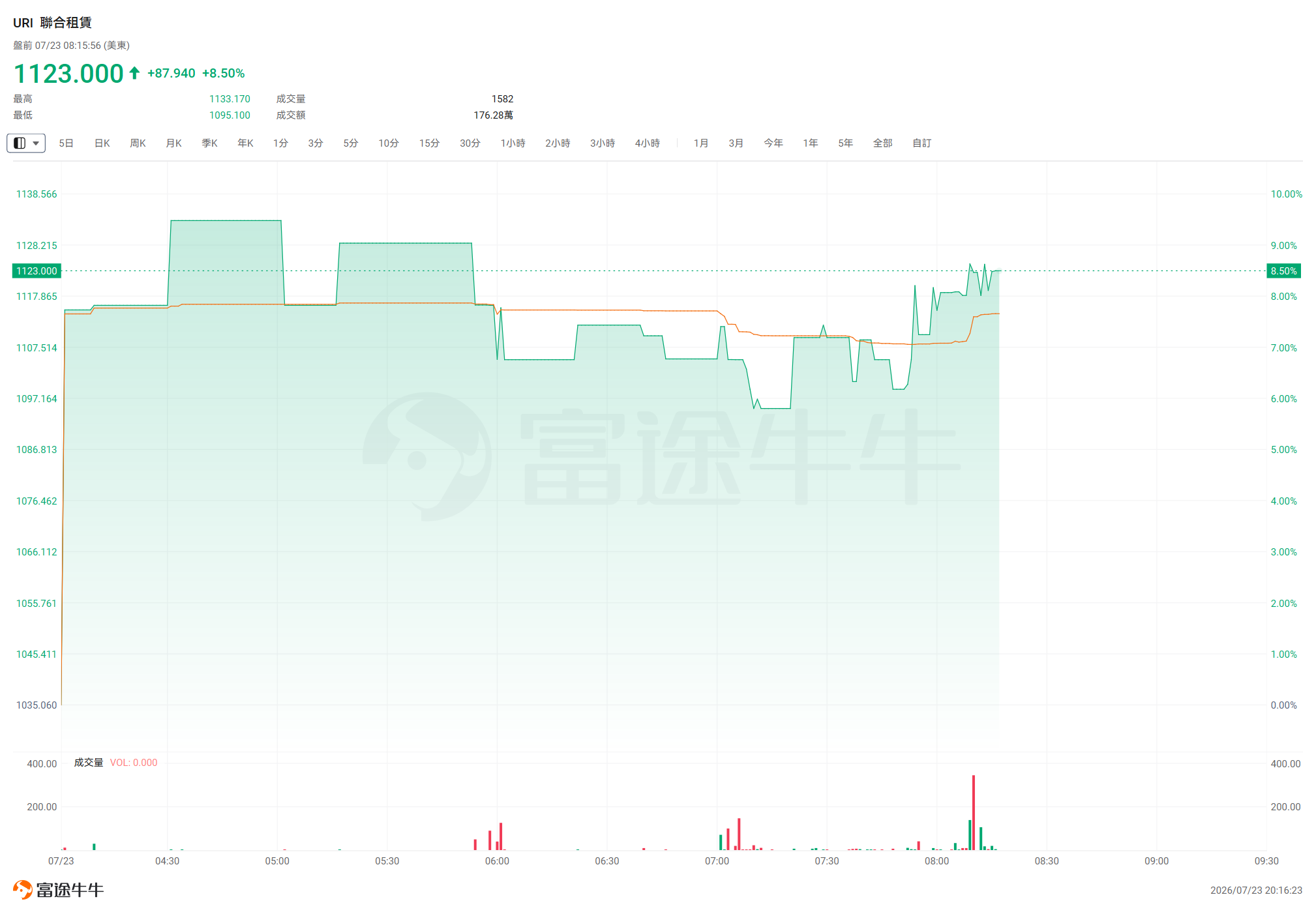
United Rentals surged more than 8% in pre-market trading after reporting stellar earnings and raising guidance.
$United Rentals (URI.US)$Second-quarter revenue increased by 11.8% year-over-year, and adjusted earnings per share rose by 21.9%, a notable acceleration from the 9.6% growth recorded in Q1. Core rental revenue reached $3.849 billion, up 12.7% year-over-year, marking a quarterly record. The company raised its full-year fiscal 2026 revenue outlook to $17.5–17.8 billion, up from the prior range of $16.9–17.4 billion. Analysts had expected $17.27 billion.
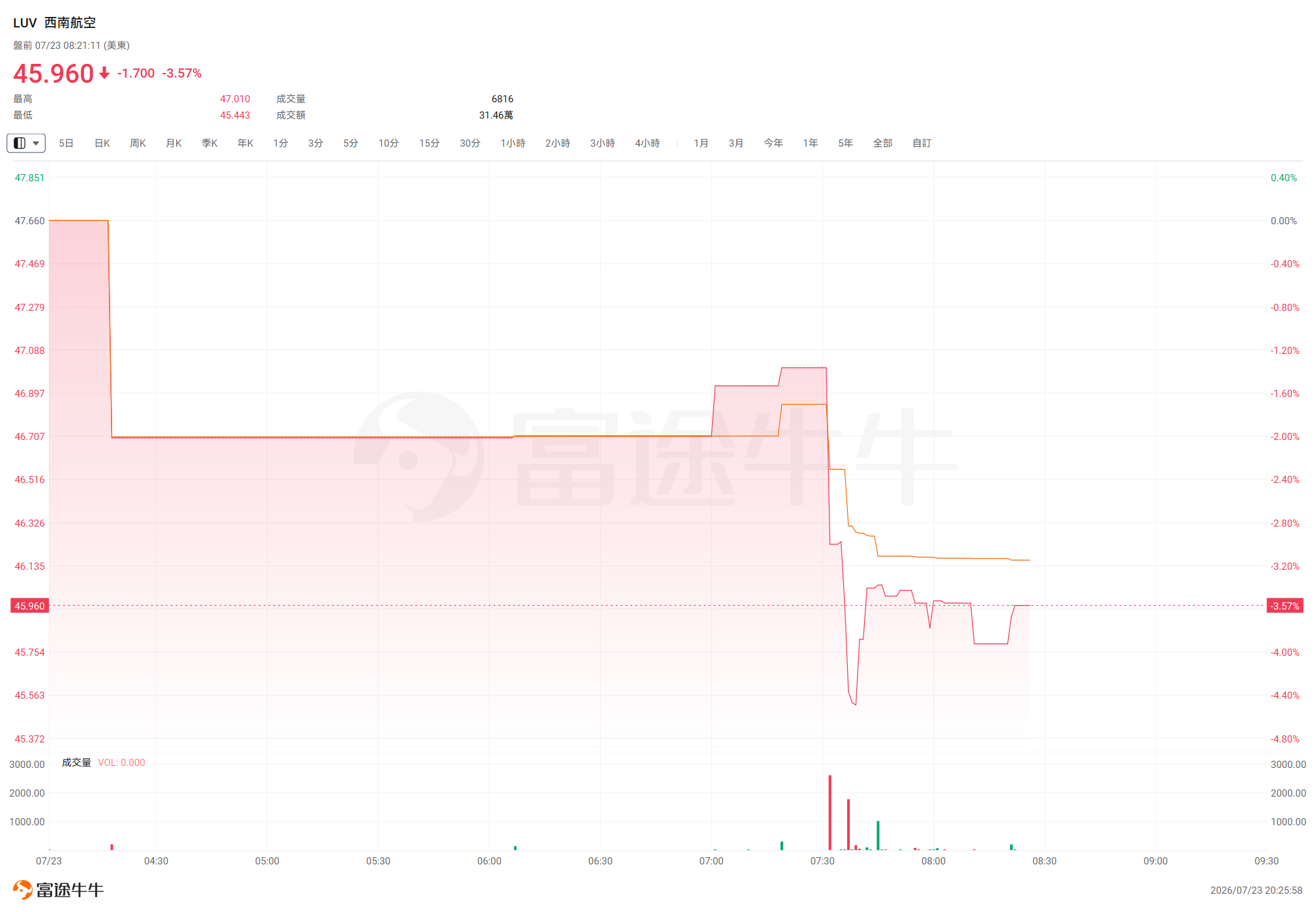
Southwest Airlines reported mixed Q2 results but provided full-year EPS guidance above expectations.
$Southwest Airlines(LUV.US)$Q2 revenue rose 16.4% year-over-year to $8.43 billion, below the market consensus estimate of $8.58 billion; adjusted earnings per share came in at $0.94, significantly exceeding the market expectation of $0.51. For the third quarter, Southwest Airlines expects adjusted EPS to be between $0.50 and $0.75, compared with the market consensus of $0.80. For full-year 2026, the company projects adjusted EPS in the range of $3.25 to $4.25, above the market estimate of $3.13.
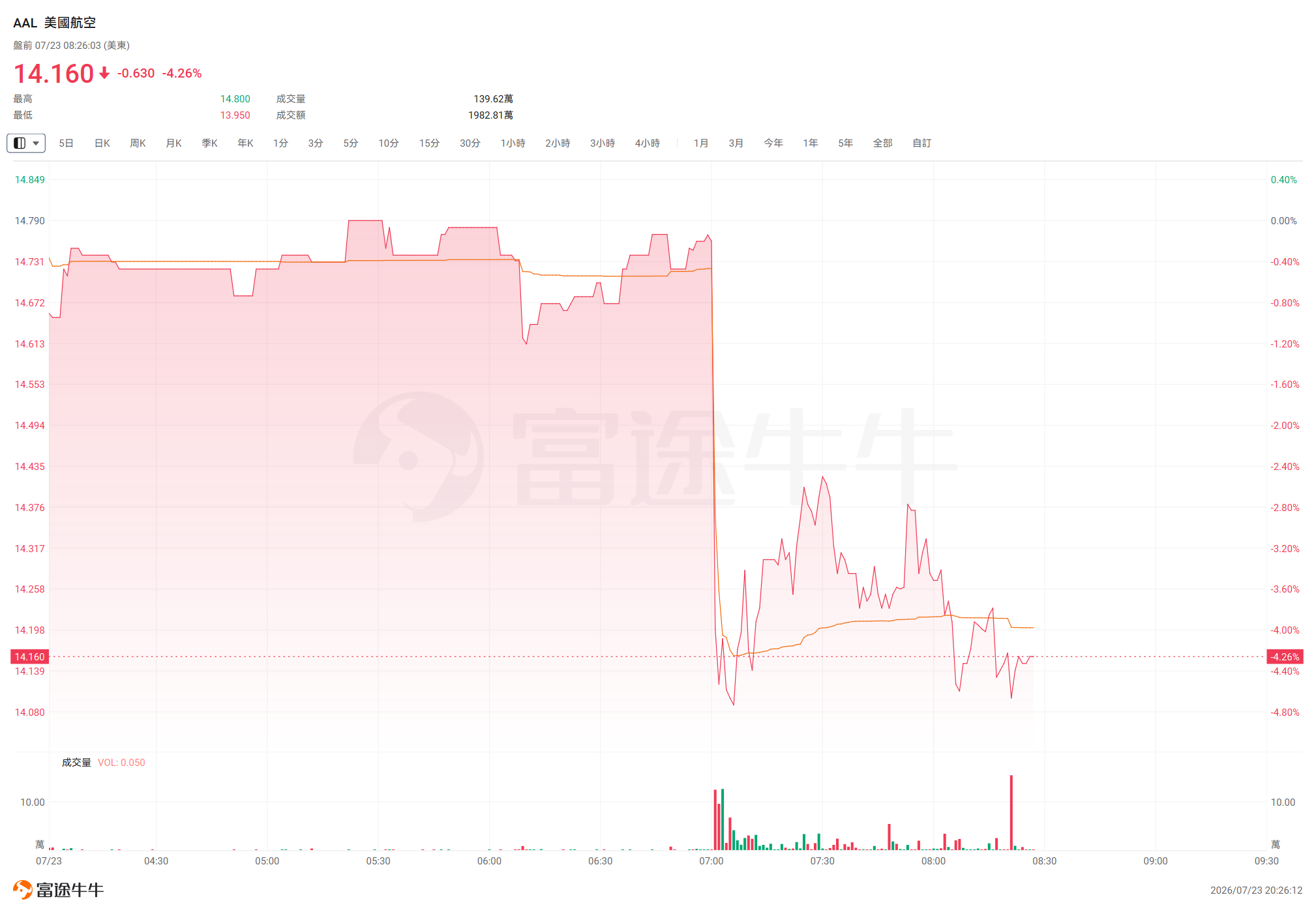
American Airlines reported Q2 results that beat expectations, but its Q3 profit guidance fell short of forecasts.
$American Airlines (AAL.US)$Second-quarter revenue totaled $16.735 billion, surpassing the market expectation of $16.707 billion; adjusted earnings per share were $0.15, well above the consensus forecast of $0.03. The company’s fuel expenses in the second quarter increased by over $2.2 billion, an 83% year-over-year rise. American Airlines now expects third-quarter adjusted EPS to range from -$0.70 to -$0.10, compared with the market consensus of $0.28. As of this report, American Airlines shares fell nearly 4% in Thursday’s pre-market trading.
Global Macro
Trump Clarifies U.S.-Saudi Nuclear Deal: Civilian-Use Only, No Enrichment; Saudi Arabia Must First Join the Abraham Accords
Former U.S. President Trump posted on a social media platform: “The civil nuclear agreement between the U.S. Department of Energy and Saudi Arabia—which involves no enrichment of materials!—is solely for non-military purposes, such as those already possessed by Iran, the UAE, and other countries, and will be approved, but entirely contingent upon Saudi Arabia joining the highly respected and successful Abraham Accords. The United States does not oppose civilian (non-enrichment) nuclear facilities.”
Rubio: Iran is pleading daily for a deal.
U.S. Secretary of State Rubio stated: “It appears Iran is not yet ready to reach an agreement. Iran pleads with us every day to strike a deal. With each passing night, the cost to Iran continues to rise until they come to their senses.”

Oil tankers in the Red Sea hit by missiles for the first time; alternative shipping routes disrupted, oil prices surge
Crude oil prices surged sharply after Iran-backed Houthi militants stated they had attacked two Saudi Arabian oil tankers in the Red Sea. The move has intensified conflict in the Middle East and threatens deeper supply disruptions. Earlier this week, the Houthis issued threats to block Saudi maritime traffic in the Red Sea. This waterway has become an increasingly vital alternative export route for Saudi Arabia to bypass the Strait of Hormuz, and escalating tensions now jeopardize the flow of millions of barrels of crude oil per day to global customers.
On the 22nd, international market intelligence firm Kpler posted on social media that shipping volumes through both the Strait of Hormuz and the Bab el-Mandeb Strait—two critical international energy transport corridors—declined on the 21st. Simultaneous pressure on both straits, combined with shrinking inventory buffers and rising refining constraints, could further weigh on the global economic recovery through energy-related shocks.
The 'Fed’s favorite inflation gauge' to be revised, bolstering the case for pausing rate hikes
The U.S. Bureau of Economic Analysis (BEA) plans to revise its methodology for calculating the Personal Consumption Expenditures (PCE) price index, covering three categories: portfolio management fees, computer software, and legal services. The BEA announced the revision plan on June 24, and the new methodology will take effect on September 30. Market participants expect the revised core PCE inflation rate to decline by 0.2 to 0.3 percentage points compared to previous figures.
Currently, over the 12 months through May, the core PCE price index rose 3.4% year-over-year; after the adjustment, this figure could fall to 3.2% or even 3.1%. This change may provide additional support for Federal Reserve officials inclined to pause rate hikes, though it is insufficient to alter the reality that inflation remains above target. The Fed aims to bring annual inflation down to 2%, and regardless of whether the pre- or post-adjustment methodology is used, core PCE remains significantly above this level.
S&P: As tanker attacks intensify, shipping insurance costs in the Strait of Hormuz surge
According to an S&P Global Energy report, shipping insurance costs in the Strait of Hormuz have surged as a new wave of tanker attacks has made underwriters increasingly reluctant to provide coverage. War risk premiums have risen to 7.5%–10% of a vessel’s hull value, up from 1%–3% just a few weeks ago. Meanwhile, some tanker operators are remaining outside the strait, unwilling to risk passage. S&P noted that commercial activity remains severely limited, with only 10 vessels transiting the Strait of Hormuz on Tuesday—compared to over 130 per day before the outbreak of conflict in the Middle East.
Ministry of Commerce: China and the U.S. are soliciting feedback on tariff reduction arrangements and will expedite implementation.
At a State Council Information Office press conference held on the 23rd, Meng Huating, Director-General of the Department of Foreign Investment at China’s Ministry of Commerce, responded to questions regarding progress on the establishment of a U.S.-China Trade Council and Investment Council. She stated that the trade teams from both countries are currently engaged in close communication on specific arrangements concerning the councils’ structure, functions, and operational models, and are also exploring the implementation of reciprocal tariff reduction frameworks each valued at approximately USD 30 billion.
China is actively soliciting feedback on the proposed tariff reductions from domestic enterprises, industry associations, local governments, and U.S.-owned business associations. The United States is also seeking public comments on the Trade Council and the reciprocal tariff reduction framework. Both sides will maintain close communication to finalize specific product-level tariff reduction arrangements as soon as possible and advance their implementation, thereby further expanding bilateral trade.
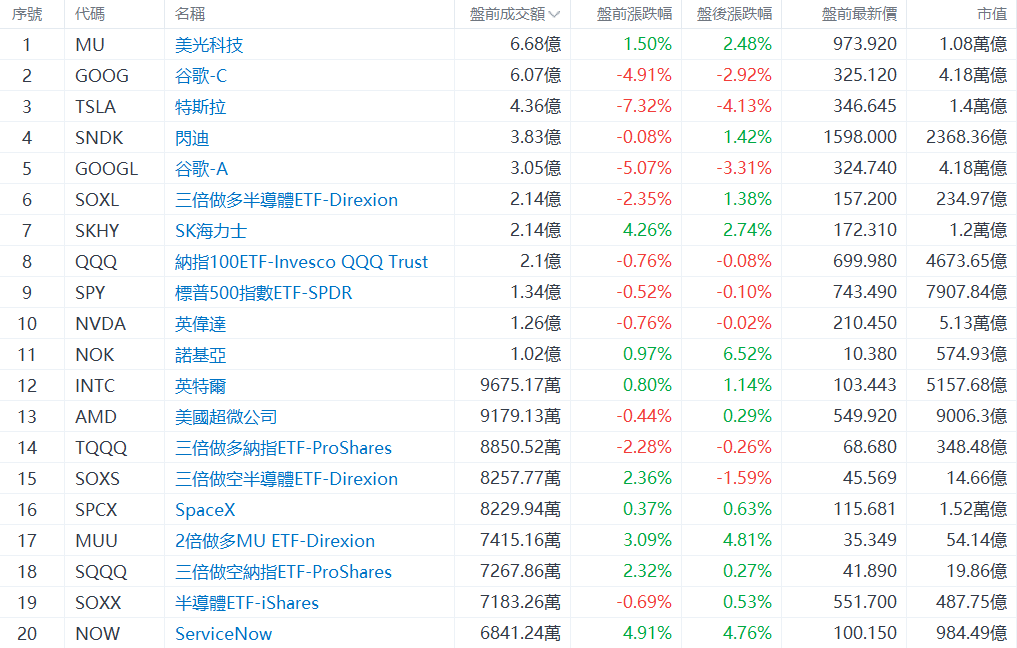
Top 20 pre-market trading volume stocks in the U.S.
U.S. Equity Market Macro Calendar Reminder
(All times listed below are in Beijing Time)
20:30 Initial Jobless Claims for the Week Ended July 18 (in ten thousands)
22:30 EIA Natural Gas Inventory for the Week Ended July 17 (in billion cubic feet)
 Looking to select stocks or analyze your holdings? Want to understand the opportunities and risks in your portfolio? For any investment-related questions,just ask Futubull AI!

Editor/melody