
BlackRock stated that U.S. Treasury yields can provide a solid buffer against losses.
Zhitong Finance APP learned that BlackRock, the world’s largest asset manager, released its third-quarter fixed income outlook report on Thursday, explicitly stating that U.S. Treasury securities are offering investors their strongest “downside protection” in recent years amid persistently elevated yields. The report notes that as inflation and economic growth gradually ease from their first-half peaks—combined with AI-driven structural economic transformation—the fixed income market is entering a phase of “richer investment opportunities.”
This assessment comes at a time when the U.S. Treasury market has experienced sharp sell-offs—with the 10-year yield approaching 4.66%, a two-month high, and the 30-year yield trading above 5% for multiple consecutive days—making BlackRock’s contrarian positioning signal worthy of market attention.
 Yield “Cushion”: 10-Year Treasuries Would Need to Rise Another 70 Basis Points to Generate a Loss
Chi Chen, Senior Portfolio Manager at BlackRock and co-manager of the $18 billion BlackRock Total Return Fund, wrote in the report that current yield levels provide a “substantial buffer” against further selloffs in the rates market. Yields on U.S. Treasuries with maturities of 10 years or less are well above 4%, while longer-dated yields exceed 5%, meaning investors are now receiving significantly higher compensation for holding bonds, rendering market valuations “increasingly attractive.”
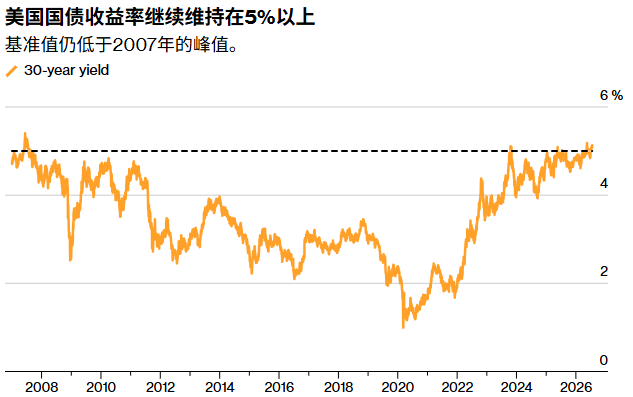
BlackRock estimates that the 10-year U.S. Treasury yield would need to rise by approximately 70 basis points from current levels before delivering a negative total return over a one-year horizon. This degree of “cushion” is exceptionally rare in the fixed income market over the past two decades. Rick Rieder, Chief Investment Officer of Global Fixed Income at BlackRock, stated in an interview: “We are in an environment where real rates are significantly higher than they have been over the past two decades. We can enjoy the returns from higher real rates and higher yields, and I believe interest rate volatility will remain low.”
Disinflation and Growth Divergence: BlackRock’s Core Macro View
BlackRock’s optimistic stance on fixed income is grounded in its macroeconomic outlook. The report forecasts that U.S. inflation and economic growth will begin to moderate from their first-half highs. This view aligns with the latest data: U.S. headline CPI declined by 0.4% month-over-month in June, marking the largest single-month drop since April 2020, while the year-over-year increase eased to 3.5%, down notably from May’s 4.2%.
However, Rieder also noted that the drivers of U.S. economic growth are becoming “more concentrated.” AI-related investment is now the primary engine of economic resilience—capital expenditures by hyperscale cloud providers have surged nearly 80% year-over-year, helping offset weakness in rate-sensitive sectors like housing. Yet he cautioned that AI-driven job growth is uneven: industries with medium AI exposure recorded annualized employment growth of 1.63% over the past three months, those with low exposure saw 1.55%, while high-exposure sectors (such as insurance) have already turned negative at -0.29%.
This macro landscape of “concentrated growth” implies that future fixed income returns will rely less on broad market exposure and more on active sector allocation, disciplined security selection, and diversified income sources.
Diverging Rate Hike Expectations: BlackRock vs. Market’s “Hawkish Pricing”
The most significant divergence between the current market and BlackRock lies in their expectations regarding Federal Reserve policy. The report states plainly: 'The market has priced in a more hawkish Fed policy path than we anticipate.'
Swap contracts indicate that traders have fully priced in a rate hike in October, expecting approximately 43 basis points of monetary tightening by year-end. According to the CME FedWatch Tool, as of July 23, the probability of a 25-basis-point rate hike by the Fed in September stood at 54.6%. U.S. Treasury yields have risen for three consecutive days, driven by renewed tensions between the U.S. and Iran, pushing the implied probability of a 25-basis-point hike in July up to 37.9%.
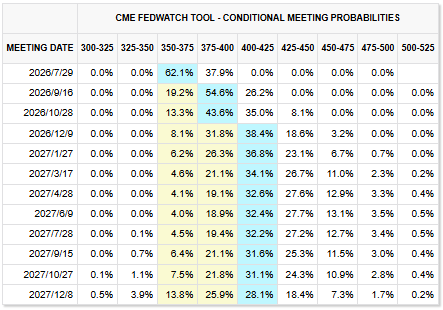
Rieder’s base case expectation is that the Fed will remain on hold at least through July and September, refrain from hiking rates this year, and potentially pivot toward easing in 2027. He believes that under new Chair Warsh, the Fed will reduce its reliance on forward guidance and instead employ a broader set of policy tools, including balance sheet operations, liquidity conditions, and monetary supply dynamics.
This divergence is directly reflected in the four potential return scenarios BlackRock has outlined for the Bloomberg U.S. Treasury Index:

Even in the most adverse scenario—a 100-basis-point rate hike—Treasury returns remain positive, quantitatively validating BlackRock’s 'downside protection' thesis.
The Warsh Era’s New Policy Paradigm: Shorter Statements, Less Guidance, More Tools
BlackRock views Warsh’s leadership of the Federal Reserve as the beginning of a 'truly new era.' The report notes that Warsh has trimmed FOMC statements from an average of over 200 words to fewer than 100, explicitly stating that the shorter format 'gives you just the facts.' Warsh himself described this approach as a deliberate move away from forward guidance—a tool he believes 'is ill-suited to the current policy crisis.'
On inflation, Warsh reaffirmed the Fed’s commitment to its 2% target, despite inflation having run above that level for more than five years. Alternative data sources tracked by BlackRock—including web-scraped pricing and retail gasoline costs—suggest that inflationary pressures may already be easing from recent highs.
BlackRock portfolio managers stated: 'These statements ultimately need to be backed by action—or validated by moderating inflation.' This implies that the credibility of policy under Chair Warsh will ultimately be defined by actual inflation data, not rhetoric.
Investment Strategy: Prioritize Yield, Emphasize Coupon, Execute with Precision
Based on the above assessment, BlackRock's fixed income investment strategy can be summarized in four core principles:
First, prioritize yield over directional duration bets. The report favors 'adopting a yield-first approach rather than establishing large directional duration positions before market data more clearly confirms a shift.' Rieder characterizes this as 'dynamic patience'—ensuring that coupon income is being earned and identifying the best opportunities.
Second, focus on coupon income in credit markets. The report notes that credit 'still supports carry trades,' and given relatively low risk, 'future returns may depend less on spread tightening and more on the growth of earnings and compounded income over time.'
Third, securitized assets are preferred over corporate credit. Rieder explicitly stated: 'The securitized market still offers value relative to the investment-grade credit market. The U.S. investment-grade credit market has seen significant issuance from data centers and hyperscale cloud providers. I believe U.S. investment-grade credit is simply unattractive.' His current areas of preference include non-agency mortgage-backed securities, commercial mortgage-backed securities (CMBS), and agency mortgage-backed securities (MBS)—the latter exhibiting lower interest rate volatility compared to investment-grade corporate bonds.
Fourth, global diversification and tactical allocation. Rieder is diversifying into European credit markets—where data center supply is limited and markets have already priced in three rate hikes by the European Central Bank. He is also making tactical allocations in emerging markets such as Mexico, while remaining cautious about U.S. dollar volatility. Additionally, he enhances returns by selling interest rate volatility through options strategies.
A once-in-20-years 'income window' in the U.S. bond market?
With $15.3 trillion in assets under management, BlackRock’s quarterly outlooks serve as a global barometer for capital markets. Against the backdrop of heightened volatility in the U.S. Treasury market, BlackRock’s core message is clear and resolute: a long-term yield of 5% provides a sufficiently thick 'cushion,' enabling bondholders to achieve positive returns even in the face of further rate hikes.
This assessment rests on three pillars: inflation gradually receding from elevated levels, economic growth becoming more concentrated yet not stalling, and a potential reconfiguration of the Federal Reserve’s policy framework under Chair Waller that could reduce interest rate volatility. For investors, BlackRock’s recommended path is equally clear: stop trying to time every interest rate move and instead focus on earning coupon income, carefully selecting opportunities within securitized assets and global credit markets.
Rieder said: 'In fixed income, I call it dynamic patience—meaning you ensure you’re collecting coupons and identifying the best opportunities.' After the most turbulent interest rate cycle in decades, the bond market has finally become a place where investors can 'earn income from coupons' again—and for BlackRock, this may well be the best entry window in 20 years.
Editor/Deng