
A sudden escalation in Middle East tensions pushed Brent crude oil prices above $100 per barrel, an unexpected sharp drop in U.S. initial jobless claims, and major tech companies' large-scale issuance of long-term bonds to finance AI infrastructure collectively exerted pressure on the bond market.
U.S. Treasury yields rose across the board on Thursday, with the 10-year yield surpassing 4.7% to reach its highest level since January 2025.
Multiple factors converged simultaneously—escalating tensions in the Middle East pushed Brent crude oil prices above $100 per barrel at one point, U.S. initial jobless claims unexpectedly plummeted, and major technology firms issued large volumes of long-term bonds to finance AI infrastructure—all exerting downward pressure on the bond market.
 The 10-year U.S. Treasury yield climbed 5 basis points to 4.71%, marking its highest level since January 15, 2025, just before the start of Trump’s second term. Meanwhile, the 30-year Treasury yield rose more than 4 basis points to 5.188%. This yield has traded above the 5% mark on 27 trading days this year, including 12 consecutive sessions—the longest stretch since the onset of the 2007 financial crisis.
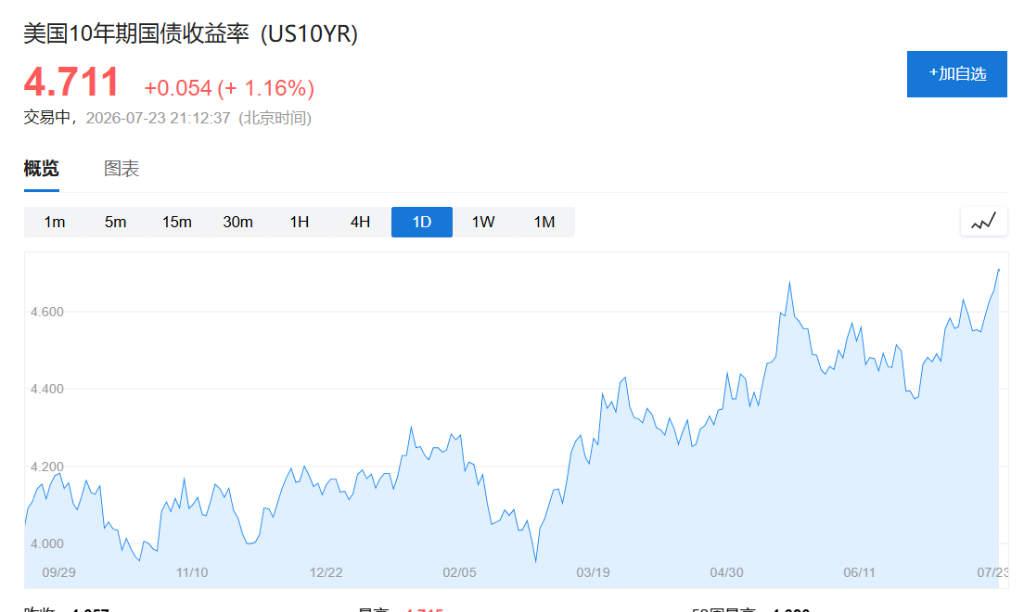
The sharp rebound in oil prices intensified market concerns about a resurgence of inflation.
Brent crude futures briefly surpassed $100 per barrel, staging a significant recovery from the low reached after the preliminary peace agreement between the U.S. and Iran last month, further clouding the Federal Reserve’s policy outlook. Chris Rupkey, chief economist at FWDBONDS, stated, 'The economy may be heating up today, but the escalation of conflict in the Middle East has sent energy prices soaring almost overnight, and the labor market outlook remains highly uncertain.'
Initial jobless claims plunge, reinforcing signals of economic resilience
For the week ending July 18, U.S. initial jobless claims dropped to 187,000, significantly below the Dow Jones survey consensus forecast of 212,000, underscoring continued resilience in the labor market.
This data further solidified market expectations that the Federal Reserve is unlikely to cut rates in the near term, pushing the 2-year Treasury yield up by over 4 basis points to 4.343%. Chris Rupkey noted that half of Fed officials have already factored a potential rate hike into their projections for this year, yet structural risks in the labor market—notably rising difficulties for recent graduates seeking employment—remain a concern policymakers must weigh carefully.
‘Whether it’s growth risks or the cost-of-living crisis driven by persistent inflation, the economy has not yet truly emerged from trouble,’ he added.
Investors’ next focal point will be Friday’s flash release of the S&P Global U.S. Purchasing Managers’ Index (PMI) report, which will provide further insight into the health of the manufacturing and services sectors.
The Middle East situation has shifted abruptly, with oil prices posting their third-largest monthly gain in the past decade.
The Houthi movement claimed attacks on two Saudi oil tankers in the Red Sea, compounded by heightened U.S. threats of escalated strikes against Iran, causing oil prices to nearly reverse their prior losses overnight this week.
July Brent crude futures surged 5% in a single day, closing above $99 per barrel—the highest level since the initial U.S.-Iran peace agreement—while West Texas Intermediate (WTI) crude futures rose approximately 4%, breaching $90 per barrel. Brent’s monthly gain is on track to rank among the top three single-month increases of the past decade.
The sharp rise in oil prices has directly pushed up inflation expectations and transmitted pressure across global bond markets.
In Europe, the yield on the UK 10-year government bond rose by 4 basis points, surpassing 5%. Newly appointed Prime Minister Andy Burnham announced a 20% reduction in business rates for hospitality venues, costing an estimated £100 million (approximately $134 million), sparking additional investor concerns about fiscal discipline. The European Central Bank is expected to hold rates steady at its policy meeting later today to assess the actual economic impact of renewed escalation in the Middle East.
AI-driven funding surge flows into bond markets, keeping long-end yields under upward pressure
According to Bloomberg, the wave of long-dated corporate bonds issued by technology firms to finance AI infrastructure is competing with U.S. Treasuries for the same pool of buyers, becoming one of the structural factors sustaining elevated long-end yields.
AI-related financing has already exceeded $500 billion. Alphabet’s earnings report shows continued expansion in AI capital expenditures, while Tesla’s spending on AI and robotics projects soared to $5.8 billion in the second quarter, resulting in its first cash burn in two years. Shares of both companies fell sharply in pre-market trading.
Tony Rodriguez of Nuveen Asset Management stated, 'Whether it’s governments, hyperscale cloud providers, or other issuers, credit bonds are now competing with more borrowers for the same group of investors at the long end.'
Alex Payne of Vanguard Capital Management noted that traditional buyers of 30-year Treasury bonds—such as pension funds and insurers—now have 'a more diverse menu of options than ever before,' adding that he believes yields have not yet peaked.
Since 2007, the U.S. Treasury market has expanded from $4.5 trillion to $31 trillion, with debt as a share of GDP doubling to over 100%. Against the dual backdrop of an AI-driven capital expenditure boom and persistently deteriorating fiscal conditions, portfolio managers widely believe that long-end yields above 5% will no longer be fleeting.
Editor/Deng