Intel’s Q2 revenue was nearly 12% above analyst expectations and rose 25% year-over-year. Revenue from its Data Center and AI group surged 59% year-over-year, nearly quadrupling the growth rate seen in Q1. Foundry business revenue increased by 31%, almost doubling the Q1 growth pace. The company’s Q3 guidance implies year-over-year growth of 15% to 23%, representing an upside of at least approximately 5% and up to more than 10% relative to market expectations. The CEO stated that AI is driving 'unprecedented' demand for computing power. The stock rose more than 13% in after-hours trading.
$Intel (INTC.US)$ Intel delivered results significantly better than market expectations, reflecting how surging data center spending driven by AI computing demand is helping the company win a long-awaited turnaround.
After U.S. market hours on Thursday, July 23 (Eastern Time), Intel reported Q2 2026 revenue nearly 12% above analyst expectations, with year-over-year revenue growth accelerating to 25%—the strongest quarterly revenue growth in nearly fifteen years. Revenue from data center–related businesses rose nearly 60% year-over-year, more than double the overall revenue growth rate.
 More importantly, Intel’s Q3 revenue guidance maintains robust double-digit growth, implying year-over-year growth of over 15% to nearly 23%—entirely above analyst expectations. Based on the midpoint of the guidance range, Intel expects Q3 revenue of approximately $16.3 billion, more than 8% above market forecasts and slightly higher than actual Q2 revenue, indicating management’s confidence in second-half demand.
In the earnings release, Intel CFO Dave Zinsner noted that the company’s Q2 performance exceeded financial expectations 'primarily due to strong market demand and improved execution, with higher factory yields and shorter production cycles driving increased shipments.' He added, 'AI-driven demand for computing power continues to strengthen.' CEO Lip-Bu Tan echoed this sentiment, stating, 'AI is driving unprecedented demand for computing power.'
Prior to the earnings release, Intel’s shares closed down more than 2% during Thursday’s regular trading session, reflecting continued market caution regarding its fundamentals. Following the earnings announcement, the stock surged in after-hours trading,一度 rising over 13%, though the gain has since narrowed to around 4%.
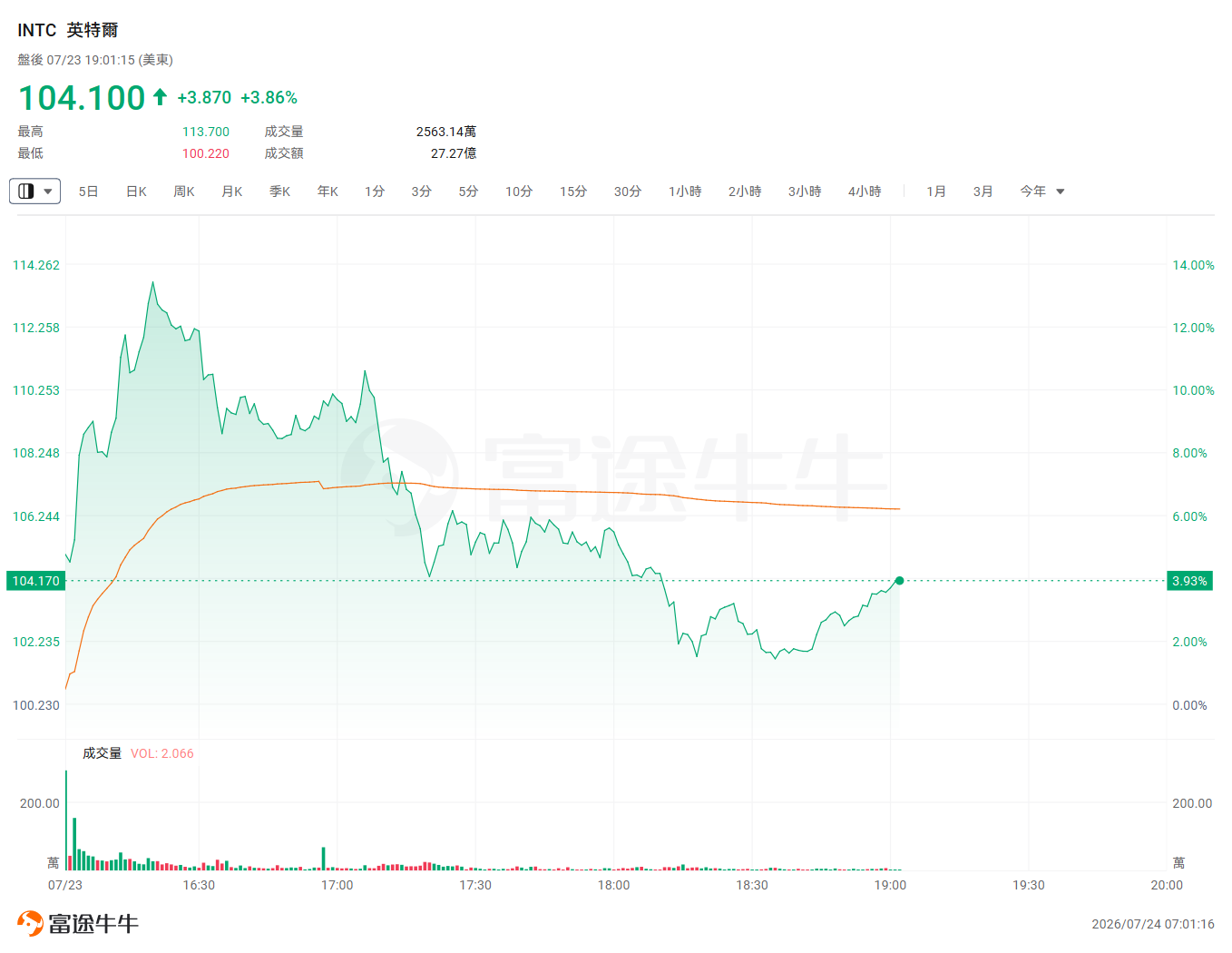
This sharp reversal indicates that investor expectations for Intel had been low, and the company not only beat Q2 revenue expectations but also provided a Q3 outlook strong enough to justify upward revisions to market forecasts. This 'expectation gap' on the revenue front was the core driver behind the rapid post-market share price rebound.
However, based on signals from the earnings report, Intel’s current focal point remains 'recovery' rather than a 'full turnaround.' Revenue exceeding expectations indicates better-than-anticipated near-term demand, order execution, or product shipments, but investors will continue to closely monitor deeper indicators such as gross margin, cash flow, data center competitiveness, AI-related initiatives, and returns on foundry investments.
Q2 Revenue Beats Expectations by Nearly 12%: Intel Delivers a Clear Positive Surprise
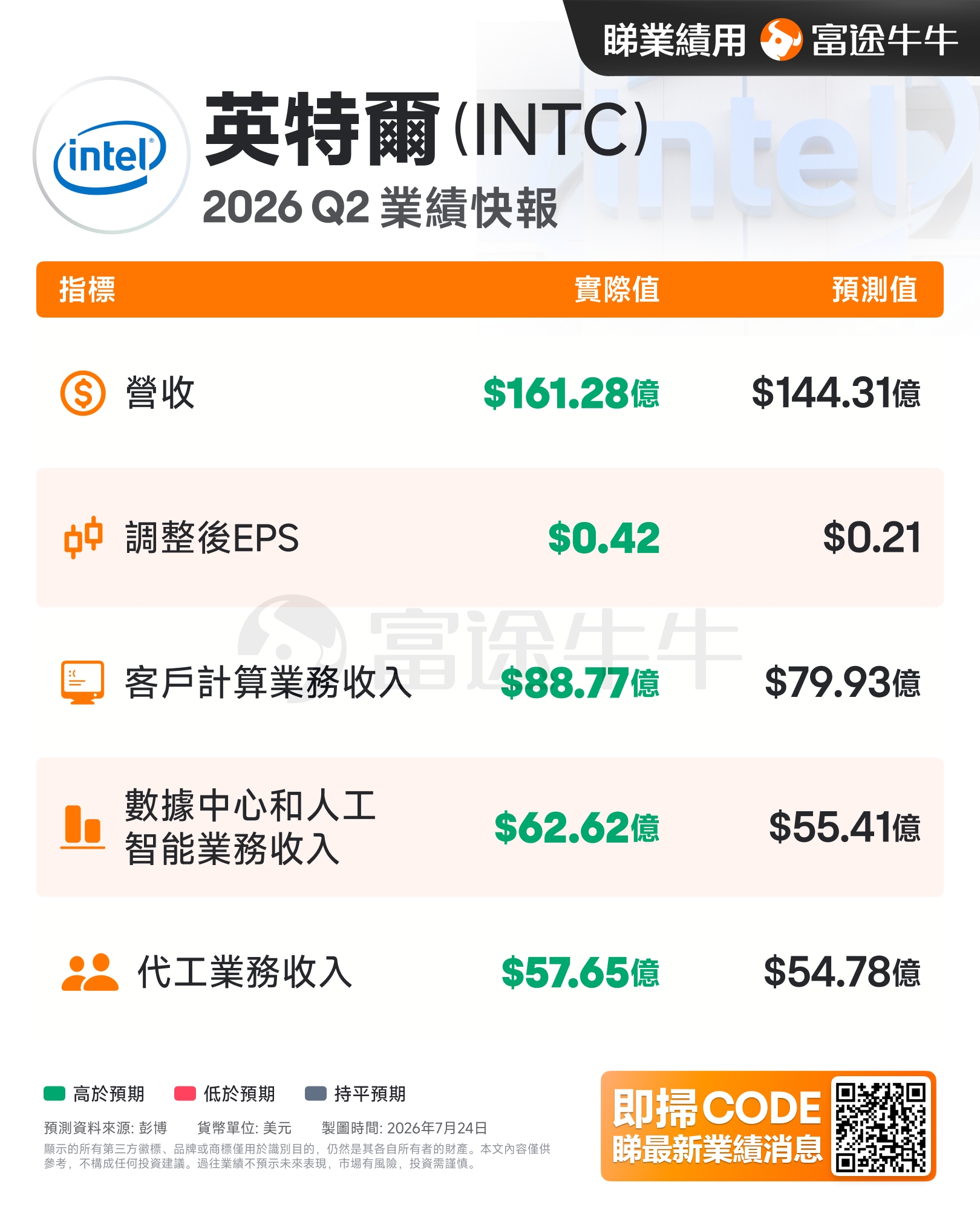
Intel reported Q2 revenue of $16.13 billion, versus a market expectation of $14.43 billion. Revenue grew approximately 25% year-over-year—3.6 times the 7% growth rate in Q1—marking the fastest year-over-year growth since Q3 2011.
The table below shows the gap between market expectations and Intel’s actual Q2 revenue and the midpoint of its Q3 guidance:

Revenue beats of this magnitude are uncommon among mature semiconductor companies. In Intel’s case, core market concerns over the past few quarters have centered on: the sustainability of the PC recovery, pressure on data center market share, lagging competitiveness in AI chips, high costs associated with catching up in advanced process technologies, and short-term profit drag from its foundry business.
Therefore, the significant Q2 revenue beat first and foremost indicates that Intel’s current business is not as weak as previously priced in by the market. Regardless of whether the outperformance stemmed from Client Computing, Data Center, Edge, or other segments, consolidated revenue suggests that Intel’s shipments, pricing, or demand environment was better than Wall Street had anticipated.
By business segment,
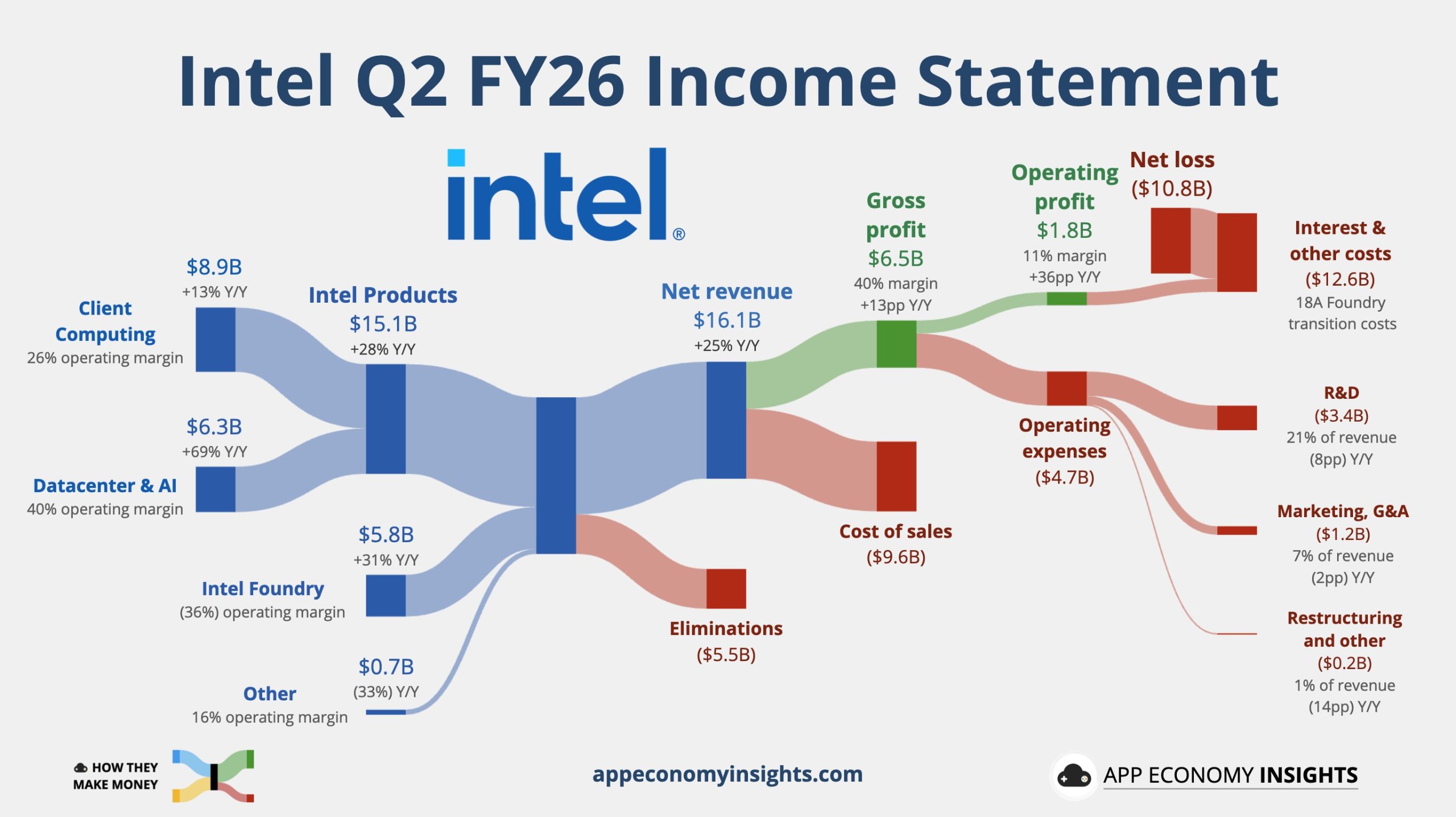
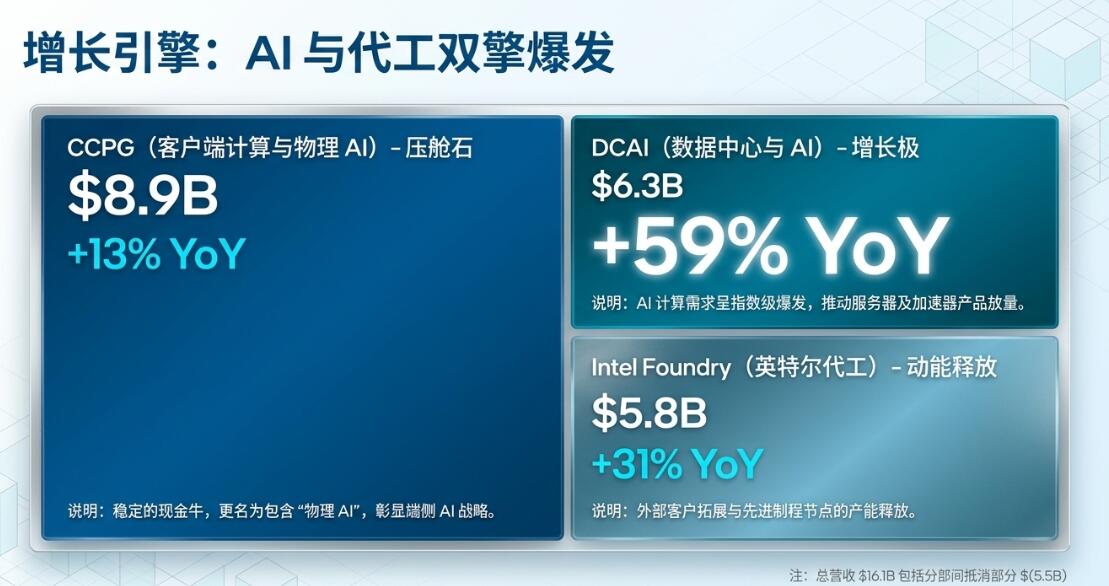
Data Center and AI (DCAI) reported second-quarter revenue of $6.3 billion, up 59% year-over-year, approximately 2.7 times the 22% growth in the first quarter, reflecting strong demand driven by AI.
Client Computing Group (CCG) posted second-quarter revenue of $8.9 billion, up 13% year-over-year, significantly outpacing the mere 1% growth in the first quarter.
Intel Foundry delivered second-quarter revenue of $5.8 billion, up 31% year-over-year, nearly double the 16% growth recorded in the first quarter.
The Q3 guidance range is at least nearly 5% above market expectations and as much as over 10% higher.
While second-quarter revenue has already been realized, market focus has shifted to third-quarter guidance, as it directly impacts profitability models and valuation expectations for the second half of the year.
Intel expects Q3 revenue to be between $15.8 billion and $16.8 billion, both figures exceeding analysts’ consensus expectation of $15.06 billion. Even at the low end of its guidance range—$15.8 billion—revenue would still be nearly 5% above market expectations; at the high end of $16.8 billion, it would be approximately 11.6% higher.
This signals that Intel’s management is not attributing the strong performance to a one-time Q2 beat, but rather expects robust demand to continue into Q3.
Compared with Q2 revenue of $16.13 billion, the low end of the Q3 guidance implies a sequential decline of about 2.0%, the midpoint of $16.3 billion represents a sequential increase of approximately 1.1%, and the high end suggests a sequential rise of roughly 4.2%.
Against the backdrop of ongoing structural divergence in the semiconductor industry, Intel’s Q3 revenue outlook—ranging from flat to modest growth—is sufficient to alleviate market concerns about weakening demand in the second half of the year.
The stock jumped sharply in after-hours trading: markets are pricing in a 'revision of pessimistic expectations.'
Following the earnings release, Intel’s stock surged more than 10% in after-hours trading, sharply contrasting with its over 2% decline during regular trading hours.
This move is not solely driven by Intel’s 'exceptionally strong results,' but rather by previously subdued market expectations. Intel’s share price had been under pressure in recent periods due to several factors, including:
Relative underperformance in the AI wave: Compared with competitors such as NVIDIA and AMD, Intel has had weaker market presence in the AI accelerator narrative.
Data center competitive pressures: Evolving demand from cloud providers and enterprise customers for high-performance computing, AI servers, and custom chips is weighing on Intel's traditional CPU business.
High costs of catching up in process technology: Massive investments in advanced process nodes are exerting near-term pressure on profit margins and free cash flow.
Uncertainty surrounding the foundry business: Intel Foundry remains in a heavy investment phase, and external customer validation, capacity utilization, and the timeline to profitability will all require time to demonstrate.
Questions remain about the PC cycle recovery: Although the PC market shows signs of recovery following inventory adjustments, the strength and sustainability of the rebound remain contentious.
Against this backdrop, any clear upside surprise in Intel’s revenue and guidance would be sufficient to trigger short-covering and repricing by long investors. The post-market surge of over 10% reflects an 'expectation revision' rather than full market confirmation of the company’s successful long-term transformation.
However, based on signals from the earnings report, Intel’s current focal point remains 'recovery' rather than a 'full turnaround.' Revenue exceeding expectations indicates better-than-anticipated near-term demand, order execution, or product shipments, but investors will continue to closely monitor deeper indicators such as gross margin, cash flow, data center competitiveness, AI-related initiatives, and returns on foundry investments.
Third-quarter guidance conveys management’s confidence, yet retains a degree of flexibility through a range.
Intel provided third-quarter revenue guidance of $15.8 billion to $16.8 billion—a $1 billion range. This indicates a certain level of confidence in demand, while also reflecting that industry visibility remains somewhat limited.
Order patterns in the semiconductor industry are typically influenced by multiple factors, including customer inventory levels, end-market demand, cloud capital expenditures, enterprise IT budgets, consumer electronics cycles, and the macroeconomic interest rate environment. Intel’s above-consensus guidance range suggests solid current order and shipment trends, though the width of the range also provides a buffer against potential demand volatility.
For investors, the key validation point in the third quarter will be whether the company delivers results near the midpoint or at the high end of the range. A result at the high end would further reinforce market confidence in second-half growth; if the outcome lands only at the low end—while still exceeding current market expectations—the stock’s subsequent upside potential could be constrained.
The narrative around Intel’s transformation continues to center on its foundry business and capital expenditure plans.
Intel's long-term narrative in recent years has not only been about selling CPUs, but also about attempting to reshape its advanced manufacturing capabilities and entering the global wafer foundry market through Intel Foundry.
This strategy is highly significant for the company, yet it comes with high investment requirements, long lead times, and substantial uncertainty. Advanced process nodes, fab construction, equipment procurement, and customer certifications all entail significant capital expenditures, with returns typically materializing over an extended period. In the short term, the foundry business may weigh on profit margins and free cash flow; in the long run, however, securing major external customer orders could unlock valuation upside.
Therefore, although the company’s latest earnings report and guidance both exceeded expectations, the market will not revise its assessment of Intel’s transformation based solely on one quarter of stronger-than-expected revenue. Investors will need to see tangible progress on several fronts: advancement in external foundry customers; timely execution of advanced process node roadmaps; improved capacity utilization; narrowing losses in the foundry business; and a sustainable balance between capital expenditures and cash flow.
This is also a key reason why Intel’s valuation has remained under pressure for an extended period: the market acknowledges the potential of its transformation but remains concerned that the required investments are too heavy and the realization timeline too slow.
AI Remains the Valuation Ceiling Issue
The dominant theme in the semiconductor sector remains AI. NVIDIA holds a dominant position in AI accelerators, AMD is accelerating its catch-up efforts, while Intel’s AI narrative is comparatively more complex.
Intel offers a portfolio spanning CPUs, networking, edge computing, PC-based AI, and certain accelerator product lines. However, what capital markets value most is whether Intel can capture a larger share of the high-growth, high-margin AI data center hardware market. If Intel fails to establish clear competitiveness in AI servers, accelerators, or the AI PC ecosystem, any valuation recovery may be limited to cyclical improvements in traditional semiconductor markets.
This explains why, despite the significant post-earnings rally in Intel’s stock price, sustained re-rating will depend on the company’s ability to translate better-than-expected revenue into a compelling AI-driven growth story—not merely a temporary rebound in legacy businesses.
 AI-Powered Earnings Insights: Build Your Options Strategy in Three Steps! Open Futubull > Stock Page > Tap [Company] >Earnings Update

Editor/Jayden