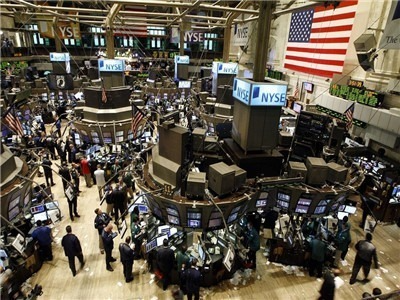
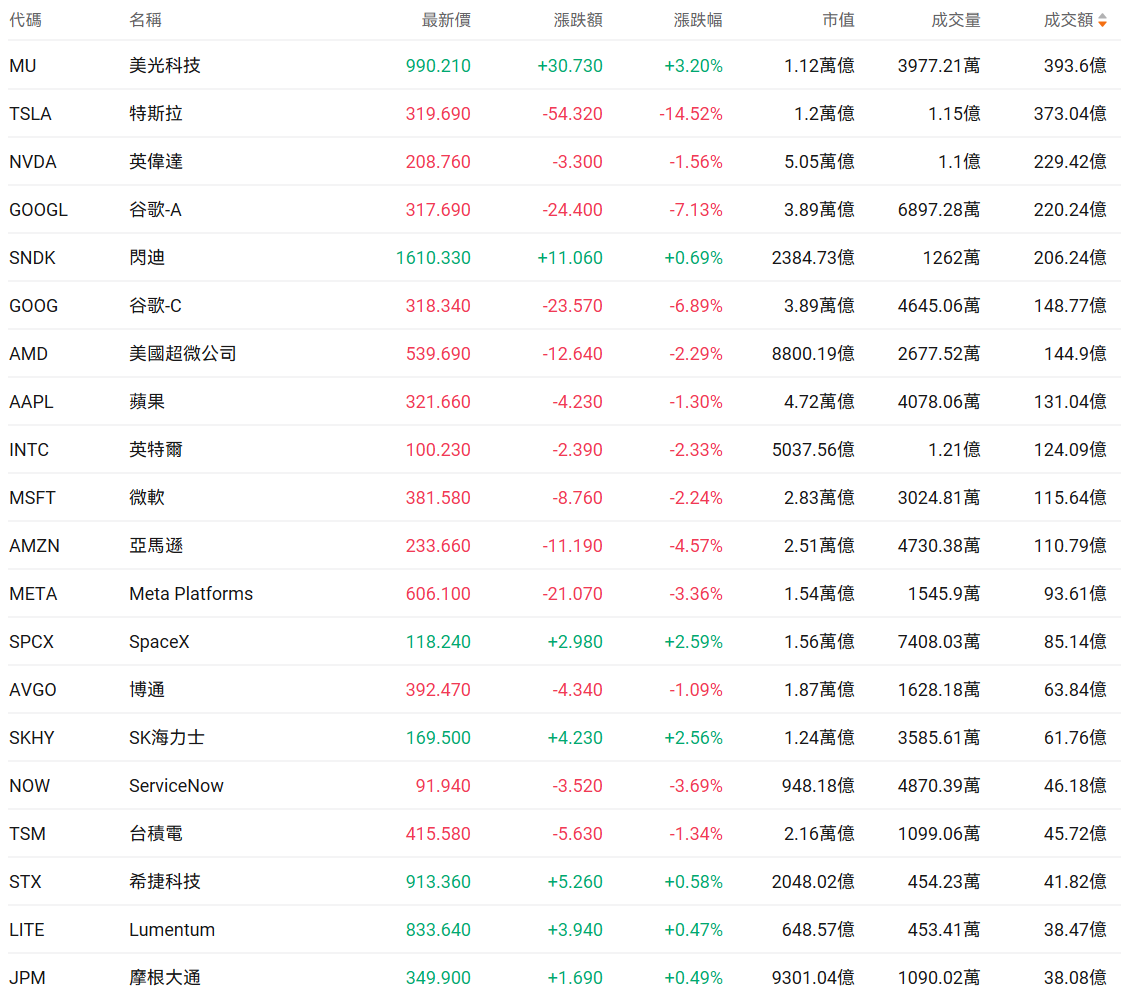
Top by trading volume on U.S. stock markets on Thursday$Micron Technology (MU.US)$Rose 3.20%, with trading volume reaching $39.36 billion.
Elon Musk stated that Micron Technology recently provided$Tesla (TSLA.US)$a 'substantial' allocation of memory chips, helping the automaker meet demand for this increasingly scarce commodity.
During Tesla’s quarterly earnings conference call on Wednesday, Musk said that Micron offered Tesla very reasonable supply terms amid tight availability and high prices for memory chips.
 The rise of global artificial intelligence (AI) systems has driven up demand for memory chips, which help computers store and manage data. This surge has triggered a broader shortage, spilling over into other industries, pushing prices higher and straining production capacity.
In the long term, Musk is pursuing in-house semiconductor production. The billionaire has launched an ambitious initiative called Terafab, aimed at manufacturing computing and memory chips at an unprecedented scale. The project is jointly undertaken by Tesla and $SpaceX (SPCX.US)$ , with Musk serving as CEO of both companies.
The second most traded stock $Tesla (TSLA.US)$ Fell 14.52%, marking its largest single-day decline since June 2025, with trading volume at $37.304 billion.
The electric vehicle maker reported weaker-than-expected second-quarter results and announced a significant increase in spending, triggering investor panic.
The company's capital expenditures in the second quarter reached $5.79 billion, surging 142% year-over-year and more than doubling in scale. Tesla expects its total capital spending for the full year to exceed $25 billion. The significant investment led this quarter'sFree cash flowto turn from positive to negative.
Although vehicle revenue exceeded market expectations, profitability deteriorated. Gross margin fell short of analyst forecasts due to lower average selling prices and a decline in high-margin regulatory credit revenue. Markets are once again concerned that Tesla may struggle to balance aggressive investment with profit growth.
According to Ihor Dusaniwsky, managing director at S3 Partners, this round of selling generated approximately $4.12 billion in mark-to-market paper gains for short sellers in a single day. Retail investors chose to buy the dip on Thursday, with Tesla emerging as the most purchased stock by retail investors, recording net inflows of $42 million.
3rd place$NVIDIA (NVDA.US)$Closed down 1.56%, with trading volume of $22.942 billion.
On Thursday, Advanced Micro Devices (AMD) unveiled a series of new data center products and stated that their performance would surpass comparable offerings from rival NVIDIA, aiming to further expand its market share in the rapidly growing AI computing market.
4th place$Alphabet-A (GOOGL.US)$ Closed down 7.13%, with trading volume of $22.024 billion.
Alphabet, Google's parent company, reported that Google Cloud revenue reached $24.8 billion in the second quarter, a substantial year-over-year increase of 82%, significantly exceeding the market expectation of $22.5 billion. However, due to a sharp rise in capital expenditures, free cash flow turned negative for the quarter—an unusual occurrence—reaching -$5.855 billion. During the earnings call, Google raised its full-year capital expenditure guidance to between $195 billion and $205 billion, up from the previous forecast of $180 billion to $190 billion. Markets are concerned whether such massive capital spending will yield commensurate returns.
In a quarterly filing, Google disclosed that as of the end of June, its commitments for future contractual expenditures reached $811 billion, an increase of nearly $500 billion from three months earlier. These amounts are reported separately from Google’s capital expenditure budget and represent purchases the company has committed to under supply agreements and outstanding purchase orders. Approximately $200.7 billion of this amount relates to short-term procurement. These commitments span various areas, including semiconductors, data centers, power, inventory, and content licensing. The sharp increase underscores how rapidly Google is securing resources as it expands the infrastructure underpinning its artificial intelligence (AI) business. This disclosure further highlights the staggering scale of AI infrastructure investment. Alphabet, Google’s parent company, stated on Wednesday that it expects to spend approximately $195 billion to $205 billion on capital expenditures alone this year to compete with Microsoft, Meta, and Amazon in expanding AI computing capacity.
7th place $Advanced Micro Devices (AMD.US)$ Closed down 2.29%, with trading volume of $14.49 billion.
At a launch event held on Thursday (July 23), AMD projected that by 2030, the AI accelerator market will reach $1.4 trillion, while the data center CPU market will amount to $220 billion. Helios is expected to begin deliveries by the end of Q3, with OpenAI planning a 'large-scale' deployment of Helios. Lisa Su stated that customer demand for Helios is 'extremely strong,' noting that the MI450 AI accelerators integrated into this rack-scale AI platform are among the fastest in the industry. AMD also claimed that its next-generation EPYC CPU, codenamed Venice, delivers up to 3.4 times the performance of Intel's comparable Xeon products and approximately 20% higher performance than NVIDIA's Vera CPU.
The event took place in San Francisco, where Lisa Su invited executives from several technology companies to join her on stage. Multiple executives pledged to adopt AMD products, including those from two major AI model developers, Anthropic and OpenAI. AMD also projected that the total computing market will reach $2 trillion by 2030.
9th place$Intel (INTC.US)$ Closed down 2.33%, with trading volume of $12.409 billion.
The company reported total revenue of $16.128 billion for the second quarter, an increase of 25% year-over-year—the highest growth rate in the past fifteen years—driven primarily by strong demand for computing, improved product delivery efficiency, and higher manufacturing yields.
GAAP operating profit for the quarter was $1.796 billion, compared to a loss of $31.76 billion in the same period last year, resulting in an operating margin of 11.1%. Non-GAAP operating profit was $2.770 billion, with a non-GAAP operating margin of 17.2%, positively driven by a 6% year-over-year reduction in operating expenses, including R&D and SG&A.
Cash, cash equivalents, and short-term investments totaled $29.727 billion at quarter-end, down significantly from the prior quarter due to capital expenditures during the quarter on equipment and cleanroom construction, resulting in adjusted free cash flow of -$8.419 billion.
Rank 11$Amazon (AMZN.US)$Closed down 4.57%, with trading volume of $11.079 billion.
Officials in Austin, Texas, confirmed that Amazon’s robotics division is expected to become the potential anchor tenant of the new Dog’s Head development project in East Austin. The City of Austin plans to establish a $2.2 billion Tax Increment Reinvestment Zone (TIRZ) to fund infrastructure and other public improvements in the area.
The development site spans 2,600 acres and is nicknamed the 'Dog’s Head' parcel due to its distinctive overall shape. Currently valued at approximately $17 million, the land is projected to exceed $26 billion in total development value by 2061—when the TIRZ policy expires—as supporting infrastructure and industrial tenants are brought in, indicating significant growth potential.
Rank 15$SK hynix (SKHY.US)$Closed up 2.56%, with trading volume of $6.176 billion.
According to reports, $SK Hynix (000660.KR)$It has completed a record-breaking U.S. ADR offering, and the quota allocated for converting Korean-listed shares into ADRs has reached the regulatory cap of 2.5% of total outstanding shares, limiting further ADR supply. This scarcity, coupled with strong demand, has amplified the stock’s price elasticity.
16th place$ServiceNow (NOW.US)$Closed down 3.69%, with trading volume of $4.618 billion.
The company reported second-quarter subscription revenue of $3.88 billion, an increase of 24.5% year-over-year. Adjusted earnings per share were $0.90, exceeding the market consensus estimate of $0.85. Current Remaining Performance Obligations (cRPO), a key indicator of future revenue, rose 21% to $13.2 billion, while total Remaining Performance Obligations reached $29 billion. ServiceNow has raised its full-year subscription revenue outlook to a range of $15.76–15.78 billion, representing growth of approximately 22.5%.
Additionally, a Morgan Stanley research report noted that the market's recent pessimism toward the software sector has gone too far. Although the AI wave has channeled investor capital into chips, cloud infrastructure, and cybersecurity, software companies’ long-term competitiveness and business models remain attractive.$Microsoft (MSFT.US)$、$Palo Alto Networks (PANW.US)$、$CrowdStrike (CRWD.US)$、$Cloudflare (NET.US)$、$Datadog (DDOG.US)$, ServiceNow, $Snowflake (SNOW.US)$and$Shopify (SHOP.US)$as the most confident overweight positions in the AI era.
Want to select stocks or get a stock diagnosis? Curious about the opportunities and risks in your portfolio? For all your investment questions,Just ask Futubull AI!

Editor/Liam