
Intel has significantly raised its capital expenditures for 2026 to over $20 billion and indicated that spending will continue to rise in 2027. Management disclosed that its leading-edge 18A node has entered volume production with yields exceeding expectations, and its custom chip business is on track to reach an annualized revenue of $4 billion, targeting a trillion-dollar market. Management emphasized that demand for CPUs and GPUs in the server segment is now nearly on par, and robust demand will underpin sustained double-digit growth in the server CPU market over the long term.
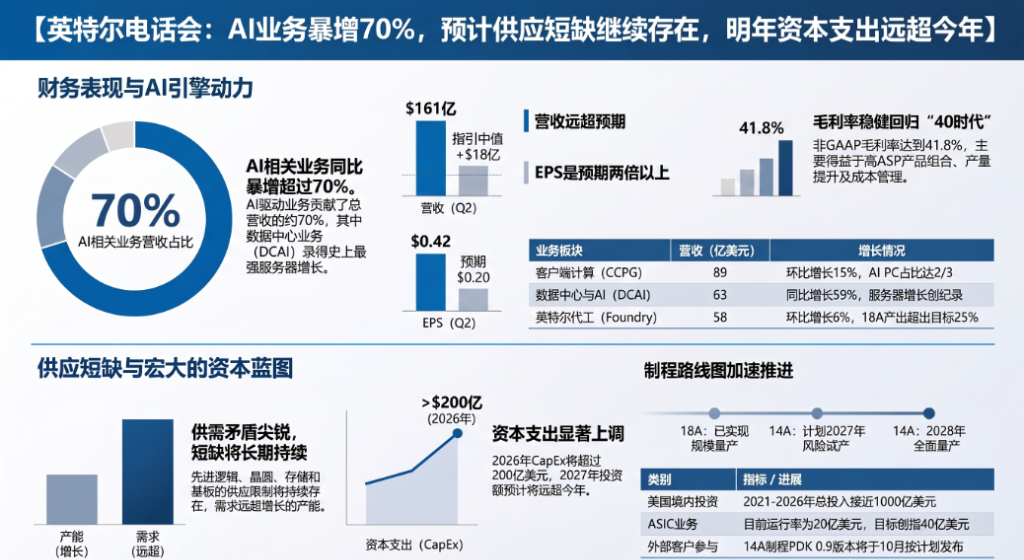
Intel delivered strong results in revenue, profit, and gross margin for the second quarter, marking the seventh consecutive quarter of exceeding market financial expectations. Management indicated the company is accelerating its shift toward an 'AI-first' strategy to capitalize on the unprecedented wave of computing infrastructure investment.
After the U.S. markets closed on the 23rd, Eastern Time, Intel released its second-quarter earnings report, with revenue nearly 12% above analysts' expectations and a 25% year-over-year increase in quarterly revenue—the strongest quarterly revenue growth rate in nearly fifteen years.
 More importantly, Intel’s revenue guidance for the third quarter maintains double-digit high growth, with a projected range implying year-over-year growth of over 15% to nearly 23%—the entire guidance range surpassing analyst expectations.
Behind this better-than-expected earnings report, the explosive growth of AI-related businesses has been the primary driver. During the earnings call, Intel CEO Lip-Bu Tan stated outright:
“Our AI-driven business grew by more than 70% year-over-year overall, including record-breaking growth in our data center segment, which contributed approximately 70% of total revenue.”
Tan emphasized that Intel is positioned at the core of the massive AI infrastructure build-out and possesses three key strategic assets: x86 CPUs, advanced packaging, and foundry services. He added:
“Today, we are seeing our strongest revenue growth in 15 years. Our core message is simple: robust demand for our products continues to outpace our growing supply.”
Additionally, management disclosed that yield and capacity ramp-up for the 18A process node are both ahead of expectations, and key metrics for the next-generation 14A node also exceed internal targets. The company announced it is actively securing supplier purchase orders and accelerating cleanroom construction, sending a clear signal to the market of its expansion intentions.
“Demand far exceeds supply”: significantly raising capital expenditures for both this year and next
Faced with the explosive demand for AI computing power, Intel’s current production capacity has become its biggest bottleneck.
Citing exceptionally strong customer demand signals, Intel announced it is raising its 2026 capital expenditure forecast to over $20 billion, a significant increase from its initial projection at the beginning of the year, and indicated that 2027 capital spending will be substantially higher than in 2026.
CFO David Zinsner disclosed that between 2021 and 2026, Intel’s combined capital expenditures on tools and facilities in the United States will total nearly $100 billion, exceeding those of any other semiconductor company during the same period.
Lip-Bu Tan candidly highlighted current industry supply chain pain points:
The entire industry is facing one of the most severe supply constraints in history, spanning advanced logic chips, silicon wafers, memory, and substrates. These shortages are expected to persist into the foreseeable future.
In terms of funding sources, the company holds approximately $30 billion in cash and short-term investments, a $10 billion revolving credit facility, and around $10 billion in monetizable non-core assets, resulting in ample overall liquidity. David Zinsner acknowledged that if expansion progresses smoothly, the company would not rule out raising capital through financial markets.
Faced with substantial capital expenditures, David Zinsner also explained the underlying investment rationale, emphasizing spending discipline:
We only commit capital expenditures when we have very high confidence in generating strong returns. As we shift toward a model that extends the lifecycle of process nodes, these returns are quite substantial.
For the third quarter, Intel provided revenue guidance in the range of $15.8 billion to $16.8 billion (midpoint $16.3 billion), with an expected Non-GAAP gross margin of 42% and earnings per share of $0.38.
Management noted that due to lead times associated with capacity expansion, the ramp-up in supply will be more concentrated toward the end of the third quarter and into the fourth quarter.
Core foundry node 18A enters volume production ahead of schedule; ASIC targets a trillion-dollar market
Intel conveyed strong confidence regarding its foundry business and process technology roadmap, areas of significant market interest.
Intel's foundry revenue in Q2 reached $580 million, up 6% quarter-over-quarter. Driven by robust growth at the 18A node, wafer output for the quarter exceeded internal targets by approximately 25% and grew over 50% sequentially. Lip-Bu Tan disclosed:
"Since joining the company a little over a year ago, my confidence in our foundry process technology roadmap has grown significantly. 18A output increased substantially during the quarter, and yields continue to outperform expectations. We are now ramping multiple new products into high-volume manufacturing on 18A, including Panther Lake and Wildcat Lake."
Additionally, the Process Design Kit (PDK) 0.5 for the 14A node has been completed, and PDK 0.9 is on track for an October release as scheduled, with high-volume production targeted for 2028.
Beyond traditional foundry services, Intel’s custom chip (ASIC) design offerings are also experiencing explosive growth.
Revenue from this business surged nearly threefold year-over-year and is now approaching an annualized run rate of $2 billion, with a future target of $4 billion. In response to an analyst’s question, Lip-Bu Tan emphasized:
"This represents a massive opportunity. I believe the total addressable market exceeds $100 billion. With our x86 IP, XPU design capabilities, advanced packaging, and leading-edge process technologies, we possess a unique advantage in delivering customized compute chips to customers."
During the quarter, Intel announced a collaboration with Fortinet to co-develop next-generation security processors, initiated a multi-year partnership with SambaNova to advance disaggregated inference performance optimization, and continued delivering Infrastructure Processing Units (IPUs) to hyperscale cloud customers.
Lip-Bu Tan stated that the company will continue expanding its product portfolio—from networking into computing, and ultimately into accelerators. Additionally, Intel recently hired former SK Hynix CEO Shoxi Li to strengthen its strategic positioning in memory architecture integration and computational storage convergence.
Data Center and AI (DCAI) segment surges; PC market faces challenges in the second half
From a business segment perspective, recognition of x86 CPUs in AI infrastructure by cloud service providers and enterprise customers has increased.
Data Center and AI Group reported Q2 revenue of $630 million, up 24% sequentially and surging 59% year-over-year, with operating profit increasing by approximately $1 billion sequentially.
Addressing market concerns regarding the evolving market share dynamics between CPUs and GPUs in the AI era, CFO Zinsner offered an optimistic outlook:
“We’ve previously discussed how the ratio of CPUs to GPUs is rising. We now believe the two have nearly reached parity at this stage, and over the long term, CPU shipments could ultimately become dominant.”
Management forecasts strong double-digit growth in industry server CPU shipments for both this year and next, a trend expected to continue through 2028.
For the Client Computing and Physical AI Group (CCPG, formerly the PC business), Q2 revenue was $890 million, up 15% sequentially. Within this, AI PC revenue grew 26% sequentially and now accounts for two-thirds of total client segment revenue.
However, management objectively highlighted downside risks for the second half of the year: due to rising memory chip prices and capacity constraints, the PC consumer market is expected to show sub-seasonal performance in H2, potentially resulting in a low double-digit decline for the full year.
Nevertheless, strong momentum in edge AI deployments will provide some positive offset for this segment.
Full Transcript of Intel’s Q2 Earnings Call (AI-assisted translation):
Moderator:
Thank you all for joining. Welcome to Intel Corporation’s second-quarter 2026 earnings conference call. All participants are currently in listen-only mode. A question-and-answer session will follow the presentation. Please note this call is being recorded.
Now, please allow me to introduce today's moderator—Mr. John Pitzer, Vice President of Investor Relations at Intel. Please begin.
John Pitzer (Vice President of Investor Relations):
Thank you. Jonathan, good afternoon to everyone joining us today. Our second-quarter earnings release and related presentation materials have been published and are available on our Investor Relations website at intc.com. For those participating in today’s call via webcast, the presentation slides can also be viewed within the webcast window.
Joining me today are our Chief Executive Officer, Lip-Bu Tan, and our Chief Financial Officer, David Zinsner. Lip-Bu will begin with remarks on our second-quarter results and progress against our strategic priorities; Dave will then discuss overall financial performance and provide guidance for the third quarter, after which we will open the call for Q&A.
Please note that today’s presentation includes forward-looking statements based on our current views of external conditions and is therefore subject to various risks and uncertainties. The presentation also references non-GAAP financial measures, which we believe provide useful information to investors. Our earnings release, most recent Form 10-K, and other filings submitted to the SEC contain additional information regarding specific risk factors that could cause actual results to differ materially from expectations; these documents also include reconciliations of non-GAAP financial measures to their GAAP equivalents.
With that, I’ll now turn the call over to Lip-Bu Tan.
Lip-Bu Tan (Chief Executive Officer):
Thank you, John, and good afternoon, everyone. The second quarter was another quarter of strong execution. Revenue, gross margin, and earnings per share all exceeded guidance, marking our seventh consecutive quarter of outperforming financial expectations.
Our core message is simple: robust demand for our products continues to outpace our growing supply capacity; we are making consistent improvements in design, manufacturing, and execution; and the operational discipline we established 15 months ago is now delivering tangible results. Today, we are witnessing our strongest revenue growth in 15 years.
Our cultural transformation continues, and our organization is already operating with greater efficiency—acting faster, making better decisions, and engaging more closely with customers. Our recent announcement to deepen our collaboration with Google Cloud will further accelerate this transformation as we embrace an AI-first mindset across our entire business. We are also continuing to strengthen our leadership team with world-class talent.
Strong global demand for and rapid construction of compute infrastructure are creating significant opportunities for both our product business and our foundry business. The industry is currently facing the most severe supply shortages in history across leading-edge logic chips, silicon wafers, memory, and substrates—shortages that are expected to persist into the foreseeable future.
Intel is uniquely positioned to benefit from this robust and sustained demand, thanks to three strategically critical assets: its x86 CPU product portfolio, advanced packaging technologies, and a broad foundry network.
As AI expands from training to inference and increasingly evolves toward autonomous agents and multi-agent systems, the density requirements for general-purpose server CPUs continue to rise. Our core server CPU business is growing at an unprecedented pace. Customer demand signals further reinforce our confidence. As Dave will detail later, we are significantly increasing investment to support this persistently favorable demand outlook.
Regarding Intel Foundry
Having joined the company over a year ago, my confidence in our foundry process roadmap has grown substantially. I am more convinced than ever of the strategic importance and unique value proposition of Intel Foundry.
In the second quarter, our fabs targeting the Intel 7, Intel 3, and Intel 18A nodes all exceeded internal wafer output targets, driven by continued yield improvements, reduced cycle times, and increased wafer starts. 18A capacity saw meaningful growth this quarter, with yields consistently exceeding expectations. We are currently ramping multiple new products on 18A while simultaneously supporting the growing demand for key products such as Panther Lake and Wildcat Lake. I continue to raise internal performance benchmarks, and the team consistently rises to meet these challenges. The successful high-volume ramp of 18A on internal products provides critical validation for Intel Foundry as we pursue external customers.
Meanwhile, we have initiated risk production of 18AP—a node that delivers additional performance and power advantages while maintaining IP and design compatibility with Intel 18A, making 18AP a highly competitive offering for external customers.
Looking beyond 18A, I am greatly encouraged by our progress on Intel 14A—both defect density and transistor performance are ahead of where 18A stood at the same stage of development. PDK 0.5 has been completed, and PDK 0.9 is on track for delivery in October as planned. We are continuously building and validating the 14A IP portfolio to drive broad adoption of the 14A product family across a wide customer base. I am pleased to see accelerating customer engagement around Intel 14A, and I am increasingly confident that 14A will emerge as a highly competitive process node across key dimensions including performance, power, density, cost, and schedule.
Based on encouraging external customer momentum and sustained growth in internal product demand, we remain on track to initiate risk production of 14A for internal products in the second half of 2027. In the second quarter, we made the commitment to achieve high-volume manufacturing by 2028.
On the advanced packaging front, customer interest in EMIB-T remains exceptionally strong. This technology is highly compelling, enabling advanced AI chip solutions that current mainstream approaches cannot deliver. EMIB-T backlog continues to grow, and both yield and reliability have met targets. Our current focus is on scaling this technology to high-volume, high-quality manufacturing to support customer product launches in 2027.
Regarding Intel's Product Business
We recently renamed our PC business to the "Client Computing and Physical AI Group" (CCPG) to underscore the significant growth opportunities in the edge AI market. I am very excited about the direction our new leadership team will aggressively pursue.
In our core PC client business, Intel 18A is now in volume production across multiple commercial and consumer products, with factory output continuing to increase month-over-month. Achieving high-volume production on internal products using 18A has also provided critical validation for Intel Foundry’s engagement with external customers. While we still have work ahead of us to establish a solid market position in the edge and physical AI ecosystem, we view it as a key growth engine for the future.
The Data Center and AI Group (DCAI) delivered solid performance this quarter. Demand from both hyperscale cloud and enterprise markets has accelerated noticeably as customers increasingly recognize the critical role CPUs—particularly x86 CPUs—play in AI infrastructure. Our server business achieved its strongest year-over-year growth in Q2, and Xeon 6 continues to rank among the fastest-ramping products in Intel’s history, reflecting both improved execution and robust customer demand. During the second quarter, we further strengthened our business outlook by winning new strategic customers and signing long-term agreements.
Our immediate priority is to rapidly scale capacity and increase factory output to meet customer demand while continuously enhancing our competitive roadmap. Additionally, through a multi-year collaboration with SambaNova, we are deepening our heterogeneous AI strategy to jointly advance performance and power efficiency in disaggregated inference.
Furthermore, our newly established design services business continues to progress steadily, with revenue nearly tripling year-over-year. We see significant opportunities to leverage our strong x86 general-purpose computing portfolio to develop more specialized computing solutions tailored for the AI era. Our unique strengths in end-to-end design and IP portfolio, combined with leading-edge wafer and packaging capabilities, position us competitively in this fast-growing segment. We are actively expanding our portfolio of specialized products—from networking to computing—and gradually extending into accelerators.
This quarter, our announcement of a collaboration with Fortinet on secure processors marked an important step forward in our ASIC strategy.
Looking ahead, I am energized by the emergence of the new Intel. We are operating with greater speed, stronger accountability, and closer alignment with our customers. There is still much work to be done, but our priorities are clear: strengthen product leadership based on our x86 computing portfolio while building Intel Foundry into a world-class wafer and packaging foundry business.
Intel is uniquely positioned to benefit from the overwhelming compute demand driven by the industry-wide, rapid build-out of computing infrastructure. We are the only company capable of designing and manufacturing a complete computing solution—from general-purpose CPUs and GPUs to specialized ASICs and CPUs optimized for autonomous agent AI. As computing architectures increasingly evolve from single-chip systems toward system-in-package designs, our advanced packaging and foundry capabilities will become even more critical strategic assets.
Our strategic direction is clear, execution is accelerating, and the opportunity ahead is immense. Early results from our strategy are already visible, and I am confident that Intel will play a pivotal role in defining the next era of computing.
I would like to thank Intel employees around the world for their daily focus, discipline, and hard work, as well as our many customers, partners, and suppliers for their continued trust in Intel.
Now, I’ll turn it over to Dave for a detailed review of our financial results.
David Zinsner (Executive Vice President and Chief Financial Officer):
Thank you, Lip-Bu. This quarter, we delivered another strong performance, driven by robust demand and disciplined execution, which enabled us to exceed expectations on the supply side.
Second-quarter revenue was $16.1 billion, $1.8 billion above the midpoint of our guidance. AI-driven businesses grew over 70% year-over-year, including record-breaking growth in our data center business, collectively contributing approximately 70% of total revenue. Notably, despite wafer output exceeding expectations this quarter, sustained strong demand continues to significantly outpace our expanding supply capacity.
Second-quarter non-GAAP gross margin was 41.8%, approximately 280 basis points above guidance, driven by higher revenue, improved yields, and a higher average selling price resulting from an optimized product mix and pricing adjustments. Non-GAAP earnings per share were $0.42, significantly exceeding the guided $0.20, benefiting from higher revenue, stronger gross margins, and solid operating leverage.
Operating cash flow for the second quarter was $7 billion, and our liquidity position remained strong at quarter-end, with cash and short-term investments totaling approximately $30 billion.
Business Segment Performance
Client Computing Group and Physical AI Products Group (CCPG)
CCPG revenue was $8.9 billion, up 15% sequentially and ahead of expectations. Despite broad-based component shortages and pricing pressures, the overall client market size remained resilient. AI PC revenue increased 26% sequentially and now accounts for two-thirds of client revenue. Edge deployment business performed steadily and currently represents approximately 10% of CCPG revenue.
CCPG reported an operating profit of $2.3 billion, or 26% of revenue, down approximately $173 million sequentially due to an inventory impairment charge related to optimizing its factory network to align with overall client and server customer demand.
The Client Computing Group (CCPG) has now ramped Intel 18A to full production scale, with over 400 design wins for Series 3 commercial and consumer products. Against a backdrop of inflationary pressures, CCPG timely launched mainstream Series 3 processors based on the A-step version to deliver cost-competitive computing capabilities. Integrated Arc GPU solutions continue to gain strong market traction, with more than 40 integrated Arc GPU design wins spanning creators, workstations, commercial, and gaming segments. Building on the success of gaming laptops in Q2, CCPG also introduced the Intel Arc G-series processors—a new product family specifically designed for next-generation handheld gaming systems—providing an additional growth vector for the business.
On the commercial side, activations of our market-leading vPro manageability software have surged by 1,500% over the past four quarters, underscoring that manageability and enhanced security have become essential requirements in agent-enabled workplace environments. We expect enterprise AI adoption to serve as a long-term tailwind for CCPG, and the AI-driven market opportunity extends well beyond this—edge and physical AI applications could eventually match or even surpass the size of the client computing market over the long term. CCPG has secured 130 Series 3 design wins for edge AI applications, including use cases such as robotic brain control deployments.
Data Center and AI Group (DCAI)
DCAI revenue was $6.3 billion, up 24% sequentially and 59% year-over-year, significantly exceeding expectations, driven primarily by robust demand from hyperscale cloud and enterprise markets. The dedicated chip product line continued its strong momentum, with revenue increasing approximately 20% sequentially and nearly tripling year-over-year. DCAI operating profit was $2.5 billion, or 40% of revenue, up approximately $1 billion sequentially, benefiting from higher revenue, improved product margins, and lower operating expenses.
This quarter, DCAI launched Xeon 6+, codenamed Clearwater Forest—the first Intel server-class product built on the Intel 18A process. Additionally, DCAI jointly announced rack-scale and disaggregated inference innovation solutions with partners such as SambaNova and Foxconn, and introduced new controllers and adapters supporting 10 to 200G Ethernet for data center, enterprise, and telecom applications, further strengthening its connectivity portfolio.
Intel Foundry
Foundry revenue was $5.8 billion, up 6% sequentially, driven by strong output growth from Intel 18A—18A wafer output exceeded targets by approximately 25% and increased by over 50% sequentially. External foundry revenue was $293 million.
Intel Foundry’s operating loss improved by $730.8 million sequentially, driven by yield improvements, cycle time optimization, and lower wafer costs from scaling across Intel 4, Intel 3, and 18A process nodes. Progress on 18A has been highly favorable: since the beginning of the year, Intel Foundry has reduced the cost of the Panther Lake mainstream SKU by approximately 50%, with a further ~20% reduction expected within the year and significant additional cost reductions targeted by 2027. This quarter, the business also initiated risk production for 18A-P and achieved the key milestone of delivering Intel 14A PDK 0.9 in October. We increased investment in Intel 14A during Q2 to prepare for risk production in 2027 and committed high-volume manufacturing in 2028.
Third Quarter Guidance
Looking ahead, customers continue to signal strong and sustainable spending, fueled by unprecedented demand for AI compute. Industry-wide supply constraints in wafers, memory, and substrates remain the primary challenge customers face in building out AI infrastructure.
Our wafer output at key process nodes has exceeded expectations from 90 days ago, and since the beginning of the third quarter, the yield trajectory for 18A has been ahead of the target set in March. Despite strong execution and positive seasonal trends, supply remains extremely tight, with recent supply growth trending more linearly toward the end of the third quarter and into the fourth quarter, particularly on the server side.
From an end-market perspective, we expect PC demand in the second half of the year to fall below typical seasonal patterns, impacted by rising memory prices and supply shortages, resulting in a low double-digit percentage year-over-year decline for full-year 2026—consistent with peer companies and third-party forecasts. Meanwhile, supply improvements, an enhanced product portfolio, and favorable tailwinds from edge deployments provide a degree of positive offset. Since our last earnings call, we have further raised our expectations for server CPU demand, anticipating robust double-digit shipment growth for the industry this year and next, with momentum extending into 2028.
Taking these factors into account, we are guiding third-quarter revenue to a range of $15.8 billion to $16.8 billion. Based on the midpoint of $16.3 billion, we forecast non-GAAP gross margin at 42%, a tax rate of 11%, and earnings per share of $0.38. Full-year non-GAAP operating expenses will continue to be tightly managed at approximately $16.5 billion. We expect non-controlling interest (NCI) to be approximately $250 million in each of the third and fourth quarters of this year, and around $1.1 billion annually under GAAP in 2027 and 2028.
On capital expenditures, driven by strong customer demand signals, we are raising our 2026 outlook, with capex now expected to exceed $20 billion—a significant increase from our initial guidance at the beginning of the year. We are actively locking in equipment purchase orders with suppliers, accelerating cleanroom construction, and securing supply for substrates and memory. Capital expenditures in 2027 are expected to be substantially higher than in 2026, with the vast majority allocated to our U.S.-based network. From 2021 through 2026, our total capital expenditures in the U.S. for equipment and facilities will approach $100 billion—significantly exceeding that of any other semiconductor company over the same period. We remain committed to closely aligning spending with customer demand, maintaining financial discipline to capture the growth opportunities ahead.
Summary
The second quarter was once again strong both financially and operationally. Developments in the client segment aligned with expectations, and server CPU demand continued to significantly outpace available supply. Emerging markets—including physical AI, specialized chips, advanced packaging, and external foundry services—each represent multi-billion-dollar annual revenue opportunities in the near term. I am confident in our ability, backed by our broad IP portfolio, to address our customers’ most pressing needs and create long-term value for shareholders.
With that, I’ll turn it back to John to begin the Q&A session.
John Pitzer (Vice President of Investor Relations):
Thank you, Dave. Please limit yourself to one question and one brief follow-up so we can accommodate as many participants as possible. Jonathan, please take the first question.
Q&A Session
Moderator:
Alright. Our first question comes from Ben Reitzes of Melius Research. Go ahead.
Ben Reitzes:
Thank you—great quarter. I’d like to ask about the roughly $3 billion in capital expenditures this year and the substantial increase expected next year. Does this imply you’ve already received formal orders for 14A or 18AP? Could you also break down the allocation between advanced packaging and front-end wafer capex? Thank you.
David Zinsner:
Let me address the second question first. Our capital expenditures are fairly diversified, and advanced packaging is included. As Lip-Bu Tan mentioned, we are very optimistic about the outlook for EMIB-T and will therefore continue investing. However, front-end wafer fab costs are significantly higher than those for packaging facilities, so overall investment remains weighted toward the front end—though both are critically important to us.
Regarding customers, this increased investment reflects our confidence in our entire customer base. Particularly in areas where we have signed long-term agreements, we now have sufficient visibility into demand over the next few years, and we are proactively aligning capacity across our business units accordingly. Of course, as I mentioned in my presentation, we maintain strict discipline around capital expenditures. Lip-Bu has also consistently emphasized that we only deploy capital when we have high confidence in the returns.
From a cash flow perspective, the factories currently under construction represent net cash outflows initially, which is why capital expenditures will continue to rise next year. However, over the long term, these investments will generate substantial returns—especially under our strategy of extending the lifecycle of our process nodes, which significantly enhances returns. This has already been clearly demonstrated by Intel 10 and Intel 7 processes.
John Pitzer:
Ben, do you have a follow-up?
Ben Reitzes:
Yes. Your competitor today mentioned that the total addressable market (TAM) for CPUs will grow to $220 billion by 2030, representing a compound annual growth rate of approximately 45%. How do you view this forecast? Does Intel see the same trend, and are you positioned to capture this opportunity?
David Zinsner:
We don’t provide specific figures, but we clearly agree this is a robust market poised for significant growth. Lip-Bu has previously noted that the CPU-to-GPU ratio continues to rise. We now believe their shipment volumes are nearing parity, and going forward, CPUs may even surpass GPUs in volume. This is a highly attractive market, and we hold a strong position within it, enabling us to capture a substantial share.
As for the precise size the market may reach, it’s inherently difficult for anyone to predict with certainty. However, based on the spending signals we’re receiving from customers, the long-term agreements we’ve already signed, and the resulting forward visibility, we expect growth to be very substantial.
Moderator:
The next question comes from Joe Moore of Morgan Stanley.
Joseph Moore:
Thank you. Regarding server CPU market share, you now have your own wafer fabrication facilities, which appears to be a significant advantage. Has this helped you gain market share this year? Looking ahead to the next five years, facing competition from both AMD and ARM, how do you view your prospects for regaining lost share?
Lip-Bu Tan:
Let me respond first, and then Dave can add more. Demand is indeed very strong, with the usage ratio between CPUs and GPUs becoming more balanced in AI agent and inference scenarios. The bigger challenge right now is scaling supply to meet customer demand.
In servers and data centers, we have a robust product roadmap: Clearwater Forest, Diamond Rapid, and Coral Rapid, which will soon introduce SMT (Simultaneous Multithreading). We remain committed to enhancing both single-threaded and multi-threaded performance, with multi-threading improvements coming in Coral Rapid.
Regarding ARM, they are an excellent partner, and I have a close personal relationship with Rene and Masa. We are not only focused on CPUs based on the ARM architecture; ARM can also be an important partner and customer in ASIC foundry services and IP licensing. Overall, we are performing well in the competitive landscape, with a strong product roadmap. While we are still catching up in certain areas, our pace of progress is rapid, and we are investing significant resources into specific CPU architecture directions to achieve a leapfrog advancement—results will become evident over time.
John Pitzer:
Joe, do you have a follow-up question?
Joseph Moore:
Yes. Regarding capital expenditures, does the difference between 'gross' and 'net' amounts still exist? Could you further clarify how capital expenditures are allocated between internal products and external foundry customers?
David Zinsner:
There is indeed a current difference between gross and net amounts, primarily related to the Advanced Manufacturing Investment Tax Credit (AMIC). This difference is currently in the low single-digit billions of dollars range and is expected to grow further as projects progress. Fundamentally, this is a timing issue: for every dollar we invest in the U.S., we receive a $0.35 investment tax credit. Given that the U.S. accounts for the vast majority of our capital expenditures, the credits are substantial. However, there is a lag: we can only begin claiming credits for buildings after facilities are completed, and for equipment only after it’s installed and ready for production, followed by filing with the Internal Revenue Service (IRS). Thus, there is a time lag between expenditure and receipt of the credit, but the difference between gross and net capital expenditures does exist.
Regarding the allocation of capital expenditures between internal and external use, we prefer to view this from the perspective of total wafer starts rather than drawing a strict distinction between internal and external. We determine required wafer starts per node based on demand drivers across our business segments, place purchase orders accordingly with suppliers, and maintain flexibility to adjust as new information becomes available. On the packaging side, we already have significant order backlog, necessitating rapid capacity expansion—both through internal manufacturing facility investments and procurement of substrates from external suppliers. Investments in these areas are currently being accelerated to get ahead of demand.
Moderator:
The next question comes from Stacy Rasgon of Bernstein Research.
Stacy Rasgon:
Thank you. I’d like to ask about the client computing segment. Strong data center performance was widely anticipated, but the client segment’s outperformance has been somewhat surprising. Is this primarily driven by pricing, or are there other factors at play? Additionally, given that the end market in the second half appears weaker than typical seasonality, could you share your outlook for the client segment in the second half?
David Zinsner:
The client segment did indeed exceed expectations, but I believe the primary driver was average selling price (ASP)—partly due to product mix shifts and partly due to proactive pricing adjustments on comparable products. Given inflationary pressures on our cost structure, we needed to pass some of those costs through to customers. Compared to the same period last year, this market is indeed declining. The 2025 window refresh created an exceptionally strong year, and we’re now in a correction phase; rising memory costs and supply tightness have also weighed on the market.
By shifting our product mix toward higher-end offerings, we’ve significantly contributed to ASP improvement, which helped drive better-than-expected results.
Looking ahead to the next quarter, client computing group (CCG) revenue is expected to remain largely flat. The overall CCG segment is anticipated to see modest growth, primarily driven by peripheral businesses, as the core client business itself stabilizes. The underlying market remains under pressure due to memory dynamics, and this segment is expected to decline slightly this quarter. However, given that CPU inventory levels have remained relatively low, we may see some CPU inventory replenishment in the third quarter. By the fourth quarter, our own business will begin to feel the impact of slowing demand. On a positive note, we need to allocate as much capacity as possible toward data center CPUs to help close the significant gap between supply and demand.
John Pitzer (confirming with Stacy for follow-up):
Stacy, do you have a follow-up question?
Stacy Rasgon:
Yes. You mentioned inventory write-downs related to the client segment—what specific items are these, and what is the magnitude? Additionally, your guidance indicates that gross margin will be roughly flat next quarter. If we exclude these write-downs, does that imply your underlying gross margin guidance is actually down sequentially?
David Zinsner:
Alright, let me break this down. We had certain products that lacked complete配套 components. From an economic standpoint, it made more sense to reallocate these products to other product lines rather than complete the original configurations. As a result, we took a write-down on this stranded inventory.
You’re correct that we guided to flat gross margins for next quarter. While the absence of inventory write-downs would indeed be favorable, this benefit is offset by another factor: although costs for Panther Lake and Granite continue to improve—and their share of the product mix is increasing—both products are still relatively early in their lifecycle and carry gross margins below the company average. This drags on overall gross margin, counterbalancing the uplift from reduced write-downs, resulting in net flat guidance.
Over the longer term, as 18A yields continue to improve, Panther Lake’s gross margin will gradually recover and eventually exceed the company average, becoming a driver of gross margin expansion. We remain deeply committed to continuously improving gross margins. Frankly, the core objective I’ve consistently emphasized within my finance team this year has been to firmly push gross margins above the 40% mark each quarter. The team has delivered exceptionally well on this goal in the first two quarters, and our guidance for the third quarter points to the same outcome. Building on this foundation, we will continue driving further gross margin improvement.
Moderator:
The next question comes from Timothy Arcuri of UBS Group.
Timothy Arcuri:
Thank you. Dave, you mentioned that capacity will increase significantly by the end of this quarter, which seems to imply a substantial sequential revenue increase in the fourth quarter. If we assume you are still shipping backlog orders and the backlog exceeds $1 billion, then Q4 should be very strong. Is that a correct understanding? Could you elaborate on the key tailwinds and headwinds?
David Zinsner:
We typically provide guidance for only one quarter at a time—that’s our standard practice. That said, if we start seeing improvements in inventory and supply by the end of Q3, then Q4 does indeed have upside potential. However, it’s important to note that even with these improvements, we still won’t fully close the gap; there will remain a shortfall into Q4.
Our internal teams have done an outstanding job ramping up capacity—somewhat exceeding the expectations of Lip-Bu and myself. However, our overall supply depends on a combination of factors, including internal wafer output as well as advanced packaging, substrates, glass core substrates, memory, and other elements. Procurement across the back-end supply chain is actually our most challenging bottleneck right now. Front-end wafer capacity ramps relatively linearly, whereas certain back-end segments exhibit more 'lumpy' capacity additions. As a result, we expect bottlenecks to gradually ease only toward the end of Q3—which explains why revenue is expected to be roughly flat this quarter but has clear upside potential in Q4.
John Pitzer:
Tim, do you have a follow-up question?
Timothy Arcuri:
Yes. Dave, the year-over-year gross margin expansion in March and June was quite strong, but based on your guidance, it appears this expansion may moderate into the low 50% range—still within your stated target band of 40% to 60%. Is that still the correct framework to use? Also, could you share your outlook for next year?
David Zinsner:
Over the long term, a range of 40%–60% remains a reasonable target for incremental outcomes. Each quarter has its own unique dynamics that influence where exactly within this range the result will fall, but overall, I believe this serves as a fairly practical benchmark.
Moderator:
The next question comes from Vivek Arya of Bank of America Securities.
Vivek Arya:
Thank you. Lip-Bu, you mentioned growing confidence in expanding your external foundry customer base. When do you expect this confidence to translate into concrete customer announcements? Additionally, of the increased capital expenditures, how much is allocated to serving external customers versus meeting internal product demand?
Lip-Bu Tan:
Thank you for your question, Vivek. I’ll first address the source of our confidence, and then Dave will discuss capital expenditures.
Regarding 18A: 18AP has entered risk production and will be ready by year-end, delivering approximately a 5% performance improvement. Yield and output for 18A continue to improve steadily, which is clearly evident from the production ramp of Panther Lake.
On 14A: PDK 0.5 has been completed, and PDK 0.9 for 14A is on track for delivery in October—a critical milestone. The yield, defect density, and performance of the 256 SRAM have all exceeded the stringent targets I set for the team; they have fully met their objectives. Risk production for 14A is scheduled for the second half of 2027, with volume production committed for 2028.
All customer engagements and feedback have been highly positive. Strong internal product demand, coupled with the depth of engagement from external foundry customers, gives me great confidence. Once they began reviewing PDK version 0.9 and observing corresponding yield performance, they became very enthusiastic and serious about what products they plan to run on 14A and how much capacity they’ll need. This is precisely the kind of proactive signal indicating genuine customer intent to move forward.
For this very reason, as I mentioned earlier, Dave and I will only initiate capital expenditures once we confirm that yields meet targets, IP is ready to serve customers, and customer engagements have reached an appropriate level.
David Zinsner:
I’ll start with 2026 and break down our capital expenditures clearly. Over the past few years, we have invested heavily in fab space, and our current fab capacity is already very ample. Only a small amount of investment remains for infrastructure improvements, which is relatively minor in scale. Therefore, the majority of our current capital expenditures are directed toward equipment procurement. Compared to 2025, equipment investments in 2026 will increase by 40%, focused on areas as expected: Intel 3, 18A, and 18A-P.
I won’t provide specific figures for 2027 at this time, as the details are still being finalized. As per our usual practice, we typically disclose these numbers formally early in the year. However, I have already clearly informed investors that we expect this figure to increase relative to 2026. Please allow me another one or two quarters to finalize the exact number.
Our capital expenditure trajectory will balance both internal and external considerations. We take a holistic view of wafer demand across all business units and plan capacity accordingly.
John Pitzer:
Vivek, do you have a follow-up question?
Vivek Arya:
Yes, I do. Dave, as you continue ramping up investments in the second half of this year and into next year, how are you thinking about your balance sheet? Can the success of the CPU business support these investments, or will additional financing be required?
David Zinsner:
That’s a great question. Our balance sheet is currently in excellent shape: we hold approximately $30 billion in cash, plus a $10 billion revolving credit facility, giving us total liquidity of around $40 billion. This has enabled us to complete deleveraging and firmly maintain our investment-grade credit rating.
Sustained growth in revenue, profit, and EBITDA continues to generate substantial cash flow for the business. Additionally, we have approximately $10 billion in non-core assets that could be monetized if needed—though we are not in a rush to do so—and these serve as a contingency option should circumstances require it.
We’ve also observed customers’ willingness to co-invest with us through prepayments, which has helped unlock additional capacity. Of course, if our business expands rapidly, we may need to access capital markets for financing, and we will inform shareholders promptly should that occur.
Moderator:
The next question comes from CJ Muse of Cantor Fitzgerald.
CJ Muse:
Good afternoon, and thank you. Dave, I understand you don’t provide guidance beyond one quarter, but could you help us understand the cadence of server revenue recovery from the second half of this year through 2027, and how we should think about the trends in both unit shipments and average selling prices (ASPs)?
David Zinsner:
Let me step back and provide some context: nearly all server wafers are produced internally, with the exception of most ASIC products. We are significantly ramping wafer starts at our core nodes, particularly Intel 3, which is the key node for producing Granite Rapids. Demand for Granite Rapids is extremely strong—it is the most supply-constrained product in our data center business, and customer acceptance has been excellent. We are steadily expanding Intel 3 capacity, with a relatively robust ramp plan for the remainder of this year and into next year, though the capacity additions will have a somewhat 'lumpy' nature.
The challenge isn’t limited to the front end; backend capacity also needs expansion, especially in tight areas such as substrates. We’ve made progress in the first half of the year, but continued effort is still required.
From a broader market perspective, we primarily discuss growth in terms of unit shipments, whereas the server market generally prices based on ASP per core. As servers continue to move toward higher core counts, the ASP per server naturally increases, which will be a significant driver of revenue growth. This gives us confidence that the compound annual growth rate (CAGR) for this business over the next few years will significantly exceed double digits.
John Pitzer:
CJ, do you have a follow-up?
CJ Muse:
Yes. Returning to the topic of capital expenditures, I understand you won’t provide guidance for next year, but is there a framework you can share to help us model this—balancing customer demand against your free cash flow targets? Or do you simply proceed with investment as soon as you secure a customer contract?
David Zinsner:
We will approach this more prudently. Looking solely at operating cash flow from our base business, even with further increases in capital expenditures—and factoring in the offsetting benefit from AMIC tax credits—the cash flow situation remains quite strong. However, third-party investments on the back end could weigh somewhat on next year’s cash flow, presenting a modest challenge to achieving positive free cash flow.
That said, all of our investments deliver attractive returns. As long as we have confidence in growth rates and the pricing-cost structure, and given that these nodes typically have long lifecycles and almost invariably generate strong returns on invested capital, we will invest decisively. However, we are being extremely cautious about committing significant capital before securing firm customer commitments—that’s one of the most important changes Lip-Bu has introduced.
You can interpret the current situation inversely: our confidence for next year, reflected in the purchase orders we’re placing now, already signals substantial confidence in our customers.
Moderator:
The final question comes from Aaron Rakers of Wells Fargo & Co.
Aaron Rakers:
Thank you. My first question concerns your ASIC business. Based on last quarter’s disclosures, annualized revenue currently stands at approximately $1.2 billion, showing solid momentum. Could you elaborate on the diversification strategy for this business? You recently announced a collaboration with Fortinet—how do you view the growth trajectory and margin profile of this segment?
Lip-Bu Tan:
This represents a massive opportunity, with a total addressable market potentially exceeding $100 billion. We possess unique advantages, including advanced CPU-based design capabilities, a robust portfolio of intellectual property, and distinctive advanced packaging expertise in high integration and multi-layer interconnects—capabilities urgently needed by many emerging AI technologies. The convergence of advanced packaging and cutting-edge silicon process technology creates abundant opportunities for developing a wide array of specialized chips.
Our security ASIC collaboration with Fortinet is a prime example—we’re advancing next-generation high-performance security processors. Additionally, Intel’s IPUs are already serving multiple hyperscale customers, representing a significant opportunity. This business has grown roughly threefold year-over-year and holds immense potential.
David Zinsner (on growth rate):
Regarding the growth rate, this business currently generates annualized revenue of approximately $2 billion, and we expect it to reach $4 billion in annualized revenue in the near future. Given the total addressable market of $100 billion, combined with our strong intellectual property portfolio and overall competitive advantages, we are well positioned to capture a significant share. Please stay tuned.
John Pitzer:
Aaron, do you have a follow-up question?
Aaron Rakers:
Yes. There are many ongoing changes in memory technologies, as well as in memory hierarchy and architecture. There’s also recent news about Intel’s internal R&D efforts, such as Z-axis memory and cross-batch memory. Will Intel play a more significant role in these emerging compute-scaling architectures? Are there major opportunities ahead in the memory space?
Lip-Bu Tan:
That’s a great question. First, memory has become a critical supply constraint, and we are deepening our collaboration with the top three memory manufacturers to meet customer demand—this is our top priority.
Second, as many of you know, Intel has a rich history in memory technology. Recently, we welcomed Shoxi Li to our team, who previously served as CEO of SK Hynix. Memory has now become a bottleneck in AI infrastructure and represents a core pain point for customers. We are also exploring how to achieve deeper integration between compute and memory, and how to enhance overall efficiency through 3D stacking and more effective memory utilization.
This is an area of active exploration, and we will continue to keep you updated on our progress.
Lip-Bu Tan (closing remarks):
Thank you all for your participation today. We have made solid progress this quarter on Intel's transformation journey, but there is still much work ahead. I look forward to meeting and engaging with you during the quarter and providing further updates in October.
Moderator:
Thank you all for participating in today’s conference call. This concludes our meeting. Please disconnect, and have a great day.
Editor/lambor