① How did the overall holdings, allocation ratio, and underweight/overweight status of actively managed equity-oriented public mutual funds toward Hong Kong equities change in Q2 2026?
② To what extent did concentration among the top ten holdings increase in Q2 2026?
The Q2 2026 reports for public mutual funds have been fully disclosed. Guosen Securities noted that allocations by actively managed equity-oriented public mutual funds to the Hong Kong market exhibited three core characteristics:
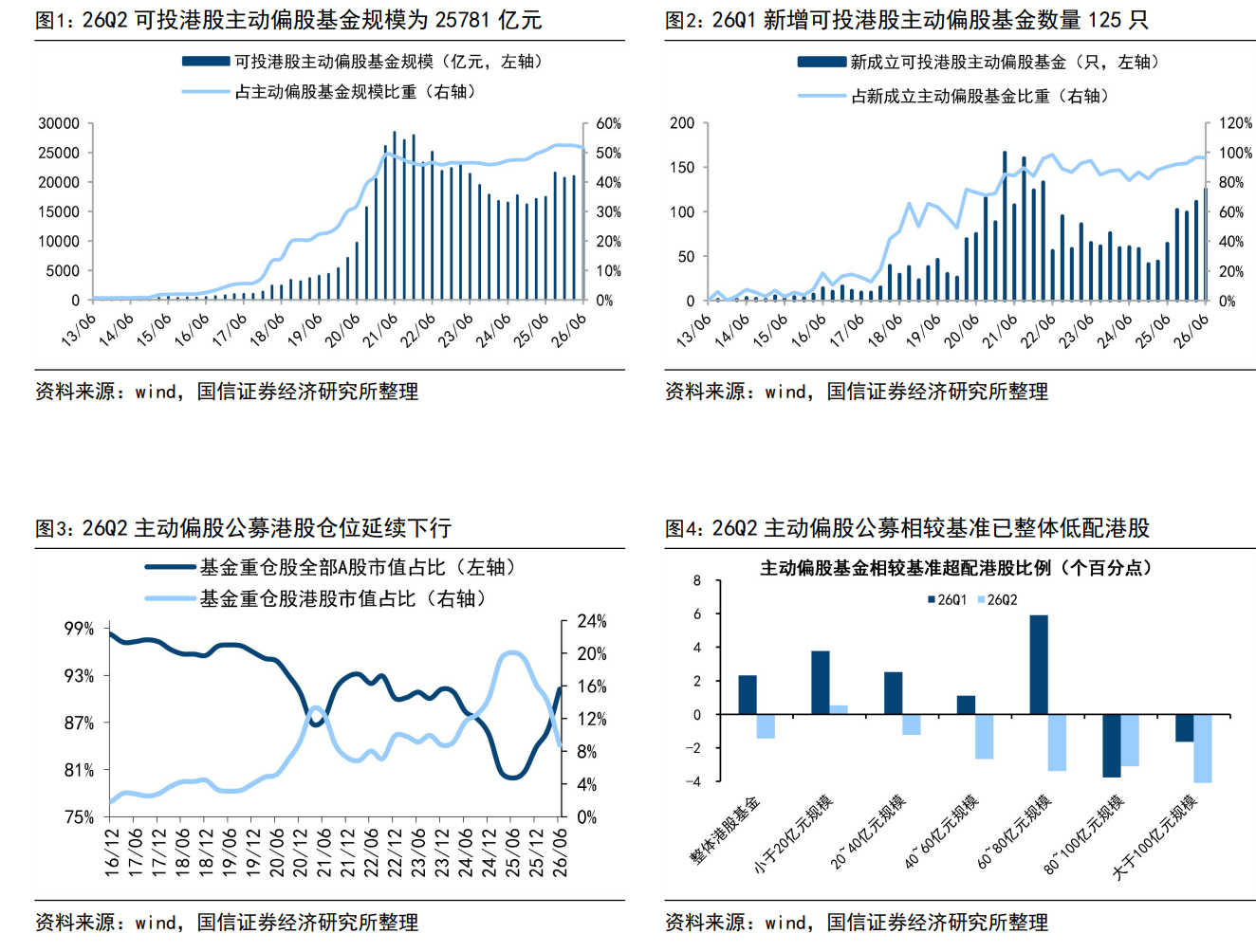
First, overall Hong Kong equity allocations declined, shifting from overweight to underweight. In Q2 2026, actively managed equity-oriented public mutual funds were underweight Hong Kong equities by 1.4 percentage points, reversing directionally from an overweight of 2.3 percentage points in Q1 2026, signaling a notable shift in fund managers’ allocation stance toward Hong Kong equities.
Second, sector-level reallocations were pronounced, with AI hardware emerging as the sole area of concentrated net buying. Semiconductor and hardware equipment segments—key components of the AI hardware theme—saw substantial increases in allocation, while software services, discretionary consumer retail, oil & gas, and non-ferrous metals sectors experienced concentrated net selling.
Third, the composition of top holdings was reshaped, with AI hardware names rising to prominence. The share of AI hardware stocks among the top ten Hong Kong equity holdings increased significantly,$SMIC (00981.HK)$、 $HUA HONG GRACE (01347.HK)$ with these names ascending to become the first and second largest holdings, respectively, leading to a modest rebound in concentration among top holdings.
Overall Allocation: Hong Kong Equity Allocations Continue to Decline, Signaling Underweight Positioning
Both the scale and the proportion of funds eligible to invest in Hong Kong equities declined
In terms of total assets under management, funds eligible to invest in Hong Kong equities amounted to RMB 2,578.1 billion in Q2 2026, accounting for 51.7% of all actively managed equity-oriented public mutual fund assets—a slight decline of 0.8 percentage points from 52.5% in Q1 2026.
In terms of the number of newly launched funds, 125 actively managed equity-oriented funds with exposure to Hong Kong equities were established in Q2 2026, accounting for 96.2% of all newly launched actively managed equity-oriented funds during the same period—a slight decline of 0.3 percentage points from 96.5% in Q1 2026. Although the share of new launches remains elevated, a concurrent decline in both scale and quantity has begun to emerge.
Market value and allocation weight of Hong Kong equity holdings both declined
Regarding market value of holdings, actively managed equity-oriented funds held HK$224.3 billion worth of top Hong Kong equity positions in Q2 2026, down HK$37.9 billion (or approximately 14.5%) from HK$262.2 billion in Q1 2026. Historically, this level remains above the post-2015 average of HK$135.2 billion, indicating that current Hong Kong equity holdings are still relatively high.
In terms of allocation weight, the proportion of top Hong Kong equity holdings in actively managed equity-oriented funds stood at 8.8% in Q2 2026, a significant drop of 5.1 percentage points from 13.9% in Q1 2026, reflecting a clear downward trend. Nevertheless, this allocation level remains above the post-2015 historical average of 7.3%.
Allocation stance shifted from overweight to underweight
Based on the benchmark indices and allocation weights for Hong Kong equities specified in the performance benchmarks of actively managed equity-oriented public mutual funds, their relative overweight or underweight positions versus the Hong Kong market were analyzed. The results show:
In Q2 2026, actively managed equity-oriented public mutual funds as a whole were underweight Hong Kong equities by 1.4 percentage points. In contrast, these funds were overweight by 2.3 percentage points in Q1 2026. This indicates that within just one quarter, the allocation stance toward Hong Kong equities among public mutual funds reversed directionally—from overweight to underweight—with a degree of contraction exceeding market expectations.
Sector allocation: AI hardware saw concentrated increases in allocation, while internet and resource sectors experienced notable reductions
Areas of increased allocation: Semiconductors and hardware equipment led the AI hardware segment
In Q2 2026, sector allocation by actively managed equity-oriented public mutual funds in the Hong Kong market exhibited pronounced structural characteristics—AI hardware emerged as the only segment receiving concentrated additional allocations.
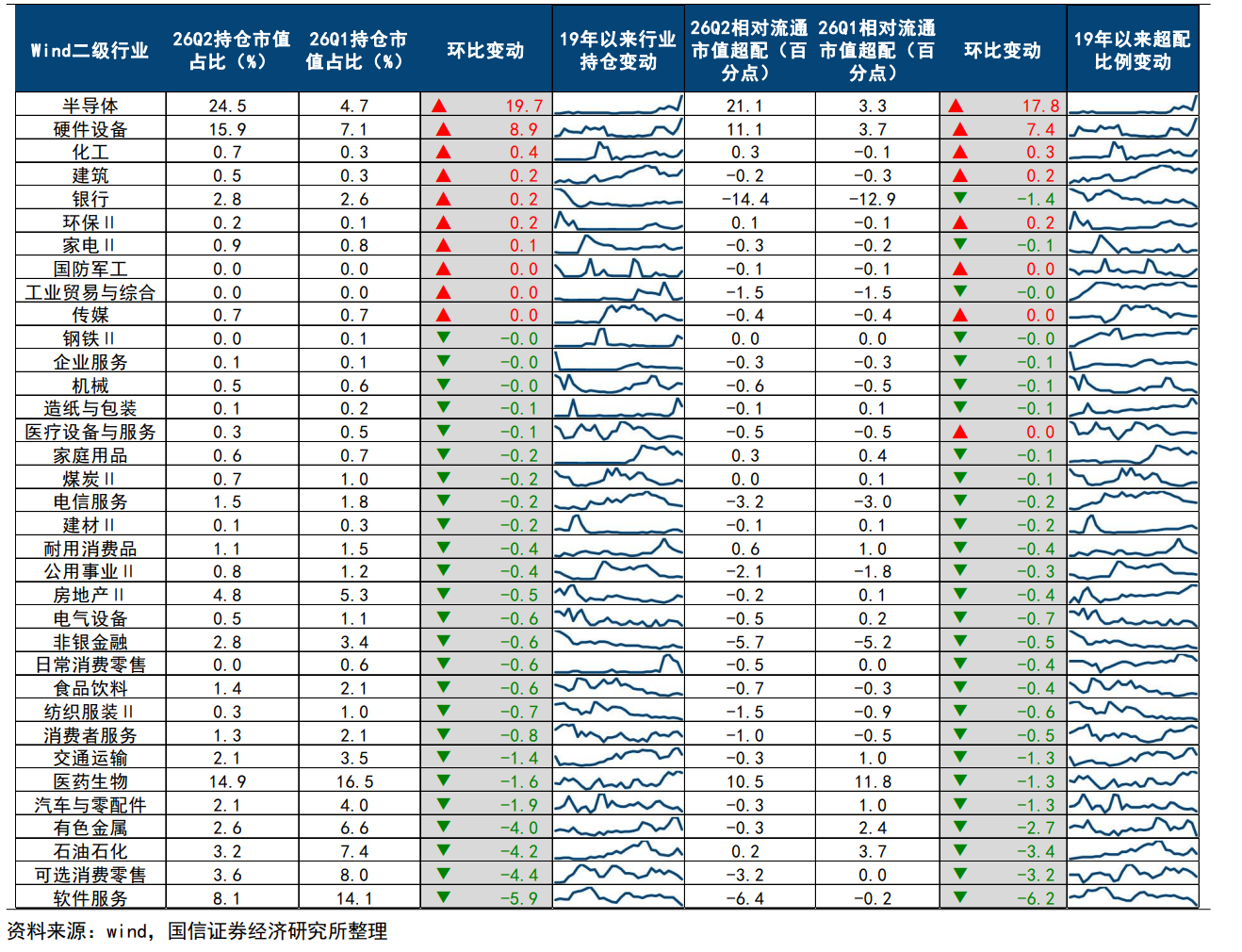
Specifically, the semiconductor sector accounted for 24.5% of total holdings by market value, a significant quarter-over-quarter increase of 19.7 percentage points from Q1 2026, making it the sector with the largest increase in allocation. The hardware equipment sector represented 15.9% of holdings, up by 8.9 percentage points from Q1 2026, ranking second in terms of allocation increase. Combined, these two AI hardware sectors accounted for 40.4% of total holdings, a substantial rise of 27.6 percentage points from 12.8% in Q1 2026, clearly reflecting mutual funds’ strong preference for the AI hardware supply chain in the Hong Kong equity market.
In terms of overweight relative to free-float market capitalization, the semiconductor sector’s overweight rose from 3.3 percentage points in Q1 2026 to 21.1 percentage points in Q2 2026, while the hardware equipment sector’s overweight increased from 3.7 percentage points to 11.1 percentage points, indicating that fund allocations to these two sectors have significantly exceeded their respective weightings in the market’s free-float capitalization.
Reduction in Allocations: Software Services, Discretionary Consumption, and Resource-Related Sectors Under Pressure
In stark contrast to the strong increase in AI hardware allocations, several traditionally favored sectors experienced concentrated selling.
The software services sector was hit hardest by reductions, with its holding weight declining by 5.9 percentage points to 8.1% in Q2 2026 from Q1 2026. The discretionary consumer retail sector saw its allocation drop by 4.4 percentage points to 3.6%. The oil & gas sector’s holding weight fell by 4.2 percentage points to 3.2%, and the non-ferrous metals sector declined by 4.0 percentage points to 2.6%.
The combined reduction across these four sectors amounted to 18.5 percentage points, reflecting a strategic reallocation by mutual funds in the Hong Kong market away from traditional internet, consumer, and resource-related sectors toward AI hardware.
Looking at changes in overweight ratios, the software services sector shifted from being underweight by 0.2 percentage points in Q1 2026 to underweight by 6.4 percentage points in Q2 2026, signaling a deepening aversion among funds toward this sector.
Sectors with Scarcity Advantages: Internet, Consumer, Innovative Pharmaceuticals, and High-Dividend Stocks All Cool Off
Focusing further on core sectors where Hong Kong equities hold a scarcity advantage over A-shares, Q2 2026 allocation data also showed a broad-based cooling trend.
The internet sector, once a flagship allocation in the Hong Kong market with a holding weight as high as 25.0% in Q1 2026, dropped to 12.7% in Q2 2026—a decline of more than half—falling behind semiconductors to become the second-largest allocated sector. Notably, the high-dividend sector also saw significant reductions, with its allocation falling from 12.3% to 7.7%, possibly reflecting mutual funds’ tactical adjustment away from high-dividend defensive strategies amid heightened market volatility.
Individual Stock Allocation: Concentration in Top Holdings Rebounds, with AI Hardware Stocks Rising to Prominence
Concentration in Top Holdings: Share of Top Ten Holdings Rebounds Significantly
In Q2 2026, the combined holding percentage of the top ten Hong Kong-listed stocks among actively managed equity-focused public mutual funds reached 53.0%, up by 6.6 percentage points from 46.4% in Q1 2026. This shift indicates that, despite an overall reduction in Hong Kong market exposure, fund portfolios have become more concentrated, with a select few core holdings receiving increased allocation.
The rebound in concentration was primarily driven by the rapid rise of leading AI hardware stocks. Although the total holdings of the top ten stocks slightly declined from RMB 1,217 billion in Q1 2026 to RMB 1,189 billion in Q2 2026, the concentration ratio rose passively due to the broader reduction in Hong Kong equity allocations.
Top Holding Composition: AI Hardware Replaces Traditional Internet Leaders
In Q2 2026, the composition of the top ten Hong Kong-listed holdings underwent significant changes, with AI hardware names surging in prominence while traditional internet and commodity-sector leaders moved down the rankings.
The top three holdings in Q2 2026 were as follows:
$SMIC (00981.HK)$ : Holdings amounted to RMB 30.9 billion, representing 13.8% of the portfolio—up sharply from RMB 7.9 billion (3.0%) in Q1 2026—propelling it to the position of the largest holding;
$HUA HONG GRACE (01347.HK)$ : Holdings amounted to RMB 17.5 billion, representing 7.8% of the portfolio, marking its debut among the top three holdings;
$TENCENT (00700.HK)$: Holdings amounted to RMB 15.2 billion, representing 6.8% of the portfolio, down from its position as the largest holding in Q1 2026 (RMB 33.6 billion / 12.8%), now ranking third.
Top three holdings in Q1 2026 review: Tencent (RMB 33.6 billion, 12.8%), $BABA-W (09988.HK)$ (RMB 19.1 billion, 7.3%),$CNOOC (00883.HK)$(RMB 16.2 billion, 6.2%).
Comparing changes between the two quarters reveals:
Rise of AI hardware: SMIC, Huahong Semiconductor,$KB LAMINATES (01888.HK)$、$YOFC (06869.HK)$and other AI hardware supply chain companies now occupy four of the top ten positions, with a combined holding weight of 33.4%, up significantly from approximately 10% in Q1 2026;
Retreat of internet giants: Tencent’s holding value declined by RMB 18.4 billion (a 54.8% drop), while Alibaba fell to the eighth position, with its holding value plunging from RMB 19.1 billion to RMB 6.3 billion (a 67.0% decline);
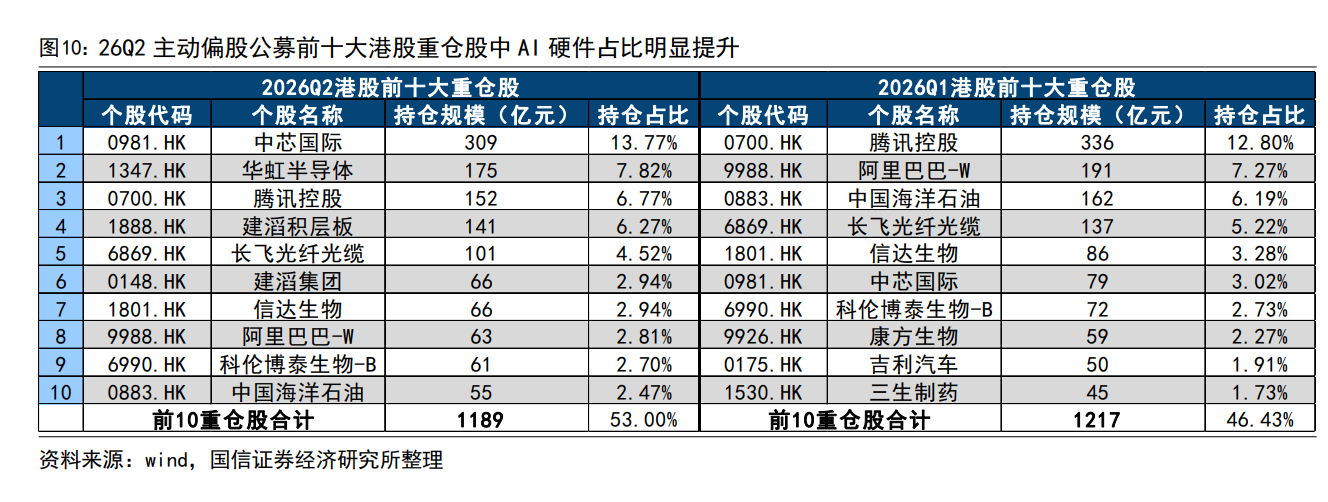
Cooling in commodities: $CNOOC (00883.HK)$ dropped from the third-largest holding to the tenth, with its holding value falling from RMB 16.2 billion to RMB 5.5 billion (a 66.0% decline).
Edited by Jeffy