
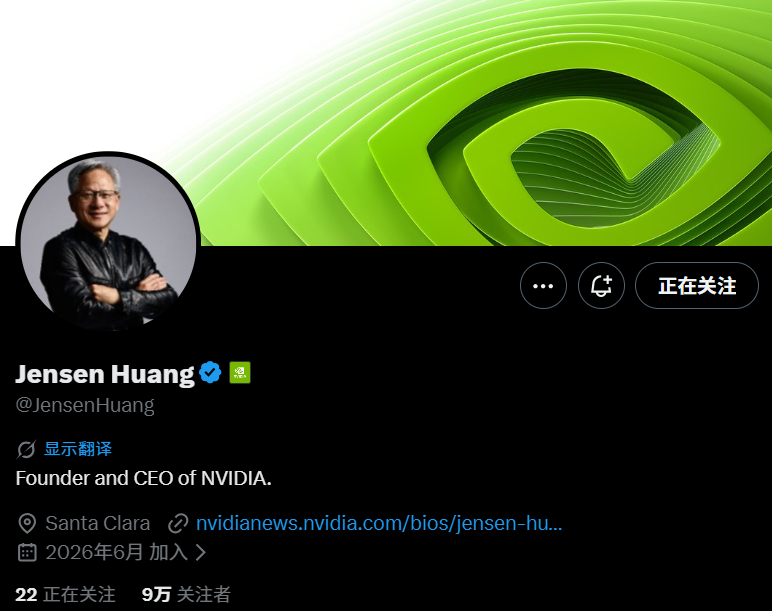
① On Friday evening Beijing time, NVIDIA CEO Jensen Huang posted his first message on the social media platform X, sparking excitement within the community;
② Huang’s inaugural post was a jointly signed letter advocating for open-source models, urging U.S. policymakers not to conflate legitimate model optimization techniques with misuse, and emphasizing the importance of an open ecosystem for AI competition and innovation.
On Friday evening Beijing time, Elon Musk’s social media platform X (formerly Twitter) welcomed a high-profile new user—Jensen Huang, head of the world’s most valuable publicly traded company.$NVIDIA (NVDA.US)$the leader of the world’s most valuable publicly traded company.
 As expected, Huang’s account launch went smoothly. After posting his first message at 21:18 Beijing time, his follower count surpassed 10,000 in less than 20 minutes. Prominent tech figures—including Microsoft CEO Nadella, well-known tech leakers Jeff Pu, Mark Gurman, and Ming-Chi Kuo—quickly arrived to welcome ‘Old Huang.’ By 22:36 Beijing time, his follower count had reached 90,000.
(Source: X)
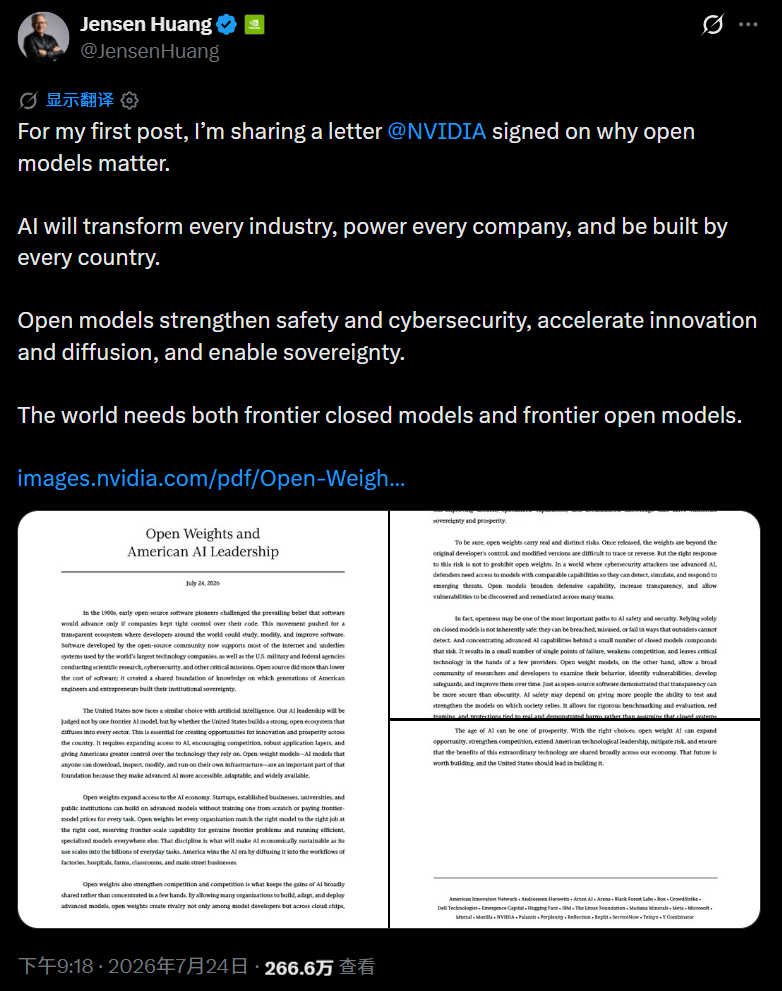
Huang’s first post was a$NVIDIA (NVDA.US)$co-signed letter highlighting the importance of open-source artificial intelligence models.
Against this backdrop, certain leading U.S. AI companies, facing intensifying competition, have increasingly emphasized the risks associated with ‘distillation’: competitors could repeatedly call APIs to generate model outputs and then use those outputs to train other models, thereby ‘replicating the capabilities of advanced models.’ U.S. government officials have recently echoed these concerns, and there are rumors that relevant policies may soon be introduced.
In the letter, co-signed by$NVIDIA (NVDA.US)$、$Microsoft (MSFT.US)$、$Meta Platforms (META.US)$、$IBM Corp (IBM.US)$、$Dell Technologies (DELL.US)$, the Linux Foundation, a16z, Y Combinator, Mistral AI, and dozens of other organizations, the signatories stressed that for the United States to develop its AI economy, it cannot rely solely on a handful of companies offering closed, cutting-edge models. Instead, it should support the development of open-weight models to broaden AI accessibility, foster competition, enhance security, and enable the diffusion of AI technology throughout the broader economy.
The open letter argued that U.S. leadership in AI should not be measured merely by possessing the single most advanced AI model, but rather by whether the United States has built a robust, open ecosystem capable of diffusing AI capabilities across all sectors. It also noted that open-source models strengthen competition, ensuring that the benefits of AI are widely shared rather than concentrated among a few corporations.
The letter acknowledged that open-weight models carry risks—for example, once released, models may fall outside developers’ control and be modified or misused—but emphasized that the solution lies not in restricting open models, but in advancing safety research and defensive capabilities.
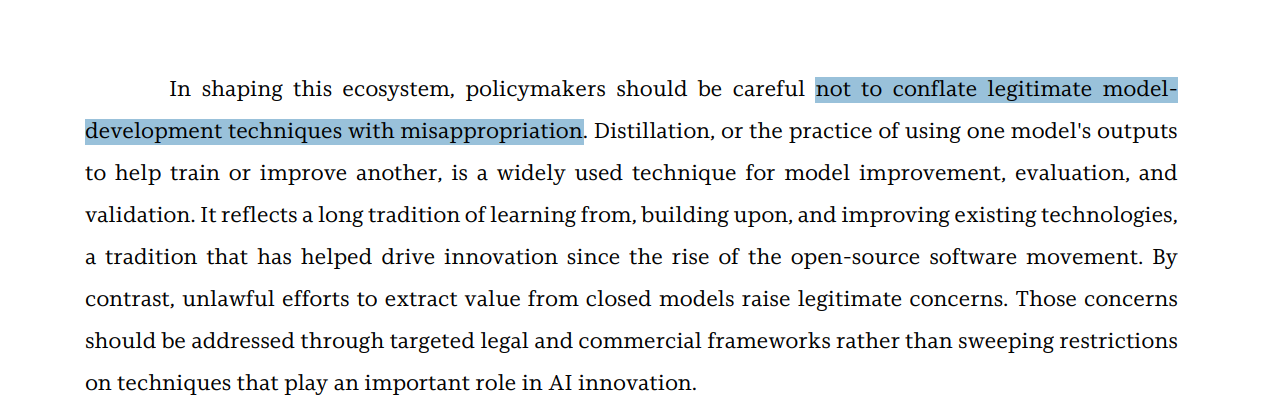
The letter included a dedicated section cautioning policymakers against conflating legitimate model development activities with abusive behavior, specifically naming ‘distillation’ as an example.
(Source: Open Letter)
The open letter states:
Distillation—using the output of one model to assist in training or improving another—is a widely used technique for model optimization, evaluation, and validation. It reflects humanity’s long-standing tradition of learning from, building upon, and refining existing technologies. This tradition has driven innovation forward since the rise of the open-source software movement.
By contrast, the unauthorized extraction of value from closed models is indeed a matter of concern. However, such issues should be addressed through targeted legal and commercial frameworks, rather than imposing broad restrictions on techniques that play a vital role in AI innovation.
Editor/melody